THE ADDIE
MODEL
THE DICK
CAREY
MODEL
PREPARED BY KAIVON RUSSELL
HRD-647-BG-2001 DIGITAL DESIGN FOR
E-LEARNING
CONTENTS
1. THE ADDIE MODEL
2. THE DICK CAREY MODEL
3. SIMILARITES
4. DIFFERENCES
5. ADVANTAGES AND DISADVANTAGES OF EACH MODEL
6. REFERENCES
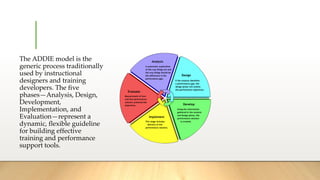
The ADDIE model is the
generic process traditionally
used by instructional
designers and training
developers. The five
phases—Analysis, Design,
Development,
Implementation, and
Evaluation—represent a
dynamic, flexible guideline
for building effective
training and performance
support tools.
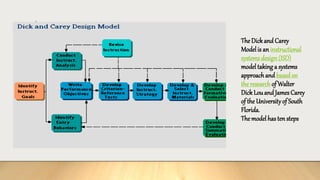
The Dick and Carey
Modelis an instructional
systems design(ISD)
modeltakinga systems
approachand basedon
the research of Walter
Dick Louand James Carey
of the Universityof South
Florida.
The modelhasten steps
SIMILARITIES
• The Dick and Carey model has some similarities with the ADDIE model in the sense that both
models identify a problem or goal, work through the steps of the model, and conclude with a
summative evaluation (Cowell, Hopkins, McWhorter, & Jorden, 2006).
• Another similarity is the system approach of both models, where there is a focus on the inputs
of each step that affect the inputs of the next steps. Also, the output of both models is what the
learner needs to know at the end of the instructional experience.
• And the last element of the system approach in both models is the process where the
instruction is designed to be delivered in different occasions and not exclusively for one
particular situation (Utami, 2013).
DIFFERENCES
• The main differences are in the number of steps where the Dick and Carey
model has more detailed steps than the ADDIE model; and the evaluation
phases where the ADDIE model has an evaluation process in its final phase,
whereas the Dick and Carey model has evaluations throughout each phase of the
model (Leiker, n.d.).
THE DICK CAREY MODEL
ADVANTAGES
• Requires clear and measurable
learning objectives, thereby
developing instruction as a
systematic process
DISADVANTAGES
• It is based on the premise that every
one of its components are essential,
and therefore none can be skipped.
THE ADDIE MODEL
ADVANTAGES
• Most widely used and the
foundation for other models
• Flexible and easily measured
DISADVANTAGE
• So detailed it can deter creativity
• Evaluation is a key component built
into ADDIE.
REFERENCES
https://www.instructionaldesign.org/models/addie/
https://mylove4learning.com/the-rapid-instructional-design-model-my-favorite-
model-to-get-the-job-done/

The ADDIE model vs The Dick Carey Model

  • 1.
    THE ADDIE MODEL THE DICK CAREY MODEL PREPAREDBY KAIVON RUSSELL HRD-647-BG-2001 DIGITAL DESIGN FOR E-LEARNING
  • 2.
    CONTENTS 1. THE ADDIEMODEL 2. THE DICK CAREY MODEL 3. SIMILARITES 4. DIFFERENCES 5. ADVANTAGES AND DISADVANTAGES OF EACH MODEL 6. REFERENCES
  • 3.
    The ADDIE modelis the generic process traditionally used by instructional designers and training developers. The five phases—Analysis, Design, Development, Implementation, and Evaluation—represent a dynamic, flexible guideline for building effective training and performance support tools.
  • 4.
    The Dick andCarey Modelis an instructional systems design(ISD) modeltakinga systems approachand basedon the research of Walter Dick Louand James Carey of the Universityof South Florida. The modelhasten steps
  • 5.
    SIMILARITIES • The Dickand Carey model has some similarities with the ADDIE model in the sense that both models identify a problem or goal, work through the steps of the model, and conclude with a summative evaluation (Cowell, Hopkins, McWhorter, & Jorden, 2006). • Another similarity is the system approach of both models, where there is a focus on the inputs of each step that affect the inputs of the next steps. Also, the output of both models is what the learner needs to know at the end of the instructional experience. • And the last element of the system approach in both models is the process where the instruction is designed to be delivered in different occasions and not exclusively for one particular situation (Utami, 2013).
  • 6.
    DIFFERENCES • The maindifferences are in the number of steps where the Dick and Carey model has more detailed steps than the ADDIE model; and the evaluation phases where the ADDIE model has an evaluation process in its final phase, whereas the Dick and Carey model has evaluations throughout each phase of the model (Leiker, n.d.).
  • 7.
    THE DICK CAREYMODEL ADVANTAGES • Requires clear and measurable learning objectives, thereby developing instruction as a systematic process DISADVANTAGES • It is based on the premise that every one of its components are essential, and therefore none can be skipped.
  • 8.
    THE ADDIE MODEL ADVANTAGES •Most widely used and the foundation for other models • Flexible and easily measured DISADVANTAGE • So detailed it can deter creativity • Evaluation is a key component built into ADDIE.
  • 9.