ADDIE VS DICK
AND CAREY
HRD-647-OL5-2204: PRIN
Kelcy A. McCray
Compare and Contrast
INSTRUCTIONAL
DESIGN MODEL
An instructional design model offers instructions for setting up suitable
pedagogical settings to accomplish instructional objectives. The process of
developing educational experiences that best support learning can be referred to
as instructional design.
ADDIE MODEL
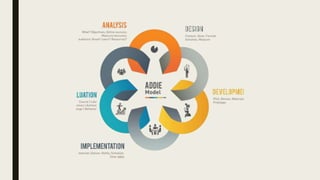
■ What does the ADDIE training paradigm entail? To build learning experiences
that are effective, instructional designers and training developers employ the
ADDIE learning paradigm. What does ADDIE stand for? The abbreviation ADDIE
stands for Analysis, Design, Development, Implementation, and Evaluation.
■ The model is an example of instructional systems design (ISD). The Dick &
Carey and Kemp ISD models are two other models. The majority of the existing
instructional design models are spin-offs or modifications of the ADDIE model.
The use of fast prototyping is one well acknowledged innovation to this
methodology. Receiving ongoing or constructive criticism as instructional
materials are being developed is the concept behind this. By spotting issues
when they are still simple to address, this strategy aims to save time and
money.
ADDIE MODEL
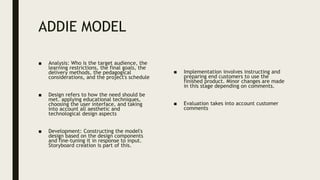
■ Analysis: Who is the target audience, the
learning restrictions, the final goals, the
delivery methods, the pedagogical
considerations, and the project's schedule
■ Design refers to how the need should be
met. applying educational techniques,
choosing the user interface, and taking
into account all aesthetic and
technological design aspects
■ Development: Constructing the model's
design based on the design components
and fine-tuning it in response to input.
Storyboard creation is part of this.
■ Implementation involves instructing and
preparing end customers to use the
finished product. Minor changes are made
in this stage depending on comments.
■ Evaluation takes into account customer
comments
Dick and Carey Model
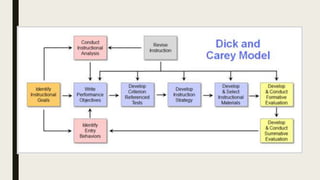
■ One of the former is the Systems Approach Paradigm by Dick and Carey,
commonly known as an instructional design model. In spite of the ostensibly
complex diagrams that appear when you search for a picture (see below), the
steps are frequently just linked insofar as what they do to assist you in
determining what to teach and how to teach it. Every one of the ten steps is
interconnected, and some may have an indirect affect on others while others
may be directly influenced.
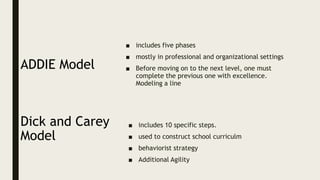
ADDIE Model
Dick and Carey
Model
■ includes five phases
■ mostly in professional and organizational settings
■ Before moving on to the next level, one must
complete the previous one with excellence.
Modeling a line
■ includes 10 specific steps.
■ used to construct school curriculm
■ behaviorist strategy
■ Additional Agility
Comparison
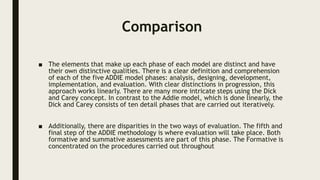
■ The elements that make up each phase of each model are distinct and have
their own distinctive qualities. There is a clear definition and comprehension
of each of the five ADDIE model phases: analysis, designing, development,
implementation, and evaluation. With clear distinctions in progression, this
approach works linearly. There are many more intricate steps using the Dick
and Carey concept. In contrast to the Addie model, which is done linearly, the
Dick and Carey consists of ten detail phases that are carried out iteratively.
■ Additionally, there are disparities in the two ways of evaluation. The fifth and
final step of the ADDIE methodology is where evaluation will take place. Both
formative and summative assessments are part of this phase. The Formative is
concentrated on the procedures carried out throughout
References
■ “ADDIE Vs. Dick and Carey
Model.” Instructional TechnologyCI
5921, sarwathusain.weebly.com/ci--
5921/addie-vs-dick-and-carey-model.
Accessed 6 Nov. 2022.
■ “What Is the ADDIE Model of Instructional
Design?” Water Bear Learning, 9 June
2020, waterbearlearning.com/addie-model-
instructional-design.

AddIe vs Dick and Carey Model.pptx

  • 1.
    ADDIE VS DICK ANDCAREY HRD-647-OL5-2204: PRIN Kelcy A. McCray Compare and Contrast
  • 2.
    INSTRUCTIONAL DESIGN MODEL An instructionaldesign model offers instructions for setting up suitable pedagogical settings to accomplish instructional objectives. The process of developing educational experiences that best support learning can be referred to as instructional design.
  • 3.
    ADDIE MODEL ■ Whatdoes the ADDIE training paradigm entail? To build learning experiences that are effective, instructional designers and training developers employ the ADDIE learning paradigm. What does ADDIE stand for? The abbreviation ADDIE stands for Analysis, Design, Development, Implementation, and Evaluation. ■ The model is an example of instructional systems design (ISD). The Dick & Carey and Kemp ISD models are two other models. The majority of the existing instructional design models are spin-offs or modifications of the ADDIE model. The use of fast prototyping is one well acknowledged innovation to this methodology. Receiving ongoing or constructive criticism as instructional materials are being developed is the concept behind this. By spotting issues when they are still simple to address, this strategy aims to save time and money.
  • 4.
    ADDIE MODEL ■ Analysis:Who is the target audience, the learning restrictions, the final goals, the delivery methods, the pedagogical considerations, and the project's schedule ■ Design refers to how the need should be met. applying educational techniques, choosing the user interface, and taking into account all aesthetic and technological design aspects ■ Development: Constructing the model's design based on the design components and fine-tuning it in response to input. Storyboard creation is part of this. ■ Implementation involves instructing and preparing end customers to use the finished product. Minor changes are made in this stage depending on comments. ■ Evaluation takes into account customer comments
  • 6.
    Dick and CareyModel ■ One of the former is the Systems Approach Paradigm by Dick and Carey, commonly known as an instructional design model. In spite of the ostensibly complex diagrams that appear when you search for a picture (see below), the steps are frequently just linked insofar as what they do to assist you in determining what to teach and how to teach it. Every one of the ten steps is interconnected, and some may have an indirect affect on others while others may be directly influenced.
  • 8.
    ADDIE Model Dick andCarey Model ■ includes five phases ■ mostly in professional and organizational settings ■ Before moving on to the next level, one must complete the previous one with excellence. Modeling a line ■ includes 10 specific steps. ■ used to construct school curriculm ■ behaviorist strategy ■ Additional Agility
  • 9.
    Comparison ■ The elementsthat make up each phase of each model are distinct and have their own distinctive qualities. There is a clear definition and comprehension of each of the five ADDIE model phases: analysis, designing, development, implementation, and evaluation. With clear distinctions in progression, this approach works linearly. There are many more intricate steps using the Dick and Carey concept. In contrast to the Addie model, which is done linearly, the Dick and Carey consists of ten detail phases that are carried out iteratively. ■ Additionally, there are disparities in the two ways of evaluation. The fifth and final step of the ADDIE methodology is where evaluation will take place. Both formative and summative assessments are part of this phase. The Formative is concentrated on the procedures carried out throughout
  • 10.
    References ■ “ADDIE Vs.Dick and Carey Model.” Instructional TechnologyCI 5921, sarwathusain.weebly.com/ci-- 5921/addie-vs-dick-and-carey-model. Accessed 6 Nov. 2022. ■ “What Is the ADDIE Model of Instructional Design?” Water Bear Learning, 9 June 2020, waterbearlearning.com/addie-model- instructional-design.