ADDIE Model vs CAREY Model
By Leticia Monteagudo HRD 647
Introduction
Instructional design models help the instructional designers to make sense of abstract
learning theory and enable real world application.
While design models help organize and visualize learning theories and principles to
guide instructional designers through a learning development process.
Both models have their strength and weakness with specific advantages.
The ADDIE Model
ADDIE’s main characteristic is that it is a linear approach. While such an approach may have some advantages such
as providing a clear-cut step by step sequence of events in teaching a lesson, a strictly linear approach can also be
very ineffective in terms of accommodating for evolving changes and processes.
Strengths
· Most widely used model and is the foundation for other ID models.
· It is flexible and can be used for traditional instruction and across many industries.
· Is most effective when testing for easily measurable criteria
· Allows for collaboration at each level and at any and every stage
· Evaluation is a key component built into ADDIE
· Structured guidance for design
The ADDIE Model
Addie is linear model, which is not amenable to accommodating user generated content or unstructured objectives. It
also assumes that one is aware of all the user requirements before developing the design, making it extremely difficult
to make accommodations during the development stage.
Weaknesses
· You cant get to the next phase without addressing the one before it.
· It is time consuming and costly
· Evaluation is a key component built into Addie
· Does not allow for designer creativity. Oftentimes poor designs are recognized after the completion of the entire
process.
· Because the process is so detailed, it sometimes deters the creative process
· Post tests provide little useful information to help assist in improving instruction
The Dick & Carey Model
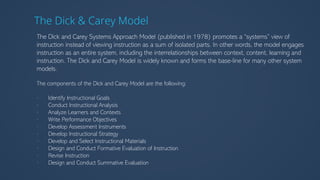
The Dick and Carey Systems Approach Model (published in 1978) promotes a “systems” view of
instruction instead of viewing instruction as a sum of isolated parts. In other words, the model engages
instruction as an entire system, including the interrelationships between context, content, learning and
instruction. The Dick and Carey Model is widely known and forms the base-line for many other system
models.
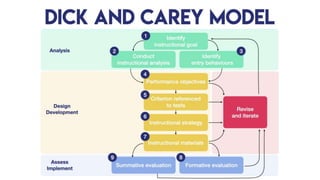
The components of the Dick and Carey Model are the following:
· Identify Instructional Goals
· Conduct Instructional Analysis
· Analyze Learners and Contexts
· Write Performance Objectives
· Develop Assessment Instruments
· Develop Instructional Strategy
· Develop and Select Instructional Materials
· Design and Conduct Formative Evaluation of Instruction
· Revise Instruction
· Design and Conduct Summative Evaluation
The Dick & Carey Model
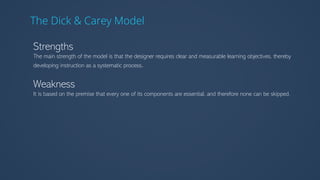
Strengths
The main strength of the model is that the designer requires clear and measurable learning objectives, thereby
developing instruction as a systematic process.
Weakness
It is based on the premise that every one of its components are essential, and therefore none can be skipped.
Comparison
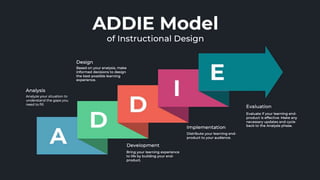
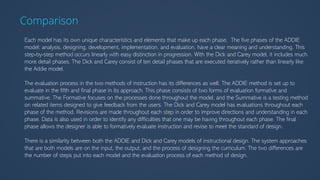
Each model has its own unique characteristics and elements that make up each phase. The five phases of the ADDIE
model: analysis, designing, development, implementation, and evaluation, have a clear meaning and understanding. This
step-by-step method occurs linearly with easy distinction in progression. With the Dick and Carey model, it includes much
more detail phases. The Dick and Carey consist of ten detail phases that are executed iteratively rather than linearly like
the Addie model.
The evaluation process in the two methods of instruction has its differences as well. The ADDIE method is set up to
evaluate in the fifth and final phase in its approach. This phase consists of two forms of evaluation formative and
summative. The Formative focuses on the processes done throughout the model, and the Summative is a testing method
on related items designed to give feedback from the users. The Dick and Carey model has evaluations throughout each
phase of the method. Revisions are made throughout each step in order to improve directions and understanding in each
phase. Data is also used in order to identify any difficulties that one may be having throughout each phase. The final
phase allows the designer is able to formatively evaluate instruction and revise to meet the standard of design.
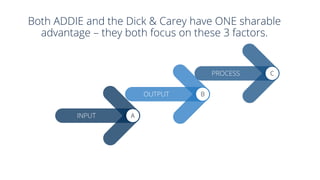
There is a similarity between both the ADDIE and Dick and Carey models of instructional design. The system approaches
that are both models are on the input, the output, and the process of designing the curriculum. The two differences are
the number of steps put into each model and the evaluation process of each method of design.
INPUT A
OUTPUT B
PROCESS C
Both ADDIE and the Dick & Carey have ONE sharable
advantage – they both focus on these 3 factors.

Addie model vs-dick carey model

  • 1.
    ADDIE Model vsCAREY Model By Leticia Monteagudo HRD 647
  • 2.
    Introduction Instructional design modelshelp the instructional designers to make sense of abstract learning theory and enable real world application. While design models help organize and visualize learning theories and principles to guide instructional designers through a learning development process. Both models have their strength and weakness with specific advantages.
  • 4.
    The ADDIE Model ADDIE’smain characteristic is that it is a linear approach. While such an approach may have some advantages such as providing a clear-cut step by step sequence of events in teaching a lesson, a strictly linear approach can also be very ineffective in terms of accommodating for evolving changes and processes. Strengths · Most widely used model and is the foundation for other ID models. · It is flexible and can be used for traditional instruction and across many industries. · Is most effective when testing for easily measurable criteria · Allows for collaboration at each level and at any and every stage · Evaluation is a key component built into ADDIE · Structured guidance for design
  • 5.
    The ADDIE Model Addieis linear model, which is not amenable to accommodating user generated content or unstructured objectives. It also assumes that one is aware of all the user requirements before developing the design, making it extremely difficult to make accommodations during the development stage. Weaknesses · You cant get to the next phase without addressing the one before it. · It is time consuming and costly · Evaluation is a key component built into Addie · Does not allow for designer creativity. Oftentimes poor designs are recognized after the completion of the entire process. · Because the process is so detailed, it sometimes deters the creative process · Post tests provide little useful information to help assist in improving instruction
  • 7.
    The Dick &Carey Model The Dick and Carey Systems Approach Model (published in 1978) promotes a “systems” view of instruction instead of viewing instruction as a sum of isolated parts. In other words, the model engages instruction as an entire system, including the interrelationships between context, content, learning and instruction. The Dick and Carey Model is widely known and forms the base-line for many other system models. The components of the Dick and Carey Model are the following: · Identify Instructional Goals · Conduct Instructional Analysis · Analyze Learners and Contexts · Write Performance Objectives · Develop Assessment Instruments · Develop Instructional Strategy · Develop and Select Instructional Materials · Design and Conduct Formative Evaluation of Instruction · Revise Instruction · Design and Conduct Summative Evaluation
  • 8.
    The Dick &Carey Model Strengths The main strength of the model is that the designer requires clear and measurable learning objectives, thereby developing instruction as a systematic process. Weakness It is based on the premise that every one of its components are essential, and therefore none can be skipped.
  • 9.
    Comparison Each model hasits own unique characteristics and elements that make up each phase. The five phases of the ADDIE model: analysis, designing, development, implementation, and evaluation, have a clear meaning and understanding. This step-by-step method occurs linearly with easy distinction in progression. With the Dick and Carey model, it includes much more detail phases. The Dick and Carey consist of ten detail phases that are executed iteratively rather than linearly like the Addie model. The evaluation process in the two methods of instruction has its differences as well. The ADDIE method is set up to evaluate in the fifth and final phase in its approach. This phase consists of two forms of evaluation formative and summative. The Formative focuses on the processes done throughout the model, and the Summative is a testing method on related items designed to give feedback from the users. The Dick and Carey model has evaluations throughout each phase of the method. Revisions are made throughout each step in order to improve directions and understanding in each phase. Data is also used in order to identify any difficulties that one may be having throughout each phase. The final phase allows the designer is able to formatively evaluate instruction and revise to meet the standard of design. There is a similarity between both the ADDIE and Dick and Carey models of instructional design. The system approaches that are both models are on the input, the output, and the process of designing the curriculum. The two differences are the number of steps put into each model and the evaluation process of each method of design.
  • 10.
    INPUT A OUTPUT B PROCESSC Both ADDIE and the Dick & Carey have ONE sharable advantage – they both focus on these 3 factors.