Leukemias in children
Leukemia in Children
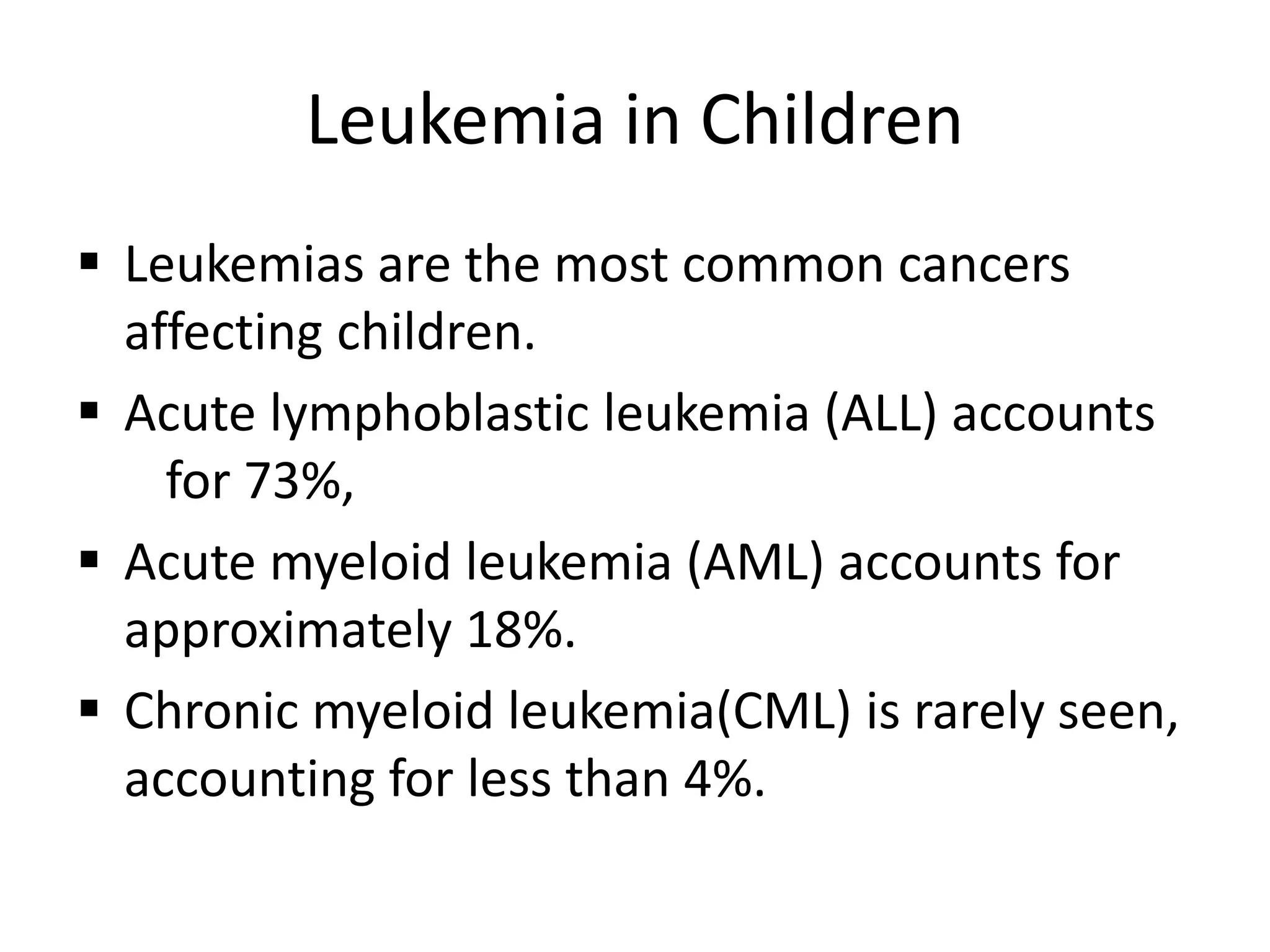
 Leukemias are the most common cancers
affecting children.
 Acute lymphoblastic leukemia (ALL) accounts
for 73%,
 Acute myeloid leukemia (AML) accounts for
approximately 18%.
 Chronic myeloid leukemia(CML) is rarely seen,
accounting for less than 4%.
Epidemiology
 ALL: 3–4 cases per 100,000 white children
 Peak incidence between 2 and 5 years of age
 Accounts for 25–30% of all childhood cancers
 In ALL, boys more commonly affected than girls
 Incidence of AML is similar for all age groups
4/28/2024 4
Factors predisposing ALL
GENETIC ENVRONMENTAL
Down’s Ionising radiation
Diamond Blackfan syndrome Drugs
NF Type1 - alkylating agents
Ataxia telengiectasia - nitrosourea
Turner - epipodophyllotoxin
Klinefelter - benzene exposure
Fanconi anemia Advanced maternal age
Blooms syndrome Paternal smoking
Pathology
• Acute leukemia
–is characterized by clonal expansion of
immature hematopoietic or lymphoid
precursors.
• Chronic leukemia
–refers to conditions characterized by the
expansion of mature marrow elements
CLINICAL FEATURES
General Systemic Effects
1. Fever (60%).
2. Lassitude (50%)
3. Pallor (40%)
Hematologic Effects Arising from Bone Marrow Invasion
1. Anaemia
– pallor, fatigability, tachycardia, dyspnoea & CHF
2. Neutropenia
– fever, ulceration of buccal mucosa and infection.
3. Thrombocytopenia
– petechial, purpura, easy bruisability, bleeding from
mucous membrane and internal bleeding.
CLINICAL FEATURES
 Clinical Manifestations Arising from Lymphoid
System Infiltration
1. Lymphadenopathy
2. Splenomegaly.
3. Hepatomegaly
CLINICAL FEATURES
Clinical Manifestations of Extramedullary Invasion
–CNS‐ ICT symptoms, seizures
–Genitourinary ‐ painless testicular swelling
–Bone joints‐ bone pain
–Skin ‐ bleeds
–Git ‐ bleeds
CLINICAL FEATURES – Childhood Cancer
CONTINUOUS FEVER, WEIGHT LOSS
HEADACHES, EARLY MORNING VOMITION
INCREASED SWELLING OR PERSISTENT PAIN IN BONES, JOINTS, BACK OR LEGS
LUMP OR MASS – ABDO, NECK, CHEST, PELVIS, ARMPITS
DEVELOPMENT OF RASH, BLEEDING, BRUISION
CONSTANT / RECURENT INFECTIONS
AWHITISH COLOR BEHIND PUPIL
NAUSEA – PERSISTANT OR VOMITING WITHO OR W/O SEIZURE
CONSTANT TIREDNESS
EYE OR VISON CHANGES
RECURRENT OR PERSISTENT FEVER
CLASSIFICATION
• Light microscopy (FAB) – morphology L1, L2, L3
• Cytochemistry ‐ staining ‐ MPO, ESTERASE
• Immunophenotyping (WHO) – CD numbering
• Cytogenetics ‐ chromosome/gene rearrangement
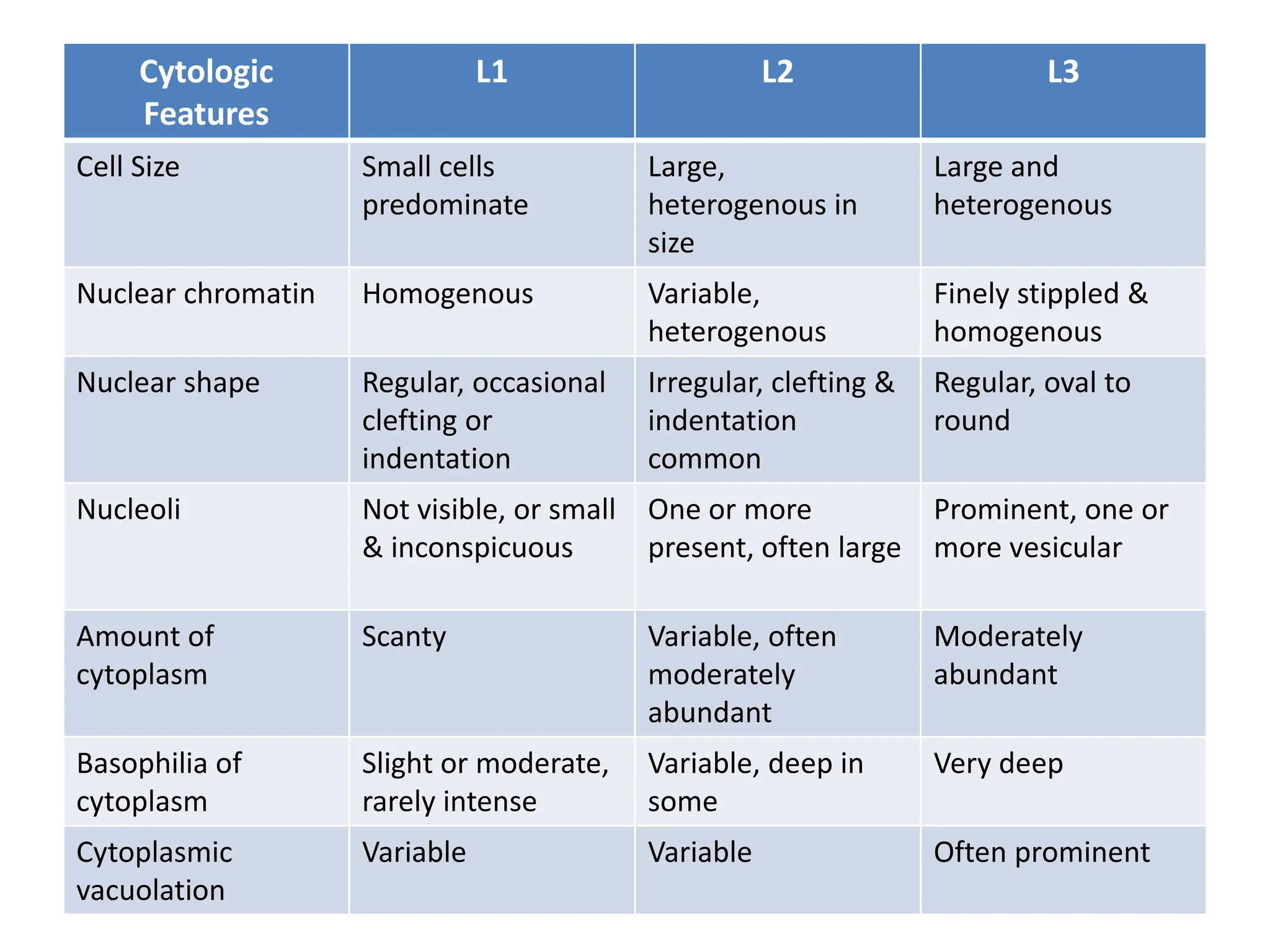
Cytologic
Features
L1 L2 L3
Cell Size Small cells
predominate
Large,
heterogenous in
size
Large and
heterogenous
Nuclear chromatin Homogenous Variable,
heterogenous
Finely stippled &
homogenous
Nuclear shape Regular, occasional
clefting or
indentation
Irregular, clefting &
indentation
common
Regular, oval to
round
Nucleoli Not visible, or small
& inconspicuous
One or more
present, often large
Prominent, one or
more vesicular
Amount of
cytoplasm
Scanty Variable, often
moderately
abundant
Moderately
abundant
Basophilia of
cytoplasm
Slight or moderate,
rarely intense
Variable, deep in
some
Very deep
Cytoplasmic
vacuolation
Variable Variable Often prominent
FAB types of acute lymphoblastic leukemia (ALL).
A) L1 morphology with uniform‐sized blasts.
B) L2 ALL with more blast cell variation. (
C) L3 blasts with more clumped nuclear chromatin, nucleoli,
basophilic cytoplasm, and cytoplasmic vacuoles.
Imjunologic
Subtype
% of cases FAB
Subtype
Cytogentetic
abnormalities
Pre B ALL 75 L1, L2 T(9;22),
t(4;11),
t(1;19)
T Cell ALL 20 L1, L2 14q11 or
7q34
Mature B Cell
ALL
(Burkitt
Leukemia)
5 L3 T(8;14)
INVESTIGATIONS
• Blood count
• Haemoglobin: Moderate to marked reduction
• Blood smear: Blasts are present on blood
smear. Very few to none (in patients with
leukopenia).
• White blood cell count: Low, normal, or
increased
• Thrombocytopenia: 92% of patients have
platelet counts below normal. Very few to
none (in patients with leukopenia).
INVESTIGATIONS – Bone Marrow
• Leukemia must be suspected when the bone
marrow contains more than 5% blasts.
• The hallmark of the diagnosis of acute
leukemia is the blast cell, are relatively
undifferentiated cell with diffusely distributed
nuclear chromatin, one or more nucleoli and
basophilic cytoplasm.
Bone marrow changes
Normal marrow
Entire marrow replaced
by blast
4/28/2024 16
IAP
UG
Teaching
slides
2015‐16
18
A,
Acute
lymphoblastic
leukemia
with
CD
22,19,10
positiv
Acute lymphoblastic leukemia with CD 22,19,10 positivity
INVESTIGATIONS
• Chest radiograph: Mediastinal mass in T‐cell
leukemia.
• Blood chemistry: Electrolytes, blood urea, uric
acid,
• Liver function tests, Immuno globulin levels.
• Coagulation profile: Decreased coagulation
factors that frequently occur with AML are:
hypofibrinogenemia, factors V, IX and X.
INVESTIGATIONS - CSF
– CNS1 , < 5 WBCs/mm3 with no blasts;
– CNS2 , < 5 WBCs/mm3, a positive "cytospin" for
blasts;
– CNS3, > 5 WBCs/mm3, blasts on cytocentrifuge
slide
Cerebrospinal fluid: Chemistry and cells.
TREATMENT
• Three phases:
1. remission induction,
2. consolidation (or intensification), and
3. continuation (or maintenance).
• Protocol adopted depends on the institution
• Modified BFM or COG protocol is often the
choice
INDUCTION
• Prednisolone 60 mg/m2/day 
• Inj.VCR 1.5mg2/day
• Inj DNR 30 mg/m2
• L ASPARGINASE 10000u/m2
• MTX I/T
INTENSIFICATION & CNS PROPHYLAXIS
• Inj CYCLOPHOSPHAMIDE 1gm/m2
• InJ CYTARABINE 75mg/m2/day
• 6 MP 60 mg/m2/d
• I/T MTX
• CRANIAL IRRADIATION
MAINTENANCE
• Inj. VCR 1.5 mg/m2 one in a month
• Tab PREDNISOLONE 60 mg/m2 for one wk
• T.6MP 50 mg/m2 p.o daily
• T.MTX 20 mg/m2 p.o wkly
The optimal duration of therapy remains unknown.
Most investigators continue to treat patients for 2
to 3 years, based on results of older studies
FOLLOW UP
If the patient completes chemotherapy
for 2 years without relapse-stop chemo
and follow up.
No relapse within 5 years-can be declared
as cured.
SUPPORTIVE CARE
• A total of 10 mg/kg/day of allopurinol in
divided doses is given in all cases before the
commencement of antileukemic drugs.
• When the blast cell count is more than
50,000/mm3 or there are large tumour
masses, allopurinol is obligatory, together with
a fluid intake of 2–3 L/m2/day
SUPPORTIVE CARE
• use of packed red cells
• When high fever and possible septicemia
occur in the presence of neutropenia,
antibiotic therapy should be started after
taking appropriate blood cultures and a chest
radiograph.(NEUTROPENIA REGIME)
• Platelet transfusions should be administered
to patients with overt bleeding or when the
platelet count is below 10,000/mm3.
ALLOGENIC STEM CELL TRANSPLANTATION
• Usually done in second remission.
• Can be done in first remission in high
risk patients
- WBC > 25000,
- philadelphia chromosome positive,
- poor initial response to remission
induction.
NEWER DRUGS
Monoclonal antibodies
rituximab (CD20),
epratuzumab (CD22)
Antimetabolites
clofarabine,
nelarabine
Tyrosine kinase inhibitor
imatinib,
nilotinib,.
REMISSION
• Patients with .0.01% leukemic cells after the
end of induction have a worse prognosis and
may require more intensive therapy.
RISK STRATIFICATION
FACTOR FAVOURABLE UNFAVOURABLE
Age (yrs) 1 – 9 < 1 OR > 10
WBC count < 10,000 > 2,00,000
Immunophenotype Precursor B Cell T Cell
Genetics Hyoperploidy Hypoploidy
CNS Status CNS 1 CNS 3
MRD (end of induction) < 0.01% 0.5 or 1%
Testicular / CNS
involvement
Absent Present
FAB Type L 1 L 3
Ethnicity White Black
DD
• ITP‐
– isolated thrombocytopenia,
– well child with
– no lymph node enlargement or spenomegaly
• Aplastic Anaemia
– Pancytopenia with
– no organ enlargement
• Juvenile Rheumatoid Arthritis
• Infectious mononucleosis
– Atypical lymphocytes
• Metastatic solid tumours
RELAPSE
• Despite current intensive front‐line
treatments, 20% of children with ALL
experience bone marrow relapse.
• Relapse may be an isolated event in the bone
marrow or may be combined with relapse in
other sites

leukemia in children with difference btw all and bll

  • 1.
  • 2.
    Leukemia in Children Leukemias are the most common cancers affecting children.  Acute lymphoblastic leukemia (ALL) accounts for 73%,  Acute myeloid leukemia (AML) accounts for approximately 18%.  Chronic myeloid leukemia(CML) is rarely seen, accounting for less than 4%.
  • 3.
    Epidemiology  ALL: 3–4cases per 100,000 white children  Peak incidence between 2 and 5 years of age  Accounts for 25–30% of all childhood cancers  In ALL, boys more commonly affected than girls  Incidence of AML is similar for all age groups
  • 4.
    4/28/2024 4 Factors predisposingALL GENETIC ENVRONMENTAL Down’s Ionising radiation Diamond Blackfan syndrome Drugs NF Type1 - alkylating agents Ataxia telengiectasia - nitrosourea Turner - epipodophyllotoxin Klinefelter - benzene exposure Fanconi anemia Advanced maternal age Blooms syndrome Paternal smoking
  • 5.
    Pathology • Acute leukemia –ischaracterized by clonal expansion of immature hematopoietic or lymphoid precursors. • Chronic leukemia –refers to conditions characterized by the expansion of mature marrow elements
  • 6.
    CLINICAL FEATURES General SystemicEffects 1. Fever (60%). 2. Lassitude (50%) 3. Pallor (40%) Hematologic Effects Arising from Bone Marrow Invasion 1. Anaemia – pallor, fatigability, tachycardia, dyspnoea & CHF 2. Neutropenia – fever, ulceration of buccal mucosa and infection. 3. Thrombocytopenia – petechial, purpura, easy bruisability, bleeding from mucous membrane and internal bleeding.
  • 7.
    CLINICAL FEATURES  ClinicalManifestations Arising from Lymphoid System Infiltration 1. Lymphadenopathy 2. Splenomegaly. 3. Hepatomegaly
  • 8.
    CLINICAL FEATURES Clinical Manifestationsof Extramedullary Invasion –CNS‐ ICT symptoms, seizures –Genitourinary ‐ painless testicular swelling –Bone joints‐ bone pain –Skin ‐ bleeds –Git ‐ bleeds
  • 9.
    CLINICAL FEATURES –Childhood Cancer CONTINUOUS FEVER, WEIGHT LOSS HEADACHES, EARLY MORNING VOMITION INCREASED SWELLING OR PERSISTENT PAIN IN BONES, JOINTS, BACK OR LEGS LUMP OR MASS – ABDO, NECK, CHEST, PELVIS, ARMPITS DEVELOPMENT OF RASH, BLEEDING, BRUISION CONSTANT / RECURENT INFECTIONS AWHITISH COLOR BEHIND PUPIL NAUSEA – PERSISTANT OR VOMITING WITHO OR W/O SEIZURE CONSTANT TIREDNESS EYE OR VISON CHANGES RECURRENT OR PERSISTENT FEVER
  • 10.
    CLASSIFICATION • Light microscopy(FAB) – morphology L1, L2, L3 • Cytochemistry ‐ staining ‐ MPO, ESTERASE • Immunophenotyping (WHO) – CD numbering • Cytogenetics ‐ chromosome/gene rearrangement
  • 11.
    Cytologic Features L1 L2 L3 CellSize Small cells predominate Large, heterogenous in size Large and heterogenous Nuclear chromatin Homogenous Variable, heterogenous Finely stippled & homogenous Nuclear shape Regular, occasional clefting or indentation Irregular, clefting & indentation common Regular, oval to round Nucleoli Not visible, or small & inconspicuous One or more present, often large Prominent, one or more vesicular Amount of cytoplasm Scanty Variable, often moderately abundant Moderately abundant Basophilia of cytoplasm Slight or moderate, rarely intense Variable, deep in some Very deep Cytoplasmic vacuolation Variable Variable Often prominent
  • 12.
    FAB types ofacute lymphoblastic leukemia (ALL). A) L1 morphology with uniform‐sized blasts. B) L2 ALL with more blast cell variation. ( C) L3 blasts with more clumped nuclear chromatin, nucleoli, basophilic cytoplasm, and cytoplasmic vacuoles.
  • 13.
    Imjunologic Subtype % of casesFAB Subtype Cytogentetic abnormalities Pre B ALL 75 L1, L2 T(9;22), t(4;11), t(1;19) T Cell ALL 20 L1, L2 14q11 or 7q34 Mature B Cell ALL (Burkitt Leukemia) 5 L3 T(8;14)
  • 14.
    INVESTIGATIONS • Blood count •Haemoglobin: Moderate to marked reduction • Blood smear: Blasts are present on blood smear. Very few to none (in patients with leukopenia). • White blood cell count: Low, normal, or increased • Thrombocytopenia: 92% of patients have platelet counts below normal. Very few to none (in patients with leukopenia).
  • 15.
    INVESTIGATIONS – BoneMarrow • Leukemia must be suspected when the bone marrow contains more than 5% blasts. • The hallmark of the diagnosis of acute leukemia is the blast cell, are relatively undifferentiated cell with diffusely distributed nuclear chromatin, one or more nucleoli and basophilic cytoplasm.
  • 16.
    Bone marrow changes Normalmarrow Entire marrow replaced by blast 4/28/2024 16
  • 17.
  • 18.
    INVESTIGATIONS • Chest radiograph:Mediastinal mass in T‐cell leukemia. • Blood chemistry: Electrolytes, blood urea, uric acid, • Liver function tests, Immuno globulin levels. • Coagulation profile: Decreased coagulation factors that frequently occur with AML are: hypofibrinogenemia, factors V, IX and X.
  • 19.
    INVESTIGATIONS - CSF –CNS1 , < 5 WBCs/mm3 with no blasts; – CNS2 , < 5 WBCs/mm3, a positive "cytospin" for blasts; – CNS3, > 5 WBCs/mm3, blasts on cytocentrifuge slide Cerebrospinal fluid: Chemistry and cells.
  • 20.
    TREATMENT • Three phases: 1.remission induction, 2. consolidation (or intensification), and 3. continuation (or maintenance). • Protocol adopted depends on the institution • Modified BFM or COG protocol is often the choice
  • 21.
    INDUCTION • Prednisolone 60mg/m2/day  • Inj.VCR 1.5mg2/day • Inj DNR 30 mg/m2 • L ASPARGINASE 10000u/m2 • MTX I/T
  • 22.
    INTENSIFICATION & CNSPROPHYLAXIS • Inj CYCLOPHOSPHAMIDE 1gm/m2 • InJ CYTARABINE 75mg/m2/day • 6 MP 60 mg/m2/d • I/T MTX • CRANIAL IRRADIATION
  • 23.
    MAINTENANCE • Inj. VCR1.5 mg/m2 one in a month • Tab PREDNISOLONE 60 mg/m2 for one wk • T.6MP 50 mg/m2 p.o daily • T.MTX 20 mg/m2 p.o wkly The optimal duration of therapy remains unknown. Most investigators continue to treat patients for 2 to 3 years, based on results of older studies
  • 24.
    FOLLOW UP If thepatient completes chemotherapy for 2 years without relapse-stop chemo and follow up. No relapse within 5 years-can be declared as cured.
  • 25.
    SUPPORTIVE CARE • Atotal of 10 mg/kg/day of allopurinol in divided doses is given in all cases before the commencement of antileukemic drugs. • When the blast cell count is more than 50,000/mm3 or there are large tumour masses, allopurinol is obligatory, together with a fluid intake of 2–3 L/m2/day
  • 26.
    SUPPORTIVE CARE • useof packed red cells • When high fever and possible septicemia occur in the presence of neutropenia, antibiotic therapy should be started after taking appropriate blood cultures and a chest radiograph.(NEUTROPENIA REGIME) • Platelet transfusions should be administered to patients with overt bleeding or when the platelet count is below 10,000/mm3.
  • 27.
    ALLOGENIC STEM CELLTRANSPLANTATION • Usually done in second remission. • Can be done in first remission in high risk patients - WBC > 25000, - philadelphia chromosome positive, - poor initial response to remission induction.
  • 28.
    NEWER DRUGS Monoclonal antibodies rituximab(CD20), epratuzumab (CD22) Antimetabolites clofarabine, nelarabine Tyrosine kinase inhibitor imatinib, nilotinib,.
  • 29.
    REMISSION • Patients with.0.01% leukemic cells after the end of induction have a worse prognosis and may require more intensive therapy.
  • 30.
    RISK STRATIFICATION FACTOR FAVOURABLEUNFAVOURABLE Age (yrs) 1 – 9 < 1 OR > 10 WBC count < 10,000 > 2,00,000 Immunophenotype Precursor B Cell T Cell Genetics Hyoperploidy Hypoploidy CNS Status CNS 1 CNS 3 MRD (end of induction) < 0.01% 0.5 or 1% Testicular / CNS involvement Absent Present FAB Type L 1 L 3 Ethnicity White Black
  • 31.
    DD • ITP‐ – isolatedthrombocytopenia, – well child with – no lymph node enlargement or spenomegaly • Aplastic Anaemia – Pancytopenia with – no organ enlargement • Juvenile Rheumatoid Arthritis • Infectious mononucleosis – Atypical lymphocytes • Metastatic solid tumours
  • 32.
    RELAPSE • Despite currentintensive front‐line treatments, 20% of children with ALL experience bone marrow relapse. • Relapse may be an isolated event in the bone marrow or may be combined with relapse in other sites