

ACUTE DIARRHEAL DISEASES
INTRO
• leading cause of illness globally
• 4.6 billion episodes worldwide per year
• ranks second to LRI as the most common infectious cause of death
worldwide
• contributes to malnutrition and thereby reduces resistance to
other infectious agents - indirect factor in a far greater burden of
disease
• wide variety of infectious agents involved, including viruses,
bacteria, and parasitic pathogens
PATHOGENIC MECHANISMS
TOXIN PRODUCTION
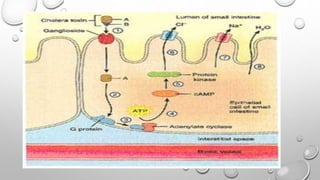
• Enterotoxins - cause watery diarrhea by acting directly on secretory
mechanisms in the intestinal mucosa. cholera toxin, heat-labile enterotoxin,
heat-stable enterotoxin
• Cytotoxins - cause destruction of mucosal cells and associated inflammatory
diarrhea
• Neurotoxins - act directly on the central or peripheral nervous system -
produced by bacteria outside the host and therefore cause symptoms soon after
ingestion - staphylococcal and Bacillus cereus toxins
INVASION
• Dysentery - from bacterial invasion and destruction of intestinal mucosal cells
• Shigella and enteroinvasive E. coli - invasion of mucosal epithelial cells,
intraepithelial multiplication, and subsequent spread to adjacent cells
• Salmonella - inflammatory diarrhea by invasion of the bowel mucosa but generally is
not associated with the destruction of enterocytes
• Salmonella typhi and Yersinia enterocolitica - penetrate intact intestinal mucosa,
multiply intracellularly in peyer's patches and intestinal lymph nodes, and then
disseminate through the bloodstream to cause enteric fever
GASTROINTESTINAL PATHOGENS CAUSING
ACUTE DIARRHEA
NONINFLAMMATORY (ENTEROTOXIN)
• Vibrio Cholerae, ETE.Coli, EAE. Coli, Clostridium Perfringens, Bacillus Cereus,
Staphylococcus Aureus
• Rotavirus, Norovirus, Enteric Adenoviruses
• Giardia Lamblia, Cryptosporidium Spp
• Proximal small bowel
• Watery diarrhea
• Stool - no fecal leukocytes; mild or no increase in fecal lactoferrin
INFLAMMATORY (INVASION OR CYTOTOXIN)
• Shigella Spp., Salmonella Spp., Campylobacter Jejuni, Enterohemorrhagic E. Coli,
Enteroinvasive E. Coli, Yersinia Enterocolitica, Listeria Monocytogenes, Vibrio
Parahaemolyticus, Clostridium Difficile
• Entamoeba Histolytica
• Colon or distal small bowel
• Dysentery or inflammatory diarrhea
• Stool - Fecal polymorphonuclear leukocytes; substantial increase in fecal
lactoferrin
PENETRATING
• Salmonella Typhi, Y. Enterocolitica
• Enteric fever
• Stool - Fecal mononuclear leukocytes
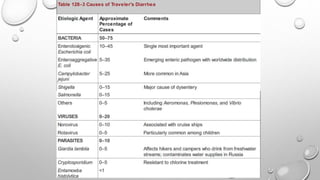
TRAVELER'S DIARRHEA
• Most common travel-related infectious illness
• time of onset is usually 3 days to 2 weeks after the traveler's arrival in a
resource-poor area
• most cases begin within the first 3–5 days
• generally self-limited, lasting 1–5 days
• related to the ingestion of contaminated food or water
• enterotoxigenic and enteroaggregative strains of E. coli are the most common
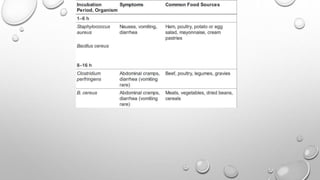
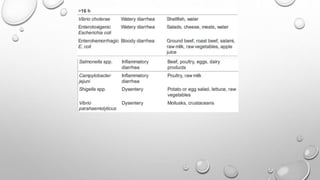
BACTERIAL FOOD POISONING
• Bacterial disease caused by an enterotoxin elaborated outside the host -
staphylococcus aureus or b. cereus, has the shortest incubation period (1–6 h) and
generally lasts <12h
• staphylococcal food poisoning - caused by contamination from infected human
carriers
• B. cereus - syndrome with a short incubation period—the emetic form, mediated by
a staphylococcal type of enterotoxin—or one with a longer incubation period (8–16
h)—the diarrheal form, caused by an enterotoxin resembling E. coli LT
• emetic form - contaminated fried rice
• Clostridium perfringens - slightly longer incubation period (8–14 h) , results from
the survival of heat-resistant spores in inadequately cooked meat, poultry, or
legumes
APPROACH TO THE PATIENT: INFECTIOUS
DIARRHEA OR BACTERIAL FOOD
POISONING
PHYSICAL EXAMINATION
• Signs of dehydration - provides essential information about the severity of the
diarrheal illness and the need for rapid therapy
• Mild dehydration - by thirst, dry mouth, decreased axillary sweat, decreased
urine output, and slight weight loss
• Moderate dehydration - orthostatic fall in blood pressure, skin tenting, and
sunken eyes
• Severe dehydration - lethargy, obtundation, feeble pulse, hypotension, and
frank shock
LABORATORY EVALUATION
• Noninflammatory diarrhea - self-limited or can be treated empirically, no need
to determine a specific etiology
• Cholera - stool should be cultured on selective media such as thiosulfate–
citrate–bile salts–sucrose (TCBS) or tellurite-taurocholate-gelatin (TTG) agar
• rotavirus - latex agglutination test
• patients with fever and evidence of inflammatory disease - stool cultured for
Salmonella, Shigella, and Campylobacter
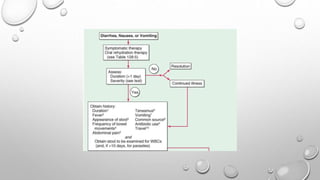
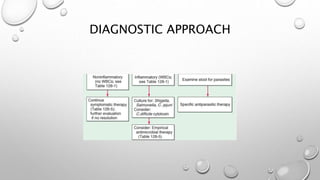
DIAGNOSTIC APPROACH
TREATMENT
• Mainstay of treatment is adequate rehydration - oral rehydration solution
• glucose-facilitated absorption of sodium and water in the small intestine remains
intact in the presence of toxin
• World Health Organization recommended a "reduced-osmolarity/reduced-salt" ORS
that is better tolerated and more effective
• 2.6 g of sodium chloride, 2.9 g of trisodium citrate, 1.5 g of potassium chloride, and
13.5 g of glucose (or 27 g of sucrose) per liter of water
• severely dehydrated or in whom vomiting precludes the use of oral therapy - IV
solutions such as Ringer's lactate
PROPHYLAXIS
• IMPROVEMENTS IN HYGIENE TO LIMIT FECAL-ORAL SPREAD OF ENTERIC
PATHOGENS
• ROTAVIRUS VACCINE
• VACCINES AGAINST S. TYPHI AND V. CHOLERAE ARE ALSO AVAILABLE
TREATMENT OF TRAVELER'S DIARRHEA
• loperamide: 4 mg initially followed by 2 mg after passage of each unformed stool,
not to exceed 8 tablets (16 mg) per day
• Loperamide should not be used by patients with fever or dysentery; its use may
prolong diarrhea in patients with infection due to Shigella or other invasive
organisms
• fluoroquinolone such as ciprofloxacin, 750 mg as a single dose or 500 mg bid for 3
days; levofloxacin, 500 mg as a single dose or 500 mg qd for 3 days; or norfloxacin,
800 mg as a single dose or 400 mg bid for 3 days
• Azithromycin, 1000 mg as a single dose or 500 mg qd for 3 days
• Rifaximin, 200 mg tid or 400 mg bid for 3 days

Acute diarrheal diseases

  • 1.
  • 2.
    INTRO • leading causeof illness globally • 4.6 billion episodes worldwide per year • ranks second to LRI as the most common infectious cause of death worldwide • contributes to malnutrition and thereby reduces resistance to other infectious agents - indirect factor in a far greater burden of disease • wide variety of infectious agents involved, including viruses, bacteria, and parasitic pathogens
  • 3.
    PATHOGENIC MECHANISMS TOXIN PRODUCTION •Enterotoxins - cause watery diarrhea by acting directly on secretory mechanisms in the intestinal mucosa. cholera toxin, heat-labile enterotoxin, heat-stable enterotoxin • Cytotoxins - cause destruction of mucosal cells and associated inflammatory diarrhea • Neurotoxins - act directly on the central or peripheral nervous system - produced by bacteria outside the host and therefore cause symptoms soon after ingestion - staphylococcal and Bacillus cereus toxins
  • 5.
    INVASION • Dysentery -from bacterial invasion and destruction of intestinal mucosal cells • Shigella and enteroinvasive E. coli - invasion of mucosal epithelial cells, intraepithelial multiplication, and subsequent spread to adjacent cells • Salmonella - inflammatory diarrhea by invasion of the bowel mucosa but generally is not associated with the destruction of enterocytes • Salmonella typhi and Yersinia enterocolitica - penetrate intact intestinal mucosa, multiply intracellularly in peyer's patches and intestinal lymph nodes, and then disseminate through the bloodstream to cause enteric fever
  • 6.
    GASTROINTESTINAL PATHOGENS CAUSING ACUTEDIARRHEA NONINFLAMMATORY (ENTEROTOXIN) • Vibrio Cholerae, ETE.Coli, EAE. Coli, Clostridium Perfringens, Bacillus Cereus, Staphylococcus Aureus • Rotavirus, Norovirus, Enteric Adenoviruses • Giardia Lamblia, Cryptosporidium Spp • Proximal small bowel • Watery diarrhea • Stool - no fecal leukocytes; mild or no increase in fecal lactoferrin
  • 7.
    INFLAMMATORY (INVASION ORCYTOTOXIN) • Shigella Spp., Salmonella Spp., Campylobacter Jejuni, Enterohemorrhagic E. Coli, Enteroinvasive E. Coli, Yersinia Enterocolitica, Listeria Monocytogenes, Vibrio Parahaemolyticus, Clostridium Difficile • Entamoeba Histolytica • Colon or distal small bowel • Dysentery or inflammatory diarrhea • Stool - Fecal polymorphonuclear leukocytes; substantial increase in fecal lactoferrin
  • 8.
    PENETRATING • Salmonella Typhi,Y. Enterocolitica • Enteric fever • Stool - Fecal mononuclear leukocytes
  • 9.
    TRAVELER'S DIARRHEA • Mostcommon travel-related infectious illness • time of onset is usually 3 days to 2 weeks after the traveler's arrival in a resource-poor area • most cases begin within the first 3–5 days • generally self-limited, lasting 1–5 days • related to the ingestion of contaminated food or water • enterotoxigenic and enteroaggregative strains of E. coli are the most common
  • 11.
  • 14.
    • Bacterial diseasecaused by an enterotoxin elaborated outside the host - staphylococcus aureus or b. cereus, has the shortest incubation period (1–6 h) and generally lasts <12h • staphylococcal food poisoning - caused by contamination from infected human carriers • B. cereus - syndrome with a short incubation period—the emetic form, mediated by a staphylococcal type of enterotoxin—or one with a longer incubation period (8–16 h)—the diarrheal form, caused by an enterotoxin resembling E. coli LT • emetic form - contaminated fried rice • Clostridium perfringens - slightly longer incubation period (8–14 h) , results from the survival of heat-resistant spores in inadequately cooked meat, poultry, or legumes
  • 15.
    APPROACH TO THEPATIENT: INFECTIOUS DIARRHEA OR BACTERIAL FOOD POISONING
  • 17.
    PHYSICAL EXAMINATION • Signsof dehydration - provides essential information about the severity of the diarrheal illness and the need for rapid therapy • Mild dehydration - by thirst, dry mouth, decreased axillary sweat, decreased urine output, and slight weight loss • Moderate dehydration - orthostatic fall in blood pressure, skin tenting, and sunken eyes • Severe dehydration - lethargy, obtundation, feeble pulse, hypotension, and frank shock
  • 18.
    LABORATORY EVALUATION • Noninflammatorydiarrhea - self-limited or can be treated empirically, no need to determine a specific etiology • Cholera - stool should be cultured on selective media such as thiosulfate– citrate–bile salts–sucrose (TCBS) or tellurite-taurocholate-gelatin (TTG) agar • rotavirus - latex agglutination test • patients with fever and evidence of inflammatory disease - stool cultured for Salmonella, Shigella, and Campylobacter
  • 19.
  • 20.
    TREATMENT • Mainstay oftreatment is adequate rehydration - oral rehydration solution • glucose-facilitated absorption of sodium and water in the small intestine remains intact in the presence of toxin • World Health Organization recommended a "reduced-osmolarity/reduced-salt" ORS that is better tolerated and more effective • 2.6 g of sodium chloride, 2.9 g of trisodium citrate, 1.5 g of potassium chloride, and 13.5 g of glucose (or 27 g of sucrose) per liter of water • severely dehydrated or in whom vomiting precludes the use of oral therapy - IV solutions such as Ringer's lactate
  • 22.
    PROPHYLAXIS • IMPROVEMENTS INHYGIENE TO LIMIT FECAL-ORAL SPREAD OF ENTERIC PATHOGENS • ROTAVIRUS VACCINE • VACCINES AGAINST S. TYPHI AND V. CHOLERAE ARE ALSO AVAILABLE
  • 23.
    TREATMENT OF TRAVELER'SDIARRHEA • loperamide: 4 mg initially followed by 2 mg after passage of each unformed stool, not to exceed 8 tablets (16 mg) per day • Loperamide should not be used by patients with fever or dysentery; its use may prolong diarrhea in patients with infection due to Shigella or other invasive organisms • fluoroquinolone such as ciprofloxacin, 750 mg as a single dose or 500 mg bid for 3 days; levofloxacin, 500 mg as a single dose or 500 mg qd for 3 days; or norfloxacin, 800 mg as a single dose or 400 mg bid for 3 days • Azithromycin, 1000 mg as a single dose or 500 mg qd for 3 days • Rifaximin, 200 mg tid or 400 mg bid for 3 days