Journal club
Presentation by dr. c.kannan,
1st year PG
MGMCRI
Rotavirus and other Diarrheal Disease in a Birth Cohort
from Southern Indian Community
From Indian pediatrics
Received: May 15, 2015;
Initial review: October 09, 2015;
Accepted: May 05, 2016.
AUTHORS
R SARKAR, BP GLADSTONE, JP WARIER,SL SHARMA, U RAMAN,
J MULIYIL AND G KANG
(From Division of Gastrointestinal Sciences, and *Community
Health Department, Christian Medical College, Vellore, TamilNadu,
India.)
Correspondence to:
Dr Gagandeep Kang,
(Division of Gastrointestinal Sciences, Christian Medical College,
Vellore 632 004)
Objective is to describe
 Incidence,
 Severity and
 Etiology of diarrheal disease
In infants and young children residing in an urban slum
community in Southern India.
Acute diarrheal diseases
 One of the top five causes of morbidity and mortality worldwide,
 Causes 0.52 million deaths annuallyin children under the age of 5 years
 The most common enteropathogens causing diarrhea are
 rotavirus,
 Cryptosporidium spp.,
 Salmonella spp.,
 Campylobacter,
 Shigella,
 diarrheagenic Escherichiacoli,
 calicivirus,
 adenovirus,
 astrovirus and possibly Giardia.
 Rotavirus, norovirus and diarrheagenic Escherichia coli are responsible for more than
half of all diarrheal deaths in under-five children
Diarrhoea
 Passage of 3 or more loose watery stools in a 24-
hour period or
 Change in the number or consistency of the stools.
An Episode of Diarrhoea
 At least one day of diarrhoea, preceded and
followed by two or more days without diarrhoea
Acute diarrhoea
 Defined as an episode lasting for less than 14 days
Persistent diarrhoea
 Defined as an episode lasting for 14 days or more
The Vesikari scale
 Severity of diarrhoea was assessed using the Vesikari scale,
 Originally designed for assessing rotavirus disease presenting to
hospital.
 An episode was considered
 mild - 5 or less,
 moderate - 6-10 and
 severe - 11 or more.
Hygiene status of the household
 Recorded for all children at the time of recruitment and
 Thereafter at 6-monthly intervals,
 Using a previously validated questionnaire
 Each household assigned a score ranging from 0 to 21.
 Good (≥13),
 Poor (10-12) and
 Very poor (≤9) hygiene
Setting
Three contiguous urban slums in Vellore, Tamil Nadu.
Participants
Children participating in a birth cohort study on diarrheal
disease are 452
Children completed three years of follow-up are 373
Work done on
 Diarrheal incidence (obtained by twice weekly home visits)
 Severity of diarrhea (assessed by the Vesikari scoring system)
 Etiological agents associated with diarrhea
 Examination of stool specimens by bacteriologic culture,
 Rotavirus enzyme immunoassay,
 PCR for norovirus and
 Microscopy for parasites).
Methods applied on work
 452 newborn infants were recruited from three contiguous urban slums
in Vellore between March 2002 and August 2003.
 They were followed up with twice weekly home visits by field workers, who enquired
about morbidity, until they attained the age of three years.
 Stool samples were collected whenever a child was found to have an episode
of diarrhea.
 During a diarrheal episode, the child was visited on alternate days until resolution.
 Detailed clinical data was collected on the
 onset, duration, frequency,
 color and consistency of stools,
 associated vomiting and fever,
 presence and severity of dehydration, and treatment.
 The Institutional Review Board of Christian Medical College, Vellore, approved the study
and written informed consent was obtained from parents/guardians of all children prior to
enrollment
Statistical analysis
 Pathogen-specific incidence rates of diarrhea episodes,
 Season-specific incidence,
 Severity and age at infection for specific diarrheal pathogens were calculated by the
 Number of episodes as the numerator and the
 Total child-years of follow-up as the denominator.
 Factors influencing severity of diarrhea (moderate/severe vs. mild) was assessed by
 logistic regression analysis
 odds ratios with 95% confidence intervals (CI) were calculated
Results and interpretations
 1856 episodes in 373 children,
 Samples collected are 1829
 Frequency in age
 1.6 episodes / child on average,
 2.76 episodes in infancy,
 1.28 episodes in 2nd year,
 0.94 episodes in 3rd year,
 Frequency in year
 95 % have one episode in 3 years,
 28 % have more than 6 episodes by the time they reach 3 years
 in 4 months 50% have one episode,
 at 6 months 75 % have more than 1 episode ,
 increased incidence b/w 3-8 months,
 Median duration is 3 days (2-4),
 42%of episodes in 1st year are >3 days,
 29% of episodes in 2nd year are >3 days,
 22%of episodes in 3rd year are >3 days
 1833(98.8%)episodes are acute,
 23(1.2%)are persistant,
 Associated symptoms
 vomitting seen in 297 (16%)episodes,
 fever seen in 317(17%)episodes,
 mucus in stool seen in 250(13.5%)episodes,
 bloody in 41(2.2%) episodes,
 Treatments
 antibiotics used in 27.5%,
 antimotility in 14.6%
 ORS given in 1564(87.4%) episodes,
 In 1793 episodes
 58.4%are mild,
 33.4% are moderate,
 8.2% are severe
 Antibiotics used
 in 19.1% of mild,
 38% moderate
 and 54.2% of severe episodes,
 Proportion of highest severity is seen in age <6 months is 12%,
 Out of 1829 episodes
 635(35.7%) are a/w 1 or >1 pathogens
 in that 28 % in infancy and
 45% are in late years,
 coinfection with 2 organisms is 88(4.8%)
 with 3 or more organisms is 9(0.5%)
 Out of positive samples
 rotavirus (18%),
 giardia(8%),
 aeromonas(4%),
 cryptosporosis(3%),
 shigella (2%),
 vibrio(1%),
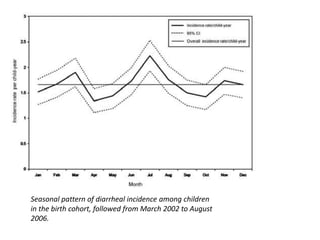
Seasonal pattern of diarrheal incidence among children
in the birth cohort, followed from March 2002 to August
2006.
WHAT IS ALREADY KNOWN?
• The etiology of diarrhea in hospitalized children is well documented, but community
estimates from longitudinal studies are lacking.
WHAT THIS STUDY ADDS?
• Poor and very poor hygiene status showed a higher risk of getting severe diarrhoea
• Good hygiene practices within the home, such as washing hands with soap before
feeding a child, can reduce the risk of 33% of childhood diarrhea
• Incidence rate of diarrhea was 1.66 episodes per child year for first 3 years of life;
highest incidence (2.76episodes per child year) is seen in infancy.
• As with hospitalized children, rotavirus was the commonest etiological agent
associated with 18% of childhood diarrhea in the community.
THANK YOU!!

5 1099296681842704390

  • 1.
    Journal club Presentation bydr. c.kannan, 1st year PG MGMCRI
  • 2.
    Rotavirus and otherDiarrheal Disease in a Birth Cohort from Southern Indian Community From Indian pediatrics Received: May 15, 2015; Initial review: October 09, 2015; Accepted: May 05, 2016.
  • 3.
    AUTHORS R SARKAR, BPGLADSTONE, JP WARIER,SL SHARMA, U RAMAN, J MULIYIL AND G KANG (From Division of Gastrointestinal Sciences, and *Community Health Department, Christian Medical College, Vellore, TamilNadu, India.) Correspondence to: Dr Gagandeep Kang, (Division of Gastrointestinal Sciences, Christian Medical College, Vellore 632 004)
  • 4.
    Objective is todescribe  Incidence,  Severity and  Etiology of diarrheal disease In infants and young children residing in an urban slum community in Southern India.
  • 5.
    Acute diarrheal diseases One of the top five causes of morbidity and mortality worldwide,  Causes 0.52 million deaths annuallyin children under the age of 5 years  The most common enteropathogens causing diarrhea are  rotavirus,  Cryptosporidium spp.,  Salmonella spp.,  Campylobacter,  Shigella,  diarrheagenic Escherichiacoli,  calicivirus,  adenovirus,  astrovirus and possibly Giardia.  Rotavirus, norovirus and diarrheagenic Escherichia coli are responsible for more than half of all diarrheal deaths in under-five children
  • 6.
    Diarrhoea  Passage of3 or more loose watery stools in a 24- hour period or  Change in the number or consistency of the stools. An Episode of Diarrhoea  At least one day of diarrhoea, preceded and followed by two or more days without diarrhoea
  • 7.
    Acute diarrhoea  Definedas an episode lasting for less than 14 days Persistent diarrhoea  Defined as an episode lasting for 14 days or more
  • 8.
    The Vesikari scale Severity of diarrhoea was assessed using the Vesikari scale,  Originally designed for assessing rotavirus disease presenting to hospital.  An episode was considered  mild - 5 or less,  moderate - 6-10 and  severe - 11 or more.
  • 9.
    Hygiene status ofthe household  Recorded for all children at the time of recruitment and  Thereafter at 6-monthly intervals,  Using a previously validated questionnaire  Each household assigned a score ranging from 0 to 21.  Good (≥13),  Poor (10-12) and  Very poor (≤9) hygiene
  • 10.
    Setting Three contiguous urbanslums in Vellore, Tamil Nadu. Participants Children participating in a birth cohort study on diarrheal disease are 452 Children completed three years of follow-up are 373
  • 11.
    Work done on Diarrheal incidence (obtained by twice weekly home visits)  Severity of diarrhea (assessed by the Vesikari scoring system)  Etiological agents associated with diarrhea  Examination of stool specimens by bacteriologic culture,  Rotavirus enzyme immunoassay,  PCR for norovirus and  Microscopy for parasites).
  • 12.
    Methods applied onwork  452 newborn infants were recruited from three contiguous urban slums in Vellore between March 2002 and August 2003.  They were followed up with twice weekly home visits by field workers, who enquired about morbidity, until they attained the age of three years.  Stool samples were collected whenever a child was found to have an episode of diarrhea.  During a diarrheal episode, the child was visited on alternate days until resolution.  Detailed clinical data was collected on the  onset, duration, frequency,  color and consistency of stools,  associated vomiting and fever,  presence and severity of dehydration, and treatment.  The Institutional Review Board of Christian Medical College, Vellore, approved the study and written informed consent was obtained from parents/guardians of all children prior to enrollment
  • 13.
    Statistical analysis  Pathogen-specificincidence rates of diarrhea episodes,  Season-specific incidence,  Severity and age at infection for specific diarrheal pathogens were calculated by the  Number of episodes as the numerator and the  Total child-years of follow-up as the denominator.  Factors influencing severity of diarrhea (moderate/severe vs. mild) was assessed by  logistic regression analysis  odds ratios with 95% confidence intervals (CI) were calculated
  • 14.
    Results and interpretations 1856 episodes in 373 children,  Samples collected are 1829  Frequency in age  1.6 episodes / child on average,  2.76 episodes in infancy,  1.28 episodes in 2nd year,  0.94 episodes in 3rd year,  Frequency in year  95 % have one episode in 3 years,  28 % have more than 6 episodes by the time they reach 3 years  in 4 months 50% have one episode,  at 6 months 75 % have more than 1 episode ,  increased incidence b/w 3-8 months,  Median duration is 3 days (2-4),  42%of episodes in 1st year are >3 days,  29% of episodes in 2nd year are >3 days,  22%of episodes in 3rd year are >3 days
  • 15.
     1833(98.8%)episodes areacute,  23(1.2%)are persistant,  Associated symptoms  vomitting seen in 297 (16%)episodes,  fever seen in 317(17%)episodes,  mucus in stool seen in 250(13.5%)episodes,  bloody in 41(2.2%) episodes,  Treatments  antibiotics used in 27.5%,  antimotility in 14.6%  ORS given in 1564(87.4%) episodes,  In 1793 episodes  58.4%are mild,  33.4% are moderate,  8.2% are severe
  • 16.
     Antibiotics used in 19.1% of mild,  38% moderate  and 54.2% of severe episodes,  Proportion of highest severity is seen in age <6 months is 12%,  Out of 1829 episodes  635(35.7%) are a/w 1 or >1 pathogens  in that 28 % in infancy and  45% are in late years,  coinfection with 2 organisms is 88(4.8%)  with 3 or more organisms is 9(0.5%)  Out of positive samples  rotavirus (18%),  giardia(8%),  aeromonas(4%),  cryptosporosis(3%),  shigella (2%),  vibrio(1%),
  • 17.
    Seasonal pattern ofdiarrheal incidence among children in the birth cohort, followed from March 2002 to August 2006.
  • 18.
    WHAT IS ALREADYKNOWN? • The etiology of diarrhea in hospitalized children is well documented, but community estimates from longitudinal studies are lacking. WHAT THIS STUDY ADDS? • Poor and very poor hygiene status showed a higher risk of getting severe diarrhoea • Good hygiene practices within the home, such as washing hands with soap before feeding a child, can reduce the risk of 33% of childhood diarrhea • Incidence rate of diarrhea was 1.66 episodes per child year for first 3 years of life; highest incidence (2.76episodes per child year) is seen in infancy. • As with hospitalized children, rotavirus was the commonest etiological agent associated with 18% of childhood diarrhea in the community.
  • 19.