BY:HARITH RIYADH
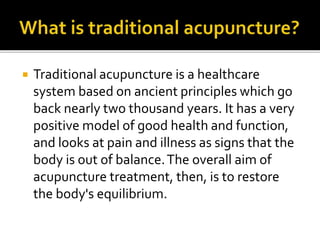
 Traditional acupuncture is a healthcare
system based on ancient principles which go
back nearly two thousand years. It has a very
positive model of good health and function,
and looks at pain and illness as signs that the
body is out of balance.The overall aim of
acupuncture treatment, then, is to restore
the body's equilibrium.
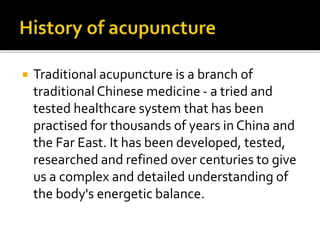
 Traditional acupuncture is a branch of
traditional Chinese medicine - a tried and
tested healthcare system that has been
practised for thousands of years in China and
the Far East. It has been developed, tested,
researched and refined over centuries to give
us a complex and detailed understanding of
the body's energetic balance.
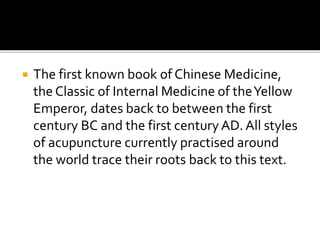
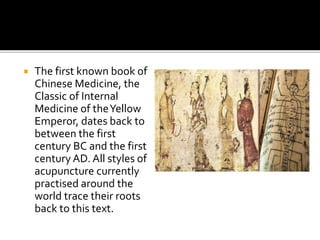
 The first known book of Chinese Medicine,
the Classic of Internal Medicine of theYellow
Emperor, dates back to between the first
century BC and the first century AD. All styles
of acupuncture currently practised around
the world trace their roots back to this text.
 The first known book of
Chinese Medicine, the
Classic of Internal
Medicine of theYellow
Emperor, dates back to
between the first
century BC and the first
century AD. All styles of
acupuncture currently
practised around the
world trace their roots
back to this text.
 Without the help of modern scientific
equipment, ancient Chinese scholars discovered
many now familiar aspects of biomedical
science, such as the effect of emotional stress on
the immune system.Traditional acupuncturists
are no less scientific or sophisticated than
western clinicians in their understanding of how
the body functions, although to this day they use
terminology that reflects Chinese medicine's
cultural and historic origins
 In China during the early part of the twentieth
century traditional medicine fell out of
fashion as symptomatic healthcare
treatments were imported from theWest
along with other cultural influences. Calls by
western trained doctors to ban traditional
Chinese medicine were rejected by the
National Medical Assembly in Shanghai on 17
March 1929.This day is still celebrated every
year as Chinese Doctors' Day
 Traditional Chinese medicine remained in the shadow of
western medicine until the Long March of 1934-5. Without
drugs, anaesthetics or surgery vast numbers of sick and
wounded soldiers faced death until doctors of traditional
Chinese medicine achieved amazing results using
acupuncture and other traditional methods of treatment.
 From this point on, traditional Chinese medicine (TCM)
and western medicine were practised side by side in China.
Under the People's Republic of China, established in 1948,
all branches ofTCM were nurtured and encouraged to
grow. By 1978, whole hospitals and research departments
were devoted to the practice ofTCM.
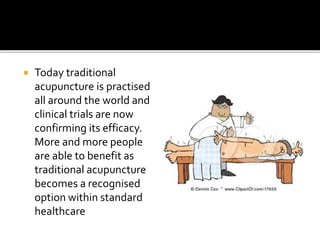
 Today traditional
acupuncture is practised
all around the world and
clinical trials are now
confirming its efficacy.
More and more people
are able to benefit as
traditional acupuncture
becomes a recognised
option within standard
healthcare
 http://www.acupuncture.org.uk/
 BRITHISH ACUPUNCTURE COUNCIL
MADLOPA
‫شكرآ‬
THANKS

acupuncture

  • 1.
  • 2.
     Traditional acupunctureis a healthcare system based on ancient principles which go back nearly two thousand years. It has a very positive model of good health and function, and looks at pain and illness as signs that the body is out of balance.The overall aim of acupuncture treatment, then, is to restore the body's equilibrium.
  • 3.
     Traditional acupunctureis a branch of traditional Chinese medicine - a tried and tested healthcare system that has been practised for thousands of years in China and the Far East. It has been developed, tested, researched and refined over centuries to give us a complex and detailed understanding of the body's energetic balance.
  • 4.
     The firstknown book of Chinese Medicine, the Classic of Internal Medicine of theYellow Emperor, dates back to between the first century BC and the first century AD. All styles of acupuncture currently practised around the world trace their roots back to this text.
  • 5.
     The firstknown book of Chinese Medicine, the Classic of Internal Medicine of theYellow Emperor, dates back to between the first century BC and the first century AD. All styles of acupuncture currently practised around the world trace their roots back to this text.
  • 6.
     Without thehelp of modern scientific equipment, ancient Chinese scholars discovered many now familiar aspects of biomedical science, such as the effect of emotional stress on the immune system.Traditional acupuncturists are no less scientific or sophisticated than western clinicians in their understanding of how the body functions, although to this day they use terminology that reflects Chinese medicine's cultural and historic origins
  • 7.
     In Chinaduring the early part of the twentieth century traditional medicine fell out of fashion as symptomatic healthcare treatments were imported from theWest along with other cultural influences. Calls by western trained doctors to ban traditional Chinese medicine were rejected by the National Medical Assembly in Shanghai on 17 March 1929.This day is still celebrated every year as Chinese Doctors' Day
  • 8.
     Traditional Chinesemedicine remained in the shadow of western medicine until the Long March of 1934-5. Without drugs, anaesthetics or surgery vast numbers of sick and wounded soldiers faced death until doctors of traditional Chinese medicine achieved amazing results using acupuncture and other traditional methods of treatment.  From this point on, traditional Chinese medicine (TCM) and western medicine were practised side by side in China. Under the People's Republic of China, established in 1948, all branches ofTCM were nurtured and encouraged to grow. By 1978, whole hospitals and research departments were devoted to the practice ofTCM.
  • 9.
     Today traditional acupunctureis practised all around the world and clinical trials are now confirming its efficacy. More and more people are able to benefit as traditional acupuncture becomes a recognised option within standard healthcare
  • 10.
  • 11.