Traditional Chinese
Medicine
Introducti
on
⚫Traditional Chinese medicine (TCM)
originated in ancient China and has
evolved over thousands of years.
⚫TCM practitioners use herbal
medicines and various mind and
body practices, such as
acupuncture and tai chi, to treat or
prevent health problems.
Introducti
on
⚫ The ancient beliefs on which TCM is based include
the following:
1. The human body is a miniature version of the larger,
surrounding universe.
2. Harmony between two opposing yet complementary
forces, called yin and yang, supports health, and
disease results from an imbalance between these
forces.
3. Five elements—fire, earth, wood, metal, and water—
symbolically represent all phenomena, including the
stages of human life, and explain the functioning of
the body and how it changes during disease.
4. Qi, a vital energy that flows through the body,
performs
multiple functions in maintaining health.
Introducti
on
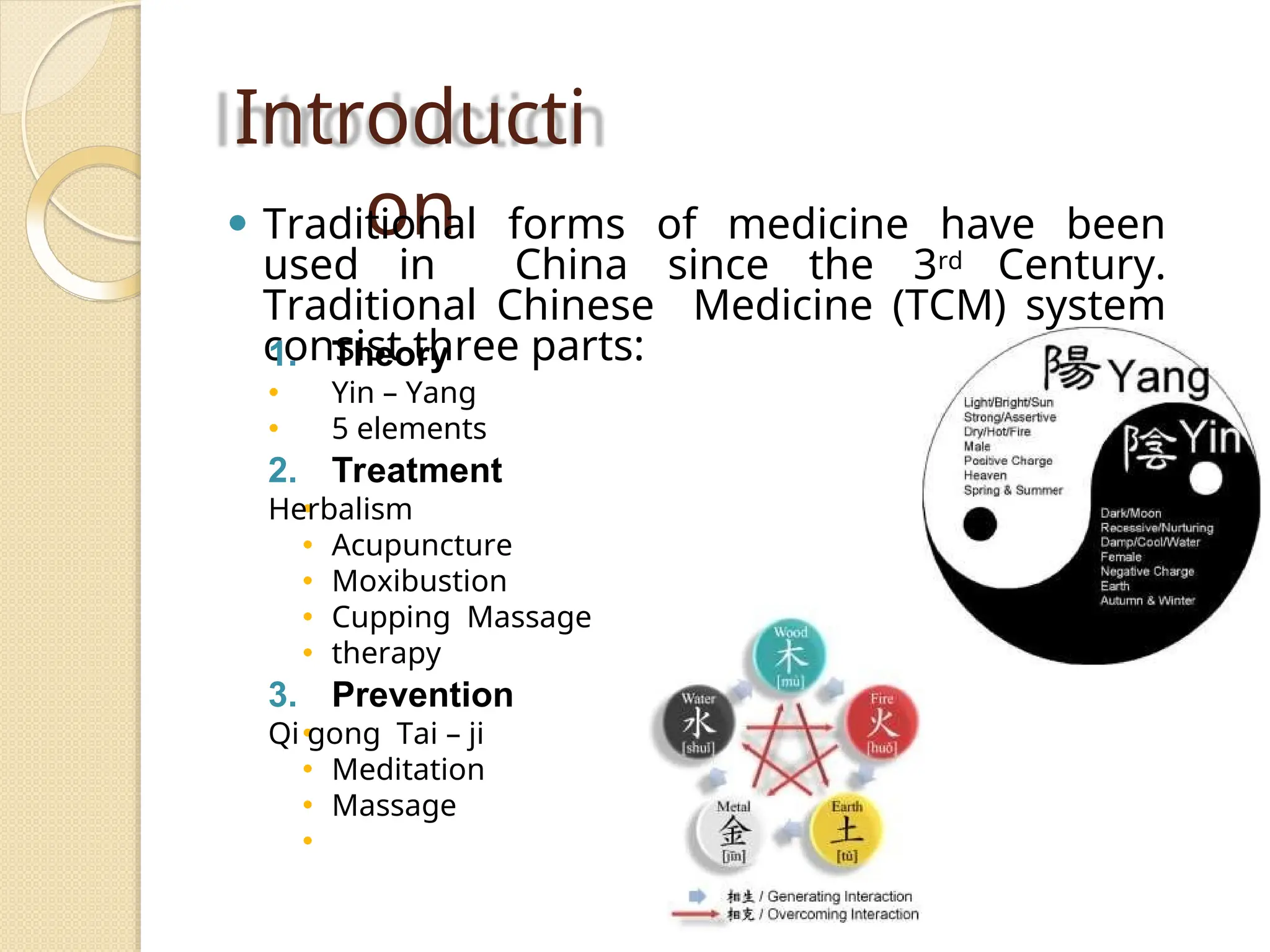
⚫ Traditional forms of medicine have been
used in China since the 3rd Century.
Traditional Chinese Medicine (TCM) system
consist three parts:
🞄
🞄
🞄
🞄
🞄
🞄
🞄
🞄
🞄
1. Theory
🞄 Yin – Yang
🞄 5 elements
2. Treatment
Herbalism
Acupuncture
Moxibustion
Cupping Massage
therapy
3. Prevention
Qi gong Tai – ji
Meditation
Massage
Daoist yin-yang
concepts
⚫ Yang predominates during the day and turns into yin
after dark.
⚫ The human body is regarded as the universe in
miniature, when the Yin and Yang elements in a
person’s body are well balanced, the person is in good
hearth.
◦ A person falls sick when the balance is disrupted.
Five elements
theory
⚫ The five vital organs
◦ the heart, liver,
spleen, lungs, and
kidneys are each
seen as
corresponding to
one of the five
elements of earth,
wood, metal, fire
and water.
◦ The five organs
function in an
interlocked and
interconnected
relationship.
◦ It is believed a
pathological change
in any of the vital
organs will affect
the health of the
other organs.
Traditional Chinese
Medicine
⚫ TCM encompasses many different
practices, including
1. Acupuncture
2. Cupping
3. Moxibustion
🞄 Burning an herb above the skin to apply heat to
acupuncture points
4. Chinese herbal medicine
5. Tui na
🞄 Chinese therapeutic massage
6. Dietary therapy
7. Tai chi and qi gong
🞄 Practices that combine specific movements or
postures, coordinated breathing, and mental focus
Traditional Chinese
Medicine
1. Chinese herbal medicine
◦ The Chinese Materia
Medica (a
pharmacological
reference book used by
TCM practitioners)
describes thousands of
medicinal substances—
primarily plants, but also
some minerals and
animal products.
◦ Different parts of plants,
such as the leaves, roots,
stems, flowers, and
seeds, are used.
◦ In TCM, herbs are often
combined in formulas
and given as teas,
capsules, liquid extracts,
granules, or powders.
Traditional Chinese
Medicine
2.
◦
◦
◦
◦
Acupuncture
◦Acupuncture is a family of
procedures involving the
stimulation of specific
points on the body using a
variety of techniques.
The acupuncture technique
that has been most often
studied scientifically
involves penetrating the
skin with thin, solid, metal
needles that are
manipulated by the hands
or by
electrical stimulation.
Acupuncture involves the
stimulation of anatomical
points on the body with
thin needled.
Acupuncture patients
usually feel little to no pain.
Acupuncture needles are
hair-thin and are
manipulated either by
hand or electricity.
Traditional Chinese
Medicine
3. Moxibustion
◦ Moxibustion is a traditional
Chinese medicine technique
that involves the burning of
mugwort, a small, spongy
herb, to facilitate healing.
◦ The purpose is to
strengthen the blood and
improve Qi flow.
◦ Direct and indirect
methods.
◦ Traditionally used to treat
colds.
◦ But it is not for everyone.
◦ Because it is used
specifically for patients
suffering from cold or
stagnant constitutions, it
should not be used on
anyone diagnosed with too
much heat.
Traditional Chinese
Medicine
4. Cupping
◦ Cupping therapy is a
form of CTM in which
cups are placed on the
skin to create suction.
◦ The cups can be made
of a variety of
materials, including:
🞄 Glass
🞄 Bamboo
🞄 Earthenware
◦ The suction of the cups
mobilizes blood flow to
promote the healing of
a broad range of
medical ailments
Traditional Chinese
Medicine
5. Tui Na
◦ Also known as
Chinese massage
◦ Uses wave-like
motions to loosen
joints and nourish
muscles.
◦ Brings awareness
back to a person’s
body, making it a
first step in the
healing process.
◦ Stimulates the flow
of Qi, blood and
body fluids
◦ Can be used to treat
pain, stress or
digestion problems.
Traditional Chinese
Medicine
6. Qigong
◦ Qigong is a Chinese
form
of exercise.
◦ It regulates the mind
and breathing to
promote the flow of Qi.
◦ Qigong is often used to
treat diseases.
◦ External Qigong is
performed on a person
by a Qigong master
◦ Internal Qigong is
practiced by oneself.
Traditional Chinese
Medicine
7. Tai chi
◦ Tai chi is a centuries-
old mind and body
practice.
◦ It involves gentle,
dance- like body
movements with
mental focus,
breathing, and
relaxation.
Traditional Chinese
Medicine
8.
Meditation
◦ Meditation has
been
practiced for thousands
of
years
.
◦ It involves focusing on
one
thing, such as
breathing
patterns, while clearing
all
other thoughts from
the
mind
.
◦ Meditation is used
to
replenish the flow of
Qi,
which helps to ward
off
illnesses
.
◦ People may
experience
various feelings
during
meditation. Some
people
may begin to
feel
overjoyed, while
others
may experience
extreme
sadness, and even
cry.
◦ Meditation is
also
popularly practiced
in
western countries as
a
means of stress
relief.
Side effects and
Risks
1. Herbal products
◦ There have been reports of products being contaminated with drugs,
toxins, or heavy metals or not containing the listed ingredients.
◦ Some of the herbs used in Chinese medicine can interact with drugs, can
have serious side effects, or may be unsafe for people with certain
medical conditions.
◦ For example, the Chinese herb ephedra (ma huang) has been linked to
serious health complications, including heart attack and stroke.
2. Acupuncture
◦ Acupuncture needles as medical devices and requires that the needles be
sterile, nontoxic, and labeled for single use by qualified practitioners only
◦ Relatively few complications from the use of acupuncture have been
reported.
◦ However, adverse effects—some of them serious—have resulted from the
use of nonsterile needles or improper delivery of acupuncture
treatments.
3. Tai chi and qi gong
◦ Are considered to be generally safe practices.
4. Moxibustion
◦ Complications include allergic reactions, burns, and infections,
◦ Both moxibustion and cupping (applying a heated cup to the skin to
create a slight suction) may mark the skin, usually temporarily.

3rd sem B.Pharm Chinese medicinal Treatment

  • 1.
  • 2.
    Introducti on ⚫Traditional Chinese medicine(TCM) originated in ancient China and has evolved over thousands of years. ⚫TCM practitioners use herbal medicines and various mind and body practices, such as acupuncture and tai chi, to treat or prevent health problems.
  • 3.
    Introducti on ⚫ The ancientbeliefs on which TCM is based include the following: 1. The human body is a miniature version of the larger, surrounding universe. 2. Harmony between two opposing yet complementary forces, called yin and yang, supports health, and disease results from an imbalance between these forces. 3. Five elements—fire, earth, wood, metal, and water— symbolically represent all phenomena, including the stages of human life, and explain the functioning of the body and how it changes during disease. 4. Qi, a vital energy that flows through the body, performs multiple functions in maintaining health.
  • 4.
    Introducti on ⚫ Traditional formsof medicine have been used in China since the 3rd Century. Traditional Chinese Medicine (TCM) system consist three parts: 🞄 🞄 🞄 🞄 🞄 🞄 🞄 🞄 🞄 1. Theory 🞄 Yin – Yang 🞄 5 elements 2. Treatment Herbalism Acupuncture Moxibustion Cupping Massage therapy 3. Prevention Qi gong Tai – ji Meditation Massage
  • 5.
    Daoist yin-yang concepts ⚫ Yangpredominates during the day and turns into yin after dark. ⚫ The human body is regarded as the universe in miniature, when the Yin and Yang elements in a person’s body are well balanced, the person is in good hearth. ◦ A person falls sick when the balance is disrupted.
  • 6.
    Five elements theory ⚫ Thefive vital organs ◦ the heart, liver, spleen, lungs, and kidneys are each seen as corresponding to one of the five elements of earth, wood, metal, fire and water. ◦ The five organs function in an interlocked and interconnected relationship. ◦ It is believed a pathological change in any of the vital organs will affect the health of the other organs.
  • 7.
    Traditional Chinese Medicine ⚫ TCMencompasses many different practices, including 1. Acupuncture 2. Cupping 3. Moxibustion 🞄 Burning an herb above the skin to apply heat to acupuncture points 4. Chinese herbal medicine 5. Tui na 🞄 Chinese therapeutic massage 6. Dietary therapy 7. Tai chi and qi gong 🞄 Practices that combine specific movements or postures, coordinated breathing, and mental focus
  • 8.
    Traditional Chinese Medicine 1. Chineseherbal medicine ◦ The Chinese Materia Medica (a pharmacological reference book used by TCM practitioners) describes thousands of medicinal substances— primarily plants, but also some minerals and animal products. ◦ Different parts of plants, such as the leaves, roots, stems, flowers, and seeds, are used. ◦ In TCM, herbs are often combined in formulas and given as teas, capsules, liquid extracts, granules, or powders.
  • 9.
    Traditional Chinese Medicine 2. ◦ ◦ ◦ ◦ Acupuncture ◦Acupuncture isa family of procedures involving the stimulation of specific points on the body using a variety of techniques. The acupuncture technique that has been most often studied scientifically involves penetrating the skin with thin, solid, metal needles that are manipulated by the hands or by electrical stimulation. Acupuncture involves the stimulation of anatomical points on the body with thin needled. Acupuncture patients usually feel little to no pain. Acupuncture needles are hair-thin and are manipulated either by hand or electricity.
  • 10.
    Traditional Chinese Medicine 3. Moxibustion ◦Moxibustion is a traditional Chinese medicine technique that involves the burning of mugwort, a small, spongy herb, to facilitate healing. ◦ The purpose is to strengthen the blood and improve Qi flow. ◦ Direct and indirect methods. ◦ Traditionally used to treat colds. ◦ But it is not for everyone. ◦ Because it is used specifically for patients suffering from cold or stagnant constitutions, it should not be used on anyone diagnosed with too much heat.
  • 11.
    Traditional Chinese Medicine 4. Cupping ◦Cupping therapy is a form of CTM in which cups are placed on the skin to create suction. ◦ The cups can be made of a variety of materials, including: 🞄 Glass 🞄 Bamboo 🞄 Earthenware ◦ The suction of the cups mobilizes blood flow to promote the healing of a broad range of medical ailments
  • 12.
    Traditional Chinese Medicine 5. TuiNa ◦ Also known as Chinese massage ◦ Uses wave-like motions to loosen joints and nourish muscles. ◦ Brings awareness back to a person’s body, making it a first step in the healing process. ◦ Stimulates the flow of Qi, blood and body fluids ◦ Can be used to treat pain, stress or digestion problems.
  • 13.
    Traditional Chinese Medicine 6. Qigong ◦Qigong is a Chinese form of exercise. ◦ It regulates the mind and breathing to promote the flow of Qi. ◦ Qigong is often used to treat diseases. ◦ External Qigong is performed on a person by a Qigong master ◦ Internal Qigong is practiced by oneself.
  • 14.
    Traditional Chinese Medicine 7. Taichi ◦ Tai chi is a centuries- old mind and body practice. ◦ It involves gentle, dance- like body movements with mental focus, breathing, and relaxation.
  • 15.
    Traditional Chinese Medicine 8. Meditation ◦ Meditationhas been practiced for thousands of years . ◦ It involves focusing on one thing, such as breathing patterns, while clearing all other thoughts from the mind . ◦ Meditation is used to replenish the flow of Qi, which helps to ward off illnesses . ◦ People may experience various feelings during meditation. Some people may begin to feel overjoyed, while others may experience extreme sadness, and even cry. ◦ Meditation is also popularly practiced in western countries as a means of stress relief.
  • 16.
    Side effects and Risks 1.Herbal products ◦ There have been reports of products being contaminated with drugs, toxins, or heavy metals or not containing the listed ingredients. ◦ Some of the herbs used in Chinese medicine can interact with drugs, can have serious side effects, or may be unsafe for people with certain medical conditions. ◦ For example, the Chinese herb ephedra (ma huang) has been linked to serious health complications, including heart attack and stroke. 2. Acupuncture ◦ Acupuncture needles as medical devices and requires that the needles be sterile, nontoxic, and labeled for single use by qualified practitioners only ◦ Relatively few complications from the use of acupuncture have been reported. ◦ However, adverse effects—some of them serious—have resulted from the use of nonsterile needles or improper delivery of acupuncture treatments. 3. Tai chi and qi gong ◦ Are considered to be generally safe practices. 4. Moxibustion ◦ Complications include allergic reactions, burns, and infections, ◦ Both moxibustion and cupping (applying a heated cup to the skin to create a slight suction) may mark the skin, usually temporarily.