Acupuncture
ALTERNATIVE THERAPY SEMINAR
Introduction
 Acupuncture is a treatment derived from ancient
Chinese medicine in which fine needles are inserted at
certain sites in the body for therapeutic or preventative
purposes.
Introduction
Theory
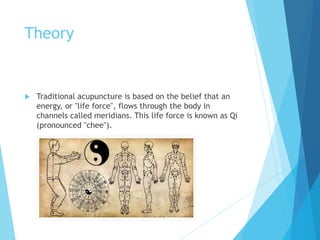
 Traditional acupuncture is based on the belief that an
energy, or "life force", flows through the body in
channels called meridians. This life force is known as Qi
(pronounced "chee").
Theory
 Practitioners who adhere to traditional beliefs about
acupuncture believe that when Qi does not flow freely
through the body, this can cause illness. They also
believe acupuncture can restore the flow of Qi, and so
restore health.
Does it work?
 Currently, the National Institute for Health and Care
Excellence (NICE) only recommends considering
acupuncture as a treatment option for chronic lower
back pain, chronic tension-type headaches
and migraines. NICE makes these recommendations on
the basis of scientific evidence.
 There is also some evidence that acupuncture works for
a small number of other problems, including neck pain
and post-chemotherapy nausea and vomiting.
 Acupuncture is sometimes used for a variety of other
conditions as well, but the evidence is not conclusive
for many of these uses.
Who may not be able to have
acupuncture?
 Because of the slight risk of bleeding, people with
bleeding disorders such as hemophilia, or people taking
medication to prevent blood clotting
anticoagulants may not be able to have acupuncture.
 If you have a blood disorder or are taking
anticoagulants, talk to your GP before you have
acupuncture.
 Acupuncture is also not usually advised if you have a
metal allergy or an infection in the area where needles
may be inserted.
Who may not be able to have
acupuncture?
 Before treatment, your acupuncture practitioner should
ask you about any underlying conditions you have or
medication you are taking, as some of these may affect
the treatment you can have.
 It is generally safe to have acupuncture when you are
pregnant. However, you should let your acupuncture
practitioner know if you are pregnant because certain
acupuncture points cannot be used safely during
pregnancy.
How acupuncture is
performed?
 Typically, an initial acupuncture session will involve an
assessment of general health, a medical history and a
physical examination, followed by insertion of the
acupuncture needles.
 Most acupuncture sessions last between 20 and 40
minutes.
 Courses of treatment often involve up to 10 separate
sessions, but this can vary.
Assessment and examination
 The acupuncture practitioner will first ask you about
your general health and your medical history.
 If your visit is because of a specific health condition,
they will ask about the symptoms of this condition and
about any other treatment you have received for it.
 After this, the acupuncture practitioner may carry out a
physical examination.
Insertion of the needles
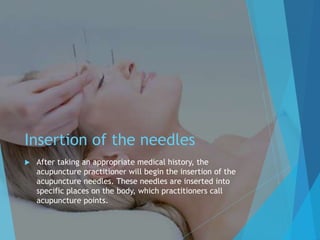
 After taking an appropriate medical history, the
acupuncture practitioner will begin the insertion of the
acupuncture needles. These needles are inserted into
specific places on the body, which practitioners call
acupuncture points.
Insertion of the needles
 During the session, you will usually be asked to sit or lie
down. You may also be asked to remove some clothes so
the practitioner can access the relevant parts of your
body.
 The needles used are fine and are usually a few
centimeters long. They should be single-use, pre-
sterilized needles that are disposed of immediately
after use.
Insertion of the needles
 Acupuncture practitioners choose specific points to
place the needles based on your condition. From 1 to 12
points will typically be used during a session, and
sometimes more depending on the number of symptoms
you have.
 The needles may be inserted just under the skin, or
deeper so they reach muscle tissue. Once the needles
are in place, they may be left in position for a length of
time lasting from a few minutes up to around 30
minutes.
What does it feel like?
 You may feel a tingling or a dull ache when the needles
are inserted. You should not experience any significant
pain. If you do, let your practitioner know straight
away.
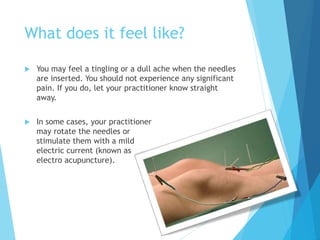
 In some cases, your practitioner
may rotate the needles or
stimulate them with a mild
electric current (known as
electro acupuncture).
Mechanisms of Action
 Several processes have been proposed to explain
acupuncture's effects, primarily those on pain.
 Acupuncture points are believed to stimulate the central
nervous system (the brain and spinal cord) to release
chemicals into the muscles, spinal cord, and brain.
 These chemicals either change the experience of pain or
release other chemicals, such as hormones, that influence
the body's self-regulating systems.
 The biochemical changes may stimulate the body's natural
healing abilities and promote physical and emotional well-
being.
Main Mechanisms of Action
 There are three main mechanisms of action:
I. Conduction of electromagnetic signals
II. Activation of opioid systems
III. Changes in brain chemistry sensation, and Involuntary
body functions
I. Conduction of
electromagnetic signals
 Western scientists have found evidence that
acupuncture points an strategic conductors of
electromagnetic signals.
 Stimulating points along these pathways through
acupuncture enables electromagnetic signals to be
relayed at it greater rate than under normal conditions.
 These signals may start the flow of pain-killing
biochemicals such as endorphins and of immune system
cells to specific sites that are injured or vulnerable to
disease.
II. Activation of opioid
systems
 Researchers has found that several types of opioids may
be released into the central nervous system during
acupuncture treatment, thereby reducing pain.
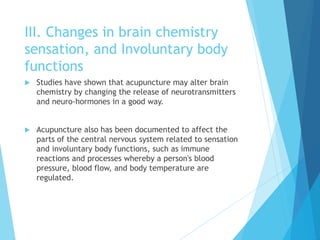
III. Changes in brain chemistry
sensation, and Involuntary body
functions
 Studies have shown that acupuncture may alter brain
chemistry by changing the release of neurotransmitters
and neuro-hormones in a good way.
 Acupuncture also has been documented to affect the
parts of the central nervous system related to sensation
and involuntary body functions, such as immune
reactions and processes whereby a person's blood
pressure, blood flow, and body temperature are
regulated.
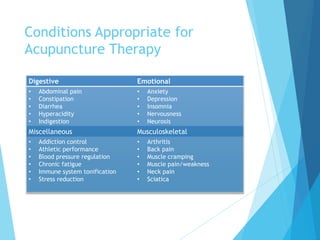
Conditions Appropriate for
Acupuncture Therapy
EmotionalDigestive
• Anxiety
• Depression
• Insomnia
• Nervousness
• Neurosis
• Abdominal pain
• Constipation
• Diarrhea
• Hyperacidity
• Indigestion
MusculoskeletalMiscellaneous
• Arthritis
• Back pain
• Muscle cramping
• Muscle pain/weakness
• Neck pain
• Sciatica
• Addiction control
• Athletic performance
• Blood pressure regulation
• Chronic fatigue
• Immune system tonification
• Stress reduction
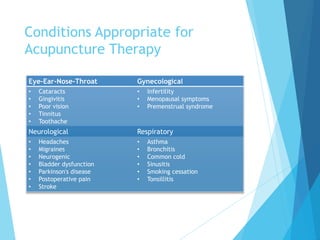
Conditions Appropriate for
Acupuncture Therapy
GynecologicalEye-Ear-Nose-Throat
• Infertility
• Menopausal symptoms
• Premenstrual syndrome
• Cataracts
• Gingivitis
• Poor vision
• Tinnitus
• Toothache
RespiratoryNeurological
• Asthma
• Bronchitis
• Common cold
• Sinusitis
• Smoking cessation
• Tonsillitis
• Headaches
• Migraines
• Neurogenic
• Bladder dysfunction
• Parkinson's disease
• Postoperative pain
• Stroke
Risks and side effects
 Acupuncture is safe when it is conducted by a qualified
practitioner.
 Mild, short-lasting side effects do occur in some cases,
however, including:
• pain where the needles puncture the skin
• bleeding or bruising where the needles puncture the skin
• drowsiness
• feeling sick
• feeling dizzy or faint
• worsening of pre-existing symptoms
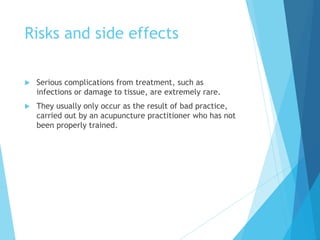
Risks and side effects
 Serious complications from treatment, such as
infections or damage to tissue, are extremely rare.
 They usually only occur as the result of bad practice,
carried out by an acupuncture practitioner who has not
been properly trained.
Risks and side effects
 The most common serious injury reported from the
needles of acupuncture has been accidental puncture of
the lung, which results in a partial collapse of the lung
called pneumothorax.
 The most common infection reported from acupuncture
treatments is viral hepatitis, a potentially serious
infection of the liver.
Risks and side effects
 Other side effects include bacterial infections locally at
the site of needle insertion in the skin and elsewhere in
the body.
 Generally, side effects seem to relate to poor hygiene
and training of the acupuncturist.
Refrence
 National Center for Complementary and Alternative
Medicine.
 WebMD (www.webmd.com)
 www.medicinenet.com
 www.nhs.uk
Done by
 Ahmed Barakat Al Tantawy
 Ahmed Osama Fathy
 Ibrahim Osama Awad Steit
THANK YOU!
END OF TEXT 

Acupuncture

  • 1.
  • 2.
    Introduction  Acupuncture isa treatment derived from ancient Chinese medicine in which fine needles are inserted at certain sites in the body for therapeutic or preventative purposes.
  • 3.
  • 4.
    Theory  Traditional acupunctureis based on the belief that an energy, or "life force", flows through the body in channels called meridians. This life force is known as Qi (pronounced "chee").
  • 5.
    Theory  Practitioners whoadhere to traditional beliefs about acupuncture believe that when Qi does not flow freely through the body, this can cause illness. They also believe acupuncture can restore the flow of Qi, and so restore health.
  • 6.
    Does it work? Currently, the National Institute for Health and Care Excellence (NICE) only recommends considering acupuncture as a treatment option for chronic lower back pain, chronic tension-type headaches and migraines. NICE makes these recommendations on the basis of scientific evidence.  There is also some evidence that acupuncture works for a small number of other problems, including neck pain and post-chemotherapy nausea and vomiting.  Acupuncture is sometimes used for a variety of other conditions as well, but the evidence is not conclusive for many of these uses.
  • 7.
    Who may notbe able to have acupuncture?  Because of the slight risk of bleeding, people with bleeding disorders such as hemophilia, or people taking medication to prevent blood clotting anticoagulants may not be able to have acupuncture.  If you have a blood disorder or are taking anticoagulants, talk to your GP before you have acupuncture.  Acupuncture is also not usually advised if you have a metal allergy or an infection in the area where needles may be inserted.
  • 8.
    Who may notbe able to have acupuncture?  Before treatment, your acupuncture practitioner should ask you about any underlying conditions you have or medication you are taking, as some of these may affect the treatment you can have.  It is generally safe to have acupuncture when you are pregnant. However, you should let your acupuncture practitioner know if you are pregnant because certain acupuncture points cannot be used safely during pregnancy.
  • 9.
    How acupuncture is performed? Typically, an initial acupuncture session will involve an assessment of general health, a medical history and a physical examination, followed by insertion of the acupuncture needles.  Most acupuncture sessions last between 20 and 40 minutes.  Courses of treatment often involve up to 10 separate sessions, but this can vary.
  • 10.
    Assessment and examination The acupuncture practitioner will first ask you about your general health and your medical history.  If your visit is because of a specific health condition, they will ask about the symptoms of this condition and about any other treatment you have received for it.  After this, the acupuncture practitioner may carry out a physical examination.
  • 11.
    Insertion of theneedles  After taking an appropriate medical history, the acupuncture practitioner will begin the insertion of the acupuncture needles. These needles are inserted into specific places on the body, which practitioners call acupuncture points.
  • 12.
    Insertion of theneedles  During the session, you will usually be asked to sit or lie down. You may also be asked to remove some clothes so the practitioner can access the relevant parts of your body.  The needles used are fine and are usually a few centimeters long. They should be single-use, pre- sterilized needles that are disposed of immediately after use.
  • 13.
    Insertion of theneedles  Acupuncture practitioners choose specific points to place the needles based on your condition. From 1 to 12 points will typically be used during a session, and sometimes more depending on the number of symptoms you have.  The needles may be inserted just under the skin, or deeper so they reach muscle tissue. Once the needles are in place, they may be left in position for a length of time lasting from a few minutes up to around 30 minutes.
  • 14.
    What does itfeel like?  You may feel a tingling or a dull ache when the needles are inserted. You should not experience any significant pain. If you do, let your practitioner know straight away.  In some cases, your practitioner may rotate the needles or stimulate them with a mild electric current (known as electro acupuncture).
  • 15.
    Mechanisms of Action Several processes have been proposed to explain acupuncture's effects, primarily those on pain.  Acupuncture points are believed to stimulate the central nervous system (the brain and spinal cord) to release chemicals into the muscles, spinal cord, and brain.  These chemicals either change the experience of pain or release other chemicals, such as hormones, that influence the body's self-regulating systems.  The biochemical changes may stimulate the body's natural healing abilities and promote physical and emotional well- being.
  • 16.
    Main Mechanisms ofAction  There are three main mechanisms of action: I. Conduction of electromagnetic signals II. Activation of opioid systems III. Changes in brain chemistry sensation, and Involuntary body functions
  • 17.
    I. Conduction of electromagneticsignals  Western scientists have found evidence that acupuncture points an strategic conductors of electromagnetic signals.  Stimulating points along these pathways through acupuncture enables electromagnetic signals to be relayed at it greater rate than under normal conditions.  These signals may start the flow of pain-killing biochemicals such as endorphins and of immune system cells to specific sites that are injured or vulnerable to disease.
  • 18.
    II. Activation ofopioid systems  Researchers has found that several types of opioids may be released into the central nervous system during acupuncture treatment, thereby reducing pain.
  • 19.
    III. Changes inbrain chemistry sensation, and Involuntary body functions  Studies have shown that acupuncture may alter brain chemistry by changing the release of neurotransmitters and neuro-hormones in a good way.  Acupuncture also has been documented to affect the parts of the central nervous system related to sensation and involuntary body functions, such as immune reactions and processes whereby a person's blood pressure, blood flow, and body temperature are regulated.
  • 20.
    Conditions Appropriate for AcupunctureTherapy EmotionalDigestive • Anxiety • Depression • Insomnia • Nervousness • Neurosis • Abdominal pain • Constipation • Diarrhea • Hyperacidity • Indigestion MusculoskeletalMiscellaneous • Arthritis • Back pain • Muscle cramping • Muscle pain/weakness • Neck pain • Sciatica • Addiction control • Athletic performance • Blood pressure regulation • Chronic fatigue • Immune system tonification • Stress reduction
  • 21.
    Conditions Appropriate for AcupunctureTherapy GynecologicalEye-Ear-Nose-Throat • Infertility • Menopausal symptoms • Premenstrual syndrome • Cataracts • Gingivitis • Poor vision • Tinnitus • Toothache RespiratoryNeurological • Asthma • Bronchitis • Common cold • Sinusitis • Smoking cessation • Tonsillitis • Headaches • Migraines • Neurogenic • Bladder dysfunction • Parkinson's disease • Postoperative pain • Stroke
  • 22.
    Risks and sideeffects  Acupuncture is safe when it is conducted by a qualified practitioner.  Mild, short-lasting side effects do occur in some cases, however, including: • pain where the needles puncture the skin • bleeding or bruising where the needles puncture the skin • drowsiness • feeling sick • feeling dizzy or faint • worsening of pre-existing symptoms
  • 23.
    Risks and sideeffects  Serious complications from treatment, such as infections or damage to tissue, are extremely rare.  They usually only occur as the result of bad practice, carried out by an acupuncture practitioner who has not been properly trained.
  • 24.
    Risks and sideeffects  The most common serious injury reported from the needles of acupuncture has been accidental puncture of the lung, which results in a partial collapse of the lung called pneumothorax.  The most common infection reported from acupuncture treatments is viral hepatitis, a potentially serious infection of the liver.
  • 25.
    Risks and sideeffects  Other side effects include bacterial infections locally at the site of needle insertion in the skin and elsewhere in the body.  Generally, side effects seem to relate to poor hygiene and training of the acupuncturist.
  • 26.
    Refrence  National Centerfor Complementary and Alternative Medicine.  WebMD (www.webmd.com)  www.medicinenet.com  www.nhs.uk
  • 27.
    Done by  AhmedBarakat Al Tantawy  Ahmed Osama Fathy  Ibrahim Osama Awad Steit
  • 28.