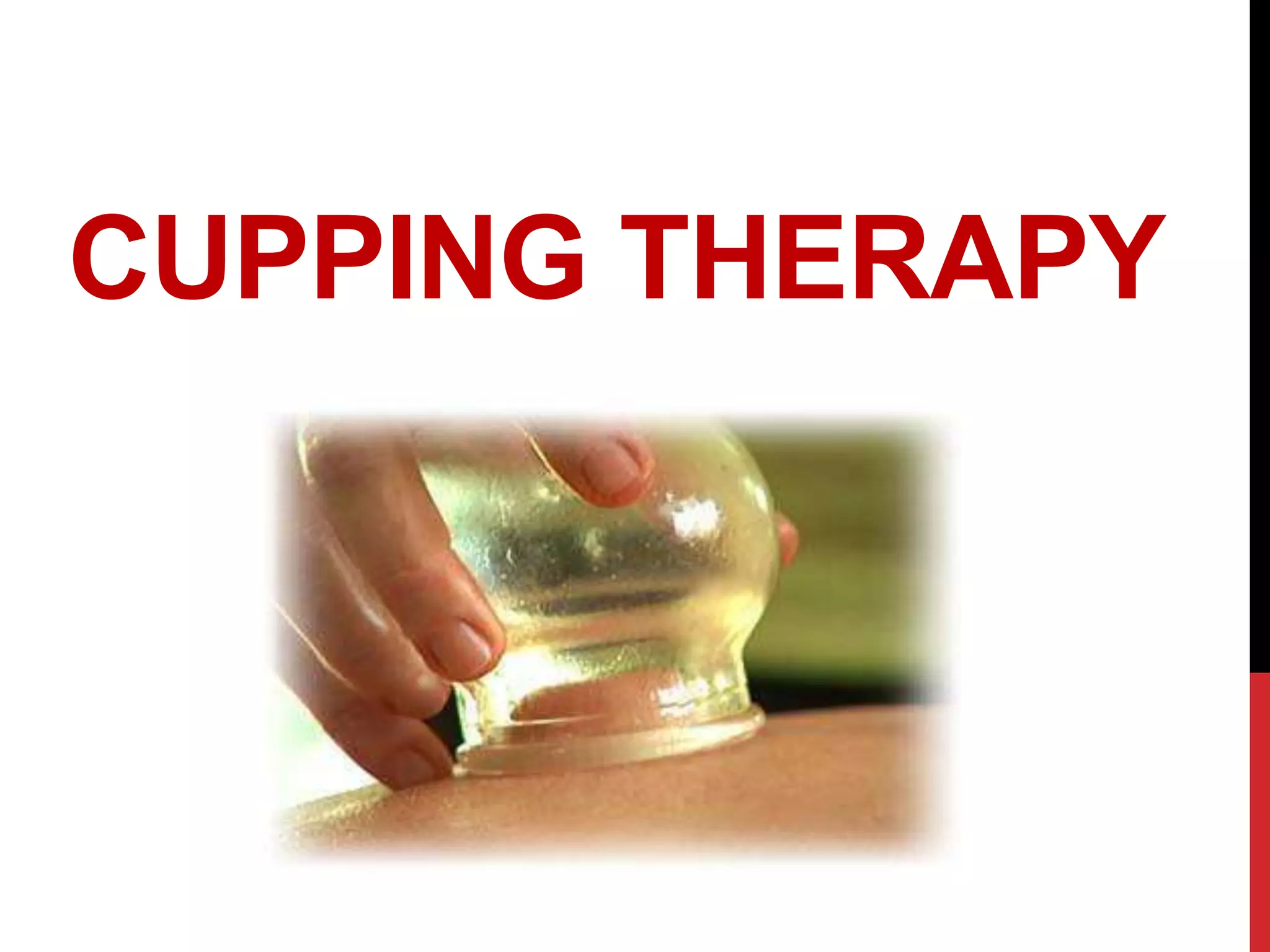
CUPPING THERAPY
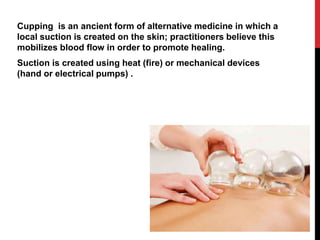
Cupping is an ancient form of alternative medicine in which a
local suction is created on the skin; practitioners believe this
mobilizes blood flow in order to promote healing.
Suction is created using heat (fire) or mechanical devices
(hand or electrical pumps) .
DESCRIPTION OF
CUPPING
Through either heat or suction, the skin is gently drawn
upwards by creating a vacuum in a cup over the target area
of the skin.
The cup stays in place for five to fifteen minutes.
It is believed by some to help treat pain, deep scar tissues in
the muscles and connective tissue, muscle knots, and
swelling
THE MECHANISM OF
ACTION
The local negative pressure applied to human causes specific
changes in local tissue structure, stretch to the nerve and muscle,
increasing blood circulation and causing autohemolysis.
Generally, cupping induced negative pressure can dilate local blood
vessels to improve microcirculation, promote capillary endothelial
cells repair, accelerate granulation and the development of new
blood vessels.
IN PRACTICE
1. cups are normally used only on softer tissue that can form
a good seal with the edge of the cup.
2. They may be used singly or with many to cover a larger
area.
3. They may be used by themselves or placed over an
acupuncture needle.
4. Skin may be lubricated, allowing the cup to move across
the skin slowly.
5. Depending on the specific treatment, skin marking is
common after the cups are removed. This may be a simple
red ring that disappears quickly,
6. Usually treatments are not painful.
HISTORY
There is reason to believe the practice dates from as early as
3000 BC.
The Ebers Papyrus, written c. 1550 BC and one of the oldest
medical textbooks in the world, describes the Egyptians' use
of cupping.
Archaeologists have found evidence in China of cupping
dating back to 1000 BC.
In ancient Greece, Hippocrates (c. 400 BC) used cupping for
internal disease and structural problems.
This method in multiple forms spread into medicine
throughout Asian and European civilizations.
IN ISLAMIC HADITH
Cupping is mentioned in the Islamic hadith :
Narrated Ibn 'Abbas: (The Prophet said), "Healing is in three
things: A gulp of honey, cupping, and branding with fire
(cauterizing). But I forbid my followers to use (cauterization)
branding with fire.
Narrated Ibn 'Abbas: The Prophet was cupped on his head for an
ailment he was suffering from while he was in a state of Ihram at a
water place called Lahl Jamal. Ibn 'Abbas further said: Allah's
Apostle was cupped on his head for unilateral headache while he
was in a state of Ihram.
It is narrated on the authority of Humaid that Anas b. Malik was
asked about the earnings of the cupper. He said: Allah's
Messenger (may peace be upon him) got himself cupped. His
cupper was Abu Taiba and he (the Holy Prophet) commanded to
give him two sa's [a unit of measurement] of corn. He (the Holy
Prophet) talked with the members of his family and they lightened
the burden of Kharaj (tax) from him (i.e. they made remission in
the charges of their own accord). He (Allah's Apostle) said: The
best (treatment) which you take is cupping, or it is the best of
your treatments.
TYPES OF CUPPING THERAPY
There are various types of cupping therapy, including:
1. Dry cupping (suction only)
2. Fire cupping (suction only)
3. Wet cupping (combination of suction and controlled
medicinal bleeding)
bleeding or wet cupping (controlled bleeding) is more common
than dry cupping .
As a general rule, wet cupping provides a more "curative-
treatment approach" to patient management whereas dry
cupping appeals more to a "therapeutic and relaxation
approach".
1- DRY CUPPING
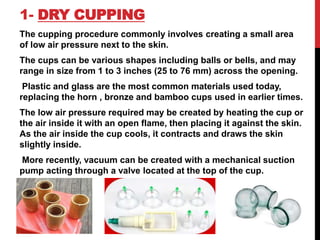
The cupping procedure commonly involves creating a small area
of low air pressure next to the skin.
The cups can be various shapes including balls or bells, and may
range in size from 1 to 3 inches (25 to 76 mm) across the opening.
Plastic and glass are the most common materials used today,
replacing the horn , bronze and bamboo cups used in earlier times.
The low air pressure required may be created by heating the cup or
the air inside it with an open flame, then placing it against the skin.
As the air inside the cup cools, it contracts and draws the skin
slightly inside.
More recently, vacuum can be created with a mechanical suction
pump acting through a valve located at the top of the cup.
2- FIRE CUPPING
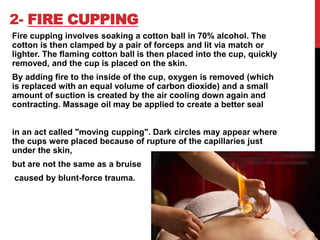
Fire cupping involves soaking a cotton ball in 70% alcohol. The
cotton is then clamped by a pair of forceps and lit via match or
lighter. The flaming cotton ball is then placed into the cup, quickly
removed, and the cup is placed on the skin.
By adding fire to the inside of the cup, oxygen is removed (which
is replaced with an equal volume of carbon dioxide) and a small
amount of suction is created by the air cooling down again and
contracting. Massage oil may be applied to create a better seal
in an act called "moving cupping". Dark circles may appear where
the cups were placed because of rupture of the capillaries just
under the skin,
but are not the same as a bruise
caused by blunt-force trauma.
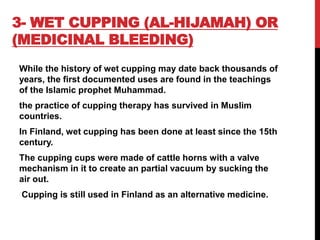
3- WET CUPPING (AL-HIJAMAH) OR
(MEDICINAL BLEEDING)
While the history of wet cupping may date back thousands of
years, the first documented uses are found in the teachings
of the Islamic prophet Muhammad.
the practice of cupping therapy has survived in Muslim
countries.
In Finland, wet cupping has been done at least since the 15th
century.
The cupping cups were made of cattle horns with a valve
mechanism in it to create an partial vacuum by sucking the
air out.
Cupping is still used in Finland as an alternative medicine.
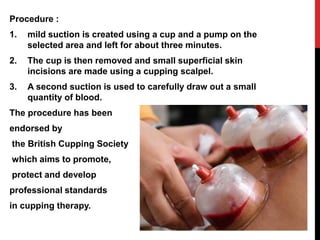
Procedure :
1. mild suction is created using a cup and a pump on the
selected area and left for about three minutes.
2. The cup is then removed and small superficial skin
incisions are made using a cupping scalpel.
3. A second suction is used to carefully draw out a small
quantity of blood.
The procedure has been
endorsed by
the British Cupping Society
which aims to promote,
protect and develop
professional standards
in cupping therapy.
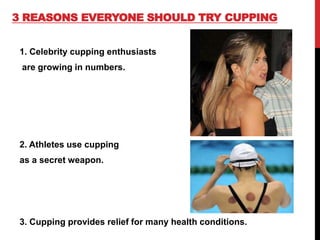
3 REASONS EVERYONE SHOULD TRY CUPPING
1. Celebrity cupping enthusiasts
are growing in numbers.
2. Athletes use cupping
as a secret weapon.
3. Cupping provides relief for many health conditions.
BENEFITS OF CUPPING THERAPY
The British Cupping Society says cupping therapy can treat a variety
of conditions. This has not been backed up by studies. But the
organization says cupping therapy is used to treat:
1. Blood disorders such as anemia and hemophilia
2. Rheumatic diseases such as arthritis
3. Fertility and gynecological disorders
4. Skin problems such as eczema and acne
5. High blood pressure (hypertension)
6. Migraine
7. Anxiety and depression
8. Bronchial congestion caused by allergies and asthma
9. Varicose veins
Supporters also believe that cupping therapy can reduce pain and
inflammation throughout the body. And they say it can promote
mental and physical relaxation and well-being.
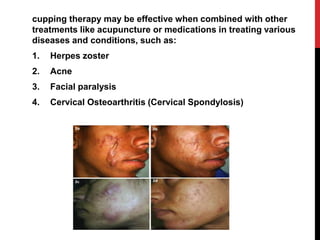
cupping therapy may be effective when combined with other
treatments like acupuncture or medications in treating various
diseases and conditions, such as:
1. Herpes zoster
2. Acne
3. Facial paralysis
4. Cervical Osteoarthritis (Cervical Spondylosis)
SIDE EFFECTS OF CUPPING THERAPY
Cupping is considered to be relatively safe, especially
when performed by trained health professionals.
Potential side effects include:
1. Mild discomfort
2. Burns
3. Bruises
4. Skin infection
the discoloration left by the cups is normally from
bruising especially if dragging the cups while
suctioned from one place to another to break down
muscle fiber.
According to the British Cupping Society, cupping
therapy should be avoided by the following groups:
1. Pregnant or menstruating women
2. People with metastatic cancer (cancer that has
spread from one part of the body to another)
3. People with bone fractures or muscle spasms
The organization also says cupping therapy should
not be applied to sites on the body that have:
1. A deep vein thrombosis
2. An ulcer
3. An artery
4. A pulse that can be felt
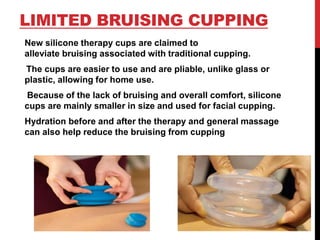
LIMITED BRUISING CUPPING
New silicone therapy cups are claimed to
alleviate bruising associated with traditional cupping.
The cups are easier to use and are pliable, unlike glass or
plastic, allowing for home use.
Because of the lack of bruising and overall comfort, silicone
cups are mainly smaller in size and used for facial cupping.
Hydration before and after the therapy and general massage
can also help reduce the bruising from cupping
EFFECTIVENESS
1. As with many forms of manual therapy, the effectiveness of
cupping is difficult to determine .
2. Cupping is widely used as an alternative treatment for cancer.
However, the American Cancer Society notes that "available
scientific evidence does not support demands that cupping has
any health benefits".
3. A 2012 review of the evidence in an article published in PLOS
ONE said that studies appeared to show that cupping therapy
was effective for treating a number of conditions, but that nearly
all included trials were evaluated as high risk of bias .
4. Very few scientific studies have been conducted on the validity of
cupping as an alternative medical practice. In fact, a significant
amount of studies either do not support cupping practices
SAFETY
1. Cupping has few major side effects aside from the pain of skin
cuts.
2. One potentially serious risk is infection.
3. Other possible minor side effects that may occur is feeling of
slight light headedness post therapy, this is similar to the
sensation one feels after having blood taken when donating
blood.
4. Cupping [hijama] encourages blood flow to the cupped region
(hyperemia), one may therefore feel warmer and hotter as a result
of vasodilatation taking place and slight sweating may occur.
5. Pregnant women or menstruating women, cancer (metastatic)
patients and patients with bone fractures or muscle spasms are
also believed to be contra-indicated.
6. Some practitioners suggest that a low risk of blood clotting is
possible and therefore walking and staying awake after a
procedure is advisable.
THANK YOU !
Made By:
Omar Hesham Abd Elaziz

Cupping therapy

  • 1.
  • 2.
    Cupping is anancient form of alternative medicine in which a local suction is created on the skin; practitioners believe this mobilizes blood flow in order to promote healing. Suction is created using heat (fire) or mechanical devices (hand or electrical pumps) .
  • 3.
    DESCRIPTION OF CUPPING Through eitherheat or suction, the skin is gently drawn upwards by creating a vacuum in a cup over the target area of the skin. The cup stays in place for five to fifteen minutes. It is believed by some to help treat pain, deep scar tissues in the muscles and connective tissue, muscle knots, and swelling
  • 4.
    THE MECHANISM OF ACTION Thelocal negative pressure applied to human causes specific changes in local tissue structure, stretch to the nerve and muscle, increasing blood circulation and causing autohemolysis. Generally, cupping induced negative pressure can dilate local blood vessels to improve microcirculation, promote capillary endothelial cells repair, accelerate granulation and the development of new blood vessels.
  • 5.
    IN PRACTICE 1. cupsare normally used only on softer tissue that can form a good seal with the edge of the cup. 2. They may be used singly or with many to cover a larger area. 3. They may be used by themselves or placed over an acupuncture needle. 4. Skin may be lubricated, allowing the cup to move across the skin slowly. 5. Depending on the specific treatment, skin marking is common after the cups are removed. This may be a simple red ring that disappears quickly, 6. Usually treatments are not painful.
  • 6.
    HISTORY There is reasonto believe the practice dates from as early as 3000 BC. The Ebers Papyrus, written c. 1550 BC and one of the oldest medical textbooks in the world, describes the Egyptians' use of cupping. Archaeologists have found evidence in China of cupping dating back to 1000 BC. In ancient Greece, Hippocrates (c. 400 BC) used cupping for internal disease and structural problems. This method in multiple forms spread into medicine throughout Asian and European civilizations.
  • 7.
    IN ISLAMIC HADITH Cuppingis mentioned in the Islamic hadith : Narrated Ibn 'Abbas: (The Prophet said), "Healing is in three things: A gulp of honey, cupping, and branding with fire (cauterizing). But I forbid my followers to use (cauterization) branding with fire. Narrated Ibn 'Abbas: The Prophet was cupped on his head for an ailment he was suffering from while he was in a state of Ihram at a water place called Lahl Jamal. Ibn 'Abbas further said: Allah's Apostle was cupped on his head for unilateral headache while he was in a state of Ihram. It is narrated on the authority of Humaid that Anas b. Malik was asked about the earnings of the cupper. He said: Allah's Messenger (may peace be upon him) got himself cupped. His cupper was Abu Taiba and he (the Holy Prophet) commanded to give him two sa's [a unit of measurement] of corn. He (the Holy Prophet) talked with the members of his family and they lightened the burden of Kharaj (tax) from him (i.e. they made remission in the charges of their own accord). He (Allah's Apostle) said: The best (treatment) which you take is cupping, or it is the best of your treatments.
  • 8.
    TYPES OF CUPPINGTHERAPY There are various types of cupping therapy, including: 1. Dry cupping (suction only) 2. Fire cupping (suction only) 3. Wet cupping (combination of suction and controlled medicinal bleeding) bleeding or wet cupping (controlled bleeding) is more common than dry cupping . As a general rule, wet cupping provides a more "curative- treatment approach" to patient management whereas dry cupping appeals more to a "therapeutic and relaxation approach".
  • 9.
    1- DRY CUPPING Thecupping procedure commonly involves creating a small area of low air pressure next to the skin. The cups can be various shapes including balls or bells, and may range in size from 1 to 3 inches (25 to 76 mm) across the opening. Plastic and glass are the most common materials used today, replacing the horn , bronze and bamboo cups used in earlier times. The low air pressure required may be created by heating the cup or the air inside it with an open flame, then placing it against the skin. As the air inside the cup cools, it contracts and draws the skin slightly inside. More recently, vacuum can be created with a mechanical suction pump acting through a valve located at the top of the cup.
  • 10.
    2- FIRE CUPPING Firecupping involves soaking a cotton ball in 70% alcohol. The cotton is then clamped by a pair of forceps and lit via match or lighter. The flaming cotton ball is then placed into the cup, quickly removed, and the cup is placed on the skin. By adding fire to the inside of the cup, oxygen is removed (which is replaced with an equal volume of carbon dioxide) and a small amount of suction is created by the air cooling down again and contracting. Massage oil may be applied to create a better seal in an act called "moving cupping". Dark circles may appear where the cups were placed because of rupture of the capillaries just under the skin, but are not the same as a bruise caused by blunt-force trauma.
  • 11.
    3- WET CUPPING(AL-HIJAMAH) OR (MEDICINAL BLEEDING) While the history of wet cupping may date back thousands of years, the first documented uses are found in the teachings of the Islamic prophet Muhammad. the practice of cupping therapy has survived in Muslim countries. In Finland, wet cupping has been done at least since the 15th century. The cupping cups were made of cattle horns with a valve mechanism in it to create an partial vacuum by sucking the air out. Cupping is still used in Finland as an alternative medicine.
  • 12.
    Procedure : 1. mildsuction is created using a cup and a pump on the selected area and left for about three minutes. 2. The cup is then removed and small superficial skin incisions are made using a cupping scalpel. 3. A second suction is used to carefully draw out a small quantity of blood. The procedure has been endorsed by the British Cupping Society which aims to promote, protect and develop professional standards in cupping therapy.
  • 13.
    3 REASONS EVERYONESHOULD TRY CUPPING 1. Celebrity cupping enthusiasts are growing in numbers. 2. Athletes use cupping as a secret weapon. 3. Cupping provides relief for many health conditions.
  • 14.
    BENEFITS OF CUPPINGTHERAPY The British Cupping Society says cupping therapy can treat a variety of conditions. This has not been backed up by studies. But the organization says cupping therapy is used to treat: 1. Blood disorders such as anemia and hemophilia 2. Rheumatic diseases such as arthritis 3. Fertility and gynecological disorders 4. Skin problems such as eczema and acne 5. High blood pressure (hypertension) 6. Migraine 7. Anxiety and depression 8. Bronchial congestion caused by allergies and asthma 9. Varicose veins Supporters also believe that cupping therapy can reduce pain and inflammation throughout the body. And they say it can promote mental and physical relaxation and well-being.
  • 15.
    cupping therapy maybe effective when combined with other treatments like acupuncture or medications in treating various diseases and conditions, such as: 1. Herpes zoster 2. Acne 3. Facial paralysis 4. Cervical Osteoarthritis (Cervical Spondylosis)
  • 16.
    SIDE EFFECTS OFCUPPING THERAPY Cupping is considered to be relatively safe, especially when performed by trained health professionals. Potential side effects include: 1. Mild discomfort 2. Burns 3. Bruises 4. Skin infection the discoloration left by the cups is normally from bruising especially if dragging the cups while suctioned from one place to another to break down muscle fiber.
  • 17.
    According to theBritish Cupping Society, cupping therapy should be avoided by the following groups: 1. Pregnant or menstruating women 2. People with metastatic cancer (cancer that has spread from one part of the body to another) 3. People with bone fractures or muscle spasms The organization also says cupping therapy should not be applied to sites on the body that have: 1. A deep vein thrombosis 2. An ulcer 3. An artery 4. A pulse that can be felt
  • 18.
    LIMITED BRUISING CUPPING Newsilicone therapy cups are claimed to alleviate bruising associated with traditional cupping. The cups are easier to use and are pliable, unlike glass or plastic, allowing for home use. Because of the lack of bruising and overall comfort, silicone cups are mainly smaller in size and used for facial cupping. Hydration before and after the therapy and general massage can also help reduce the bruising from cupping
  • 19.
    EFFECTIVENESS 1. As withmany forms of manual therapy, the effectiveness of cupping is difficult to determine . 2. Cupping is widely used as an alternative treatment for cancer. However, the American Cancer Society notes that "available scientific evidence does not support demands that cupping has any health benefits". 3. A 2012 review of the evidence in an article published in PLOS ONE said that studies appeared to show that cupping therapy was effective for treating a number of conditions, but that nearly all included trials were evaluated as high risk of bias . 4. Very few scientific studies have been conducted on the validity of cupping as an alternative medical practice. In fact, a significant amount of studies either do not support cupping practices
  • 20.
    SAFETY 1. Cupping hasfew major side effects aside from the pain of skin cuts. 2. One potentially serious risk is infection. 3. Other possible minor side effects that may occur is feeling of slight light headedness post therapy, this is similar to the sensation one feels after having blood taken when donating blood. 4. Cupping [hijama] encourages blood flow to the cupped region (hyperemia), one may therefore feel warmer and hotter as a result of vasodilatation taking place and slight sweating may occur. 5. Pregnant women or menstruating women, cancer (metastatic) patients and patients with bone fractures or muscle spasms are also believed to be contra-indicated. 6. Some practitioners suggest that a low risk of blood clotting is possible and therefore walking and staying awake after a procedure is advisable.
  • 21.
    THANK YOU ! MadeBy: Omar Hesham Abd Elaziz