
Auriculo therapy
DR. SATYENDRA SINGH
INTRODUCTION
 Auriculotherapy is the art of healing by pricking the
ear on specific points.
 It is about 2000 year old treating modality.
 The main stay of the art is the concept of all the
Zang-fu Organs and twelve meridians are having
their representation on the cutis of the external ear.
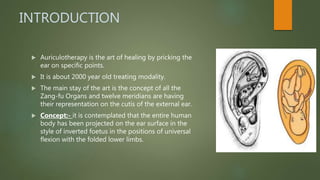
 Concept:- it is contemplated that the entire human
body has been projected on the ear surface in the
style of inverted foetus in the positions of universal
flexion with the folded lower limbs.
The ear
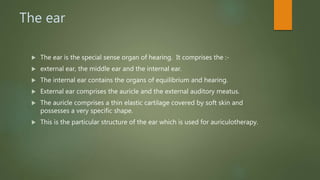
 The ear is the special sense organ of hearing. It comprises the :-
 external ear, the middle ear and the internal ear.
 The internal ear contains the organs of equilibrium and hearing.
 External ear comprises the auricle and the external auditory meatus.
 The auricle comprises a thin elastic cartilage covered by soft skin and
possesses a very specific shape.
 This is the particular structure of the ear which is used for auriculotherapy.
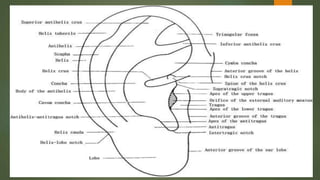
The parts of the auricle
 The auricle has two surfaces, the outer surface and the inner surface. The
outer surface is the external surface, readily visible. The inner surface is in
the proximity of the head. The elevations of the one surface form the
grooves on the other aspect
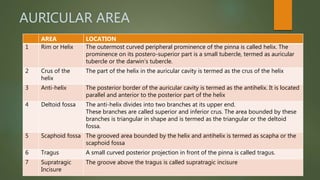
AURICULAR AREA
AREA LOCATION
1 Rim or Helix The outermost curved peripheral prominence of the pinna is called helix. The
prominence on its postero-superior part is a small tubercle, termed as auricular
tubercle or the darwin’s tubercle.
2 Crus of the
helix
The part of the helix in the auricular cavity is termed as the crus of the helix
3 Anti-helix The posterior border of the auricular cavity is termed as the antihelix. It is located
parallel and anterior to the posterior part of the helix
4 Deltoid fossa The anti-helix divides into two branches at its upper end.
These branches are called superior and inferior crus. The area bounded by these
branches is triangular in shape and is termed as the triangular or the deltoid
fossa.
5 Scaphoid fossa The grooved area bounded by the helix and antihelix is termed as scapha or the
scaphoid fossa
6 Tragus A small curved posterior projection in front of the pinna is called tragus.
7 Supratragic
Incisure
The groove above the tragus is called supratragic incisure
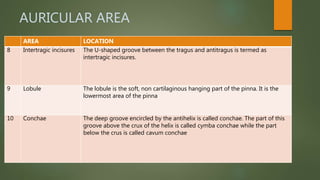
AURICULAR AREA
AREA LOCATION
8 Intertragic incisures The U-shaped groove between the tragus and antitragus is termed as
intertragic incisures.
9 Lobule The lobule is the soft, non cartilaginous hanging part of the pinna. It is the
lowermost area of the pinna
10 Conchae The deep groove encircled by the antihelix is called conchae. The part of this
groove above the crux of the helix is called cymba conchae while the part
below the crus is called cavum conchae
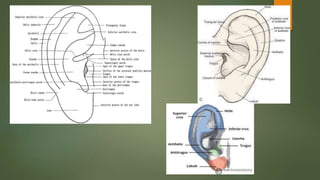
Orifice of the external acoustic meatus
 Interhelix incisures:- the depression between the trags and anti-helix is
called interhelix incisures
 Tail of the helix:- this marks the junction of the helix with the auricular
lobule
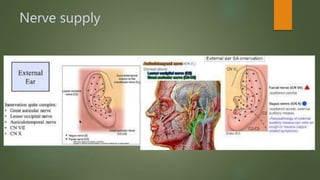
Nerve supply
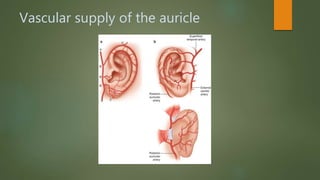
Vascular supply of the auricle
AURICULAR ZONES AND SPECIFIC
ACUPUNCTURE POINTS
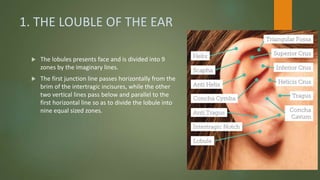
1. THE LOUBLE OF THE EAR
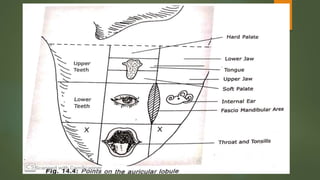
 The lobules presents face and is divided into 9
zones by the imaginary lines.
 The first junction line passes horizontally from the
brim of the intertragic incisures, while the other
two vertical lines pass below and parallel to the
first horizontal line so as to divide the lobule into
nine equal sized zones.
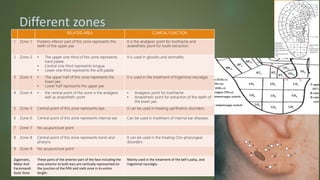
Different zones
RELATED AREA CLINICAL FUNCTION
1 Zone-1 Postero-inferior part of this zone represents the
teeth of the upper jaw.
It is the analgesic point for toothache and
anaesthetic point for tooth extraction
2 Zone-2 • The upper one-third of this zone represents
hard palate.
• Central one-third represents tongue.
• Lower one third represents the soft palate
It is used in glossitis and stomatitis
3 Zone-3 • The upper half of this zone represents the
lower jaw.
• Lower half represents the upper jaw
It is used in the treatment of trigeminal neuralgia
4 Zone-4 • the central point of this zone is the analgesic
well as anaesthetic point
• Analgesic point for toothache
• Anaesthetic point for extraction of the teeth of
the lower jaw.
5 Zone-5 Central point of this zone represents eye. It can be used in treating ophthalmic disorders.
6 Zone-6 Central point of this zone represents internal ear. Can be used in treatment of internal ear diseases.
7 Zone-7 No acupuncture point
8 Zone-8 Central point of this zone represents tonsil and
pharynx
It can be used in the treating Oro-pharyngeal
disorders
9 Zone-9 No acupuncture point
Zygomatic,
Malar And
Faciomandi
bular Zone
These parts of the anterior part of the face including the
area anterior to both ears are vertically represented on
the junction of the fifth and sixth zone in its entire
length.
Mainly used in the treatment of the bell’s palsy, and
trigeminal neuralgia.
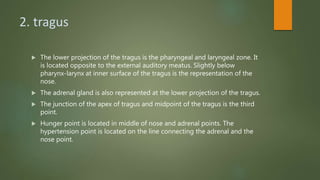
2. tragus
 The lower projection of the tragus is the pharyngeal and laryngeal zone. It
is located opposite to the external auditory meatus. Slightly below
pharynx-larynx at inner surface of the tragus is the representation of the
nose.
 The adrenal gland is also represented at the lower projection of the tragus.
 The junction of the apex of tragus and midpoint of the tragus is the third
point.
 Hunger point is located in middle of nose and adrenal points. The
hypertension point is located on the line connecting the adrenal and the
nose point.
3. Supratragic incisures (heart and
external ear)
 External ear is located at the depression in front of the supra-tragic
incisures, while the heart is in the depression on the apex of the tragus.
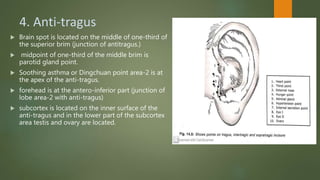
4. Anti-tragus
 Brain spot is located on the middle of one-third of
the superior brim (junction of antitragus.)
 midpoint of one-third of the middle brim is
parotid gland point.
 Soothing asthma or Dingchuan point area-2 is at
the apex of the anti-tragus.
 forehead is at the antero-inferior part (junction of
lobe area-2 with anti-tragus)
 subcortex is located on the inner surface of the
anti-tragus and in the lower part of the subcortex
area testis and ovary are located.
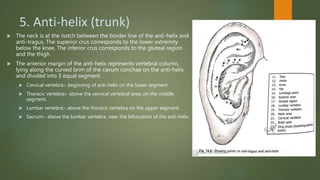
5. Anti-helix (trunk)
 The neck is at the notch between the border line of the anti-helix and
anti-tragus. The superior crus corresponds to the lower extremity
below the knee. The inferior crus corresponds to the gluteal region
and the thigh.
 The anterior margin of the anti-helix represents vertebral column,
lying along the curved brim of the cavum conchae on the anti-helix
and divided into 3 equal segment.
 Cervical vertebra:- beginning of anti-helix on the lower segment.
 Thoracic vertebra:- above the cervical vertebral area, on the middle
segment.
 Lumbar vertebra:- above the thoracic vertebra on the upper segment.
 Sacrum:- above the lumbar vertebra, near the bifurcation of the anti-helix.
Superior and inferior crus of acti-helix
 Toes, heel and ankle are located at the postero-superior and antero-superior
part of the superior crus of the anti-helix.
 Knee joint is located on the superior crus with the same level of the superior
border of the inferior crus of the anti-helix. Hip joint is postero-inferior to the
knee joint point.
 Midpoint in the superior border of the inferior crus is the ischium and buttock
point, the lower projection of the anti-helix at the level of coccygeal vertebrae
point is lumbago point.
 Border line between the brim of the inferior crus of the anti-helix and curved
brim of the anterior portion of the helix represents sympathetic area.
 In between the hip joint and the sympathetic area, on the superior border of
the inferior crus, in the middle segment, is the sciatic nerve point.
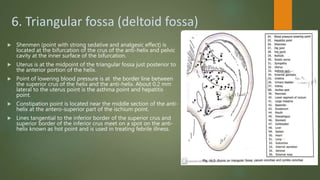
6. Triangular fossa (deltoid fossa)
 Shenmen (point with strong sedative and analgesic effect) is
located at the bifurcation of the crus of the anti-helix and pelvic
cavity at the inner surface of the bifurcation.
 Uterus is at the midpoint of the triangular fossa just posterior to
the anterior portion of the helix.
 Point of lowering blood pressure is at the border line between
the superior crus of the helix and the anti-helix. About 0.2 mm
lateral to the uterus point is the asthma point and hepatitis
point.
 Constipation point is located near the middle section of the anti-
helix at the antero-superior part of the ischium point.
 Lines tangential to the inferior border of the superior crus and
superior border of the inferior crus meet on a spot on the anti-
helix known as hot point and is used in treating febrile illness.
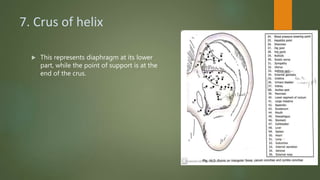
7. Crus of helix
 This represents diaphragm at its lower
part, while the point of support is at the
end of the crus.
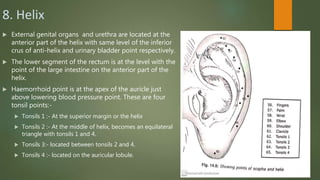
8. Helix
 External genital organs and urethra are located at the
anterior part of the helix with same level of the inferior
crus of anti-helix and urinary bladder point respectively.
 The lower segment of the rectum is at the level with the
point of the large intestine on the anterior part of the
helix.
 Haemorrhoid point is at the apex of the auricle just
above lowering blood pressure point. These are four
tonsil points:-
 Tonsils 1 :- At the superior margin or the helix
 Tonsils 2 :- At the middle of helix, becomes an equilateral
triangle with tonsils 1 and 4.
 Tonsils 3:- located between tonsils 2 and 4.
 Tonsils 4 :- located on the auricular lobule.
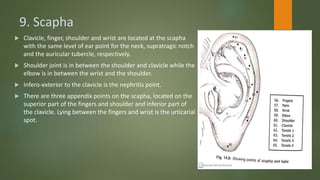
9. Scapha
 Clavicle, finger, shoulder and wrist are located at the scapha
with the same level of ear point for the neck, supratragic notch
and the auricular tubercle, respectively.
 Shoulder joint is in between the shoulder and clavicle while the
elbow is in between the wrist and the shoulder.
 Infero-exterior to the clavicle is the nephritis point.
 There are three appendix points on the scapha, located on the
superior part of the fingers and shoulder and inferior part of
the clavicle. Lying between the fingers and wrist is the urticarial
spot.
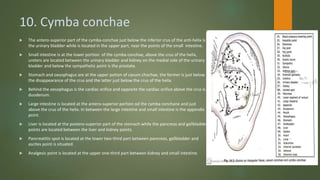
10. Cymba conchae
 The antero-superior part of the cymba-conchae just below the inferior crus of the anti-helix is
the urinary bladder while is located in the upper part, near the points of the small intestine.
 Small intestine is at the lower portion of the cymba conchae, above the crus of the helix,
ureters are located between the urinary bladder and kidney on the medial side of the urinary
bladder and below the sympathetic point is the prostate.
 Stomach and oesophagus are at the upper potion of cavum chochae, the former is just below
the disappearance of the crus and the latter just below the crus of the helix.
 Behind the oesophagus is the cardiac orifice and opposite the cardiac orifice above the crus is
duodenum.
 Large intestine is located at the antero-superior portion od the cymba conchane and just
above the crus of the helix. In between the large intestine and small intestine is the appendix
point.
 Liver is located at the postero-superior part of the stomach while the pancreas and gallbladder
points are located between the liver and kidney points.
 Pancreatitis spot is located at the lower two-third part between pancreas, gallbladder and
ascites point is situated.
 Analgesic point is located at the upper one-third part between kidney and small intestine.
11. Cavum conchae (thoracic region)
 Heart lies in the deepest part, while lung lies at the
circumference of the heart area.
 Bronchi are located in the lung area.
 Spleen is at the exterior-inferior part of the stomach area.
 In the centre of the lung area tuberculosis point is located.
 Trachea is in between the heart and external auditory metus.
 Hepatomegaly spot is located at the lateral side between the
stomach and disappearance of the crus of the helix.
 In the centre of this hepatic cirrhosis point is located.
 Hepatitis area is slightly below the middle of the stomach and
spleen area.
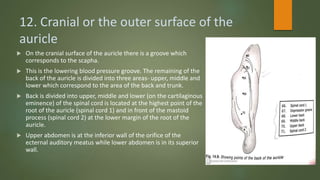
12. Cranial or the outer surface of the
auricle
 On the cranial surface of the auricle there is a groove which
corresponds to the scapha.
 This is the lowering blood pressure groove. The remaining of the
back of the auricle is divided into three areas- upper, middle and
lower which correspond to the area of the back and trunk.
 Back is divided into upper, middle and lower (on the cartilaginous
eminence) of the spinal cord is located at the highest point of the
root of the auricle (spinal cord 1) and in front of the mastoid
process (spinal cord 2) at the lower margin of the root of the
auricle.
 Upper abdomen is at the inferior wall of the orifice of the
ecternal auditory meatus while lower abdomen is in its superior
wall.
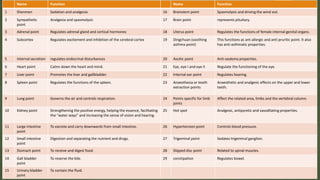
Commonly used Auricular points
Name Function Name Function
1 Shenmen Sedation and analgesia 16 Brainstem point Spasmolysis and driving the wind out.
2 Sympathetic
point
Analgesia and spasmolysis 17 Brain point represents pituitary.
3 Adrenal point Regulates adrenal gland and cortical hormones 18 Uterus point Regulates the functions of female internal genital organs.
4 Subcortex Regulates excitement and inhibition of the cerebral cortex 19 Dingchuan (soothing
asthma point)
This functions as ant-allergic and anti pruritic point. It also
has anti-asthmatic properties.
5 Internal secretion regulates endocrinal disturbances 20 Ascitic point Anti-oedema properties.
6 Heart point Calms down the heart and mind. 21 Eye, eye I and eye II Regulate the functioning of the eye.
7 Liver point Promotes the liver and gallbladder. 22 Internal ear point Regulates hearing.
8 Spleen point Regulates the functions of the spleen. 23 Anaesthesia or tooth
extraction points
Anaesthetic and analgesic effects on the upper and lower
teeth.
9 Lung point Governs the air and controls respiration. 24 Points specific for limb
joints
Affect the related area, limbs and the vertebral column.
10 Kidney point Strengthening the positive energy, helping the essence, facilitating
the “water ways” and increasing the sense of vision and hearing.
25 Hot spot Analgesic, antipyretic and vasodilating properties.
11 Large intestine
point
To excrete and carry downwards from small intestine. 26 Hypertension point Controls blood pressure.
12 Small intestine
point
Digestion and separating the nutrient and drugs. 27 Trigeminal point Sedates trigeminal ganglion.
13 Stomach point To receive and digest food. 28 Slipped disc point Related to spinal muscles.
14 Gall bladder
point
To reserve the bile. 29 constipation Regulates bowel.
15 Urinary bladder
point
To contain the fluid.
Rule for selection of the points
 1. Auricular points are of following categories:-
I. Those representing particular organs.
II. Those possessing special function. For example
I. Blood pressure lowering point for hypertension.
II. Hot point for fever.
III. Shemen for sedation.
IV. Endocrine point for hormonal regulation.
V. Trigeminal point
III. Specific point for disorders. For example
I. Dingchuan for asthma.
II. Ascitic point for oedema.
III. Analgesia point.
 In treating diseases, the point can be selected from above categories in
various combination. For example:
 Organ affected
 Sedation point
 Endocrine point.
2. Use of the meridian system:- areas representing the pertaining organ can
be used in the treatment of the diseases along the pathway of the
meridian.
3. Coupled organ, for example, small intestine for heart, spleen and gastric
ulcer.
4. Application of the western knowledge of medicine, for example pancreas
point for diabetes mellitus.
5. Use of the point detector low electric resistance point of the auricle.
6. By examination of the auricle through inspection and palpation.
Procedure
 Fine filiform needles and press needles are used.
 Filiform needles are inserted obliquely, subcutaneously, care being taken
not to penetrate the cartilage.
 Electrical stimulation may be given.
 Hand stimulation is not advised
 The treatment is carried out fir 20-30 minutes a day up to 7-10 dats and
then a rest period of one week is given.
 Press needles when used are kept in place with the help of the adhesive
leucoplast and left in situ for 3 to 5 days.
Thank you

Auriculotherapy

  • 1.
  • 2.
    INTRODUCTION  Auriculotherapy isthe art of healing by pricking the ear on specific points.  It is about 2000 year old treating modality.  The main stay of the art is the concept of all the Zang-fu Organs and twelve meridians are having their representation on the cutis of the external ear.  Concept:- it is contemplated that the entire human body has been projected on the ear surface in the style of inverted foetus in the positions of universal flexion with the folded lower limbs.
  • 3.
    The ear  Theear is the special sense organ of hearing. It comprises the :-  external ear, the middle ear and the internal ear.  The internal ear contains the organs of equilibrium and hearing.  External ear comprises the auricle and the external auditory meatus.  The auricle comprises a thin elastic cartilage covered by soft skin and possesses a very specific shape.  This is the particular structure of the ear which is used for auriculotherapy.
  • 4.
    The parts ofthe auricle  The auricle has two surfaces, the outer surface and the inner surface. The outer surface is the external surface, readily visible. The inner surface is in the proximity of the head. The elevations of the one surface form the grooves on the other aspect
  • 5.
    AURICULAR AREA AREA LOCATION 1Rim or Helix The outermost curved peripheral prominence of the pinna is called helix. The prominence on its postero-superior part is a small tubercle, termed as auricular tubercle or the darwin’s tubercle. 2 Crus of the helix The part of the helix in the auricular cavity is termed as the crus of the helix 3 Anti-helix The posterior border of the auricular cavity is termed as the antihelix. It is located parallel and anterior to the posterior part of the helix 4 Deltoid fossa The anti-helix divides into two branches at its upper end. These branches are called superior and inferior crus. The area bounded by these branches is triangular in shape and is termed as the triangular or the deltoid fossa. 5 Scaphoid fossa The grooved area bounded by the helix and antihelix is termed as scapha or the scaphoid fossa 6 Tragus A small curved posterior projection in front of the pinna is called tragus. 7 Supratragic Incisure The groove above the tragus is called supratragic incisure
  • 7.
    AURICULAR AREA AREA LOCATION 8Intertragic incisures The U-shaped groove between the tragus and antitragus is termed as intertragic incisures. 9 Lobule The lobule is the soft, non cartilaginous hanging part of the pinna. It is the lowermost area of the pinna 10 Conchae The deep groove encircled by the antihelix is called conchae. The part of this groove above the crux of the helix is called cymba conchae while the part below the crus is called cavum conchae
  • 9.
    Orifice of theexternal acoustic meatus  Interhelix incisures:- the depression between the trags and anti-helix is called interhelix incisures  Tail of the helix:- this marks the junction of the helix with the auricular lobule
  • 10.
  • 11.
    Vascular supply ofthe auricle
  • 12.
    AURICULAR ZONES ANDSPECIFIC ACUPUNCTURE POINTS
  • 13.
    1. THE LOUBLEOF THE EAR  The lobules presents face and is divided into 9 zones by the imaginary lines.  The first junction line passes horizontally from the brim of the intertragic incisures, while the other two vertical lines pass below and parallel to the first horizontal line so as to divide the lobule into nine equal sized zones.
  • 14.
    Different zones RELATED AREACLINICAL FUNCTION 1 Zone-1 Postero-inferior part of this zone represents the teeth of the upper jaw. It is the analgesic point for toothache and anaesthetic point for tooth extraction 2 Zone-2 • The upper one-third of this zone represents hard palate. • Central one-third represents tongue. • Lower one third represents the soft palate It is used in glossitis and stomatitis 3 Zone-3 • The upper half of this zone represents the lower jaw. • Lower half represents the upper jaw It is used in the treatment of trigeminal neuralgia 4 Zone-4 • the central point of this zone is the analgesic well as anaesthetic point • Analgesic point for toothache • Anaesthetic point for extraction of the teeth of the lower jaw. 5 Zone-5 Central point of this zone represents eye. It can be used in treating ophthalmic disorders. 6 Zone-6 Central point of this zone represents internal ear. Can be used in treatment of internal ear diseases. 7 Zone-7 No acupuncture point 8 Zone-8 Central point of this zone represents tonsil and pharynx It can be used in the treating Oro-pharyngeal disorders 9 Zone-9 No acupuncture point Zygomatic, Malar And Faciomandi bular Zone These parts of the anterior part of the face including the area anterior to both ears are vertically represented on the junction of the fifth and sixth zone in its entire length. Mainly used in the treatment of the bell’s palsy, and trigeminal neuralgia.
  • 16.
    2. tragus  Thelower projection of the tragus is the pharyngeal and laryngeal zone. It is located opposite to the external auditory meatus. Slightly below pharynx-larynx at inner surface of the tragus is the representation of the nose.  The adrenal gland is also represented at the lower projection of the tragus.  The junction of the apex of tragus and midpoint of the tragus is the third point.  Hunger point is located in middle of nose and adrenal points. The hypertension point is located on the line connecting the adrenal and the nose point.
  • 17.
    3. Supratragic incisures(heart and external ear)  External ear is located at the depression in front of the supra-tragic incisures, while the heart is in the depression on the apex of the tragus.
  • 18.
    4. Anti-tragus  Brainspot is located on the middle of one-third of the superior brim (junction of antitragus.)  midpoint of one-third of the middle brim is parotid gland point.  Soothing asthma or Dingchuan point area-2 is at the apex of the anti-tragus.  forehead is at the antero-inferior part (junction of lobe area-2 with anti-tragus)  subcortex is located on the inner surface of the anti-tragus and in the lower part of the subcortex area testis and ovary are located.
  • 19.
    5. Anti-helix (trunk) The neck is at the notch between the border line of the anti-helix and anti-tragus. The superior crus corresponds to the lower extremity below the knee. The inferior crus corresponds to the gluteal region and the thigh.  The anterior margin of the anti-helix represents vertebral column, lying along the curved brim of the cavum conchae on the anti-helix and divided into 3 equal segment.  Cervical vertebra:- beginning of anti-helix on the lower segment.  Thoracic vertebra:- above the cervical vertebral area, on the middle segment.  Lumbar vertebra:- above the thoracic vertebra on the upper segment.  Sacrum:- above the lumbar vertebra, near the bifurcation of the anti-helix.
  • 20.
    Superior and inferiorcrus of acti-helix  Toes, heel and ankle are located at the postero-superior and antero-superior part of the superior crus of the anti-helix.  Knee joint is located on the superior crus with the same level of the superior border of the inferior crus of the anti-helix. Hip joint is postero-inferior to the knee joint point.  Midpoint in the superior border of the inferior crus is the ischium and buttock point, the lower projection of the anti-helix at the level of coccygeal vertebrae point is lumbago point.  Border line between the brim of the inferior crus of the anti-helix and curved brim of the anterior portion of the helix represents sympathetic area.  In between the hip joint and the sympathetic area, on the superior border of the inferior crus, in the middle segment, is the sciatic nerve point.
  • 21.
    6. Triangular fossa(deltoid fossa)  Shenmen (point with strong sedative and analgesic effect) is located at the bifurcation of the crus of the anti-helix and pelvic cavity at the inner surface of the bifurcation.  Uterus is at the midpoint of the triangular fossa just posterior to the anterior portion of the helix.  Point of lowering blood pressure is at the border line between the superior crus of the helix and the anti-helix. About 0.2 mm lateral to the uterus point is the asthma point and hepatitis point.  Constipation point is located near the middle section of the anti- helix at the antero-superior part of the ischium point.  Lines tangential to the inferior border of the superior crus and superior border of the inferior crus meet on a spot on the anti- helix known as hot point and is used in treating febrile illness.
  • 22.
    7. Crus ofhelix  This represents diaphragm at its lower part, while the point of support is at the end of the crus.
  • 23.
    8. Helix  Externalgenital organs and urethra are located at the anterior part of the helix with same level of the inferior crus of anti-helix and urinary bladder point respectively.  The lower segment of the rectum is at the level with the point of the large intestine on the anterior part of the helix.  Haemorrhoid point is at the apex of the auricle just above lowering blood pressure point. These are four tonsil points:-  Tonsils 1 :- At the superior margin or the helix  Tonsils 2 :- At the middle of helix, becomes an equilateral triangle with tonsils 1 and 4.  Tonsils 3:- located between tonsils 2 and 4.  Tonsils 4 :- located on the auricular lobule.
  • 24.
    9. Scapha  Clavicle,finger, shoulder and wrist are located at the scapha with the same level of ear point for the neck, supratragic notch and the auricular tubercle, respectively.  Shoulder joint is in between the shoulder and clavicle while the elbow is in between the wrist and the shoulder.  Infero-exterior to the clavicle is the nephritis point.  There are three appendix points on the scapha, located on the superior part of the fingers and shoulder and inferior part of the clavicle. Lying between the fingers and wrist is the urticarial spot.
  • 25.
    10. Cymba conchae The antero-superior part of the cymba-conchae just below the inferior crus of the anti-helix is the urinary bladder while is located in the upper part, near the points of the small intestine.  Small intestine is at the lower portion of the cymba conchae, above the crus of the helix, ureters are located between the urinary bladder and kidney on the medial side of the urinary bladder and below the sympathetic point is the prostate.  Stomach and oesophagus are at the upper potion of cavum chochae, the former is just below the disappearance of the crus and the latter just below the crus of the helix.  Behind the oesophagus is the cardiac orifice and opposite the cardiac orifice above the crus is duodenum.  Large intestine is located at the antero-superior portion od the cymba conchane and just above the crus of the helix. In between the large intestine and small intestine is the appendix point.  Liver is located at the postero-superior part of the stomach while the pancreas and gallbladder points are located between the liver and kidney points.  Pancreatitis spot is located at the lower two-third part between pancreas, gallbladder and ascites point is situated.  Analgesic point is located at the upper one-third part between kidney and small intestine.
  • 26.
    11. Cavum conchae(thoracic region)  Heart lies in the deepest part, while lung lies at the circumference of the heart area.  Bronchi are located in the lung area.  Spleen is at the exterior-inferior part of the stomach area.  In the centre of the lung area tuberculosis point is located.  Trachea is in between the heart and external auditory metus.  Hepatomegaly spot is located at the lateral side between the stomach and disappearance of the crus of the helix.  In the centre of this hepatic cirrhosis point is located.  Hepatitis area is slightly below the middle of the stomach and spleen area.
  • 27.
    12. Cranial orthe outer surface of the auricle  On the cranial surface of the auricle there is a groove which corresponds to the scapha.  This is the lowering blood pressure groove. The remaining of the back of the auricle is divided into three areas- upper, middle and lower which correspond to the area of the back and trunk.  Back is divided into upper, middle and lower (on the cartilaginous eminence) of the spinal cord is located at the highest point of the root of the auricle (spinal cord 1) and in front of the mastoid process (spinal cord 2) at the lower margin of the root of the auricle.  Upper abdomen is at the inferior wall of the orifice of the ecternal auditory meatus while lower abdomen is in its superior wall.
  • 28.
  • 29.
    Name Function NameFunction 1 Shenmen Sedation and analgesia 16 Brainstem point Spasmolysis and driving the wind out. 2 Sympathetic point Analgesia and spasmolysis 17 Brain point represents pituitary. 3 Adrenal point Regulates adrenal gland and cortical hormones 18 Uterus point Regulates the functions of female internal genital organs. 4 Subcortex Regulates excitement and inhibition of the cerebral cortex 19 Dingchuan (soothing asthma point) This functions as ant-allergic and anti pruritic point. It also has anti-asthmatic properties. 5 Internal secretion regulates endocrinal disturbances 20 Ascitic point Anti-oedema properties. 6 Heart point Calms down the heart and mind. 21 Eye, eye I and eye II Regulate the functioning of the eye. 7 Liver point Promotes the liver and gallbladder. 22 Internal ear point Regulates hearing. 8 Spleen point Regulates the functions of the spleen. 23 Anaesthesia or tooth extraction points Anaesthetic and analgesic effects on the upper and lower teeth. 9 Lung point Governs the air and controls respiration. 24 Points specific for limb joints Affect the related area, limbs and the vertebral column. 10 Kidney point Strengthening the positive energy, helping the essence, facilitating the “water ways” and increasing the sense of vision and hearing. 25 Hot spot Analgesic, antipyretic and vasodilating properties. 11 Large intestine point To excrete and carry downwards from small intestine. 26 Hypertension point Controls blood pressure. 12 Small intestine point Digestion and separating the nutrient and drugs. 27 Trigeminal point Sedates trigeminal ganglion. 13 Stomach point To receive and digest food. 28 Slipped disc point Related to spinal muscles. 14 Gall bladder point To reserve the bile. 29 constipation Regulates bowel. 15 Urinary bladder point To contain the fluid.
  • 30.
    Rule for selectionof the points  1. Auricular points are of following categories:- I. Those representing particular organs. II. Those possessing special function. For example I. Blood pressure lowering point for hypertension. II. Hot point for fever. III. Shemen for sedation. IV. Endocrine point for hormonal regulation. V. Trigeminal point III. Specific point for disorders. For example I. Dingchuan for asthma. II. Ascitic point for oedema. III. Analgesia point.
  • 31.
     In treatingdiseases, the point can be selected from above categories in various combination. For example:  Organ affected  Sedation point  Endocrine point. 2. Use of the meridian system:- areas representing the pertaining organ can be used in the treatment of the diseases along the pathway of the meridian. 3. Coupled organ, for example, small intestine for heart, spleen and gastric ulcer. 4. Application of the western knowledge of medicine, for example pancreas point for diabetes mellitus. 5. Use of the point detector low electric resistance point of the auricle. 6. By examination of the auricle through inspection and palpation.
  • 32.
    Procedure  Fine filiformneedles and press needles are used.  Filiform needles are inserted obliquely, subcutaneously, care being taken not to penetrate the cartilage.  Electrical stimulation may be given.  Hand stimulation is not advised  The treatment is carried out fir 20-30 minutes a day up to 7-10 dats and then a rest period of one week is given.  Press needles when used are kept in place with the help of the adhesive leucoplast and left in situ for 3 to 5 days.
  • 33.