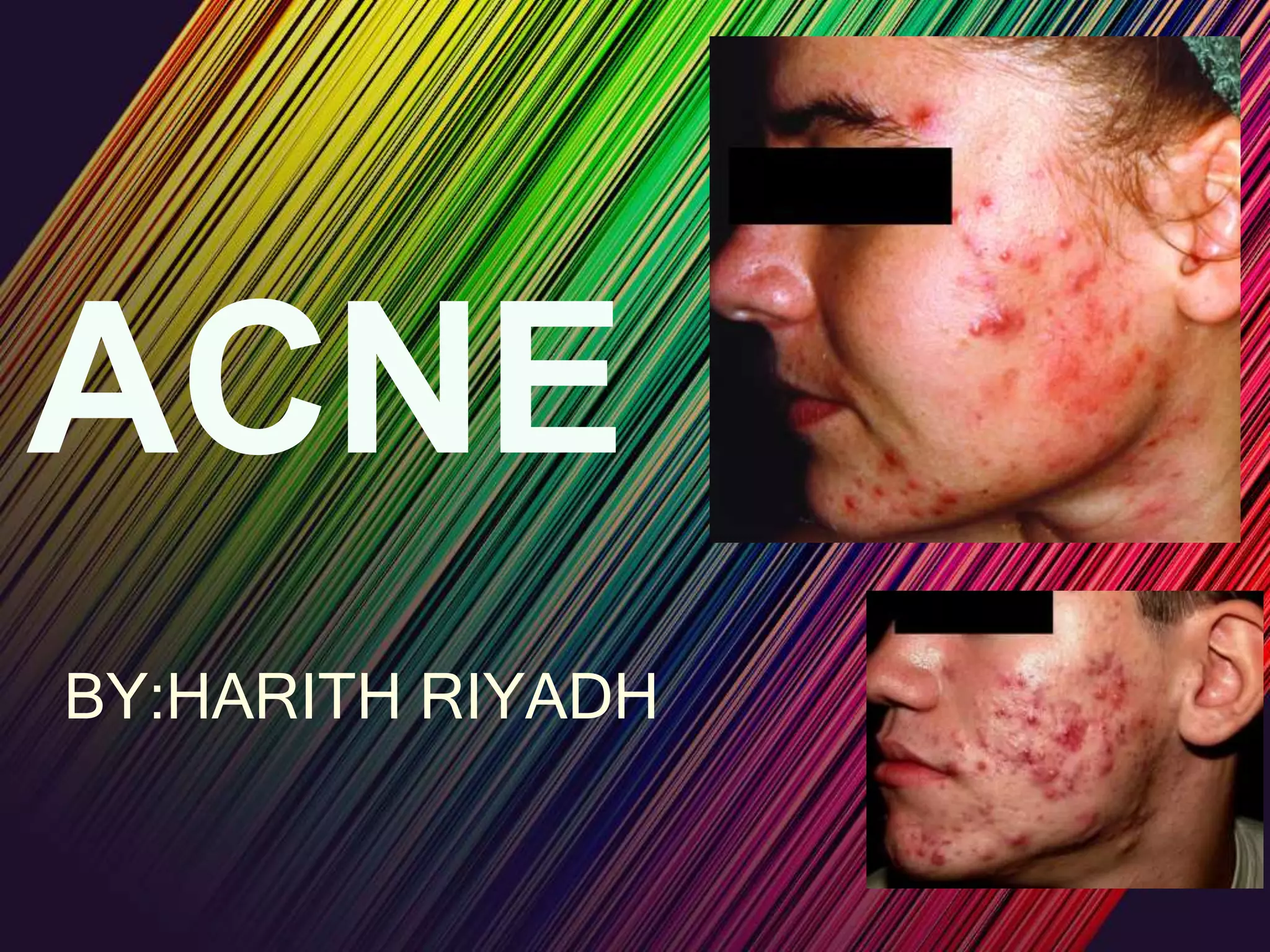

ACNE
BY:HARITH RIYADH
Definition
• Acne is a skin condition that occurs when your hair
follicles become plugged with oil and dead skin cells.
Acne usually appears on your face, neck, chest, back
and shoulders. Effective treatments are available, but
acne can be persistent. The pimples and bumps heal
slowly, and when one begins to go away, others seem to
crop up. Acne is most common among teenagers, with a
reported prevalence of 70 to 87 percent. Increasingly,
younger children are getting acne as well. Depending on
its severity, acne can cause emotional distress and scar
the skin. The earlier you start treatment, the lower your
risk of lasting physical and emotional damage
Symptoms
• Acne is more severe in some people than in
others. Doctors distinguish between mild,
moderate and severe forms of acne. There are
also inflammatory and non-inflammatory types of
acne. Non-inflammatory acne is a milder type,
which most people would refer to as “pimples” or
“blackheads” rather than “acne.” Unlike normal
pimples, acne develops over a longer period of
time and stays longer. It sometimes leaves small
red marks or scars behind. “Normal” pimples
usually form quickly and then disappear again
soon afterwards.
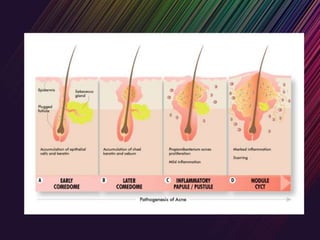
• Mild acne: People with mild acne have comedones
(blackheads or whiteheads), which are clogged pores in
the skin. The dark color of blackheads has nothing to do
with dirt: They look dark because this kind of blackhead
is “open,” and the skin pigment melanin reacts with
oxygen in the air. Whiteheads are closed, and have a
white or yellowish head. The more the oil builds up, the
more likely it is that bacteria will multiply and lead to
inflammatory acne. Acne is also considered to be “mild
acne” if someone only has a few pimples, or small ones.
• Moderate acne: People who have
moderate acne have noticeably more
pimples. Inflamed pimples are called
“papules” (small bumps) or “pustules”
(filled with yellow pus).
• Severe acne: People who have severe
forms of acne have a lot of papules and
pustules, as well as nodules on their skin.
These nodules are often reddish and
painful, and can cause scarring
Causes
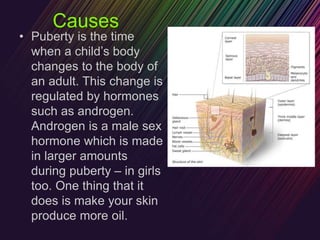
• Puberty is the time
when a child’s body
changes to the body of
an adult. This change is
regulated by hormones
such as androgen.
Androgen is a male sex
hormone which is made
in larger amounts
during puberty – in girls
too. One thing that it
does is make your skin
produce more oil.
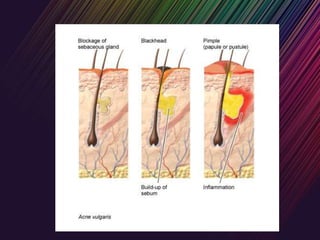
• The oil that is made in the skin is called sebum,
and it is produced in oil glands referred to as
sebaceous glands. Sebum has an important
function: It protects the outermost skin layer and
helps to keep it moisturized. But if a layer of
dead cells builds up at the opening of a pore, the
sebum cannot be released. The oil builds up in
the skin, forming a comedone (blackhead or
whitehead). If this becomes inflamed, it turns
into a pimple (also called zits or spots). Acne
mostly develops on areas of skin that have more
oil glands, like the face, chest, back and
shoulders.
• The main reason teenagers get acne is
because their bodies make more of the
hormone androgen during puberty. Once
their hormone levels have settled down,
typically by their early twenties, acne
usually goes away on its own. But not all
teenagers have acne, so it is believed that
other things play a role too, such as
genetic factors and the immune system.
TEATMENT
1. Topical medications: Retinoids .
Antibiotics. Dapsone (Aczone)
2. Oral medications : Antibiotics.
Combined oral contraceptives. Anti-
androgen agent. Isotretinoin.
3. Therapies : Light therapy. Chemical peel.
Extraction of whiteheads and blackheads.
Steroid injection
Treating acne scars
1. By surgical operation
2. By laser
3. Chemical therapy
ACNE

ACNE

  • 1.
  • 2.
    Definition • Acne isa skin condition that occurs when your hair follicles become plugged with oil and dead skin cells. Acne usually appears on your face, neck, chest, back and shoulders. Effective treatments are available, but acne can be persistent. The pimples and bumps heal slowly, and when one begins to go away, others seem to crop up. Acne is most common among teenagers, with a reported prevalence of 70 to 87 percent. Increasingly, younger children are getting acne as well. Depending on its severity, acne can cause emotional distress and scar the skin. The earlier you start treatment, the lower your risk of lasting physical and emotional damage
  • 3.
    Symptoms • Acne ismore severe in some people than in others. Doctors distinguish between mild, moderate and severe forms of acne. There are also inflammatory and non-inflammatory types of acne. Non-inflammatory acne is a milder type, which most people would refer to as “pimples” or “blackheads” rather than “acne.” Unlike normal pimples, acne develops over a longer period of time and stays longer. It sometimes leaves small red marks or scars behind. “Normal” pimples usually form quickly and then disappear again soon afterwards.
  • 4.
    • Mild acne:People with mild acne have comedones (blackheads or whiteheads), which are clogged pores in the skin. The dark color of blackheads has nothing to do with dirt: They look dark because this kind of blackhead is “open,” and the skin pigment melanin reacts with oxygen in the air. Whiteheads are closed, and have a white or yellowish head. The more the oil builds up, the more likely it is that bacteria will multiply and lead to inflammatory acne. Acne is also considered to be “mild acne” if someone only has a few pimples, or small ones.
  • 5.
    • Moderate acne:People who have moderate acne have noticeably more pimples. Inflamed pimples are called “papules” (small bumps) or “pustules” (filled with yellow pus).
  • 6.
    • Severe acne:People who have severe forms of acne have a lot of papules and pustules, as well as nodules on their skin. These nodules are often reddish and painful, and can cause scarring
  • 7.
    Causes • Puberty isthe time when a child’s body changes to the body of an adult. This change is regulated by hormones such as androgen. Androgen is a male sex hormone which is made in larger amounts during puberty – in girls too. One thing that it does is make your skin produce more oil.
  • 8.
    • The oilthat is made in the skin is called sebum, and it is produced in oil glands referred to as sebaceous glands. Sebum has an important function: It protects the outermost skin layer and helps to keep it moisturized. But if a layer of dead cells builds up at the opening of a pore, the sebum cannot be released. The oil builds up in the skin, forming a comedone (blackhead or whitehead). If this becomes inflamed, it turns into a pimple (also called zits or spots). Acne mostly develops on areas of skin that have more oil glands, like the face, chest, back and shoulders.
  • 9.
    • The mainreason teenagers get acne is because their bodies make more of the hormone androgen during puberty. Once their hormone levels have settled down, typically by their early twenties, acne usually goes away on its own. But not all teenagers have acne, so it is believed that other things play a role too, such as genetic factors and the immune system.
  • 12.
    TEATMENT 1. Topical medications:Retinoids . Antibiotics. Dapsone (Aczone) 2. Oral medications : Antibiotics. Combined oral contraceptives. Anti- androgen agent. Isotretinoin. 3. Therapies : Light therapy. Chemical peel. Extraction of whiteheads and blackheads. Steroid injection
  • 13.
    Treating acne scars 1.By surgical operation 2. By laser 3. Chemical therapy