
Introduction OnIntroduction On
AcupressureAcupressure
Presented by
Vaishali Bhagwani
What is Naturopathy?What is Naturopathy?
““Naturopathy is a distinct system of primary health care,
an art, science, philosophy and practice of diagnosing,
treating and preventing disease.”
 Naturopathy physicians seek to restore and maintain
optimum health.
Naturopathy is defined by principles rather than by
methods or modalities.
Diagnostic and therapeutic methods are diverse and will
continue to evolve as knowledge of health and diseases
expands.
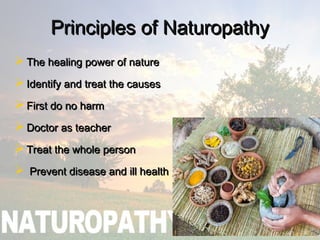
Principles of NaturopathyPrinciples of Naturopathy
 The healing power of natureThe healing power of nature
 Identify and treat the causesIdentify and treat the causes
 First do no harmFirst do no harm
 DoctorDoctor as teacheras teacher
 Treat the whole personTreat the whole person
 Prevent disease and ill healthPrevent disease and ill health
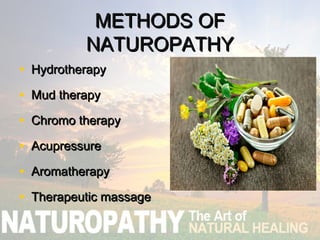
METHODS OFMETHODS OF
NATUROPATHYNATUROPATHY
• HydrotherapyHydrotherapy
• Mud therapyMud therapy
• Chromo therapyChromo therapy
• AcupressureAcupressure
• AromatherapyAromatherapy
• Therapeutic massageTherapeutic massage
AcupressureAcupressure
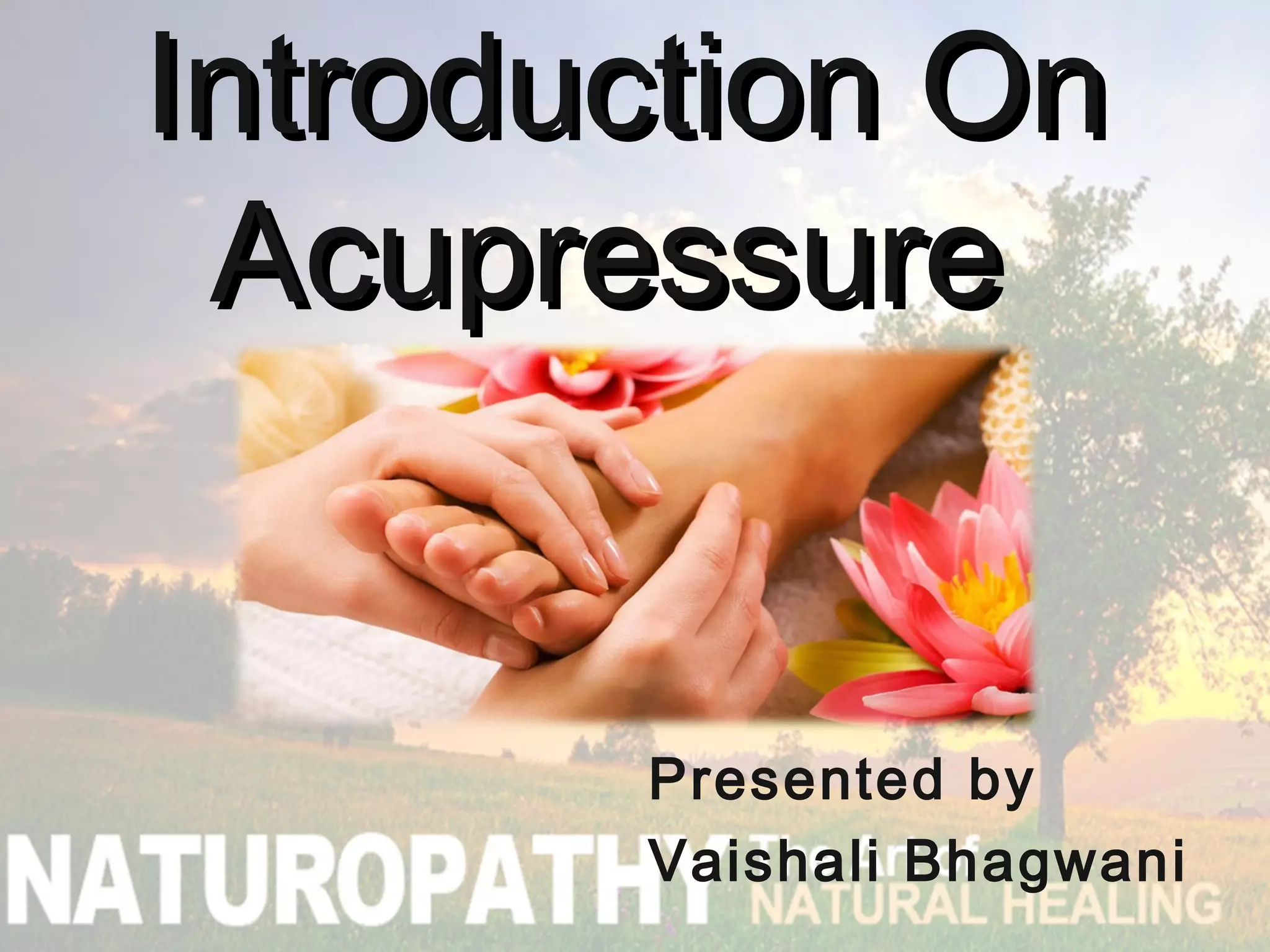
Acupressure is an ancient healing art that uses the fingers or any
blunted objects to press key points called as ‘Acu Points’ (Energy
stored points) on the surface rhythmically on the skin to stimulate the
body’s natural self-curative abilities. When these points are pressed,
they release muscular tension and promote the circulation of blood and
the body’s life force to aid healing.
•Acupuncture and acupressure use the same points, while
acupressure uses the gentle but firm pressure of hands or any blunted
objects, but acupuncture employs needles, Acupressure has been
practiced as a healing art for at least 5,000 years. This complete health
system has been documented for use in treating over 3000 conditions.
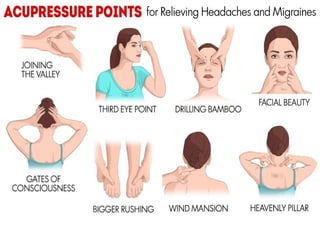
• Acupressure can be effective in helping relieve
headaches, eyestrain, sinus problems, neck pain,
backaches, arthritis, muscle aches, and tension
due to stress, ulcer pain, menstrual cramps, lower
back aches, constipation, and indigestion, anxiety,
insomnia.
• There are also great advantages to using acupressure as a
way to balance the body and maintain good health. The
healing touch of acupressure reduces tension, increases
circulation, and enables the body to relax deeply. By
relieving stress, acupressure strengthens resistance to
disease and promotes wellness.
HISTORY OF ACCUPRESSURE
• Historical evidence, documents, edifices, etc. corroborate that
acupressure and acupuncture therapy was known in India 5000
years ago. The people of India also practiced
acupuncture at that time.
• Charaka, in “Charaka Samhitta”, has further added about the
meridianology part of Acupressure
• Acupuncture traditionally was termed as ‘Bhedan
Karma”(meaning “Piercing Through Therapy”), and was a part of
the traditional Indian methods of using pressure points or
marma.The methods of application were referred to as Marma-
Chikitsa (Treatment of marma or points.)
• Sushruta, another physician of ancient India, has described the
pressure points (marma) as being areas of very high
concentration of energy or vitality (Prana).Thus, these ancient
historical references indicate that Acupuncture as “Suchi-
Chikitsa” (suchi mean needle) was practised in India.
• Elsewhere, in China, the history witnessed some
remarkable advancements in the field of medicine.
Chinese people also used to practise Chinese herbal
medicines and Acupressure among different indigenous
methods. During, this period Acupressure and others
were developed in a more scientific manner.
• In 1971, America’s president Richard Nixon’s visit to
China and his much publicised interest in Acupressure
paved the way for its revival and propagation into the rest
of the world.
• This resulted in World Health Organisation (WHO) adding
Acupressure in its discussion in inter-regional seminar
held at Beijing, China in 1979. Such successive events
made WHO recognise Acupressure as an alternative
method of treatment.
Classification of acupressureClassification of acupressure
• Acupressure has been classified into FIVE basic parts:
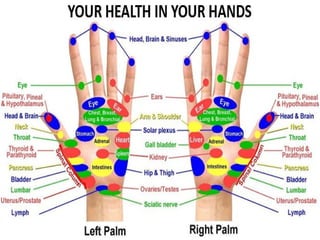
• REFLEXOLOGY : In reflexology there are 39 points that represent 39
organs of the body and are located on the palm and sole.
• MERIDIANOLOGY : There are 12 pairs of bilateral and 8 extra
meridians distributed all over the body. Around 400 points are situated
on the pathway of these meridians.
• SCALP THERAPY : Over the scalp there are numerous points that
represent different parts of the body.
• AURICLE THERAPY :Here the entire body’s point is found on the
ears.
• SU-JOK THERAPY : The whole body and its points are located on
Advantages of acupressure
• Acupressure as a mode of treatment finds themselves
with the following advantages:
• Easy to learn.
• Any one can learn.
• Easy to diagnosis.
• Self-dependency.
• No use of medicines.
• No side effects.
• Zero cost treatments.
Treats acute & chronic diseases.
Disadvantages of acupressure
• Time consuming.
• During pregnancy has the potential to causes
miscarriages.
• Acupressure cannot treat cold effectively.
• It cannot be used for all medical conditions.
• Drug and alcohol addicted people should not be treated
with acupressure.
APPLICATIONSAPPLICATIONS
• Most people try acupressure for a specific ailment. Some
of the more common ailments include:
• Cancer-related fatigue
• Headache
• Menstrual cramps
• Motion sickness
• Muscle tension and pain
• Nausea or vomiting after surgery or chemotherapy
• Nausea and vomiting during pregnancy and morning
sickness​
• Stress management
Thank
you

ACUPRESSURE

  • 1.
  • 2.
    What is Naturopathy?Whatis Naturopathy? ““Naturopathy is a distinct system of primary health care, an art, science, philosophy and practice of diagnosing, treating and preventing disease.”  Naturopathy physicians seek to restore and maintain optimum health. Naturopathy is defined by principles rather than by methods or modalities. Diagnostic and therapeutic methods are diverse and will continue to evolve as knowledge of health and diseases expands.
  • 3.
    Principles of NaturopathyPrinciplesof Naturopathy  The healing power of natureThe healing power of nature  Identify and treat the causesIdentify and treat the causes  First do no harmFirst do no harm  DoctorDoctor as teacheras teacher  Treat the whole personTreat the whole person  Prevent disease and ill healthPrevent disease and ill health
  • 4.
    METHODS OFMETHODS OF NATUROPATHYNATUROPATHY •HydrotherapyHydrotherapy • Mud therapyMud therapy • Chromo therapyChromo therapy • AcupressureAcupressure • AromatherapyAromatherapy • Therapeutic massageTherapeutic massage
  • 5.
    AcupressureAcupressure Acupressure is anancient healing art that uses the fingers or any blunted objects to press key points called as ‘Acu Points’ (Energy stored points) on the surface rhythmically on the skin to stimulate the body’s natural self-curative abilities. When these points are pressed, they release muscular tension and promote the circulation of blood and the body’s life force to aid healing. •Acupuncture and acupressure use the same points, while acupressure uses the gentle but firm pressure of hands or any blunted objects, but acupuncture employs needles, Acupressure has been practiced as a healing art for at least 5,000 years. This complete health system has been documented for use in treating over 3000 conditions.
  • 6.
    • Acupressure canbe effective in helping relieve headaches, eyestrain, sinus problems, neck pain, backaches, arthritis, muscle aches, and tension due to stress, ulcer pain, menstrual cramps, lower back aches, constipation, and indigestion, anxiety, insomnia. • There are also great advantages to using acupressure as a way to balance the body and maintain good health. The healing touch of acupressure reduces tension, increases circulation, and enables the body to relax deeply. By relieving stress, acupressure strengthens resistance to disease and promotes wellness.
  • 7.
    HISTORY OF ACCUPRESSURE •Historical evidence, documents, edifices, etc. corroborate that acupressure and acupuncture therapy was known in India 5000 years ago. The people of India also practiced acupuncture at that time. • Charaka, in “Charaka Samhitta”, has further added about the meridianology part of Acupressure • Acupuncture traditionally was termed as ‘Bhedan Karma”(meaning “Piercing Through Therapy”), and was a part of the traditional Indian methods of using pressure points or marma.The methods of application were referred to as Marma- Chikitsa (Treatment of marma or points.) • Sushruta, another physician of ancient India, has described the pressure points (marma) as being areas of very high concentration of energy or vitality (Prana).Thus, these ancient historical references indicate that Acupuncture as “Suchi- Chikitsa” (suchi mean needle) was practised in India.
  • 8.
    • Elsewhere, inChina, the history witnessed some remarkable advancements in the field of medicine. Chinese people also used to practise Chinese herbal medicines and Acupressure among different indigenous methods. During, this period Acupressure and others were developed in a more scientific manner. • In 1971, America’s president Richard Nixon’s visit to China and his much publicised interest in Acupressure paved the way for its revival and propagation into the rest of the world. • This resulted in World Health Organisation (WHO) adding Acupressure in its discussion in inter-regional seminar held at Beijing, China in 1979. Such successive events made WHO recognise Acupressure as an alternative method of treatment.
  • 9.
    Classification of acupressureClassificationof acupressure • Acupressure has been classified into FIVE basic parts: • REFLEXOLOGY : In reflexology there are 39 points that represent 39 organs of the body and are located on the palm and sole. • MERIDIANOLOGY : There are 12 pairs of bilateral and 8 extra meridians distributed all over the body. Around 400 points are situated on the pathway of these meridians. • SCALP THERAPY : Over the scalp there are numerous points that represent different parts of the body. • AURICLE THERAPY :Here the entire body’s point is found on the ears. • SU-JOK THERAPY : The whole body and its points are located on
  • 11.
    Advantages of acupressure •Acupressure as a mode of treatment finds themselves with the following advantages: • Easy to learn. • Any one can learn. • Easy to diagnosis. • Self-dependency. • No use of medicines. • No side effects. • Zero cost treatments. Treats acute & chronic diseases.
  • 13.
    Disadvantages of acupressure •Time consuming. • During pregnancy has the potential to causes miscarriages. • Acupressure cannot treat cold effectively. • It cannot be used for all medical conditions. • Drug and alcohol addicted people should not be treated with acupressure.
  • 14.
    APPLICATIONSAPPLICATIONS • Most peopletry acupressure for a specific ailment. Some of the more common ailments include: • Cancer-related fatigue • Headache • Menstrual cramps • Motion sickness • Muscle tension and pain • Nausea or vomiting after surgery or chemotherapy • Nausea and vomiting during pregnancy and morning sickness​ • Stress management
  • 15.