AN INTRODUCTION TO SYSTEM 
DYNAMICS & FEEDBACK LOOP 
STRUCTURES 
Presented by:- 
Bhupendra Kumar 
Roll No.-094008 
Integrated M.Tech.
CONTENTS 
 Introduction to system dynamics 
 history 
 System Dynamics Modeling 
 Critical Aspects 
 Understand cause and effects 
 Feedback loop structures 
 Causal loop diagrams 
 Loop dominance 
 Exogenous Items
INTRODUCTION TO SYSTEM DYNAMICS 
 System dynamics focuses on the structure and behavior 
of systems composed of interacting feedback loops. 
 System Dynamics helps in designing the 
interconnections and structures to give more confidence 
and predictability in behavior of the systems. 
 System dynamics is an approach to understanding the 
behaviour of complex systems over time. It deals with 
internal feedback loops and time delays that affect the 
behaviour of the entire system.
HISTORY 
 Cybernetics (Wiener, 1948): the study of how biological, 
engineering, social, and economic systems are controlled 
and regulated 
 Industrial Dynamics (Forrester, 1961): applied principles 
of cybernetics to industrial systems 
 System Dynamics: Forrester’s work has been broadened 
to include other social and economic systems 
 Relying on computer, System Dynamics provides a 
framework in which to apply the idea of systems theory 
to social and economic problems
SYSTEM DYNAMICS MODELING 
 Identify a problem 
 Develop a dynamic hypothesis explaining the cause of 
the problem 
 Create a basic structure of a causal graph 
 Augment the causal graph with more information 
 Convert the augmented causal graph to a System 
Dynamics flow graph 
 Translate a System Dynamics flow graph into 
DYNAMO programs or equations
CRITICAL ASPECTS 
 Thinking in terms of cause-and-effect relationships 
 Focusing on the feedback linkages among components of 
a system 
 Determining the appropriate boundaries for defining 
what is to be included within a system
UNDERSTAND CAUSE & EFFECT 
 Causal thinking is the key to organizing ideas in a system 
dynamics study 
 Instead of ‘cause’, ‘affect’ or ‘influence’ can be used to 
describe the related components in the system 
 Some are logical (e.g. physics) 
 Food intake weight 
 Money  happiness 
 Fire  smoke 
 Some are not (e.g. sociology, economics) 
 Use of seatbelts  reduced highway fatalities 
 Shortened daylight hours  increased suicide rates
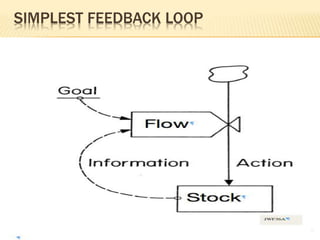
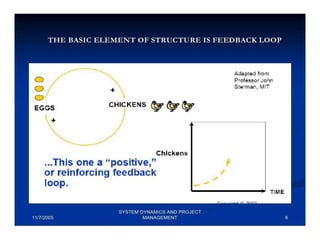
FEEDBACK LOOP STRUCTURES 
 Thinking in terms of “cause and effect” is not enough 
 ocean  evaporation  cloud  rain  ocean  … 
 Feedback: an initial cause ripples through a chain of 
causation ultimately to re-affect itself 
 Search to identify closed, causal feedback loops is one 
key element of System Dynamics 
 The most important causal influences will be exactly 
those that are enclosed within feedback loop
SIMPLEST FEEDBACK LOOP
CAUSAL LOOP DIAGRAM (CLD) 
 Represent the feedback structure of systems 
 Capture 
 The hypotheses about the causes of dynamics 
 The important feedbacks
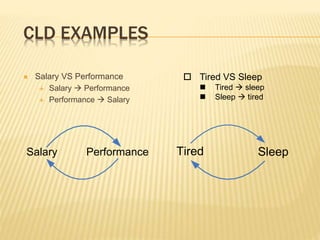
CLD EXAMPLES 
 Salary VS Performance 
 Salary  Performance 
 Performance  Salary 
Salary Performance 
 Tired VS Sleep 
 Tired  sleep 
 Sleep  tired 
Tired Sleep
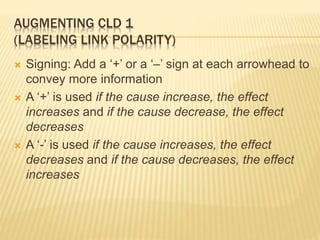
AUGMENTING CLD 1 
(LABELING LINK POLARITY) 
 Signing: Add a ‘+’ or a ‘–’ sign at each arrowhead to 
convey more information 
 A ‘+’ is used if the cause increase, the effect 
increases and if the cause decrease, the effect 
decreases 
 A ‘-’ is used if the cause increases, the effect 
decreases and if the cause decreases, the effect 
increases
SIGNING ARCS 
+ 
Salary Performance 
+ 
+ 
Tired Sleep 
-
AUGMENTING CLD 2 
(DETERMINING LOOP POLARITY) 
 Positive feedback loops 
 Have an even number of ‘–’ signs 
 Some quantity increase, a “snowball” effect takes 
over and that quantity continues to increase 
 The “snowball” effect can also work in reverse 
 Generate behaviors of growth, amplify, deviation, and 
reinforce 
 Notation: place + 
symbol in the center of the loop 
 Negative feedback loops 
 Have an odd number of “–” signs 
 Tend to produce “stable”, “balance”, “equilibrium” 
and “goal-seeking” behavior over time 
 Notation: place - 
symbol in the center of the loop
CLD WITH POSITIVE FEEDBACK LOOP 
 Salary  Performance, Performance  Salary 
Salary Performance 
The better I perform 
The more salary I get 
The better I perform 
+ 
+ 
+ 
The more salary I get 
The better I perform
CLD WITH NEGATIVE FEEDBACK LOOP 
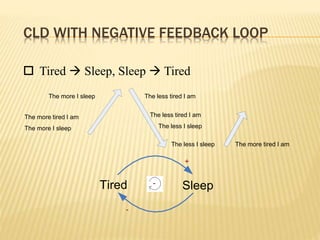
 Tired  Sleep, Sleep  Tired 
The more I sleep The less tired I am 
Tired Sleep 
The more tired I am 
The more I sleep 
The less tired I am 
The less I sleep 
The less I sleep The more tired I am 
+ 
- 
-
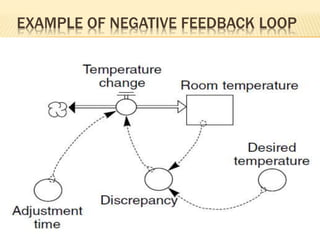
EXAMPLE OF NEGATIVE FEEDBACK LOOP
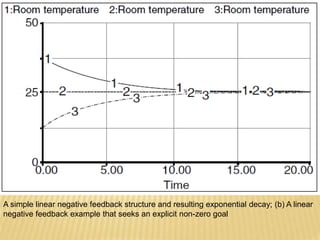
A simple linear negative feedback structure and resulting exponential decay; (b) A linear 
negative feedback example that seeks an explicit non-zero goal
LOOP DOMINANCE 
 There are systems which have more than one feedback 
loop within them 
 A particular loop in a system of more than one loop is 
most responsible for the overall behavior of that system 
 The dominating loop might shift over time 
 When a feedback loop is within another, one loop must 
dominate 
 Stable conditions will exist when negative loops 
dominate positive loops
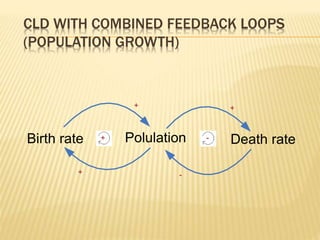
CLD WITH COMBINED FEEDBACK LOOPS 
(POPULATION GROWTH) 
+ + 
Birth rate + Polulation - Death rate 
+ -
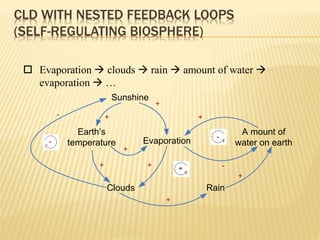
CLD WITH NESTED FEEDBACK LOOPS 
(SELF-REGULATING BIOSPHERE) 
 Evaporation  clouds  rain  amount of water  
Sunshine 
Evaporation 
A mount of 
water on earth 
Clouds Rain 
Earth’s 
- temperature 
+ 
- 
+ 
+ 
+ 
+ + 
+ 
+ 
- + 
- 
evaporation  …
EXOGENOUS ITEMS 
 Items that affect other items in the system but are 
not themselves affected by anything in the system 
 Arrows are drawn from these items but there are no 
arrows drawn to these items 
Sunlight reaching 
each plant 
Density of plants 
Sunlight + 
+ 
- 
-
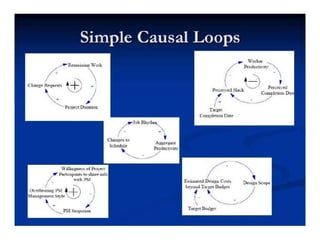
SIMPLE CAUSAL LOOPS
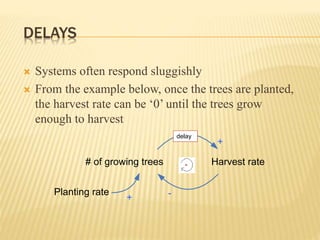
DELAYS 
 Systems often respond sluggishly 
 From the example below, once the trees are planted, 
the harvest rate can be ‘0’ until the trees grow 
enough to harvest 
delay 
# of growing trees Harvest rate 
Planting rate 
+ 
+ 
- 
-
REFERENCES 
 System Dynamics Society 
 Forrester J.W., Industrial Dynamics 
 Yaman Barlas, System dynamics: systemic feedback 
modeling for policy analysis
An introduction to system dynamics & feedback loop

An introduction to system dynamics & feedback loop

  • 1.
    AN INTRODUCTION TOSYSTEM DYNAMICS & FEEDBACK LOOP STRUCTURES Presented by:- Bhupendra Kumar Roll No.-094008 Integrated M.Tech.
  • 2.
    CONTENTS  Introductionto system dynamics  history  System Dynamics Modeling  Critical Aspects  Understand cause and effects  Feedback loop structures  Causal loop diagrams  Loop dominance  Exogenous Items
  • 3.
    INTRODUCTION TO SYSTEMDYNAMICS  System dynamics focuses on the structure and behavior of systems composed of interacting feedback loops.  System Dynamics helps in designing the interconnections and structures to give more confidence and predictability in behavior of the systems.  System dynamics is an approach to understanding the behaviour of complex systems over time. It deals with internal feedback loops and time delays that affect the behaviour of the entire system.
  • 4.
    HISTORY  Cybernetics(Wiener, 1948): the study of how biological, engineering, social, and economic systems are controlled and regulated  Industrial Dynamics (Forrester, 1961): applied principles of cybernetics to industrial systems  System Dynamics: Forrester’s work has been broadened to include other social and economic systems  Relying on computer, System Dynamics provides a framework in which to apply the idea of systems theory to social and economic problems
  • 5.
    SYSTEM DYNAMICS MODELING  Identify a problem  Develop a dynamic hypothesis explaining the cause of the problem  Create a basic structure of a causal graph  Augment the causal graph with more information  Convert the augmented causal graph to a System Dynamics flow graph  Translate a System Dynamics flow graph into DYNAMO programs or equations
  • 6.
    CRITICAL ASPECTS Thinking in terms of cause-and-effect relationships  Focusing on the feedback linkages among components of a system  Determining the appropriate boundaries for defining what is to be included within a system
  • 7.
    UNDERSTAND CAUSE &EFFECT  Causal thinking is the key to organizing ideas in a system dynamics study  Instead of ‘cause’, ‘affect’ or ‘influence’ can be used to describe the related components in the system  Some are logical (e.g. physics)  Food intake weight  Money  happiness  Fire  smoke  Some are not (e.g. sociology, economics)  Use of seatbelts  reduced highway fatalities  Shortened daylight hours  increased suicide rates
  • 8.
    FEEDBACK LOOP STRUCTURES  Thinking in terms of “cause and effect” is not enough  ocean  evaporation  cloud  rain  ocean  …  Feedback: an initial cause ripples through a chain of causation ultimately to re-affect itself  Search to identify closed, causal feedback loops is one key element of System Dynamics  The most important causal influences will be exactly those that are enclosed within feedback loop
  • 9.
  • 10.
    CAUSAL LOOP DIAGRAM(CLD)  Represent the feedback structure of systems  Capture  The hypotheses about the causes of dynamics  The important feedbacks
  • 11.
    CLD EXAMPLES Salary VS Performance  Salary  Performance  Performance  Salary Salary Performance  Tired VS Sleep  Tired  sleep  Sleep  tired Tired Sleep
  • 12.
    AUGMENTING CLD 1 (LABELING LINK POLARITY)  Signing: Add a ‘+’ or a ‘–’ sign at each arrowhead to convey more information  A ‘+’ is used if the cause increase, the effect increases and if the cause decrease, the effect decreases  A ‘-’ is used if the cause increases, the effect decreases and if the cause decreases, the effect increases
  • 13.
    SIGNING ARCS + Salary Performance + + Tired Sleep -
  • 14.
    AUGMENTING CLD 2 (DETERMINING LOOP POLARITY)  Positive feedback loops  Have an even number of ‘–’ signs  Some quantity increase, a “snowball” effect takes over and that quantity continues to increase  The “snowball” effect can also work in reverse  Generate behaviors of growth, amplify, deviation, and reinforce  Notation: place + symbol in the center of the loop  Negative feedback loops  Have an odd number of “–” signs  Tend to produce “stable”, “balance”, “equilibrium” and “goal-seeking” behavior over time  Notation: place - symbol in the center of the loop
  • 15.
    CLD WITH POSITIVEFEEDBACK LOOP  Salary  Performance, Performance  Salary Salary Performance The better I perform The more salary I get The more salary I get The better I perform + + + The more salary I get The better I perform
  • 17.
    CLD WITH NEGATIVEFEEDBACK LOOP  Tired  Sleep, Sleep  Tired The more I sleep The less tired I am Tired Sleep The more tired I am The more I sleep The less tired I am The less I sleep The less I sleep The more tired I am + - -
  • 18.
    EXAMPLE OF NEGATIVEFEEDBACK LOOP
  • 19.
    A simple linearnegative feedback structure and resulting exponential decay; (b) A linear negative feedback example that seeks an explicit non-zero goal
  • 20.
    LOOP DOMINANCE There are systems which have more than one feedback loop within them  A particular loop in a system of more than one loop is most responsible for the overall behavior of that system  The dominating loop might shift over time  When a feedback loop is within another, one loop must dominate  Stable conditions will exist when negative loops dominate positive loops
  • 21.
    CLD WITH COMBINEDFEEDBACK LOOPS (POPULATION GROWTH) + + Birth rate + Polulation - Death rate + -
  • 22.
    CLD WITH NESTEDFEEDBACK LOOPS (SELF-REGULATING BIOSPHERE)  Evaporation  clouds  rain  amount of water  Sunshine Evaporation A mount of water on earth Clouds Rain Earth’s - temperature + - + + + + + + + - + - evaporation  …
  • 23.
    EXOGENOUS ITEMS Items that affect other items in the system but are not themselves affected by anything in the system  Arrows are drawn from these items but there are no arrows drawn to these items Sunlight reaching each plant Density of plants Sunlight + + - -
  • 24.
  • 25.
    DELAYS  Systemsoften respond sluggishly  From the example below, once the trees are planted, the harvest rate can be ‘0’ until the trees grow enough to harvest delay # of growing trees Harvest rate Planting rate + + - -
  • 26.
    REFERENCES  SystemDynamics Society  Forrester J.W., Industrial Dynamics  Yaman Barlas, System dynamics: systemic feedback modeling for policy analysis