Activity Diagrams
Activity Diagrams
 To model the dynamic aspects of a
system
 It is essentially a flowchart
Showing flow of control from activity to activity
 Purpose
Model business workflows
Model operations
Activity Diagrams
Activity diagrams commonly contain
Activity states and action states
Transitions
Objects
Action States and Activity States
 Action states are atomic and cannot be decomposed
Work of the action state is not interrupted
 Activity states can be further decomposed
Their activity being represented by other activity
diagrams
They may be interrupted
Transitions
When the action or activity of a state
completes, flow of control passes
immediately to the next action or activity
state
A flow of control has to start and end
someplace
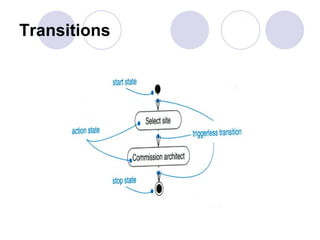
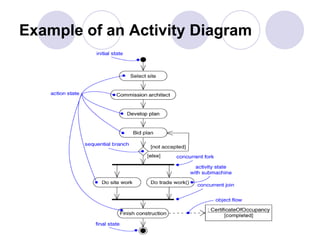
initial state -- a solid ball
stop state -- a solid ball inside a circle
Transitions
Branching
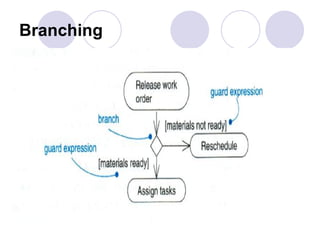
A branch specifies alternate paths taken
based on some Boolean expression
A branch may have one incoming
transition and two or more outgoing ones
Branching
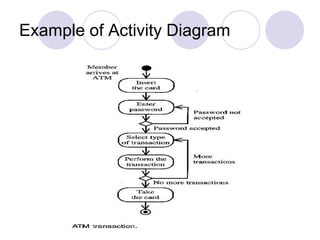
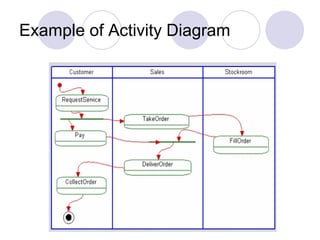
Example of Activity Diagram
Forking and Joining
Use a synchronization bar to specify the
forking and joining of parallel flows of
control
A synchronization bar is rendered as a
thick horizontal or vertical line
Fork
 A fork may have one incoming transitions and two or more
outgoing transitions
 each transition represents an independent flow of control
 conceptually, the activities of each of outgoing transitions are
concurrent
 either truly concurrent (multiple nodes)
 or sequential yet interrupted (one node)
Join
 A join may have two or more incoming transitions
and one outgoing transition
above the join, the activities associated with each of
these paths continues in parallel
at the join, the concurrent flows synchronize
each waits until all incoming flows have reached the
join, at which point one flow of control continues on
below the join
Example of an Activity Diagram
Swimlanes
 Activity diagrams tell you what happens, but they do not tell you who
does what. In programming, this means that the diagram does not
convey which class is responsible for each activity.
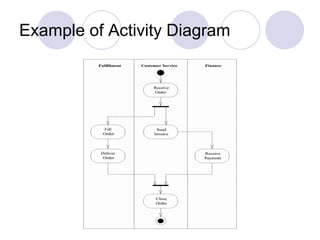
 A swimlane is a way to group activities performed by the same actor
on an activity diagram or to group activities in a single thread.
 each group representing the business organization responsible
for those activities
 each group is called a swimlane
 Each swimlane is divided from its neighbor by a vertical solid line
Swimlanes
 Each swimlane has a name unique within its diagram
 Each swimlane may represent some real-world entity
 Each swimlane may be implemented by one or more
classes
 Every activity belongs to exactly one swimlane, but
transitions may cross lanes
Example of Activity Diagram
Thanks

Lecture6 activity diagrams

  • 1.
  • 2.
    Activity Diagrams  Tomodel the dynamic aspects of a system  It is essentially a flowchart Showing flow of control from activity to activity  Purpose Model business workflows Model operations
  • 3.
    Activity Diagrams Activity diagramscommonly contain Activity states and action states Transitions Objects
  • 4.
    Action States andActivity States  Action states are atomic and cannot be decomposed Work of the action state is not interrupted  Activity states can be further decomposed Their activity being represented by other activity diagrams They may be interrupted
  • 5.
    Transitions When the actionor activity of a state completes, flow of control passes immediately to the next action or activity state A flow of control has to start and end someplace initial state -- a solid ball stop state -- a solid ball inside a circle
  • 6.
  • 7.
    Branching A branch specifiesalternate paths taken based on some Boolean expression A branch may have one incoming transition and two or more outgoing ones
  • 8.
  • 9.
  • 10.
    Forking and Joining Usea synchronization bar to specify the forking and joining of parallel flows of control A synchronization bar is rendered as a thick horizontal or vertical line
  • 11.
    Fork  A forkmay have one incoming transitions and two or more outgoing transitions  each transition represents an independent flow of control  conceptually, the activities of each of outgoing transitions are concurrent  either truly concurrent (multiple nodes)  or sequential yet interrupted (one node)
  • 12.
    Join  A joinmay have two or more incoming transitions and one outgoing transition above the join, the activities associated with each of these paths continues in parallel at the join, the concurrent flows synchronize each waits until all incoming flows have reached the join, at which point one flow of control continues on below the join
  • 13.
    Example of anActivity Diagram
  • 14.
    Swimlanes  Activity diagramstell you what happens, but they do not tell you who does what. In programming, this means that the diagram does not convey which class is responsible for each activity.  A swimlane is a way to group activities performed by the same actor on an activity diagram or to group activities in a single thread.  each group representing the business organization responsible for those activities  each group is called a swimlane  Each swimlane is divided from its neighbor by a vertical solid line
  • 15.
    Swimlanes  Each swimlanehas a name unique within its diagram  Each swimlane may represent some real-world entity  Each swimlane may be implemented by one or more classes  Every activity belongs to exactly one swimlane, but transitions may cross lanes
  • 16.
  • 17.
  • 18.