UML Lecture Series UML SIG UML for Business Modeling (Activity Diagram)
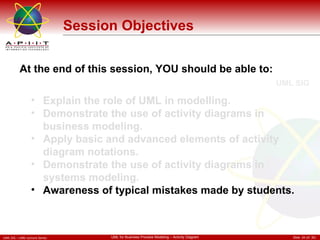
Session Objectives Explain the role of UML in modelling. Demonstrate the use of activity diagrams in business modeling.  Apply basic and advanced elements of activity diagram notations.  Demonstrate the use of activity diagrams in systems modeling. Awareness of typical mistakes made by students.  At the end of this session, YOU should be able to:
Keywords Business modelling Activity state Transition Triggerless transition Synchronisation bar Start state Stop/End state Branch Guard Fork Join Concurrent thread Alternative thread Conditional thread System modelling
Session Objectives Explain the role of UML in modelling. Demonstrate the use of activity diagrams in business modeling.  Apply basic and advanced elements of activity diagram notations.  Demonstrate the use of activity diagrams in systems modeling. Awareness of typical mistakes made by students.  At the end of this session, YOU should be able to:
Why Model? Captures Processes Enhances Communication Manages Complexity Defines Architecture Enables Reuse
Introduction to UML UML is a language for  visualising ,  specifying ,  constructing  and  documenting  the artifacts of a  software  intensive system. Open Specification by OMG (Object Management Group). Current standard is UML 2.0. However, most students use UML 1.4 which is sufficient for most academic projects.  UML is an analysis and design technique. It has to be used together with a process in a development environment.
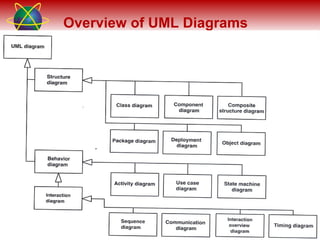
Overview of UML Diagrams
Thoughts to Ponder … If you reuse code, You'll save a load, But if you reuse design, Your future will shine. Ralph E. Johnson.
…  What is design? ... It’s where you stand with a foot in two worlds—the world of technology and the world of people and human purposes—and you try to bring the two together.   Terry Winograd, “Bringing Design to Software”, Addison Wesley, Stanford University and Interval Research Corporation, With John Bennett, Laura De Young, and Bradley Hartfield, ISBN: 0-201-85491-0. 310 Thoughts to Ponder …
Session Objectives Explain the role of UML in modelling. Demonstrate the use of activity diagrams in business modeling.  Apply basic and advanced elements of activity diagram notations.  Demonstrate the use of activity diagrams in systems modeling. Awareness of typical mistakes made by students.  At the end of this session, YOU should be able to:
Business Modelling
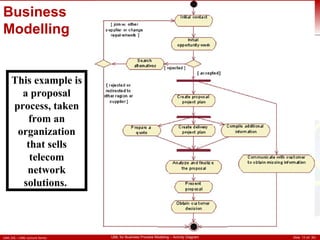
Activity Diagram In its basic form, an activity diagram is a simple and intuitive illustration of what happens in a workflow, what activities can be done in parallel, and whether there are alternative paths through the workflow.  Historically, activity diagrams have mostly been used in the business process modeling domain but are also useful in system modelling.
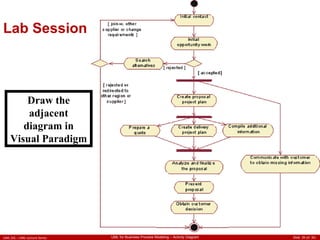
Business Modelling This example is a proposal process, taken from an organization that sells telecom network solutions.
Session Objectives Explain the role of UML in modelling. Demonstrate the use of activity diagrams in business modeling.  Apply basic and advanced elements of activity diagram notations.  Demonstrate the use of activity diagrams in systems modeling. Awareness of typical mistakes made by students.   At the end of this session, YOU should be able to:
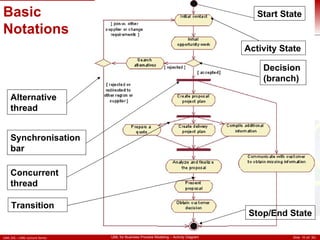
Basic Notations Start State Activity State Decision  (branch) Synchronisation bar Stop/End State Concurrent thread Alternative  thread Transition
Activity Diagram - Notations Activity states , represent the performance of a step within the workflow.  Transition  show what activity state follows after another.  Decisions  (branch)  for which a set of  guard  conditions are defined. These are conditions that must be met to trigger the transition.  Synchronization bars , which you can use to show parallel subflows. Synchronization bars allow you to show  concurrent threads   - fork or join.
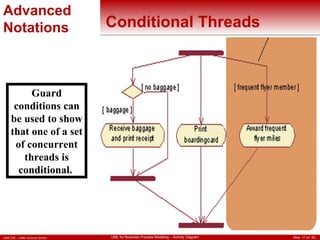
Advanced Notations Guard conditions can be used to show that one of a set of concurrent threads is conditional.  Conditional Threads
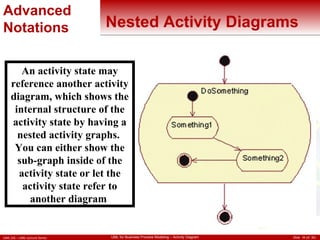
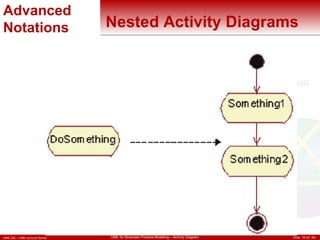
Advanced Notations An activity state may reference another activity diagram, which shows the internal structure of the activity state by having a nested activity graphs.  You can either show the sub-graph inside of the activity state or let the activity state refer to another diagram   Nested Activity Diagrams
Advanced Notations Nested Activity Diagrams
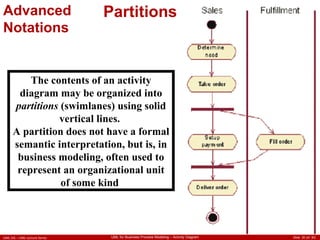
Advanced Notations The contents of an activity diagram may be organized into  partitions  (swimlanes) using solid vertical lines.  A partition does not have a formal semantic interpretation, but is, in business modeling, often used to represent an organizational unit of some kind   Partitions
Session Objectives Explain the role of UML in modelling. Demonstrate the use of activity diagrams in business modeling.  Apply basic and advanced elements of activity diagram notations.  Demonstrate the use of activity diagrams in systems modeling. Awareness of typical mistakes made by students.   At the end of this session, YOU should be able to:
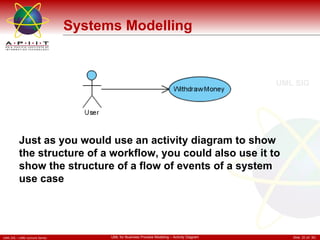
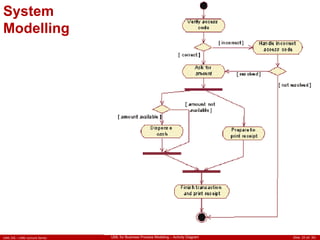
Systems Modelling Just as you would use an activity diagram to show the structure of a workflow, you could also use it to show the structure of a flow of events of a system use case
System Modelling
Session Objectives Explain the role of UML in modelling. Demonstrate the use of activity diagrams in business modeling.  Apply basic and advanced elements of activity diagram notations.  Demonstrate the use of activity diagrams in systems modeling. Awareness of typical mistakes made by students.  At the end of this session, YOU should be able to:
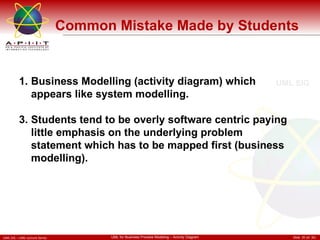
Common Mistake Made by Students Business Modelling (activity diagram) which appears like system modelling. Students tend to be overly software centric paying little emphasis on the underlying problem statement which has to be mapped first (business modelling).
True/False Business modelling is typically done before system modelling. Alternative thread must go along with a branch. A branch can have at most THREE (3) alternative threads Fork: One incoming transition and two or more outgoing transition. Branch: Two or more incoming transition and one outgoing transition. Synchronisation bar allow sequential threads. Conditional threads are also called  triggered transitions  and must be shown with a guard condition.  Transitions without guard conditions are called  triggerless transitions .
Summary Role of UML in systems modelling. Basic elements of activity diagrams are activity states, transitions, decisions, and synchronization bars.  Activity diagrams can be used to show concurrent threads, and alternative threads, as well as conditional threads in a workflow.  Activity diagrams can be used to illustrate the workflow of business processes - called business modelling. Activity diagrams can be used to illustrate the flow of events of a use case – for systems modelling. Awareness of typical mistakes by students.
Reference Ericsson M. 2004, “ Activity Diagram: What They Are and How To Use Them ” Level: Advanced, The Rational Edge, IBM
Lab Session Draw the adjacent diagram in Visual Paradigm
Q & A Question and Answer Session

Activity Diagram

  • 1.
    UML Lecture SeriesUML SIG UML for Business Modeling (Activity Diagram)
  • 2.
    Session Objectives Explainthe role of UML in modelling. Demonstrate the use of activity diagrams in business modeling. Apply basic and advanced elements of activity diagram notations. Demonstrate the use of activity diagrams in systems modeling. Awareness of typical mistakes made by students. At the end of this session, YOU should be able to:
  • 3.
    Keywords Business modellingActivity state Transition Triggerless transition Synchronisation bar Start state Stop/End state Branch Guard Fork Join Concurrent thread Alternative thread Conditional thread System modelling
  • 4.
    Session Objectives Explainthe role of UML in modelling. Demonstrate the use of activity diagrams in business modeling. Apply basic and advanced elements of activity diagram notations. Demonstrate the use of activity diagrams in systems modeling. Awareness of typical mistakes made by students. At the end of this session, YOU should be able to:
  • 5.
    Why Model? CapturesProcesses Enhances Communication Manages Complexity Defines Architecture Enables Reuse
  • 6.
    Introduction to UMLUML is a language for visualising , specifying , constructing and documenting the artifacts of a software intensive system. Open Specification by OMG (Object Management Group). Current standard is UML 2.0. However, most students use UML 1.4 which is sufficient for most academic projects. UML is an analysis and design technique. It has to be used together with a process in a development environment.
  • 7.
  • 8.
    Thoughts to Ponder… If you reuse code, You'll save a load, But if you reuse design, Your future will shine. Ralph E. Johnson.
  • 9.
    … Whatis design? ... It’s where you stand with a foot in two worlds—the world of technology and the world of people and human purposes—and you try to bring the two together. Terry Winograd, “Bringing Design to Software”, Addison Wesley, Stanford University and Interval Research Corporation, With John Bennett, Laura De Young, and Bradley Hartfield, ISBN: 0-201-85491-0. 310 Thoughts to Ponder …
  • 10.
    Session Objectives Explainthe role of UML in modelling. Demonstrate the use of activity diagrams in business modeling. Apply basic and advanced elements of activity diagram notations. Demonstrate the use of activity diagrams in systems modeling. Awareness of typical mistakes made by students. At the end of this session, YOU should be able to:
  • 11.
  • 12.
    Activity Diagram Inits basic form, an activity diagram is a simple and intuitive illustration of what happens in a workflow, what activities can be done in parallel, and whether there are alternative paths through the workflow. Historically, activity diagrams have mostly been used in the business process modeling domain but are also useful in system modelling.
  • 13.
    Business Modelling Thisexample is a proposal process, taken from an organization that sells telecom network solutions.
  • 14.
    Session Objectives Explainthe role of UML in modelling. Demonstrate the use of activity diagrams in business modeling. Apply basic and advanced elements of activity diagram notations. Demonstrate the use of activity diagrams in systems modeling. Awareness of typical mistakes made by students. At the end of this session, YOU should be able to:
  • 15.
    Basic Notations StartState Activity State Decision (branch) Synchronisation bar Stop/End State Concurrent thread Alternative thread Transition
  • 16.
    Activity Diagram -Notations Activity states , represent the performance of a step within the workflow. Transition show what activity state follows after another. Decisions (branch) for which a set of guard conditions are defined. These are conditions that must be met to trigger the transition. Synchronization bars , which you can use to show parallel subflows. Synchronization bars allow you to show concurrent threads - fork or join.
  • 17.
    Advanced Notations Guardconditions can be used to show that one of a set of concurrent threads is conditional. Conditional Threads
  • 18.
    Advanced Notations Anactivity state may reference another activity diagram, which shows the internal structure of the activity state by having a nested activity graphs. You can either show the sub-graph inside of the activity state or let the activity state refer to another diagram Nested Activity Diagrams
  • 19.
    Advanced Notations NestedActivity Diagrams
  • 20.
    Advanced Notations Thecontents of an activity diagram may be organized into partitions (swimlanes) using solid vertical lines. A partition does not have a formal semantic interpretation, but is, in business modeling, often used to represent an organizational unit of some kind Partitions
  • 21.
    Session Objectives Explainthe role of UML in modelling. Demonstrate the use of activity diagrams in business modeling. Apply basic and advanced elements of activity diagram notations. Demonstrate the use of activity diagrams in systems modeling. Awareness of typical mistakes made by students. At the end of this session, YOU should be able to:
  • 22.
    Systems Modelling Justas you would use an activity diagram to show the structure of a workflow, you could also use it to show the structure of a flow of events of a system use case
  • 23.
  • 24.
    Session Objectives Explainthe role of UML in modelling. Demonstrate the use of activity diagrams in business modeling. Apply basic and advanced elements of activity diagram notations. Demonstrate the use of activity diagrams in systems modeling. Awareness of typical mistakes made by students. At the end of this session, YOU should be able to:
  • 25.
    Common Mistake Madeby Students Business Modelling (activity diagram) which appears like system modelling. Students tend to be overly software centric paying little emphasis on the underlying problem statement which has to be mapped first (business modelling).
  • 26.
    True/False Business modellingis typically done before system modelling. Alternative thread must go along with a branch. A branch can have at most THREE (3) alternative threads Fork: One incoming transition and two or more outgoing transition. Branch: Two or more incoming transition and one outgoing transition. Synchronisation bar allow sequential threads. Conditional threads are also called triggered transitions and must be shown with a guard condition. Transitions without guard conditions are called triggerless transitions .
  • 27.
    Summary Role ofUML in systems modelling. Basic elements of activity diagrams are activity states, transitions, decisions, and synchronization bars. Activity diagrams can be used to show concurrent threads, and alternative threads, as well as conditional threads in a workflow. Activity diagrams can be used to illustrate the workflow of business processes - called business modelling. Activity diagrams can be used to illustrate the flow of events of a use case – for systems modelling. Awareness of typical mistakes by students.
  • 28.
    Reference Ericsson M.2004, “ Activity Diagram: What They Are and How To Use Them ” Level: Advanced, The Rational Edge, IBM
  • 29.
    Lab Session Drawthe adjacent diagram in Visual Paradigm
  • 30.
    Q & AQuestion and Answer Session