RECIPROCAL TEACHING
Refers to as an instructional activity in which
students become the teacher in small group reading
sessions.
METHODS :
• Teachers model, then help students learn to guide group
discussions.
• Using four strategies:
1. Summarizing,
2. Question generating,
3. Clarifying,
4. Predicting.
• Once students have learned the strategies, they take
turns assuming the role of teacher in leading a dialogue
about what has been read.
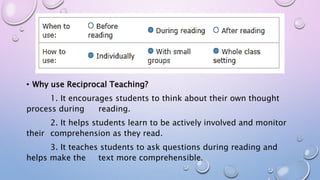
• Why use Reciprocal Teaching?
1. It encourages students to think about their own thought
process during reading.
2. It helps students learn to be actively involved and monitor
their comprehension as they read.
3. It teaches students to ask questions during reading and
helps make the text more comprehensible.
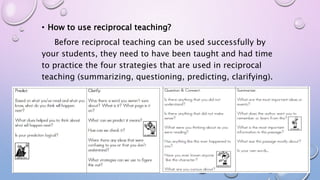
• How to use reciprocal teaching?
Before reciprocal teaching can be used successfully by
your students, they need to have been taught and had time
to practice the four strategies that are used in reciprocal
teaching (summarizing, questioning, predicting, clarifying).
STRATEGIES & APPROACHES:
• Put students in groups of four.
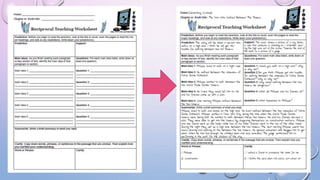
• Distribute one note card to each member of the group identifying
each person's unique role:
• Summarizer
• Questioner
• Clarifier
• Predictor
• Have students read a few paragraphs of the assigned text
selection. Encourage them to use note-taking strategies such as
selective underlining or sticky-notes to help them better prepare
for their role in the discussion.
• At the given stopping point, the summarizer will highlight the key
• The questioner will then pose questions about the selection:
• Unclear parts
• Puzzling information
• Connections to other concepts already learned
• The clarifier will address confusing parts and attempt to answer the
questions that were just posed.
• The predictor can offer predictions about what the author will tell the
group next or, if it's a literary selection, the predictor might suggest
what the next events in the story will be.
• The roles in the group then switch one person to the right, and the next
selection is read. Students repeat the process using their new roles. This
continues until the entire selection is read.
• Throughout the process, the teacher's role is to guide and nurture the
students' ability to use the four strategies successfully within the small
group. The teacher's role is lessened as students develop skill.
Differentiated instruction:
For second language learners, students of varying reading skill, and
for younger learners;
1. Pair a student with lower reading skills with one who is more
advanced to work together.
2. Ask student to write out questions about parts of the story that
doesn't make sense to them.
Our group comments:
• Great strategy, I'll be training to practice it in my class rooms, also I'll be training my
students too.
• Reciprocal reading is an excellent methodology in teaching as it helps the students to be
more involved in their own learning. They are also able to comprehend different aspects
of the texts, develop their reading and oral skills and to assist their fellow students to do
so too.
• Great strategies for teaching comprehension skills at all grade levels.
• This is a powerful tool for what good readers often instinctively do, and what developing
readers need to strengthen. Pretty amazing, when RT is applied correctly and students
buy in.
• Doing reciprocal teaching helps students to understand and comprehend what they are
reading.
• Reciprocal teaching would be an excellent skill to use in the classroom because it would
hep the students understand the material better and it would let the students take
• I understand that reciprocated learning is extremely beneficial to the learner
because it allows the learner to take the role of the teacher and allows them to
create, think at a high level, and use time well to analyse the information, well
enough to teach it to others.
• I love this method. We are moving into writing small paragraphs so this will help
a lot.
• I have used his type of teaching for years. Working in small groups is so
beneficial to all students and give me the chance to assess. Fantastic for
comprehension.
• I want to try this teaching activity to help students improve their comprehension
abilities, however i wonder how it will work with 1st graders.
• Although I had not known the correct term for this type of teaching, I have been
using this in my small group guided reading times. The students will begin with
an open ended question as they answer the question and peers are allowed to
answer, as well.
• This reminds me of guided reading. Reciprocal teaching is a great idea on
THANK
YOU

Reciprocal teaching

  • 1.
    RECIPROCAL TEACHING Refers toas an instructional activity in which students become the teacher in small group reading sessions.
  • 2.
    METHODS : • Teachersmodel, then help students learn to guide group discussions. • Using four strategies: 1. Summarizing, 2. Question generating, 3. Clarifying, 4. Predicting. • Once students have learned the strategies, they take turns assuming the role of teacher in leading a dialogue about what has been read.
  • 3.
    • Why useReciprocal Teaching? 1. It encourages students to think about their own thought process during reading. 2. It helps students learn to be actively involved and monitor their comprehension as they read. 3. It teaches students to ask questions during reading and helps make the text more comprehensible.
  • 4.
    • How touse reciprocal teaching? Before reciprocal teaching can be used successfully by your students, they need to have been taught and had time to practice the four strategies that are used in reciprocal teaching (summarizing, questioning, predicting, clarifying).
  • 5.
    STRATEGIES & APPROACHES: •Put students in groups of four. • Distribute one note card to each member of the group identifying each person's unique role: • Summarizer • Questioner • Clarifier • Predictor • Have students read a few paragraphs of the assigned text selection. Encourage them to use note-taking strategies such as selective underlining or sticky-notes to help them better prepare for their role in the discussion. • At the given stopping point, the summarizer will highlight the key
  • 6.
    • The questionerwill then pose questions about the selection: • Unclear parts • Puzzling information • Connections to other concepts already learned • The clarifier will address confusing parts and attempt to answer the questions that were just posed. • The predictor can offer predictions about what the author will tell the group next or, if it's a literary selection, the predictor might suggest what the next events in the story will be. • The roles in the group then switch one person to the right, and the next selection is read. Students repeat the process using their new roles. This continues until the entire selection is read. • Throughout the process, the teacher's role is to guide and nurture the students' ability to use the four strategies successfully within the small group. The teacher's role is lessened as students develop skill.
  • 7.
    Differentiated instruction: For secondlanguage learners, students of varying reading skill, and for younger learners; 1. Pair a student with lower reading skills with one who is more advanced to work together. 2. Ask student to write out questions about parts of the story that doesn't make sense to them.
  • 9.
    Our group comments: •Great strategy, I'll be training to practice it in my class rooms, also I'll be training my students too. • Reciprocal reading is an excellent methodology in teaching as it helps the students to be more involved in their own learning. They are also able to comprehend different aspects of the texts, develop their reading and oral skills and to assist their fellow students to do so too. • Great strategies for teaching comprehension skills at all grade levels. • This is a powerful tool for what good readers often instinctively do, and what developing readers need to strengthen. Pretty amazing, when RT is applied correctly and students buy in. • Doing reciprocal teaching helps students to understand and comprehend what they are reading. • Reciprocal teaching would be an excellent skill to use in the classroom because it would hep the students understand the material better and it would let the students take
  • 10.
    • I understandthat reciprocated learning is extremely beneficial to the learner because it allows the learner to take the role of the teacher and allows them to create, think at a high level, and use time well to analyse the information, well enough to teach it to others. • I love this method. We are moving into writing small paragraphs so this will help a lot. • I have used his type of teaching for years. Working in small groups is so beneficial to all students and give me the chance to assess. Fantastic for comprehension. • I want to try this teaching activity to help students improve their comprehension abilities, however i wonder how it will work with 1st graders. • Although I had not known the correct term for this type of teaching, I have been using this in my small group guided reading times. The students will begin with an open ended question as they answer the question and peers are allowed to answer, as well. • This reminds me of guided reading. Reciprocal teaching is a great idea on
  • 11.