CHARACTERISTICS OF EFFECTIVE TEACHER
BY TASNEEM SAIFUDDIN
M.PHIL SCHOLAR
DEFINITION
According to Harry Wong, there are three main characteristics of an effective
teacher:
 Has positive expectations for student success
 Excels at classroom management
 Designs lessons for mastery
CHARACTERISTICS
 Based on a scheme originally developed by M. Hildebrand, 1971.
1. Organization and Clarity
 explains clearly
 is well prepared
 makes difficult topics easy to understand
 uses examples, details, analogies, metaphors, and variety in modes of
explanation to make material not only understandable but memorable
 makes the objectives of the course and each class clear
 establishes a context for material
CHARACTERSITICS
2. Analytic/Synthetic Approach
 has a thorough command of the field
 contrasts the implications of various theories
 gives the student a sense of the field, its past, present, and future directions,
the origins of ideas and concepts
 presents facts and concepts from related fields
 discusses viewpoints other than his/her own
CHARACTERISTICS
3.Dynamism and Enthusiasm
 is an energetic, dynamic person
 seems to enjoy teaching
 conveys a love of the field
 has an aura of self-confidence
CHARACTERISTICS
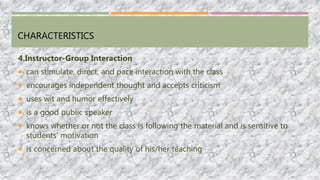
4.Instructor-Group Interaction
 can stimulate, direct, and pace interaction with the class
 encourages independent thought and accepts criticism
 uses wit and humor effectively
 is a good public speaker
 knows whether or not the class is following the material and is sensitive to
students’ motivation
 is concerned about the quality of his/her teaching
CHARACTERISTICS
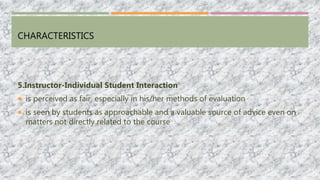
5.Instructor-Individual Student Interaction
 is perceived as fair, especially in his/her methods of evaluation
 is seen by students as approachable and a valuable source of advice even on
matters not directly related to the course
WHAT IS MOTIVATION?
 Motivation is an internal impulse that brings us to complete an action.
Without motivation, there is no action.
 Motivation is important because it is what causes us to actively look for
resources to guarantee our success. While some motivation requires a
conscious effort, others, like looking for food, eating, and shelter innate
motives that we are born with and allow us to stay alive. Secondary
motives keep us motivated to do activities and learn, which depend on each
person’s culture.
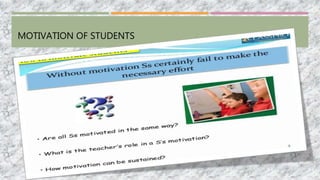
MOTIVATION OF STUDENTS
MOTIVATION
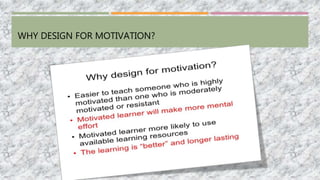
WHY DESIGN FOR MOTIVATION?
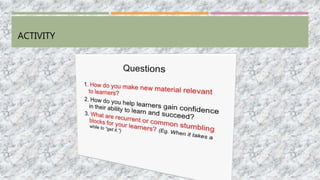
ACTIVITY
HOW TO MOTIVATE?
 Encourage students
 Offer incentives
 Get them involved
 Be creative
 Draw connections to real life
 Delegate responsibilities
 Spread excitement like a virus
 Open ended Assignments
 Respect the students
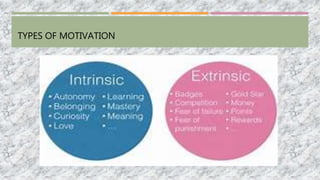
TYPES OF MOTIVATION
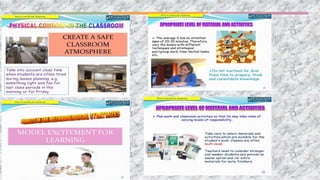
PROVISION OF ENVIRONMENT CONDUCIVE TO LEARNING
 PHYSICAL SPACE
 The physical space includes the layout and arrangement of the desks or
tables, the placement of computers and equipment, and items on the bulletin
boards and walls.
 GETTING STUDENTS TO COOPERATE
 One of the most challenging aspects of maintaining a neat and organized
environment that is conducive to learning is getting the students to
cooperate. To begin, you should clearly define the rules and routines for
transitions between activities and classes. Practice the transitions with the
class, and correct undesirable behaviors. Decrease the amount of unstructured
time by having materials prepared and readily available.
PROVISION OF ENVIRONMENT CONDUCIVE TO LEARNING
 CREATING A COMMUNAL ATMOSPHERE
 A communal atmosphere is a feeling established by instilling a sense of
community among the students. Another way to express this is creating a
learning community. After establishing the rules, routines, and transitions,
your next objective will be to transition the classroom into a communal
atmosphere, focusing on relationships and taking a personal interest in each
contributor to the community.
PROVISION OF ENVIRONMENT CONDUCIVE TO LEARNING
 CLASSROOM CLIMATE AND CULTURE
 After establishing a classroom community, the final step in creating a positive
atmosphere conducive to learning is to develop a positive classroom climate
and culture. A classroom’s climate and culture are the atmosphere and quality
of life in a classroom. Your role as teacher is that of the primary contributor to
the climate and culture. Your interaction with the students, disciplinary
measures, mannerisms, support, encouragement, cooperation, and focus on
individual students all contribute to an atmosphere conducive to learning.
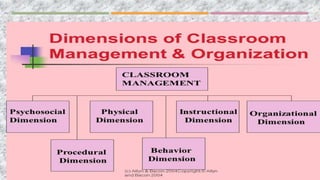
CLASSROOM MANAGEMENT DIMENSIONS
MODEL IDEAL BEHAVIOR
 Use polite language
 Maintain eye contact
 Keep phones in your pockets
 Let one another speak uninterrupted
 Raise concerns about one another’s statements in a respectful manner
CLASS ROOM MANAGEMENT
 LET STUDENTS HELP ESTABLISH GUIDELINES
 Encourage all students to help you build classroom rules, as you’ll generate
more buy-in than just telling them what they’re not allowed to do.
 AVOID PUNISHMENT
 Address isolated behavior issues instead of punishing an entire class, as the
latter can hurt your relationships with students who are on-task and
thereby jeopardize other classroom management efforts.
 Instead, call out specific students in a friendly manner.
CLASS ROOM MANAGEMENT
 INJECT INITIATIVE
 Promote growth mindset, and inject variety into your lessons, by allowing
students to work ahead and deliver short presentations to share take-
away points.
 OFFER PRAISE
 Inspire the class
 Improve a student’s self-esteem
 Reinforce rules and values you want to see
CLASS ROOM MANAGEMENT
 USE NONVERBAL COMMUNICATION
 Complement words with actions and visual aids to improve content
delivery, helping students focus and process lessons.
 GIVE TANGIBLE REWARDS
 Reward specific students at the end of each lesson, in front of the class, as
another motivational and behavior-reinforcement technique.
CLASS ROOM MANAGEMENT
 BRING EXCITEMENT FOR CONTENT
 OFFER DIFFERENT TYPES OF FREE STUDY TIME
 ADDRESS BAD BEHAVIOR QUICKLY
 GAMIFY PERSONAL LESSON PLANS
DIMENSIONS OF CLASSROOM MANAGEMENT
1.PSYCHOSOCIAL DIMENSION
 The psychosocial dimension of a classroom relates to what Smith (2004) calls
the classroom climate . Though students and their peers, as well as the
teacher, can affect the classroom climate, it is the teacher’s job to create and
maintain a positive classroom environment. The teacher will strive for his
classroom to be a supportive and caring environment for his students, while
at the same time being organized and conducive to learning.
2. PROCEDURAL DIMENSION
 Procedural Dimension
 Clear classroom procedures are imperative for a smooth-running classroom.
 When students know exactly what is expected of them in any given situation,
confusion and chaos can be avoided. Procedures should be taught at the start
of the school year so that they can be learned quickly and followed
throughout the entire school year.
3.PHYSICAL DIMENSION
 Physical Dimension
 For the physical layout of my classroom, the teacher will have all of the desks
facing the front of the classroom so that no student struggles to see the
lesson being taught.
 The individual desks grouped in pairs will be an effective way to organize the
students’ desks, being conducive to individual work without distractions and
also having the ability to be utilized for working together in pairs.
4.BEHAVIORAL DIMENSION
 Behavioral Dimension
 The behavioral dimension of classroom management is perhaps one of the
most
influential dimensions in managing a classroom. This is the dimension in which
classroom rules reside. Rules should be clear and concise; a limit of six or seven
rules is a good approach to rule making. Rules should be stated in a positive
way
5.INSTRUCTIONAL DIMENSION
 Instructional Dimension
 The instructional dimension of future classroom is the most exciting to plan
for, because it relates to the actual teaching that will be doing with teaching
philosophy, to put it briefly, will rely on a multi-faceted approach. The plan to
teach in many different styles and ways so that my students will always be
engaged, and all of their different interests will be played upon in my lessons.
6. ORGANIZATIONAL DIMENSION
 Organizational Dimension
 The organization of a classroom is key in its success. This can be seen in all of
the dimensions we have talked about so far, from the physical organization of a
classroom to the procedural organization. It will also be important for as a
teacher to have the work environment well organized.
7.ADDRESSING CHALLENGE BEHAVIORS
 Addressing Challenging Behaviors
 Even the most organized plans for classroom management can’t prevent
some problems from arising in the classroom. As future teachers, we are
given many tools to bring with us to our classrooms in order to help with
challenging behaviors . Response to Intervention and Curriculum Based
Measurements are both useful systems of dealing with troubles that students
may have with learning