i

observation tool

Effective Classroom
Observations

Presented by Pamela Potts
Director, iCOR Impact
Adjunct Instructor, JCCC
913.948.8742
pamela.potts@icorimpact.com
www.icorimpact.com
Presentation found at: http://www.slideshare.net/pamelaspotts
Description
¡  Effective Classroom Observations
¡  Classroom observations can be an effective tool
to improve teaching and learning. In this
workshop, we will review best practices in
classroom observations, a typical observation
format, how to collect the data, and using
observation data to provide effective feedback.

i

observation tool
i

observation tool

Quote:

“Pay attention to where you are going
because without meaning you might get
nowhere.”
A.A MILNE
Ultimate Goal:
Increase Student Outcomes
¡  “Students that are engaged learners learn more
and they retain what they learn longer.”
Carl Riddile, NASSP

¡  “Student engagement happens as a result of a
teacher’s careful planning and execution of
research-based strategies.”
Robert Marzano

¡  “Classroom observations can support systematic
improvement in teacher effectiveness.”
Research from CASTL/Center for Advanced Study of
Teaching and Learning

i

observation tool
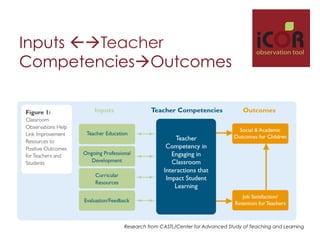
Inputs ßàTeacher
CompetenciesàOutcomes

i

observation tool

Research from CASTL/Center for Advanced Study of Teaching and Learning
Classroom Observations
¡  At the core, classroom observations should be
about:
¡  Coaching
¡  Building up professional practice
¡  Supporting better outcomes for students

i

observation tool
Observation System
¡  Examples would be:
¡  Charlotte Danielson
¡  Robert Marzano
¡  Jim Knight
¡  Kim Marshall
¡  Are you currently using a paper and pencil to collect
the observation
¡  No matter what system you use, the tool that you
use to collect the data should be easy to use and
not laborious, or it will be too hard to and too easy to
quit

i

observation tool
Best Practices in
Classroom
Observations
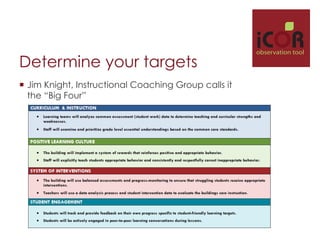
Determine your targets
¡  Jim Knight, Instructional Coaching Group calls it
the “Big Four”

i

observation tool
Determine your targets
¡  Do you have a system in place that helps you
define the goals?
¡  After defining the desired outcome, an
observation system can be selected to align with
objectives

i

observation tool
Questions
¡  What questions about classrooms do I want
answered?
¡  “People are not motivated by other people’s
goals” is the basis for involving teachers and
administrators in a partnership for identifying
areas for improvement through staff feedback,
observations and data analysis. Focusing on the
humanity of individuals and valuing the
professional contributions of all staff is vital to
establishing a culture of respect, learning and
continuous improvement.
Dr. Bret Church, Assistant Superintendent
Leavenworth KS

i

observation tool
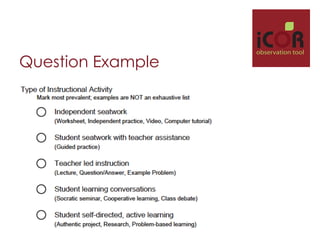
Question Example

i

observation tool
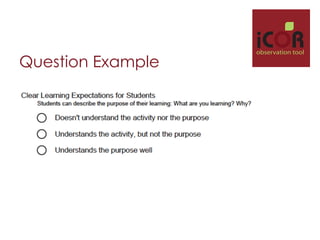
Question Example

i

observation tool
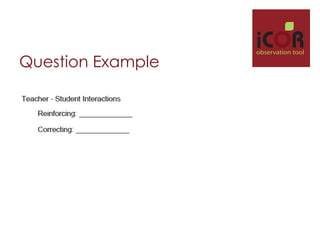
Question Example

i

observation tool
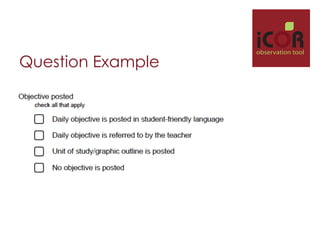
Question Example

i

observation tool
Observers & Procedures
¡  Are there clear directions for conducting
observations and assigning scores?
¡  3 Considerations:
¡  Training protocol to ensure consistency in scoring
methodology and general training on how to rate the
same classroom
¡  Observation protocol
¡  Length of observation
¡  Specific time of day / time of class period
¡  Whether or not the observations are
announced or unannounced
¡  Scoring directions
¡  Rubric for scoring
¡  Are scores based on behavior counts or
qualitative judgments?
¡  Important to have consistency across
observers

i

observation tool
Observational Data

i

observation tool

¡  The most appropriate use of observation data is
to get a sense of individual or programmatic
areas of strength and areas of challenge, to
guide individualized professional development or
other support, and to check to see if this support
is working to move teachers “up” in their ability to
provide quality teaching.

Research from CASTL/Center for Advanced Study of Teaching and Learning
Use Observations in the
Context of Relationships
¡  Professional development efforts are most
successful when they are embedded in the
context of supportive relationships between
teachers and those making observations and
providing feedback.
¡  Teachers need to know that they are valued
collaborative partners, and that their intent
concerns and goals are understood, and that
consultants/mentors/administrator will meet them
where they are and offer a balance of support
and challenge going forward to help them make
the greatest strides in their practice.

i

observation tool
Reading the Data
¡  How does data / information help you make
decisions?
¡  How it is going to influence the professional
development decision?
¡  Think how data can help you in opening up
topics to discuss with a teacher/teachers
¡  Report examples:

i

observation tool
Professional Development
¡  Primary goal for conducting classroom
observations not just the quality of the classroom
processes, but also to use that information to
help teachers improve their practices (and
eventually, student outcomes)
¡  What is in place for professional development

i

observation tool
Demo iCOR
¡  To see how iCOR can fit into your classroom
observation system:
¡  Visit icorimpact.com
¡  Attend a webinar
¡  Have a one-on-one demo with your team
¡  Request a 90-day trial

Thank you
Pamela Potts and the iCOR Impact Team

i

observation tool

Effective Classroom Observations

  • 1.
    i observation tool Effective Classroom Observations Presentedby Pamela Potts Director, iCOR Impact Adjunct Instructor, JCCC 913.948.8742 pamela.potts@icorimpact.com www.icorimpact.com Presentation found at: http://www.slideshare.net/pamelaspotts
  • 2.
    Description ¡  Effective ClassroomObservations ¡  Classroom observations can be an effective tool to improve teaching and learning. In this workshop, we will review best practices in classroom observations, a typical observation format, how to collect the data, and using observation data to provide effective feedback. i observation tool
  • 3.
    i observation tool Quote: “Pay attentionto where you are going because without meaning you might get nowhere.” A.A MILNE
  • 4.
    Ultimate Goal: Increase StudentOutcomes ¡  “Students that are engaged learners learn more and they retain what they learn longer.” Carl Riddile, NASSP ¡  “Student engagement happens as a result of a teacher’s careful planning and execution of research-based strategies.” Robert Marzano ¡  “Classroom observations can support systematic improvement in teacher effectiveness.” Research from CASTL/Center for Advanced Study of Teaching and Learning i observation tool
  • 5.
    Inputs ßàTeacher CompetenciesàOutcomes i observation tool Researchfrom CASTL/Center for Advanced Study of Teaching and Learning
  • 6.
    Classroom Observations ¡  Atthe core, classroom observations should be about: ¡  Coaching ¡  Building up professional practice ¡  Supporting better outcomes for students i observation tool
  • 7.
    Observation System ¡  Exampleswould be: ¡  Charlotte Danielson ¡  Robert Marzano ¡  Jim Knight ¡  Kim Marshall ¡  Are you currently using a paper and pencil to collect the observation ¡  No matter what system you use, the tool that you use to collect the data should be easy to use and not laborious, or it will be too hard to and too easy to quit i observation tool
  • 8.
  • 9.
    Determine your targets ¡ Jim Knight, Instructional Coaching Group calls it the “Big Four” i observation tool
  • 10.
    Determine your targets ¡ Do you have a system in place that helps you define the goals? ¡  After defining the desired outcome, an observation system can be selected to align with objectives i observation tool
  • 11.
    Questions ¡  What questionsabout classrooms do I want answered? ¡  “People are not motivated by other people’s goals” is the basis for involving teachers and administrators in a partnership for identifying areas for improvement through staff feedback, observations and data analysis. Focusing on the humanity of individuals and valuing the professional contributions of all staff is vital to establishing a culture of respect, learning and continuous improvement. Dr. Bret Church, Assistant Superintendent Leavenworth KS i observation tool
  • 12.
  • 13.
  • 14.
  • 15.
  • 16.
    Observers & Procedures ¡ Are there clear directions for conducting observations and assigning scores? ¡  3 Considerations: ¡  Training protocol to ensure consistency in scoring methodology and general training on how to rate the same classroom ¡  Observation protocol ¡  Length of observation ¡  Specific time of day / time of class period ¡  Whether or not the observations are announced or unannounced ¡  Scoring directions ¡  Rubric for scoring ¡  Are scores based on behavior counts or qualitative judgments? ¡  Important to have consistency across observers i observation tool
  • 17.
    Observational Data i observation tool ¡ The most appropriate use of observation data is to get a sense of individual or programmatic areas of strength and areas of challenge, to guide individualized professional development or other support, and to check to see if this support is working to move teachers “up” in their ability to provide quality teaching. Research from CASTL/Center for Advanced Study of Teaching and Learning
  • 18.
    Use Observations inthe Context of Relationships ¡  Professional development efforts are most successful when they are embedded in the context of supportive relationships between teachers and those making observations and providing feedback. ¡  Teachers need to know that they are valued collaborative partners, and that their intent concerns and goals are understood, and that consultants/mentors/administrator will meet them where they are and offer a balance of support and challenge going forward to help them make the greatest strides in their practice. i observation tool
  • 19.
    Reading the Data ¡ How does data / information help you make decisions? ¡  How it is going to influence the professional development decision? ¡  Think how data can help you in opening up topics to discuss with a teacher/teachers ¡  Report examples: i observation tool
  • 20.
    Professional Development ¡  Primarygoal for conducting classroom observations not just the quality of the classroom processes, but also to use that information to help teachers improve their practices (and eventually, student outcomes) ¡  What is in place for professional development i observation tool
  • 21.
    Demo iCOR ¡  Tosee how iCOR can fit into your classroom observation system: ¡  Visit icorimpact.com ¡  Attend a webinar ¡  Have a one-on-one demo with your team ¡  Request a 90-day trial Thank you Pamela Potts and the iCOR Impact Team i observation tool