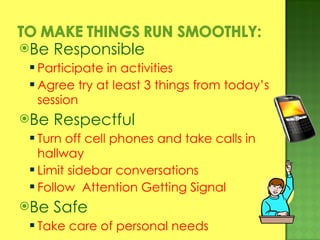
Be Responsible Participate in activities Agree try at least 3 things from today’s session Be Respectful Turn off cell phones and take calls in hallway Limit sidebar conversations Follow  Attention Getting Signal Be Safe Take care of personal needs
 
Brandi Simonsen Rob Horner George Sugia Ed Kame’enui Jeffrey Colvin Randy Sprick Marzano
Partners A and B First A tell B your name, District you work for and it’s location Your educational role, grade level, Why you are here/ what you hope to take back  from today Switch and B tell A Share with others at your table
“ A Leader is best when people barely know that he exists;… Not so good when people obey him or acclaim him;…. Worse when they despise or don’t respect him. Fail to honor people you lead, they fail to honor you… But of a good leader, who talks little, when his work is done, his aim fulfilled, they will all say: We did this ourselves!” Lao-Tsu, 604 BC
Consider your educational experience.  How did teachers/principals manage behavioral errors when you were in school? Consider your upbringing.  How did your parents deal with inappropriate behavior?
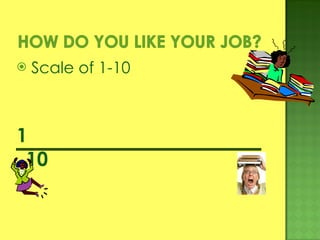
Scale of 1-10 1  10
Through what lens do you see your students, classroom, behavior? Is teaching more or less stressful than in the past or than you thought it would be? How do you handle frustration? How SHOULD students act?
Paraverbals Posture Positioning Face Tone of Voice What You Say
 
Mindfulness Heightened sense of situational awareness  A conscious control over one’s thoughts and behavior relative to the situation Read the sentence on the next slide only once and count the number of F’s in it
FINAL FOLIOS SEEM TO RESULT FROM YEARS OF DUTIFUL STUDY OF TEXTS ALONG WITH YEARS OF SCIENTIFIC EXPERIENCE DID YOU FIND 8?
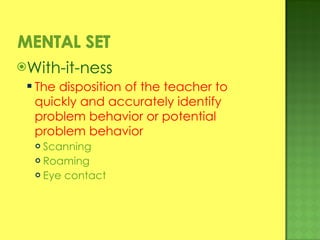
With-it-ness The disposition of the teacher to quickly and accurately identify problem behavior or potential problem behavior Scanning Roaming Eye contact
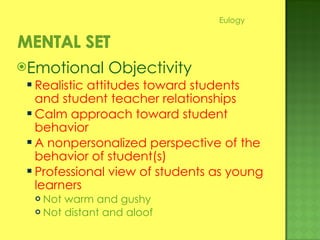
Emotional Objectivity Realistic attitudes toward students and student teacher relationships Calm approach toward student behavior A nonpersonalized perspective of the behavior of student(s) Professional view of students as young learners Not warm and gushy Not distant and aloof Eulogy
Write down 7 things you know about PBS A and B compare and explain your list, Share list with others at your table
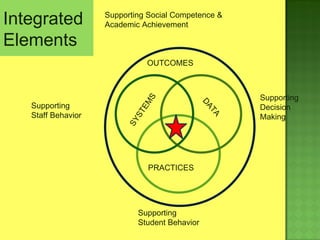
SYSTEMS PRACTICES DATA Supporting Staff Behavior Supporting Student Behavior OUTCOMES Supporting Social Competence & Academic Achievement Supporting Decision Making Integrated Elements
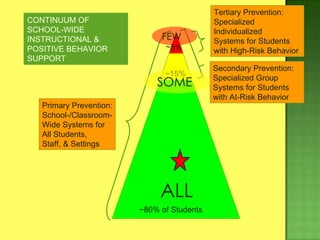
Primary Prevention: School-/Classroom- Wide Systems for All Students, Staff, & Settings Secondary Prevention: Specialized Group Systems for Students with At-Risk Behavior Tertiary Prevention: Specialized  Individualized Systems for Students with High-Risk Behavior ~80% of Students ~15%  ~5%  CONTINUUM OF SCHOOL-WIDE  INSTRUCTIONAL &  POSITIVE BEHAVIOR SUPPORT ALL SOME FEW
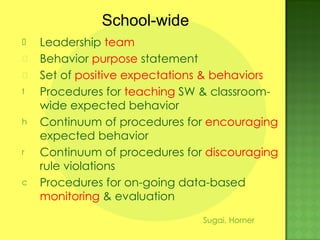
Leadership  team Behavior  purpose  statement Set of  positive expectations & behaviors Procedures for  teaching  SW & classroom-wide expected behavior Continuum of procedures for  encouraging  expected behavior Continuum of procedures for  discouraging  rule violations Procedures for on-going data-based  monitoring  & evaluation School-wide Sugai, Horner
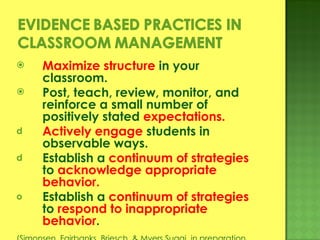
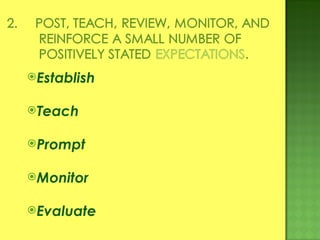
Maximize structure  in your classroom. Post, teach, review, monitor, and reinforce a small number of positively stated  expectations. Actively engage  students in observable ways. Establish a  continuum of strategies  to  acknowledge appropriate behavior. Establish a  continuum of strategies  to  respond to inappropriate behavior . (Simonsen, Fairbanks, Briesch, & Myers Sugai, in preparation )
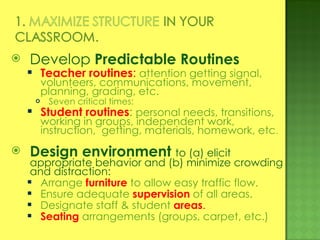
Develop  Predictable Routines Teacher routines :  attention getting signal, volunteers, communications, movement, planning, grading, etc. Seven critical times: Student routines :  personal needs, transitions, working in groups, independent work, instruction,  getting, materials, homework, etc . Design environment   to (a) elicit appropriate behavior and (b) minimize crowding and distraction: Arrange   furniture   to allow easy traffic flow. Ensure adequate  supervision   of all areas. Designate staff & student  areas . Seating   arrangements (groups, carpet, etc.)
Establish Teach Prompt   Monitor Evaluate
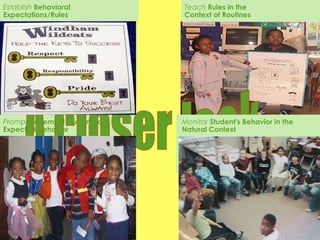
Establish  Behavioral Expectations/Rules Teach  Rules in the  Context of Routines Prompt  or Remind Students of Expected behavior A closer look... Monitor  Student's Behavior in the Natural Context
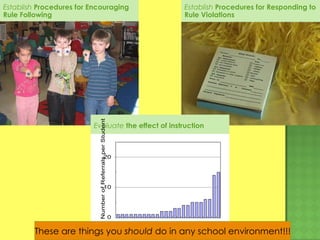
Establish  Procedures for Encouraging Rule Following Establish  Procedures for Responding to Rule Violations Evaluate  the effect of instruction These are things you  should  do in any school environment!!!
Provide high rates of opportunities to respond Vary individual v. group responding Increase participatory instruction  (enthusiasm, laughter) Consider various observable ways to engage students Written responses  Writing on individual white boards  Choral responding Gestures Other: ____________ Link engagement with outcome objectives  (set goals to increase engagement and assess student change CARs verbal/written)
Direct Instruction Computer Assisted Instruction Class-wide Peer Tutoring Guided notes Response Cards
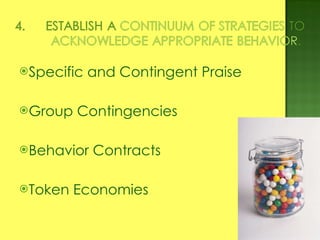
Specific and Contingent Praise Group Contingencies Behavior Contracts Token Economies
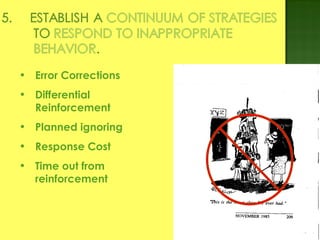
Error Corrections Differential Reinforcement Planned ignoring Response Cost Time out   from reinforcement

Classroom management

  • 1.
  • 2.
    Be Responsible Participatein activities Agree try at least 3 things from today’s session Be Respectful Turn off cell phones and take calls in hallway Limit sidebar conversations Follow Attention Getting Signal Be Safe Take care of personal needs
  • 3.
  • 4.
    Brandi Simonsen RobHorner George Sugia Ed Kame’enui Jeffrey Colvin Randy Sprick Marzano
  • 5.
    Partners A andB First A tell B your name, District you work for and it’s location Your educational role, grade level, Why you are here/ what you hope to take back from today Switch and B tell A Share with others at your table
  • 6.
    “ A Leaderis best when people barely know that he exists;… Not so good when people obey him or acclaim him;…. Worse when they despise or don’t respect him. Fail to honor people you lead, they fail to honor you… But of a good leader, who talks little, when his work is done, his aim fulfilled, they will all say: We did this ourselves!” Lao-Tsu, 604 BC
  • 7.
    Consider your educationalexperience. How did teachers/principals manage behavioral errors when you were in school? Consider your upbringing. How did your parents deal with inappropriate behavior?
  • 8.
  • 9.
    Through what lensdo you see your students, classroom, behavior? Is teaching more or less stressful than in the past or than you thought it would be? How do you handle frustration? How SHOULD students act?
  • 10.
    Paraverbals Posture PositioningFace Tone of Voice What You Say
  • 11.
  • 12.
    Mindfulness Heightened senseof situational awareness A conscious control over one’s thoughts and behavior relative to the situation Read the sentence on the next slide only once and count the number of F’s in it
  • 13.
    FINAL FOLIOS SEEMTO RESULT FROM YEARS OF DUTIFUL STUDY OF TEXTS ALONG WITH YEARS OF SCIENTIFIC EXPERIENCE DID YOU FIND 8?
  • 14.
    With-it-ness The dispositionof the teacher to quickly and accurately identify problem behavior or potential problem behavior Scanning Roaming Eye contact
  • 15.
    Emotional Objectivity Realisticattitudes toward students and student teacher relationships Calm approach toward student behavior A nonpersonalized perspective of the behavior of student(s) Professional view of students as young learners Not warm and gushy Not distant and aloof Eulogy
  • 16.
    Write down 7things you know about PBS A and B compare and explain your list, Share list with others at your table
  • 17.
    SYSTEMS PRACTICES DATASupporting Staff Behavior Supporting Student Behavior OUTCOMES Supporting Social Competence & Academic Achievement Supporting Decision Making Integrated Elements
  • 18.
    Primary Prevention: School-/Classroom-Wide Systems for All Students, Staff, & Settings Secondary Prevention: Specialized Group Systems for Students with At-Risk Behavior Tertiary Prevention: Specialized Individualized Systems for Students with High-Risk Behavior ~80% of Students ~15% ~5% CONTINUUM OF SCHOOL-WIDE INSTRUCTIONAL & POSITIVE BEHAVIOR SUPPORT ALL SOME FEW
  • 19.
    Leadership teamBehavior purpose statement Set of positive expectations & behaviors Procedures for teaching SW & classroom-wide expected behavior Continuum of procedures for encouraging expected behavior Continuum of procedures for discouraging rule violations Procedures for on-going data-based monitoring & evaluation School-wide Sugai, Horner
  • 20.
    Maximize structure in your classroom. Post, teach, review, monitor, and reinforce a small number of positively stated expectations. Actively engage students in observable ways. Establish a continuum of strategies to acknowledge appropriate behavior. Establish a continuum of strategies to respond to inappropriate behavior . (Simonsen, Fairbanks, Briesch, & Myers Sugai, in preparation )
  • 21.
    Develop PredictableRoutines Teacher routines : attention getting signal, volunteers, communications, movement, planning, grading, etc. Seven critical times: Student routines : personal needs, transitions, working in groups, independent work, instruction, getting, materials, homework, etc . Design environment to (a) elicit appropriate behavior and (b) minimize crowding and distraction: Arrange furniture to allow easy traffic flow. Ensure adequate supervision of all areas. Designate staff & student areas . Seating arrangements (groups, carpet, etc.)
  • 22.
    Establish Teach Prompt Monitor Evaluate
  • 23.
    Establish BehavioralExpectations/Rules Teach Rules in the Context of Routines Prompt or Remind Students of Expected behavior A closer look... Monitor Student's Behavior in the Natural Context
  • 24.
    Establish Proceduresfor Encouraging Rule Following Establish Procedures for Responding to Rule Violations Evaluate the effect of instruction These are things you should do in any school environment!!!
  • 25.
    Provide high ratesof opportunities to respond Vary individual v. group responding Increase participatory instruction (enthusiasm, laughter) Consider various observable ways to engage students Written responses Writing on individual white boards Choral responding Gestures Other: ____________ Link engagement with outcome objectives (set goals to increase engagement and assess student change CARs verbal/written)
  • 26.
    Direct Instruction ComputerAssisted Instruction Class-wide Peer Tutoring Guided notes Response Cards
  • 27.
    Specific and ContingentPraise Group Contingencies Behavior Contracts Token Economies
  • 28.
    Error Corrections DifferentialReinforcement Planned ignoring Response Cost Time out from reinforcement

Editor's Notes

  • #7 I will always try to … I will never… There is no teaching unless learning occurs
  • #15 Study by Jacob Kounin – withitness had the biggest decrease in disruptive behavior
  • #16 Eulogy
  • #23 Sarah
  • #28 Amy