PASSIVE CIRCUIT
COMPONENTS
Efforts By –
SAKSHAM KOUL
PASSIVE CIRCUIT COMPONENTS – WHAT?
 A passive component is an electronic component which can only receive energy,
which it can either dissipate, absorb or store it in an electric field or a magnetic field.
 Passive elements do not need any form of electrical power to operate.
 They are contrary in principle to the active circuit elements, which can be
understood as suppliers of energy in a circuit, such as a battery.
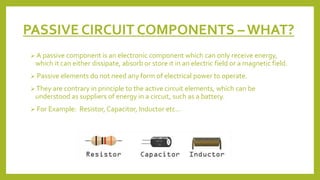
 For Example: Resistor, Capacitor, Inductor etc…
RESISTOR
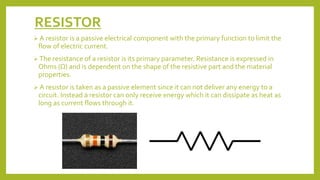
 A resistor is a passive electrical component with the primary function to limit the
flow of electric current.
 The resistance of a resistor is its primary parameter. Resistance is expressed in
Ohms (Ω) and is dependent on the shape of the resistive part and the material
properties.
 A resistor is taken as a passive element since it can not deliver any energy to a
circuit. Instead a resistor can only receive energy which it can dissipate as heat as
long as current flows through it.
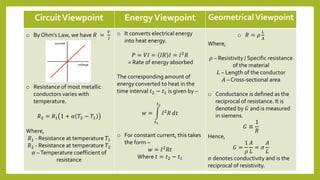
CircuitViewpoint EnergyViewpoint GeometricalViewpoint
o By Ohm’s Law, we have 𝑅 =
𝑉
𝐼
o Resistance of most metallic
conductors varies with
temperature.
𝑅2 = 𝑅1 1 + 𝛼 𝑇2 − 𝑇1
Where,
𝑅1 - Resistance at temperature 𝑇1
𝑅2 - Resistance at temperature 𝑇2
𝛼 –Temperature coefficient of
resistance
o It converts electrical energy
into heat energy.
𝑃 = 𝑉𝐼 = 𝐼𝑅 𝐼 = 𝐼2 𝑅
= Rate of energy absorbed
The corresponding amount of
energy converted to heat in the
time interval 𝑡2 − 𝑡1 is given by –
𝑤 =
𝑡1
𝑡2
𝐼2 𝑅 ⅆ𝑡
o For constant current, this takes
the form –
𝑤 = 𝐼2 𝑅𝑡
Where 𝑡 = 𝑡2 − 𝑡1
o 𝑅 = 𝜌
𝐿
𝐴
Where,
𝜌 – Resistivity / Specific resistance
of the material
𝐿 – Length of the conductor
𝐴 – Cross-sectional area
o Conductance is defined as the
reciprocal of resistance. It is
denoted by 𝐺 and is measured
in siemens.
𝐺 ≡
1
𝑅
Hence,
𝐺 =
1
𝜌
𝐴
𝐿
= 𝜎
𝐴
𝐿
𝜎 denotes conductivity and is the
reciprocal of resistivity.
CAPACITOR
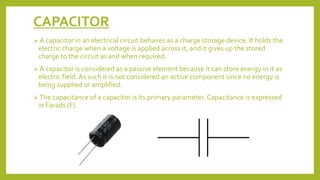
 A capacitor in an electrical circuit behaves as a charge storage device. It holds the
electric charge when a voltage is applied across it, and it gives up the stored
charge to the circuit as and when required.
 A capacitor is considered as a passive element because it can store energy in it as
electric field. As such it is not considered an active component since no energy is
being supplied or amplified.
 The capacitance of a capacitor is its primary parameter. Capacitance is expressed
in Farads (F).
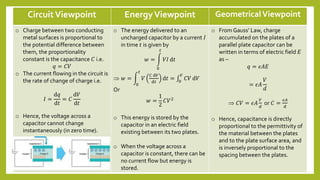
CircuitViewpoint EnergyViewpoint GeometricalViewpoint
o Charge between two conducting
metal surfaces is proportional to
the potential difference between
them, the proportionality
constant is the capacitance 𝐶 i.e.
𝑞 = 𝐶𝑉
o The current flowing in the circuit is
the rate of change of charge i.e.
𝐼 =
ⅆ𝑞
ⅆ𝑡
= 𝐶
ⅆ𝑉
ⅆ𝑡
o Hence, the voltage across a
capacitor cannot change
instantaneously (in zero time).
o The energy delivered to an
uncharged capacitor by a current 𝐼
in time 𝑡 is given by
𝑤 =
0
𝑡
𝑉𝐼 ⅆ𝑡
 𝑤 =
0
𝑡
𝑉
𝐶 ⅆ𝑉
ⅆ𝑡
ⅆ𝑡 = 0
𝑉
𝐶𝑉 ⅆ𝑉
Or
𝑤 =
1
2
𝐶𝑉2
o This energy is stored by the
capacitor in an electric field
existing between its two plates.
o When the voltage across a
capacitor is constant, there can be
no current flow but energy is
stored.
o From Gauss’ Law, charge
accumulated on the plates of a
parallel plate capacitor can be
written in terms of electric field 𝐸
as –
𝑞 = 𝜖𝐴𝐸
= 𝜖𝐴
𝑉
ⅆ
 𝐶𝑉 = 𝜖𝐴
𝑉
𝑑
or 𝐶 =
𝜖𝐴
𝑑
o Hence, capacitance is directly
proportional to the permittivity of
the material between the plates
and to the plate surface area, and
is inversely proportional to the
spacing between the plates.
INDUCTOR
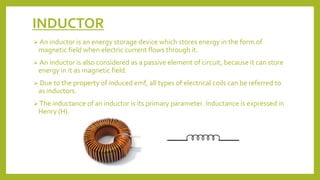
 An inductor is an energy storage device which stores energy in the form of
magnetic field when electric current flows through it.
 An inductor is also considered as a passive element of circuit, because it can store
energy in it as magnetic field.
 Due to the property of induced emf, all types of electrical coils can be referred to
as inductors.
 The inductance of an inductor is its primary parameter. Inductance is expressed in
Henry (H).
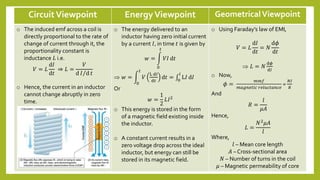
CircuitViewpoint EnergyViewpoint GeometricalViewpoint
o The induced emf across a coil is
directly proportional to the rate of
change of current through it, the
proportionality constant is
inductance 𝐿 i.e.
𝑉 = 𝐿
ⅆ𝐼
ⅆ𝑡
⇒ 𝐿 =
𝑉
ⅆ 𝐼 ⅆ 𝑡
o Hence, the current in an inductor
cannot change abruptly in zero
time.
o The energy delivered to an
inductor having zero initial current
by a current 𝐼, in time 𝑡 is given by
𝑤 =
0
𝑡
𝑉𝐼 ⅆ𝑡
 𝑤 =
0
𝑡
𝑉
L ⅆ𝐼
ⅆ𝑡
ⅆ𝑡 = 0
𝐼
L𝐼 ⅆ𝐼
Or
𝑤 =
1
2
𝐿𝐼2
o This energy is stored in the form
of a magnetic field existing inside
the inductor.
o A constant current results in a
zero voltage drop across the ideal
inductor, but energy can still be
stored in its magnetic field.
o Using Faraday’s law of EMI,
𝑉 = 𝐿
ⅆ𝐼
ⅆ𝑡
= 𝑁
ⅆ𝜙
ⅆ𝑡
 𝐿 = 𝑁
ⅆ𝜙
ⅆ𝐼
o Now,
𝜙 =
𝑚𝑚𝑓
𝑚𝑎𝑔𝑛𝑒𝑡𝑖𝑐 𝑟𝑒𝑙𝑢𝑐𝑡𝑎𝑛𝑐𝑒
=
𝑁𝐼
𝑅
And
𝑅 =
𝑙
𝜇𝐴
Hence,
𝐿 =
𝑁2 𝜇𝐴
𝑙
Where,
𝑙 – Mean core length
𝐴 – Cross-sectional area
𝑁 – Number of turns in the coil
𝜇 – Magnetic permeability of core

Passive Circuit Components

  • 1.
  • 2.
    PASSIVE CIRCUIT COMPONENTS– WHAT?  A passive component is an electronic component which can only receive energy, which it can either dissipate, absorb or store it in an electric field or a magnetic field.  Passive elements do not need any form of electrical power to operate.  They are contrary in principle to the active circuit elements, which can be understood as suppliers of energy in a circuit, such as a battery.  For Example: Resistor, Capacitor, Inductor etc…
  • 3.
    RESISTOR  A resistoris a passive electrical component with the primary function to limit the flow of electric current.  The resistance of a resistor is its primary parameter. Resistance is expressed in Ohms (Ω) and is dependent on the shape of the resistive part and the material properties.  A resistor is taken as a passive element since it can not deliver any energy to a circuit. Instead a resistor can only receive energy which it can dissipate as heat as long as current flows through it.
  • 4.
    CircuitViewpoint EnergyViewpoint GeometricalViewpoint oBy Ohm’s Law, we have 𝑅 = 𝑉 𝐼 o Resistance of most metallic conductors varies with temperature. 𝑅2 = 𝑅1 1 + 𝛼 𝑇2 − 𝑇1 Where, 𝑅1 - Resistance at temperature 𝑇1 𝑅2 - Resistance at temperature 𝑇2 𝛼 –Temperature coefficient of resistance o It converts electrical energy into heat energy. 𝑃 = 𝑉𝐼 = 𝐼𝑅 𝐼 = 𝐼2 𝑅 = Rate of energy absorbed The corresponding amount of energy converted to heat in the time interval 𝑡2 − 𝑡1 is given by – 𝑤 = 𝑡1 𝑡2 𝐼2 𝑅 ⅆ𝑡 o For constant current, this takes the form – 𝑤 = 𝐼2 𝑅𝑡 Where 𝑡 = 𝑡2 − 𝑡1 o 𝑅 = 𝜌 𝐿 𝐴 Where, 𝜌 – Resistivity / Specific resistance of the material 𝐿 – Length of the conductor 𝐴 – Cross-sectional area o Conductance is defined as the reciprocal of resistance. It is denoted by 𝐺 and is measured in siemens. 𝐺 ≡ 1 𝑅 Hence, 𝐺 = 1 𝜌 𝐴 𝐿 = 𝜎 𝐴 𝐿 𝜎 denotes conductivity and is the reciprocal of resistivity.
  • 5.
    CAPACITOR  A capacitorin an electrical circuit behaves as a charge storage device. It holds the electric charge when a voltage is applied across it, and it gives up the stored charge to the circuit as and when required.  A capacitor is considered as a passive element because it can store energy in it as electric field. As such it is not considered an active component since no energy is being supplied or amplified.  The capacitance of a capacitor is its primary parameter. Capacitance is expressed in Farads (F).
  • 6.
    CircuitViewpoint EnergyViewpoint GeometricalViewpoint oCharge between two conducting metal surfaces is proportional to the potential difference between them, the proportionality constant is the capacitance 𝐶 i.e. 𝑞 = 𝐶𝑉 o The current flowing in the circuit is the rate of change of charge i.e. 𝐼 = ⅆ𝑞 ⅆ𝑡 = 𝐶 ⅆ𝑉 ⅆ𝑡 o Hence, the voltage across a capacitor cannot change instantaneously (in zero time). o The energy delivered to an uncharged capacitor by a current 𝐼 in time 𝑡 is given by 𝑤 = 0 𝑡 𝑉𝐼 ⅆ𝑡  𝑤 = 0 𝑡 𝑉 𝐶 ⅆ𝑉 ⅆ𝑡 ⅆ𝑡 = 0 𝑉 𝐶𝑉 ⅆ𝑉 Or 𝑤 = 1 2 𝐶𝑉2 o This energy is stored by the capacitor in an electric field existing between its two plates. o When the voltage across a capacitor is constant, there can be no current flow but energy is stored. o From Gauss’ Law, charge accumulated on the plates of a parallel plate capacitor can be written in terms of electric field 𝐸 as – 𝑞 = 𝜖𝐴𝐸 = 𝜖𝐴 𝑉 ⅆ  𝐶𝑉 = 𝜖𝐴 𝑉 𝑑 or 𝐶 = 𝜖𝐴 𝑑 o Hence, capacitance is directly proportional to the permittivity of the material between the plates and to the plate surface area, and is inversely proportional to the spacing between the plates.
  • 7.
    INDUCTOR  An inductoris an energy storage device which stores energy in the form of magnetic field when electric current flows through it.  An inductor is also considered as a passive element of circuit, because it can store energy in it as magnetic field.  Due to the property of induced emf, all types of electrical coils can be referred to as inductors.  The inductance of an inductor is its primary parameter. Inductance is expressed in Henry (H).
  • 8.
    CircuitViewpoint EnergyViewpoint GeometricalViewpoint oThe induced emf across a coil is directly proportional to the rate of change of current through it, the proportionality constant is inductance 𝐿 i.e. 𝑉 = 𝐿 ⅆ𝐼 ⅆ𝑡 ⇒ 𝐿 = 𝑉 ⅆ 𝐼 ⅆ 𝑡 o Hence, the current in an inductor cannot change abruptly in zero time. o The energy delivered to an inductor having zero initial current by a current 𝐼, in time 𝑡 is given by 𝑤 = 0 𝑡 𝑉𝐼 ⅆ𝑡  𝑤 = 0 𝑡 𝑉 L ⅆ𝐼 ⅆ𝑡 ⅆ𝑡 = 0 𝐼 L𝐼 ⅆ𝐼 Or 𝑤 = 1 2 𝐿𝐼2 o This energy is stored in the form of a magnetic field existing inside the inductor. o A constant current results in a zero voltage drop across the ideal inductor, but energy can still be stored in its magnetic field. o Using Faraday’s law of EMI, 𝑉 = 𝐿 ⅆ𝐼 ⅆ𝑡 = 𝑁 ⅆ𝜙 ⅆ𝑡  𝐿 = 𝑁 ⅆ𝜙 ⅆ𝐼 o Now, 𝜙 = 𝑚𝑚𝑓 𝑚𝑎𝑔𝑛𝑒𝑡𝑖𝑐 𝑟𝑒𝑙𝑢𝑐𝑡𝑎𝑛𝑐𝑒 = 𝑁𝐼 𝑅 And 𝑅 = 𝑙 𝜇𝐴 Hence, 𝐿 = 𝑁2 𝜇𝐴 𝑙 Where, 𝑙 – Mean core length 𝐴 – Cross-sectional area 𝑁 – Number of turns in the coil 𝜇 – Magnetic permeability of core