08/16/2024
S.GURUPRASAD
SRI VENKATESWARA INSTITUTE OF SCIENCE AND TECHNOLOGY
1
SRI VENKATESWARA INSTITUTE OF SCIENCE &
TECHNOLOGY: KADAPA
FUNDAMENTALS OF
ELECTRICAL CIRCUITS
20A02101T
I B.Tech-I Sem ECE
Prepared by :
S GURUPRASAD
Asso. Professor, EEE
08/16/2024 2
Course Objectives:
• To make the student learn about
• Basic characteristics of R, L, C parameters, their Voltage and
Current Relations and Various combinations of these
parameters.
• The Single Phase AC circuits and concepts of real power,
reactive power, complex power, phase angle and phase
difference
• Series and parallel resonances, bandwidth, current locus
diagrams
• Network theorems and their applications
• Network Topology and concepts like Tree, Cut-set , Tie-set,
Loop, Co-Tree
S.GURUPRASAD
SRI VENKATESWARA INSTITUTE OF SCIENCE AND TECHNOLOGY
08/16/2024 3
Unit- 1 : Introduction to Electrical & Magnetic
Circuits
• Electrical Circuits: Circuit Concept - Types of elements
- Source Transformation
- Voltage - Current Relationship for Passive Elements
- Kirchhoff’s Laws
- Network Reduction Techniques- Series, Parallel, Series Parallel
- Star-to-Delta or Delta-to-Star Transformation
- Examples
• Magnetic Circuits: Faraday’s Laws of Electromagnetic Induction
- Concept of Self and Mutual Inductance
- Dot Convention
- Coefficient of Coupling
- Composite Magnetic Circuit
- Analysis of Series and Parallel Magnetic Circuits
- MMF Calculations.
S.GURUPRASAD
SRI VENKATESWARA INSTITUTE OF SCIENCE AND TECHNOLOGY
08/16/2024 4
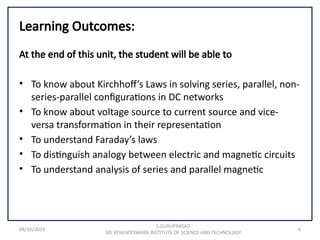
Learning Outcomes:
At the end of this unit, the student will be able to
• To know about Kirchhoff’s Laws in solving series, parallel, non-
series-parallel configurations in DC networks
• To know about voltage source to current source and vice-
versa transformation in their representation
• To understand Faraday’s laws
• To distinguish analogy between electric and magnetic circuits
• To understand analysis of series and parallel magnetic
S.GURUPRASAD
SRI VENKATESWARA INSTITUTE OF SCIENCE AND TECHNOLOGY
08/16/2024 5
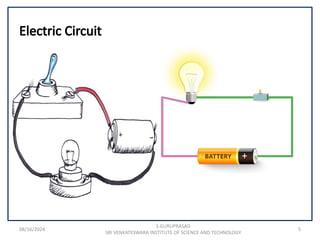
Electric Circuit
S.GURUPRASAD
SRI VENKATESWARA INSTITUTE OF SCIENCE AND TECHNOLOGY
08/16/2024 6
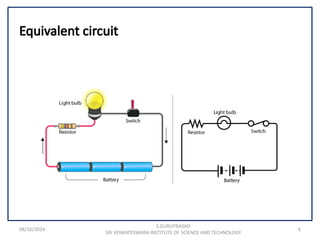
Equivalent circuit
S.GURUPRASAD
SRI VENKATESWARA INSTITUTE OF SCIENCE AND TECHNOLOGY
08/16/2024 7
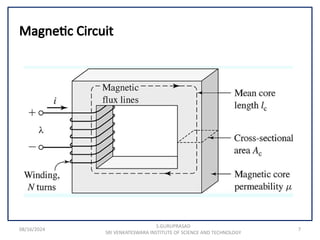
Magnetic Circuit
S.GURUPRASAD
SRI VENKATESWARA INSTITUTE OF SCIENCE AND TECHNOLOGY
08/16/2024 8
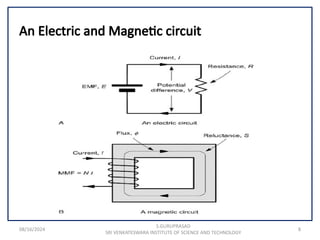
An Electric and Magnetic circuit
S.GURUPRASAD
SRI VENKATESWARA INSTITUTE OF SCIENCE AND TECHNOLOGY
08/16/2024 9
Types of Elements
S.GURUPRASAD
SRI VENKATESWARA INSTITUTE OF SCIENCE AND TECHNOLOGY
08/16/2024 10
Active and Passive
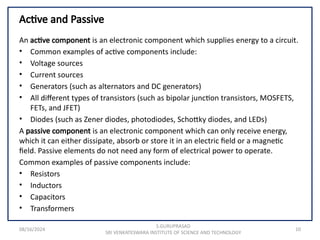
An active component is an electronic component which supplies energy to a circuit.
• Common examples of active components include:
• Voltage sources
• Current sources
• Generators (such as alternators and DC generators)
• All different types of transistors (such as bipolar junction transistors, MOSFETS,
FETs, and JFET)
• Diodes (such as Zener diodes, photodiodes, Schottky diodes, and LEDs)
A passive component is an electronic component which can only receive energy,
which it can either dissipate, absorb or store it in an electric field or a magnetic
field. Passive elements do not need any form of electrical power to operate.
Common examples of passive components include:
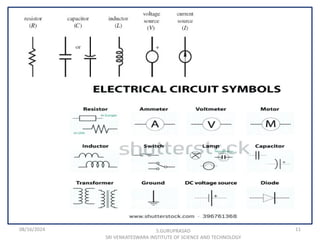
• Resistors
• Inductors
• Capacitors
• Transformers
S.GURUPRASAD
SRI VENKATESWARA INSTITUTE OF SCIENCE AND TECHNOLOGY
08/16/2024 11
S.GURUPRASAD
SRI VENKATESWARA INSTITUTE OF SCIENCE AND TECHNOLOGY
12
08/16/2024
S.GURUPRASAD
SRI VENKATESWARA INSTITUTE OF SCIENCE AND TECHNOLOGY
08/16/2024 13
Active and Passive
An active component is an electronic component which supplies energy to a circuit.
• Common examples of active components include:
• Voltage sources
• Current sources
• Generators (such as alternators and DC generators)
• All different types of transistors (such as bipolar junction transistors, MOSFETS,
FETs, and JFET)
• Diodes (such as Zener diodes, photodiodes, Schottky diodes, and LEDs)
A passive component is an electronic component which can only receive energy,
which it can either dissipate, absorb or store it in an electric field or a magnetic
field. Passive elements do not need any form of electrical power to operate.
Common examples of passive components include:
• Resistors
• Inductors
• Capacitors
• Transformers
S.GURUPRASAD
SRI VENKATESWARA INSTITUTE OF SCIENCE AND TECHNOLOGY
08/16/2024 14
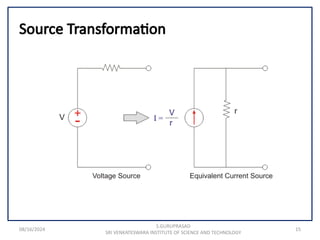
• An electrical source transformation (or just ”source
transformation”) is a method for simplifying circuits
by replacing a voltage source with its equivalent
current source, or a current source with its
equivalent voltage source. Source transformations
are implemented using Thevenin’s theorem and
Norton’s Theorem.
S.GURUPRASAD
SRI VENKATESWARA INSTITUTE OF SCIENCE AND TECHNOLOGY
Source Transformation- Voltage - Current
08/16/2024 15
Source Transformation
S.GURUPRASAD
SRI VENKATESWARA INSTITUTE OF SCIENCE AND TECHNOLOGY

basic electrical and electronics engineering

  • 1.
    08/16/2024 S.GURUPRASAD SRI VENKATESWARA INSTITUTEOF SCIENCE AND TECHNOLOGY 1 SRI VENKATESWARA INSTITUTE OF SCIENCE & TECHNOLOGY: KADAPA FUNDAMENTALS OF ELECTRICAL CIRCUITS 20A02101T I B.Tech-I Sem ECE Prepared by : S GURUPRASAD Asso. Professor, EEE
  • 2.
    08/16/2024 2 Course Objectives: •To make the student learn about • Basic characteristics of R, L, C parameters, their Voltage and Current Relations and Various combinations of these parameters. • The Single Phase AC circuits and concepts of real power, reactive power, complex power, phase angle and phase difference • Series and parallel resonances, bandwidth, current locus diagrams • Network theorems and their applications • Network Topology and concepts like Tree, Cut-set , Tie-set, Loop, Co-Tree S.GURUPRASAD SRI VENKATESWARA INSTITUTE OF SCIENCE AND TECHNOLOGY
  • 3.
    08/16/2024 3 Unit- 1: Introduction to Electrical & Magnetic Circuits • Electrical Circuits: Circuit Concept - Types of elements - Source Transformation - Voltage - Current Relationship for Passive Elements - Kirchhoff’s Laws - Network Reduction Techniques- Series, Parallel, Series Parallel - Star-to-Delta or Delta-to-Star Transformation - Examples • Magnetic Circuits: Faraday’s Laws of Electromagnetic Induction - Concept of Self and Mutual Inductance - Dot Convention - Coefficient of Coupling - Composite Magnetic Circuit - Analysis of Series and Parallel Magnetic Circuits - MMF Calculations. S.GURUPRASAD SRI VENKATESWARA INSTITUTE OF SCIENCE AND TECHNOLOGY
  • 4.
    08/16/2024 4 Learning Outcomes: Atthe end of this unit, the student will be able to • To know about Kirchhoff’s Laws in solving series, parallel, non- series-parallel configurations in DC networks • To know about voltage source to current source and vice- versa transformation in their representation • To understand Faraday’s laws • To distinguish analogy between electric and magnetic circuits • To understand analysis of series and parallel magnetic S.GURUPRASAD SRI VENKATESWARA INSTITUTE OF SCIENCE AND TECHNOLOGY
  • 5.
    08/16/2024 5 Electric Circuit S.GURUPRASAD SRIVENKATESWARA INSTITUTE OF SCIENCE AND TECHNOLOGY
  • 6.
    08/16/2024 6 Equivalent circuit S.GURUPRASAD SRIVENKATESWARA INSTITUTE OF SCIENCE AND TECHNOLOGY
  • 7.
    08/16/2024 7 Magnetic Circuit S.GURUPRASAD SRIVENKATESWARA INSTITUTE OF SCIENCE AND TECHNOLOGY
  • 8.
    08/16/2024 8 An Electricand Magnetic circuit S.GURUPRASAD SRI VENKATESWARA INSTITUTE OF SCIENCE AND TECHNOLOGY
  • 9.
    08/16/2024 9 Types ofElements S.GURUPRASAD SRI VENKATESWARA INSTITUTE OF SCIENCE AND TECHNOLOGY
  • 10.
    08/16/2024 10 Active andPassive An active component is an electronic component which supplies energy to a circuit. • Common examples of active components include: • Voltage sources • Current sources • Generators (such as alternators and DC generators) • All different types of transistors (such as bipolar junction transistors, MOSFETS, FETs, and JFET) • Diodes (such as Zener diodes, photodiodes, Schottky diodes, and LEDs) A passive component is an electronic component which can only receive energy, which it can either dissipate, absorb or store it in an electric field or a magnetic field. Passive elements do not need any form of electrical power to operate. Common examples of passive components include: • Resistors • Inductors • Capacitors • Transformers S.GURUPRASAD SRI VENKATESWARA INSTITUTE OF SCIENCE AND TECHNOLOGY
  • 11.
    08/16/2024 11 S.GURUPRASAD SRI VENKATESWARAINSTITUTE OF SCIENCE AND TECHNOLOGY
  • 12.
  • 13.
    08/16/2024 13 Active andPassive An active component is an electronic component which supplies energy to a circuit. • Common examples of active components include: • Voltage sources • Current sources • Generators (such as alternators and DC generators) • All different types of transistors (such as bipolar junction transistors, MOSFETS, FETs, and JFET) • Diodes (such as Zener diodes, photodiodes, Schottky diodes, and LEDs) A passive component is an electronic component which can only receive energy, which it can either dissipate, absorb or store it in an electric field or a magnetic field. Passive elements do not need any form of electrical power to operate. Common examples of passive components include: • Resistors • Inductors • Capacitors • Transformers S.GURUPRASAD SRI VENKATESWARA INSTITUTE OF SCIENCE AND TECHNOLOGY
  • 14.
    08/16/2024 14 • Anelectrical source transformation (or just ”source transformation”) is a method for simplifying circuits by replacing a voltage source with its equivalent current source, or a current source with its equivalent voltage source. Source transformations are implemented using Thevenin’s theorem and Norton’s Theorem. S.GURUPRASAD SRI VENKATESWARA INSTITUTE OF SCIENCE AND TECHNOLOGY Source Transformation- Voltage - Current
  • 15.
    08/16/2024 15 Source Transformation S.GURUPRASAD SRIVENKATESWARA INSTITUTE OF SCIENCE AND TECHNOLOGY