Principles of Electric Circuits - Floyd © Copyright 2006 Prentice-Hall
ACTIVE AND PASSIVE
COMPONENTS
BY
A S R S S SNIGDHA -23R11A6201
AAKHILA- 23R11A6203
B REKHA-23R11A6206
B HASINI - 23R11A6207
T SUJANA-23R11A6241
Principles of Electric Circuits - Floyd © Copyright 2006 Prentice-Hall
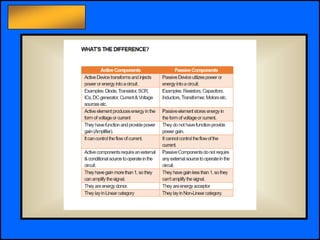
PASSIVE COMPONENT
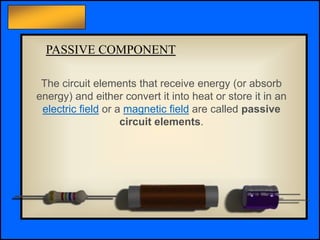
The circuit elements that receive energy (or absorb
energy) and either convert it into heat or store it in an
electric field or a magnetic field are called passive
circuit elements.
Principles of Electric Circuits - Floyd © Copyright 2006 Prentice-Hall
Passive Components
Mica
Foil
Foil
Mica
Foil
Foil
Mica
Foil
Tantalum electrolytic
capacitor (polarized)
Mica capacitor_
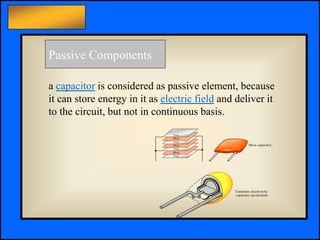
a capacitor is considered as passive element, because
it can store energy in it as electric field and deliver it
to the circuit, but not in continuous basis.
Principles of Electric Circuits - Floyd © Copyright 2006 Prentice-Hall
Passive Components
TRANSFORMERS
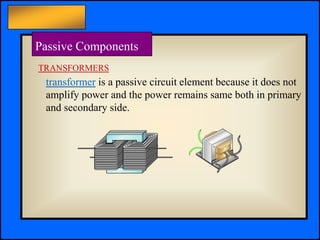
transformer is a passive circuit element because it does not
amplify power and the power remains same both in primary
and secondary side.
Principles of Electric Circuits - Floyd © Copyright 2006 Prentice-Hall
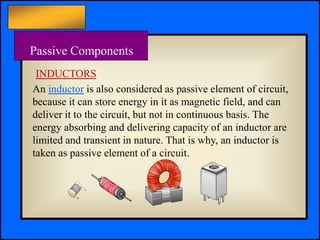
INDUCTORS
Passive Components
An inductor is also considered as passive element of circuit,
because it can store energy in it as magnetic field, and can
deliver it to the circuit, but not in continuous basis. The
energy absorbing and delivering capacity of an inductor are
limited and transient in nature. That is why, an inductor is
taken as passive element of a circuit.
Principles of Electric Circuits - Floyd © Copyright 2006 Prentice-Hall
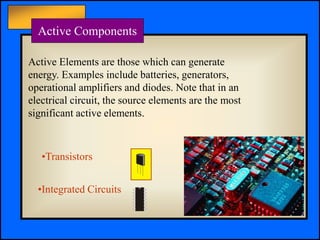
•Transistors
Active Components
•Integrated Circuits
Active Elements are those which can generate
energy. Examples include batteries, generators,
operational amplifiers and diodes. Note that in an
electrical circuit, the source elements are the most
significant active elements.
Principles of Electric Circuits - Floyd © Copyright 2006 Prentice-Hall
Diodes
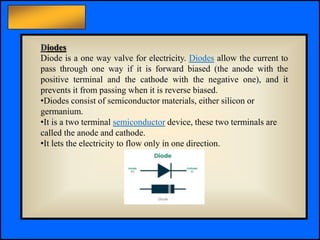
Diode is a one way valve for electricity. Diodes allow the current to
pass through one way if it is forward biased (the anode with the
positive terminal and the cathode with the negative one), and it
prevents it from passing when it is reverse biased.
•Diodes consist of semiconductor materials, either silicon or
germanium.
•It is a two terminal semiconductor device, these two terminals are
called the anode and cathode.
•It lets the electricity to flow only in one direction.
Principles of Electric Circuits - Floyd © Copyright 2006 Prentice-Hall
Transistors
Transistor is the most important invention of the last century,
its invention led to the advancement of electronics in a large
and amazing way. Transistors amplify and switch electronic
signals. The transistor amplifies, connects and disconnects
electrical signals (acts as an electronic switch).
•Transistors are able to amplify the power of a signal
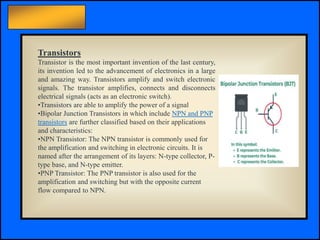
•Bipolar Junction Transistors in which include NPN and PNP
transistors are further classified based on their applications
and characteristics:
•NPN Transistor: The NPN transistor is commonly used for
the amplification and switching in electronic circuits. It is
named after the arrangement of its layers: N-type collector, P-
type base, and N-type emitter.
•PNP Transistor: The PNP transistor is also used for the
amplification and switching but with the opposite current
flow compared to NPN.
Principles of Electric Circuits - Floyd © Copyright 2006 Prentice-Hall
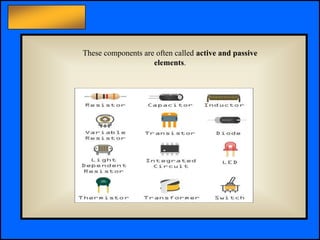
These components are often called active and passive
elements.
Principles of Electric Circuits - Floyd © Copyright 2006 Prentice-Hall
THANK YOU

activeandpassive-180729035344 (1).power point presentation

  • 1.
    Principles of ElectricCircuits - Floyd © Copyright 2006 Prentice-Hall ACTIVE AND PASSIVE COMPONENTS BY A S R S S SNIGDHA -23R11A6201 AAKHILA- 23R11A6203 B REKHA-23R11A6206 B HASINI - 23R11A6207 T SUJANA-23R11A6241
  • 2.
    Principles of ElectricCircuits - Floyd © Copyright 2006 Prentice-Hall PASSIVE COMPONENT The circuit elements that receive energy (or absorb energy) and either convert it into heat or store it in an electric field or a magnetic field are called passive circuit elements.
  • 3.
    Principles of ElectricCircuits - Floyd © Copyright 2006 Prentice-Hall Passive Components Mica Foil Foil Mica Foil Foil Mica Foil Tantalum electrolytic capacitor (polarized) Mica capacitor_ a capacitor is considered as passive element, because it can store energy in it as electric field and deliver it to the circuit, but not in continuous basis.
  • 4.
    Principles of ElectricCircuits - Floyd © Copyright 2006 Prentice-Hall Passive Components TRANSFORMERS transformer is a passive circuit element because it does not amplify power and the power remains same both in primary and secondary side.
  • 5.
    Principles of ElectricCircuits - Floyd © Copyright 2006 Prentice-Hall INDUCTORS Passive Components An inductor is also considered as passive element of circuit, because it can store energy in it as magnetic field, and can deliver it to the circuit, but not in continuous basis. The energy absorbing and delivering capacity of an inductor are limited and transient in nature. That is why, an inductor is taken as passive element of a circuit.
  • 6.
    Principles of ElectricCircuits - Floyd © Copyright 2006 Prentice-Hall •Transistors Active Components •Integrated Circuits Active Elements are those which can generate energy. Examples include batteries, generators, operational amplifiers and diodes. Note that in an electrical circuit, the source elements are the most significant active elements.
  • 7.
    Principles of ElectricCircuits - Floyd © Copyright 2006 Prentice-Hall Diodes Diode is a one way valve for electricity. Diodes allow the current to pass through one way if it is forward biased (the anode with the positive terminal and the cathode with the negative one), and it prevents it from passing when it is reverse biased. •Diodes consist of semiconductor materials, either silicon or germanium. •It is a two terminal semiconductor device, these two terminals are called the anode and cathode. •It lets the electricity to flow only in one direction.
  • 8.
    Principles of ElectricCircuits - Floyd © Copyright 2006 Prentice-Hall Transistors Transistor is the most important invention of the last century, its invention led to the advancement of electronics in a large and amazing way. Transistors amplify and switch electronic signals. The transistor amplifies, connects and disconnects electrical signals (acts as an electronic switch). •Transistors are able to amplify the power of a signal •Bipolar Junction Transistors in which include NPN and PNP transistors are further classified based on their applications and characteristics: •NPN Transistor: The NPN transistor is commonly used for the amplification and switching in electronic circuits. It is named after the arrangement of its layers: N-type collector, P- type base, and N-type emitter. •PNP Transistor: The PNP transistor is also used for the amplification and switching but with the opposite current flow compared to NPN.
  • 9.
    Principles of ElectricCircuits - Floyd © Copyright 2006 Prentice-Hall
  • 10.
    Principles of ElectricCircuits - Floyd © Copyright 2006 Prentice-Hall These components are often called active and passive elements.
  • 11.
    Principles of ElectricCircuits - Floyd © Copyright 2006 Prentice-Hall THANK YOU