by
Lorenz Karlo Alfuente
  Emmanuel Celso
      Mestidio
     JP Alegario
      SSC II - Orion
• is a component of an electrical circuit that resists the
  flow of electrical current. A resistor has two terminals
  across which electricity must pass, and is designed to
  drop the voltage of the current as it flows from one
  terminal to the next. A resistor is primarily used to create
  and maintain a known safe current within an electrical
  component.
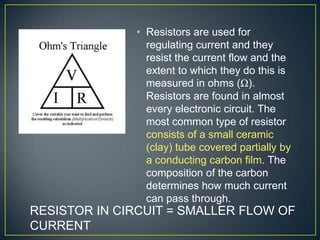
• Resistance is measured in ohms, after Ohm's law. This
  rule states that electrical resistance is equal to the drop in
  voltage across the terminals of the resistor divided by the
  current being applied to the resistor.
• NO RESISTOR, LARGE FLOW OF CURRENT
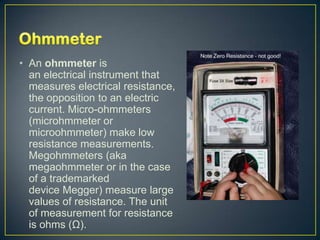
• An ohmmeter is
  an electrical instrument that
  measures electrical resistance,
  the opposition to an electric
  current. Micro-ohmmeters
  (microhmmeter or
  microohmmeter) make low
  resistance measurements.
  Megohmmeters (aka
  megaohmmeter or in the case
  of a trademarked
  device Megger) measure large
  values of resistance. The unit
  of measurement for resistance
  is ohms (Ω).
• Resistors are used with transducers to
  make sensor subsystems. Transducers are
  electronic components which convert energy
  from one form into another, where one of the
  forms of energy is electrical. A light dependent
  resistor or LDR is an example of an input
  transducer. Changes in the brightness of the
  light shining onto the surface of the LDR result in
  changes in its resistance. As will be explained
  later, an input transducer is most often
  connected along with a resistor to make a circuit
  called a potential divider. In this case, the
  output of the potential divider will be a voltage
  signal which reflects changes in illumination.
• Resistors are used for
                regulating current and they
                resist the current flow and the
                extent to which they do this is
                measured in ohms (Ω).
                Resistors are found in almost
                every electronic circuit. The
                most common type of resistor
                consists of a small ceramic
                (clay) tube covered partially by
                a conducting carbon film. The
                composition of the carbon
                determines how much current
                can pass through.
RESISTOR IN CIRCUIT = SMALLER FLOW OF
CURRENT
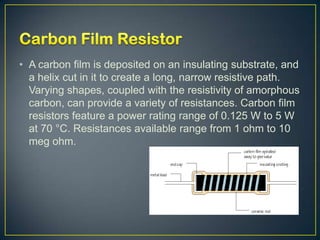
• A carbon film is deposited on an insulating substrate, and
  a helix cut in it to create a long, narrow resistive path.
  Varying shapes, coupled with the resistivity of amorphous
  carbon, can provide a variety of resistances. Carbon film
  resistors feature a power rating range of 0.125 W to 5 W
  at 70 °C. Resistances available range from 1 ohm to 10
  meg ohm.
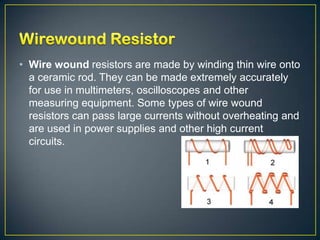
• Wire wound resistors are made by winding thin wire onto
  a ceramic rod. They can be made extremely accurately
  for use in multimeters, oscilloscopes and other
  measuring equipment. Some types of wire wound
  resistors can pass large currents without overheating and
  are used in power supplies and other high current
  circuits.
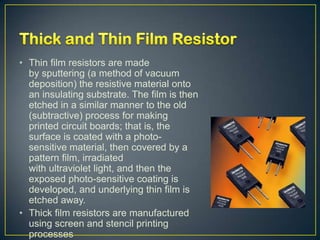
• Thin film resistors are made
  by sputtering (a method of vacuum
  deposition) the resistive material onto
  an insulating substrate. The film is then
  etched in a similar manner to the old
  (subtractive) process for making
  printed circuit boards; that is, the
  surface is coated with a photo-
  sensitive material, then covered by a
  pattern film, irradiated
  with ultraviolet light, and then the
  exposed photo-sensitive coating is
  developed, and underlying thin film is
  etched away.
• Thick film resistors are manufactured
  using screen and stencil printing
  processes
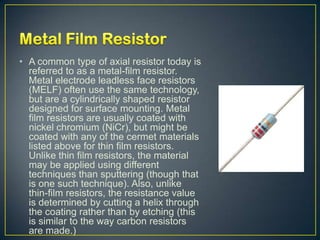
• A common type of axial resistor today is
  referred to as a metal-film resistor.
  Metal electrode leadless face resistors
  (MELF) often use the same technology,
  but are a cylindrically shaped resistor
  designed for surface mounting. Metal
  film resistors are usually coated with
  nickel chromium (NiCr), but might be
  coated with any of the cermet materials
  listed above for thin film resistors.
  Unlike thin film resistors, the material
  may be applied using different
  techniques than sputtering (though that
  is one such technique). Also, unlike
  thin-film resistors, the resistance value
  is determined by cutting a helix through
  the coating rather than by etching (this
  is similar to the way carbon resistors
  are made.)
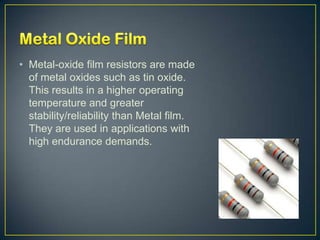
• Metal-oxide film resistors are made
  of metal oxides such as tin oxide.
  This results in a higher operating
  temperature and greater
  stability/reliability than Metal film.
  They are used in applications with
  high endurance demands.
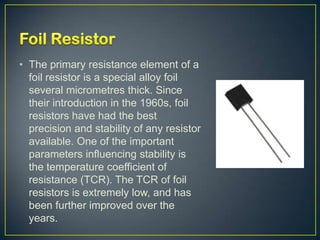
• The primary resistance element of a
  foil resistor is a special alloy foil
  several micrometres thick. Since
  their introduction in the 1960s, foil
  resistors have had the best
  precision and stability of any resistor
  available. One of the important
  parameters influencing stability is
  the temperature coefficient of
  resistance (TCR). The TCR of foil
  resistors is extremely low, and has
  been further improved over the
  years.
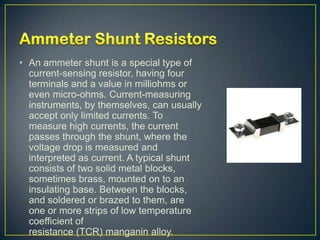
• An ammeter shunt is a special type of
  current-sensing resistor, having four
  terminals and a value in milliohms or
  even micro-ohms. Current-measuring
  instruments, by themselves, can usually
  accept only limited currents. To
  measure high currents, the current
  passes through the shunt, where the
  voltage drop is measured and
  interpreted as current. A typical shunt
  consists of two solid metal blocks,
  sometimes brass, mounted on to an
  insulating base. Between the blocks,
  and soldered or brazed to them, are
  one or more strips of low temperature
  coefficient of
  resistance (TCR) manganin alloy.
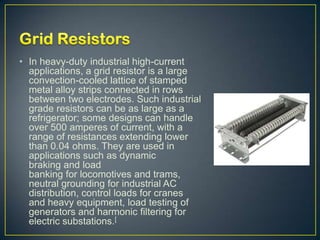
• In heavy-duty industrial high-current
  applications, a grid resistor is a large
  convection-cooled lattice of stamped
  metal alloy strips connected in rows
  between two electrodes. Such industrial
  grade resistors can be as large as a
  refrigerator; some designs can handle
  over 500 amperes of current, with a
  range of resistances extending lower
  than 0.04 ohms. They are used in
  applications such as dynamic
  braking and load
  banking for locomotives and trams,
  neutral grounding for industrial AC
  distribution, control loads for cranes
  and heavy equipment, load testing of
  generators and harmonic filtering for
  electric substations.[
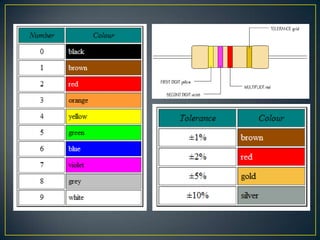
• Resistors are too small to have numbers printed on them
  and so they are marked with a number of colored bands.
  Each color stands for a number. Three color bands
  shows the resistors value in ohms and the fourth shows
  tolerance. Resistors can never be made to a precise
  value and the tolerance band (the fourth band) tells us,
  using a percentage, how close the resistor is to its coded
  value.
               RESISTOR’S VALUE TOLERANCE
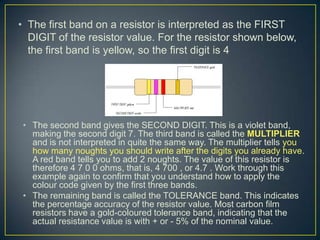
• The first band on a resistor is interpreted as the FIRST
  DIGIT of the resistor value. For the resistor shown below,
  the first band is yellow, so the first digit is 4


 • The second band gives the SECOND DIGIT. This is a violet band,
   making the second digit 7. The third band is called the MULTIPLIER
   and is not interpreted in quite the same way. The multiplier tells you
   how many noughts you should write after the digits you already have.
   A red band tells you to add 2 noughts. The value of this resistor is
   therefore 4 7 0 0 ohms, that is, 4 700 , or 4.7 . Work through this
   example again to confirm that you understand how to apply the
   colour code given by the first three bands.
 • The remaining band is called the TOLERANCE band. This indicates
   the percentage accuracy of the resistor value. Most carbon film
   resistors have a gold-coloured tolerance band, indicating that the
   actual resistance value is with + or - 5% of the nominal value.
• Real resistor values (the E6 and E12 series)
• To produce a sensible range of resistor values you need to increase the
  size of the 'step' as the value increases. The standard resistor values are
  based on this idea and they form a series which follows the same pattern
  for every multiple of ten.

• The E6 series (6 values for each multiple of ten, for resistors with 20%
  tolerance)
  10, 15, 22, 33, 47, 68, ... then it continues 100, 150, 220, 330, 470, 680,
  1000 etc.
  Notice how the step size increases as the value increases. For this series
  the step (to the next value) is roughly half the value.

• The E12 series (12 values for each multiple of ten, for resistors with 10%
  tolerance)
  10, 12, 15, 18, 22, 27, 33, 39, 47, 56, 68, 82, ... then it continues 100,
  120, 150 etc.
  Notice how this is the E6 series with an extra value in the gaps.
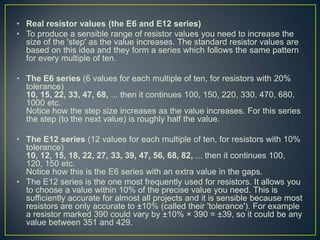
• The E12 series is the one most frequently used for resistors. It allows you
  to choose a value within 10% of the precise value you need. This is
  sufficiently accurate for almost all projects and it is sensible because most
  resistors are only accurate to ±10% (called their 'tolerance'). For example
  a resistor marked 390 could vary by ±10% × 390 = ±39, so it could be any
  value between 351 and 429.
• When current flows through a resistance, electrical energy is
  converted into heat. This is obvious in an electric torch where
  the lamp filament heats up and glows white hot. Although the
  result may be less evident or imperceptible, exactly the same
  process of energy conversion goes on when current flows
  through any electronic component.
• The power output of a lamp, resistor, or other component, is
  defined as the rate of change of electrical energy to heat, light,
  or some other form of energy. Power is measured in watts, W,
  or milliwatts, mW, and can be calculated from:
                                P= VI
                          where P is power.
• What is the power output of a resistor when the voltage across it
  is 6 V, and the current flowing through it is 100 mA?


0.6 W of heat are generated in this resistor. To prevent
overheating, it must be possible for heat to be lost, or dissipated,
to the surroundings at the same rate
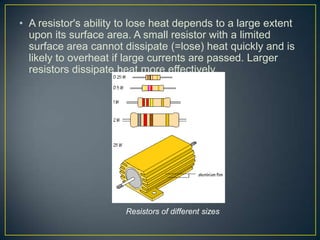
• A resistor's ability to lose heat depends to a large extent
  upon its surface area. A small resistor with a limited
  surface area cannot dissipate (=lose) heat quickly and is
  likely to overheat if large currents are passed. Larger
  resistors dissipate heat more effectively.


                       Resistors of different sizes
• The standard size of carbon film resistor used in most
  circuits has a power rating of 0.5 W. This means that a
  resistor of this size can lose heat at a maximum rate of
  0.5 W. Some resistors are designed to pass very large
  currents and are cased in aluminum with fins to increase
  surface area and promote heat loss.
• Input and signal processing subsystems in electronic
  circuits rarely involve large currents, but power rating
  should be considered when circuits drive output
  transducers, such as lamps, LEDs, and loudspeakers.
Thank you for listening!
Presented by: Lorenz Alfuente, Emmanuel Mestidio and JP Alegario
Credits to:
 http://www.doctronics.co.uk/resistor.htm
 http://en.wikipedia.org/wiki/Resistor
 http://www.kpsec.freeuk.com/components/resist.htm
 http://www.wisegeek.com/what-is-a-resistor.htm
 http://www.technologystudent.com/elec1/resist1.htm

Resistors

  • 1.
    by Lorenz Karlo Alfuente Emmanuel Celso Mestidio JP Alegario SSC II - Orion
  • 2.
    • is acomponent of an electrical circuit that resists the flow of electrical current. A resistor has two terminals across which electricity must pass, and is designed to drop the voltage of the current as it flows from one terminal to the next. A resistor is primarily used to create and maintain a known safe current within an electrical component. • Resistance is measured in ohms, after Ohm's law. This rule states that electrical resistance is equal to the drop in voltage across the terminals of the resistor divided by the current being applied to the resistor. • NO RESISTOR, LARGE FLOW OF CURRENT
  • 3.
    • An ohmmeteris an electrical instrument that measures electrical resistance, the opposition to an electric current. Micro-ohmmeters (microhmmeter or microohmmeter) make low resistance measurements. Megohmmeters (aka megaohmmeter or in the case of a trademarked device Megger) measure large values of resistance. The unit of measurement for resistance is ohms (Ω).
  • 4.
    • Resistors areused with transducers to make sensor subsystems. Transducers are electronic components which convert energy from one form into another, where one of the forms of energy is electrical. A light dependent resistor or LDR is an example of an input transducer. Changes in the brightness of the light shining onto the surface of the LDR result in changes in its resistance. As will be explained later, an input transducer is most often connected along with a resistor to make a circuit called a potential divider. In this case, the output of the potential divider will be a voltage signal which reflects changes in illumination.
  • 5.
    • Resistors areused for regulating current and they resist the current flow and the extent to which they do this is measured in ohms (Ω). Resistors are found in almost every electronic circuit. The most common type of resistor consists of a small ceramic (clay) tube covered partially by a conducting carbon film. The composition of the carbon determines how much current can pass through. RESISTOR IN CIRCUIT = SMALLER FLOW OF CURRENT
  • 7.
    • A carbonfilm is deposited on an insulating substrate, and a helix cut in it to create a long, narrow resistive path. Varying shapes, coupled with the resistivity of amorphous carbon, can provide a variety of resistances. Carbon film resistors feature a power rating range of 0.125 W to 5 W at 70 °C. Resistances available range from 1 ohm to 10 meg ohm.
  • 8.
    • Wire woundresistors are made by winding thin wire onto a ceramic rod. They can be made extremely accurately for use in multimeters, oscilloscopes and other measuring equipment. Some types of wire wound resistors can pass large currents without overheating and are used in power supplies and other high current circuits.
  • 9.
    • Thin filmresistors are made by sputtering (a method of vacuum deposition) the resistive material onto an insulating substrate. The film is then etched in a similar manner to the old (subtractive) process for making printed circuit boards; that is, the surface is coated with a photo- sensitive material, then covered by a pattern film, irradiated with ultraviolet light, and then the exposed photo-sensitive coating is developed, and underlying thin film is etched away. • Thick film resistors are manufactured using screen and stencil printing processes
  • 10.
    • A commontype of axial resistor today is referred to as a metal-film resistor. Metal electrode leadless face resistors (MELF) often use the same technology, but are a cylindrically shaped resistor designed for surface mounting. Metal film resistors are usually coated with nickel chromium (NiCr), but might be coated with any of the cermet materials listed above for thin film resistors. Unlike thin film resistors, the material may be applied using different techniques than sputtering (though that is one such technique). Also, unlike thin-film resistors, the resistance value is determined by cutting a helix through the coating rather than by etching (this is similar to the way carbon resistors are made.)
  • 11.
    • Metal-oxide filmresistors are made of metal oxides such as tin oxide. This results in a higher operating temperature and greater stability/reliability than Metal film. They are used in applications with high endurance demands.
  • 12.
    • The primaryresistance element of a foil resistor is a special alloy foil several micrometres thick. Since their introduction in the 1960s, foil resistors have had the best precision and stability of any resistor available. One of the important parameters influencing stability is the temperature coefficient of resistance (TCR). The TCR of foil resistors is extremely low, and has been further improved over the years.
  • 13.
    • An ammetershunt is a special type of current-sensing resistor, having four terminals and a value in milliohms or even micro-ohms. Current-measuring instruments, by themselves, can usually accept only limited currents. To measure high currents, the current passes through the shunt, where the voltage drop is measured and interpreted as current. A typical shunt consists of two solid metal blocks, sometimes brass, mounted on to an insulating base. Between the blocks, and soldered or brazed to them, are one or more strips of low temperature coefficient of resistance (TCR) manganin alloy.
  • 14.
    • In heavy-dutyindustrial high-current applications, a grid resistor is a large convection-cooled lattice of stamped metal alloy strips connected in rows between two electrodes. Such industrial grade resistors can be as large as a refrigerator; some designs can handle over 500 amperes of current, with a range of resistances extending lower than 0.04 ohms. They are used in applications such as dynamic braking and load banking for locomotives and trams, neutral grounding for industrial AC distribution, control loads for cranes and heavy equipment, load testing of generators and harmonic filtering for electric substations.[
  • 17.
    • Resistors aretoo small to have numbers printed on them and so they are marked with a number of colored bands. Each color stands for a number. Three color bands shows the resistors value in ohms and the fourth shows tolerance. Resistors can never be made to a precise value and the tolerance band (the fourth band) tells us, using a percentage, how close the resistor is to its coded value. RESISTOR’S VALUE TOLERANCE
  • 18.
    • The firstband on a resistor is interpreted as the FIRST DIGIT of the resistor value. For the resistor shown below, the first band is yellow, so the first digit is 4 • The second band gives the SECOND DIGIT. This is a violet band, making the second digit 7. The third band is called the MULTIPLIER and is not interpreted in quite the same way. The multiplier tells you how many noughts you should write after the digits you already have. A red band tells you to add 2 noughts. The value of this resistor is therefore 4 7 0 0 ohms, that is, 4 700 , or 4.7 . Work through this example again to confirm that you understand how to apply the colour code given by the first three bands. • The remaining band is called the TOLERANCE band. This indicates the percentage accuracy of the resistor value. Most carbon film resistors have a gold-coloured tolerance band, indicating that the actual resistance value is with + or - 5% of the nominal value.
  • 20.
    • Real resistorvalues (the E6 and E12 series) • To produce a sensible range of resistor values you need to increase the size of the 'step' as the value increases. The standard resistor values are based on this idea and they form a series which follows the same pattern for every multiple of ten. • The E6 series (6 values for each multiple of ten, for resistors with 20% tolerance) 10, 15, 22, 33, 47, 68, ... then it continues 100, 150, 220, 330, 470, 680, 1000 etc. Notice how the step size increases as the value increases. For this series the step (to the next value) is roughly half the value. • The E12 series (12 values for each multiple of ten, for resistors with 10% tolerance) 10, 12, 15, 18, 22, 27, 33, 39, 47, 56, 68, 82, ... then it continues 100, 120, 150 etc. Notice how this is the E6 series with an extra value in the gaps. • The E12 series is the one most frequently used for resistors. It allows you to choose a value within 10% of the precise value you need. This is sufficiently accurate for almost all projects and it is sensible because most resistors are only accurate to ±10% (called their 'tolerance'). For example a resistor marked 390 could vary by ±10% × 390 = ±39, so it could be any value between 351 and 429.
  • 22.
    • When currentflows through a resistance, electrical energy is converted into heat. This is obvious in an electric torch where the lamp filament heats up and glows white hot. Although the result may be less evident or imperceptible, exactly the same process of energy conversion goes on when current flows through any electronic component. • The power output of a lamp, resistor, or other component, is defined as the rate of change of electrical energy to heat, light, or some other form of energy. Power is measured in watts, W, or milliwatts, mW, and can be calculated from: P= VI where P is power. • What is the power output of a resistor when the voltage across it is 6 V, and the current flowing through it is 100 mA? 0.6 W of heat are generated in this resistor. To prevent overheating, it must be possible for heat to be lost, or dissipated, to the surroundings at the same rate
  • 23.
    • A resistor'sability to lose heat depends to a large extent upon its surface area. A small resistor with a limited surface area cannot dissipate (=lose) heat quickly and is likely to overheat if large currents are passed. Larger resistors dissipate heat more effectively. Resistors of different sizes
  • 24.
    • The standardsize of carbon film resistor used in most circuits has a power rating of 0.5 W. This means that a resistor of this size can lose heat at a maximum rate of 0.5 W. Some resistors are designed to pass very large currents and are cased in aluminum with fins to increase surface area and promote heat loss. • Input and signal processing subsystems in electronic circuits rarely involve large currents, but power rating should be considered when circuits drive output transducers, such as lamps, LEDs, and loudspeakers.
  • 26.
    Thank you forlistening! Presented by: Lorenz Alfuente, Emmanuel Mestidio and JP Alegario Credits to:  http://www.doctronics.co.uk/resistor.htm  http://en.wikipedia.org/wiki/Resistor  http://www.kpsec.freeuk.com/components/resist.htm  http://www.wisegeek.com/what-is-a-resistor.htm  http://www.technologystudent.com/elec1/resist1.htm