Overall Equipment Effectiveness (OEE) and Six Loss Explained
What is OEE? In an ideal environment, all equipment would operate all the time at full capacity producing good quality product.  In real life, however, this situation is almost non-existent.  Put simply overall equipment effectiveness (OEE) is a measure of what you actually made over what you could have made in theory over that timeframe.  The difference between the ideal (theoretical) and actual situation is due to losses.  These losses can be categorised into various metrics that provide you with excellent data to enable you to target that specific area and help you  Improve . The three main categories of OEE are Availability, Performance and Quality.  By measuring the performance in each of these categories and multiplying the result will give you the OEE figure.  These three categories are subdivided into what is known as the ‘Six Big Losses’.  The ‘Six Big Losses’ are: Planned or External unplanned loss, Breakdown loss, Minor stops, Speed loss, Production rejects and Rejects on start up.
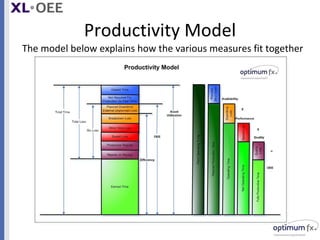
Productivity Model The model below explains how the various measures fit together
OEE Calculation OEE = Availability X Performance X Quality
What is Six Loss? It would feel odd to drive a car without a dashboard… 6 loss Analysis  is like the dashboard, providing useful information for making decisions at different times in your journey.  Example: When there is an indication that you are low on fuel – you will fill it up  When the Revs are too high – you will change gear
Why use Six Loss? Six Loss allows you to accurately pinpoint the area of focus that will impact on the performance of the equipment’s output. To reduce each loss there is an improvement tool. All the Six Loss is doing is breaking down the equipment’s overall loss into six clear categories, to which, you can apply certain techniques to improve.  It is what you do with this information makes the difference .  Speed of Execution and intervention followed by monitoring is critical. Combine Six Loss data with using the right tools on the biggest loss and accelerate the speed of execution - This WILL improve the performance of your equipment.  Many manufacturing plants spend a lot of time in measuring and recording data and don’t use most of it. Sometimes less is more!!! This is a key part of your Manufacturing Strategy
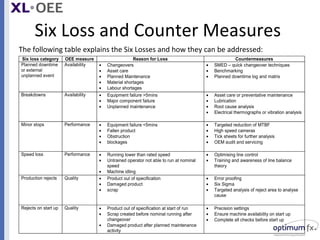
Six Loss and Counter Measures    The following table explains the Six Losses and how they can be addressed:
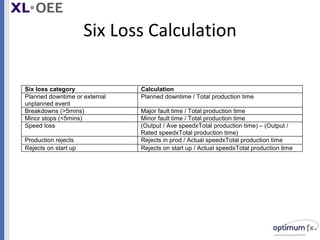
Six Loss Calculation
OEE and Six Loss Analysis Example
Methods of Data Capture Reactive Slow reaction Historical information Snap shot of loss during review Inaccurate Perceived losses on equipment Proactive Rapid reaction Real time Continuous visualisation Accurate Real losses on equipment Manual Data Capture Automated Data Capture
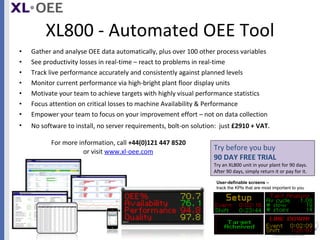
XL800 - Automated OEE Tool Gather and analyse OEE data automatically, plus over 100 other process variables See productivity losses in real-time – react to problems in real-time Track live performance accurately and consistently against planned levels Monitor current performance via high-bright plant floor display units Motivate your team to achieve targets with highly visual performance statistics Focus attention on critical losses to machine Availability & Performance Empower your team to focus on your improvement effort – not on data collection No software to install, no server requirements, bolt-on solution:  just  £2910 + VAT . For more information, call  +44(0)121 447 8520 or visit  www.xl-oee.com Try before you buy 90 DAY FREE TRIAL Try an XL800 unit in your plant for 90 days. After 90 days, simply return it or pay for it. User-definable screens –  track the KPIs that are most important to you

Oee Explained

  • 1.
    Overall Equipment Effectiveness(OEE) and Six Loss Explained
  • 2.
    What is OEE?In an ideal environment, all equipment would operate all the time at full capacity producing good quality product. In real life, however, this situation is almost non-existent. Put simply overall equipment effectiveness (OEE) is a measure of what you actually made over what you could have made in theory over that timeframe. The difference between the ideal (theoretical) and actual situation is due to losses. These losses can be categorised into various metrics that provide you with excellent data to enable you to target that specific area and help you Improve . The three main categories of OEE are Availability, Performance and Quality. By measuring the performance in each of these categories and multiplying the result will give you the OEE figure. These three categories are subdivided into what is known as the ‘Six Big Losses’. The ‘Six Big Losses’ are: Planned or External unplanned loss, Breakdown loss, Minor stops, Speed loss, Production rejects and Rejects on start up.
  • 3.
    Productivity Model Themodel below explains how the various measures fit together
  • 4.
    OEE Calculation OEE= Availability X Performance X Quality
  • 5.
    What is SixLoss? It would feel odd to drive a car without a dashboard… 6 loss Analysis is like the dashboard, providing useful information for making decisions at different times in your journey. Example: When there is an indication that you are low on fuel – you will fill it up When the Revs are too high – you will change gear
  • 6.
    Why use SixLoss? Six Loss allows you to accurately pinpoint the area of focus that will impact on the performance of the equipment’s output. To reduce each loss there is an improvement tool. All the Six Loss is doing is breaking down the equipment’s overall loss into six clear categories, to which, you can apply certain techniques to improve. It is what you do with this information makes the difference . Speed of Execution and intervention followed by monitoring is critical. Combine Six Loss data with using the right tools on the biggest loss and accelerate the speed of execution - This WILL improve the performance of your equipment. Many manufacturing plants spend a lot of time in measuring and recording data and don’t use most of it. Sometimes less is more!!! This is a key part of your Manufacturing Strategy
  • 7.
    Six Loss andCounter Measures The following table explains the Six Losses and how they can be addressed:
  • 8.
  • 9.
    OEE and SixLoss Analysis Example
  • 10.
    Methods of DataCapture Reactive Slow reaction Historical information Snap shot of loss during review Inaccurate Perceived losses on equipment Proactive Rapid reaction Real time Continuous visualisation Accurate Real losses on equipment Manual Data Capture Automated Data Capture
  • 11.
    XL800 - AutomatedOEE Tool Gather and analyse OEE data automatically, plus over 100 other process variables See productivity losses in real-time – react to problems in real-time Track live performance accurately and consistently against planned levels Monitor current performance via high-bright plant floor display units Motivate your team to achieve targets with highly visual performance statistics Focus attention on critical losses to machine Availability & Performance Empower your team to focus on your improvement effort – not on data collection No software to install, no server requirements, bolt-on solution: just £2910 + VAT . For more information, call +44(0)121 447 8520 or visit www.xl-oee.com Try before you buy 90 DAY FREE TRIAL Try an XL800 unit in your plant for 90 days. After 90 days, simply return it or pay for it. User-definable screens – track the KPIs that are most important to you