A3 Problem Solving
Key Learning Objective
• To learn how to solve basic problems using the 3 step method. What
makes up a problem
• 3 Step Method
1. Clarify the Problem – Define the Problem
2. Analyse the Problem
3. See Countermeasure Through & Verify Results
• Summarized Key Points
• Q&A
Agenda
2
• Defining problems
• Pareto
• Determining correct root cause
• Utilization of Cause and Effect Diagrams
• Understanding 5 Why Analysis
• Implementing and monitoring results
Key Learning Objective
3
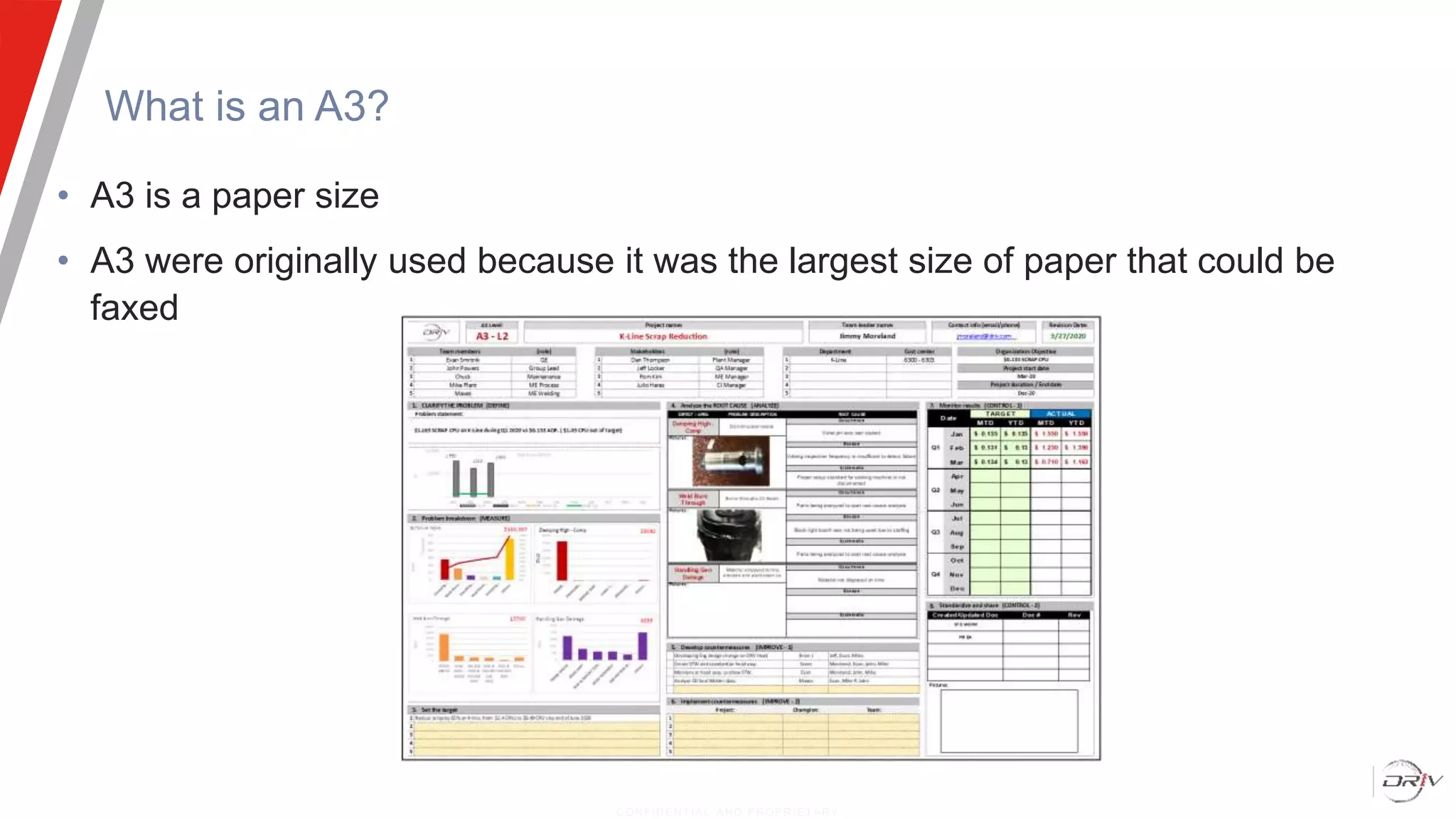
• A3 is a paper size
• A3 were originally used because it was the largest size of paper that could be
faxed
What is an A3?
CONFIDENT IAL AND PROPRIETARY
A3 Overview
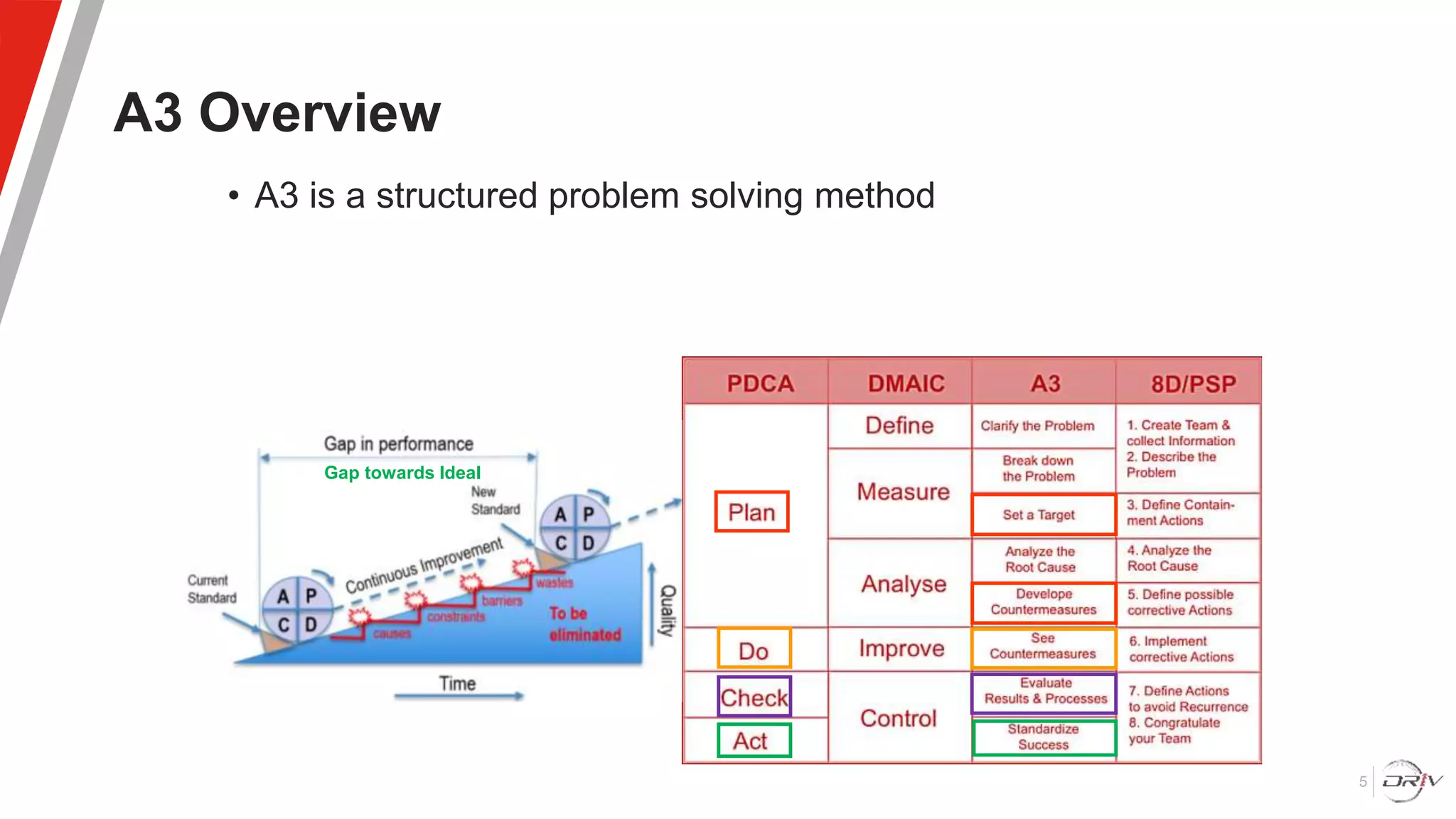
• A3 is a structured problem solving method
5
Gap towards Ideal
6
What Defines a Safe Environment?
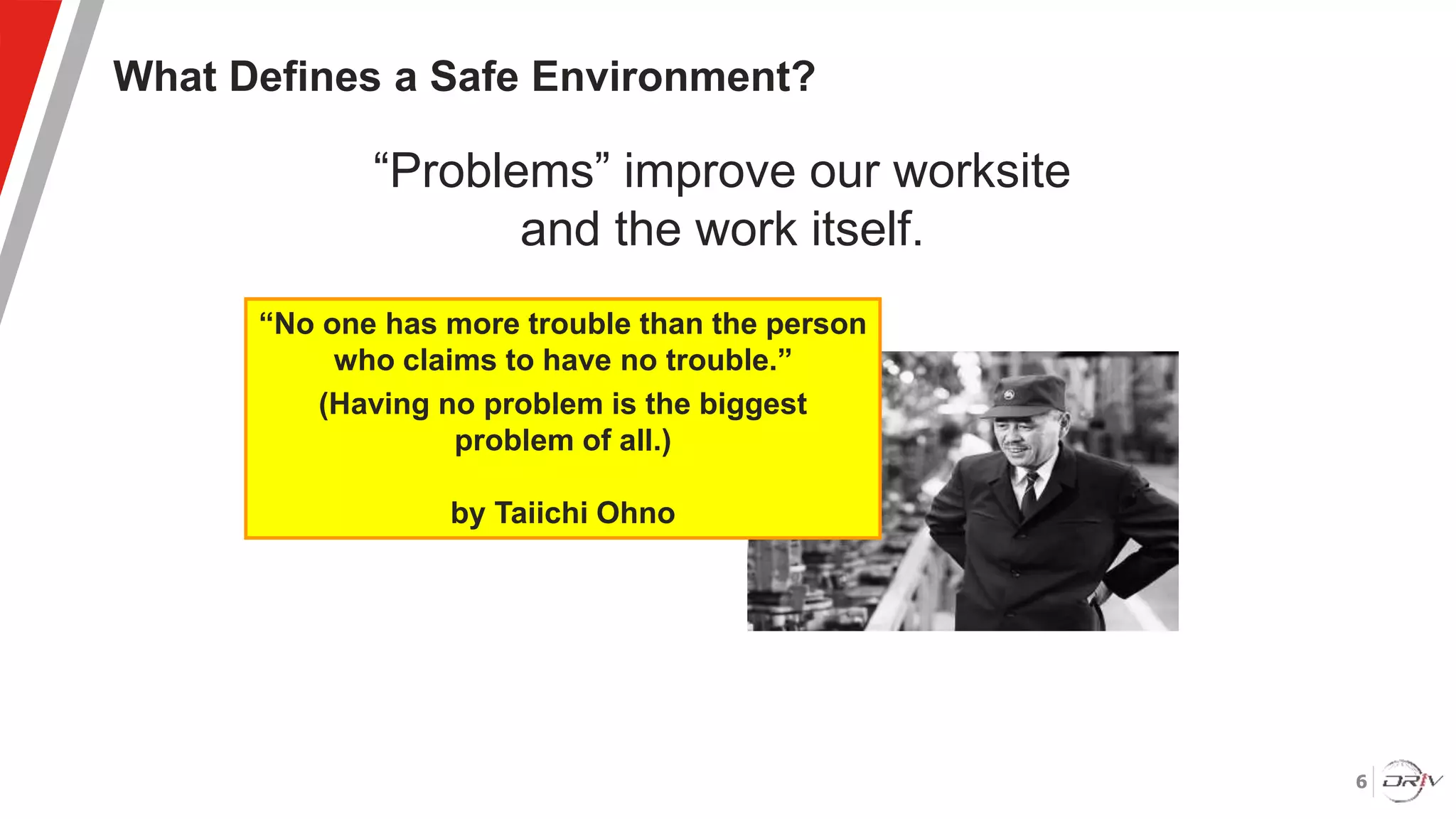
“Problems” improve our worksite
and the work itself.
“No one has more trouble than the person
who claims to have no trouble.”
(Having no problem is the biggest
problem of all.)
by Taiichi Ohno
Step 1- Clarifying the Problem
“DRiV: Confidential” 7
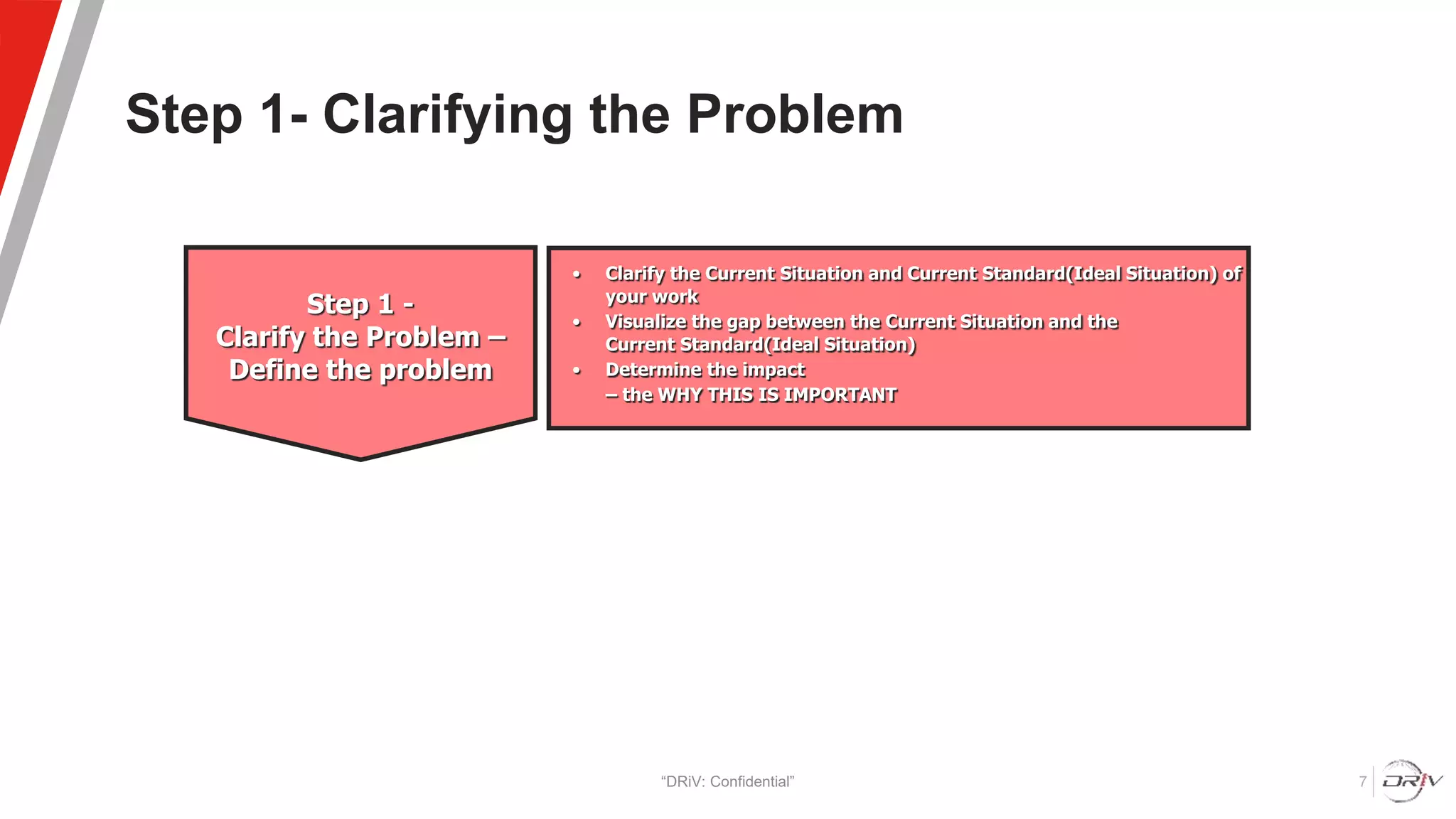
Step 1 -
Clarify the Problem –
Define the problem
• Clarify the Current Situation and Current Standard(Ideal Situation) of
your work
• Visualize the gap between the Current Situation and the
Current Standard(Ideal Situation)
• Determine the impact
– the WHY THIS IS IMPORTANT
8
What is a problem?
3
1
2
5
4
Aug Sep Oct Nov
The Ideal/Standard
The Current Situation
Defects
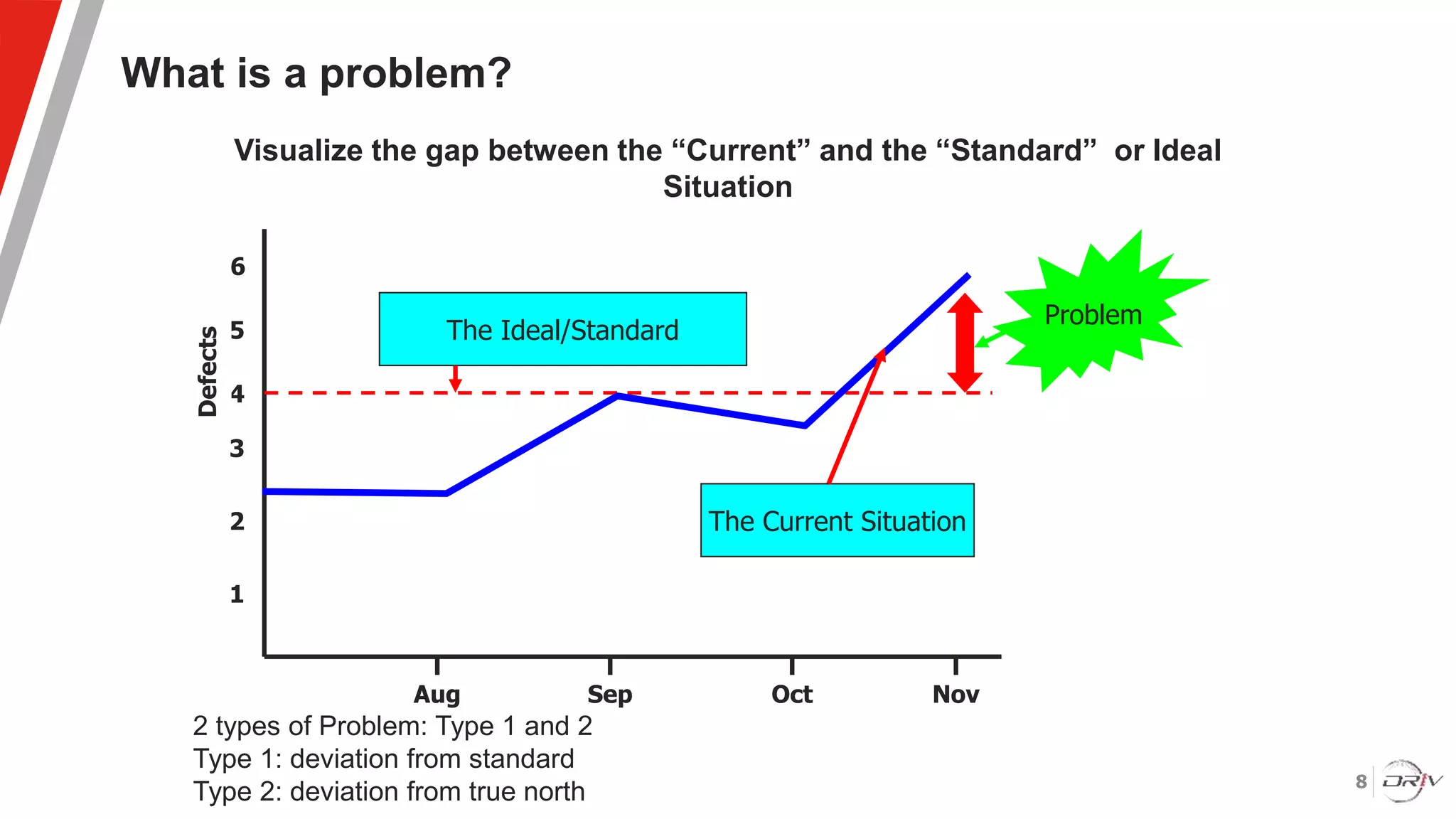
Visualize the gap between the “Current” and the “Standard” or Ideal
Situation
Problem
6
2 types of Problem: Type 1 and 2
Type 1: deviation from standard
Type 2: deviation from true north
Obstacles to Problem Solving
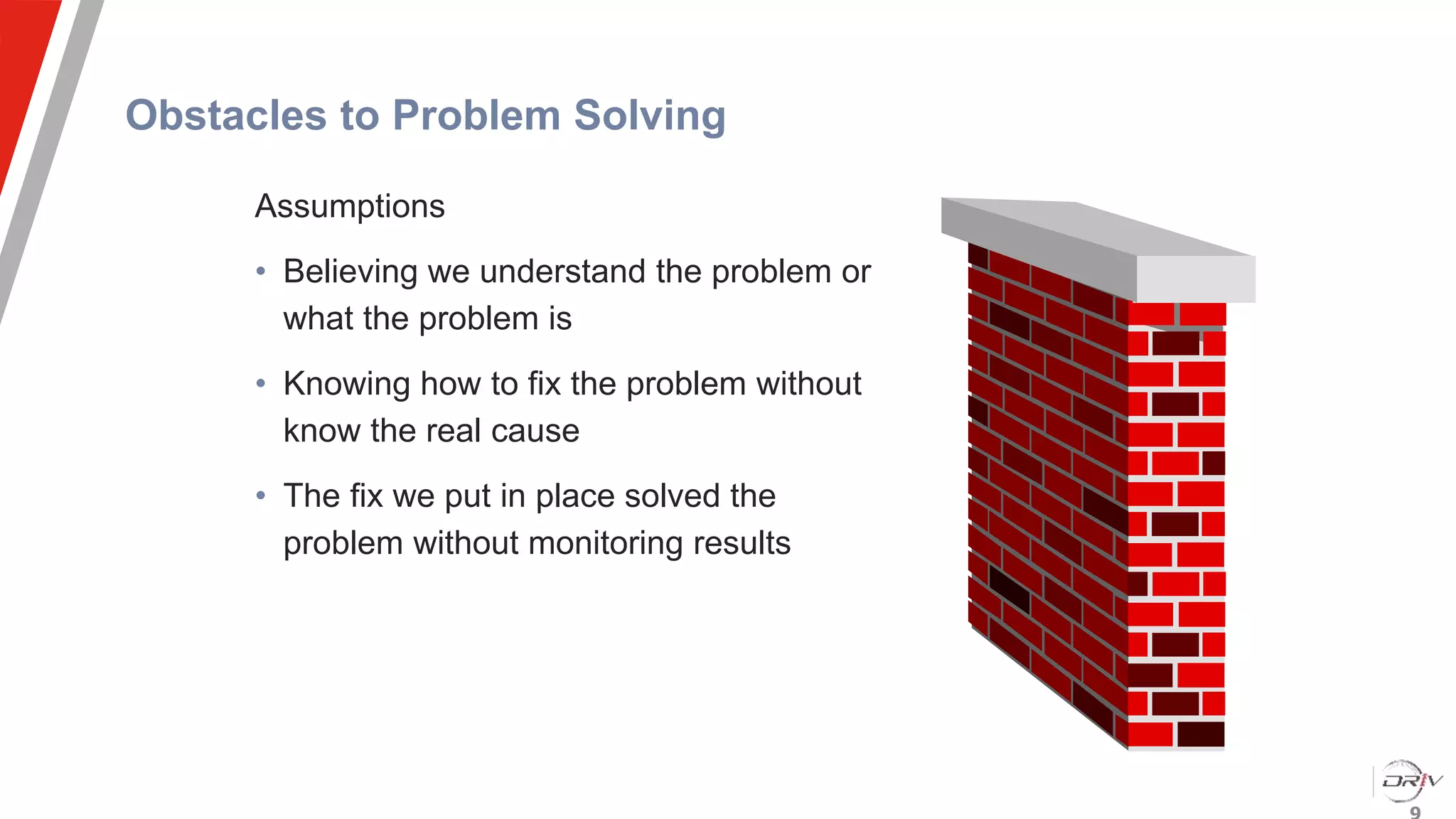
Assumptions
• Believing we understand the problem or
what the problem is
• Knowing how to fix the problem without
know the real cause
• The fix we put in place solved the
problem without monitoring results
How to Develop a Problem Statement
• What?
• Where?
• When?
• How many?
• What is the standard that was violated?
CONFIDENT IAL AND PROPRIETARY
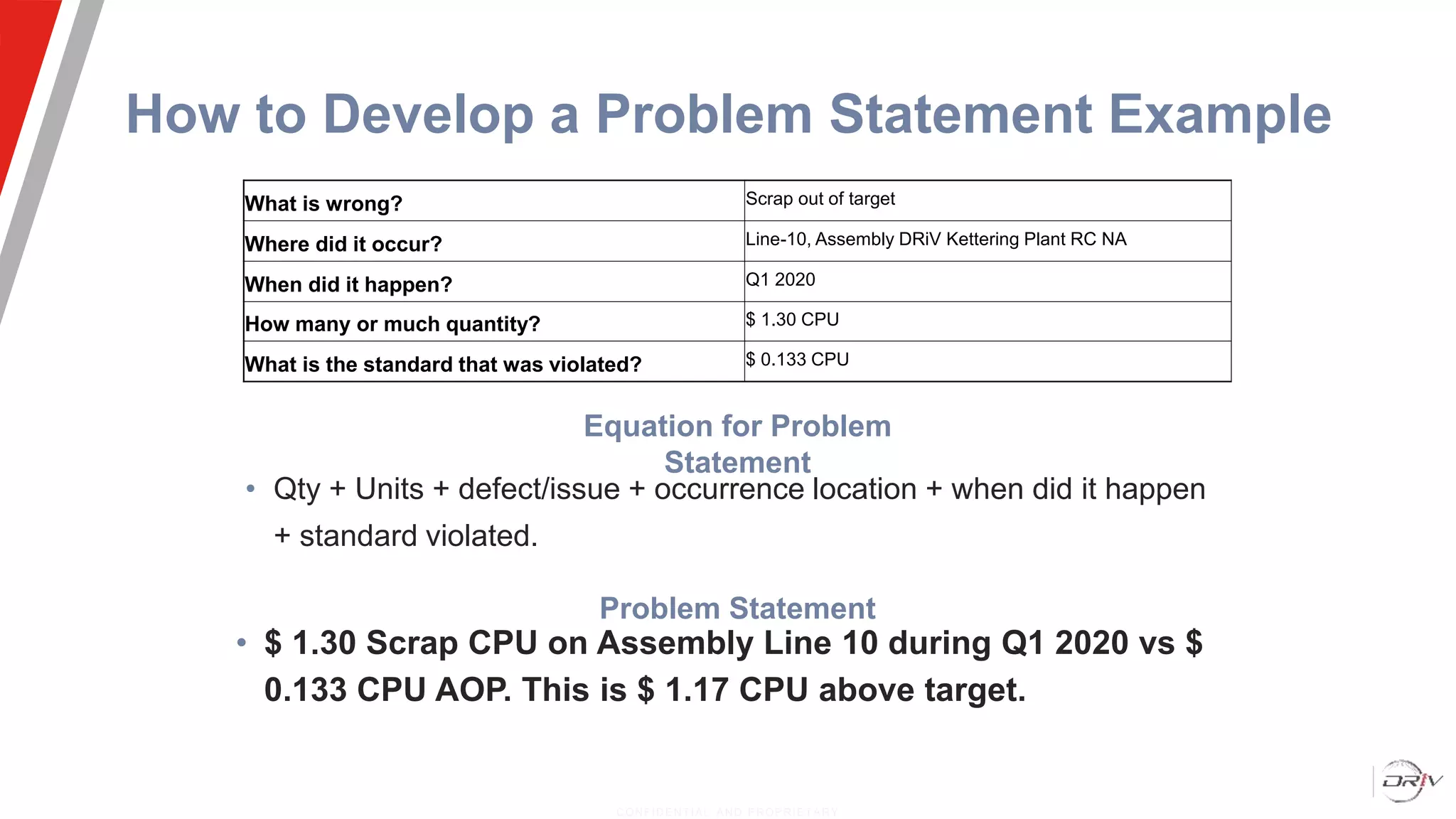
How to Develop a Problem Statement Example
• Qty + Units + defect/issue + occurrence location + when did it happen
+ standard violated.
• $ 1.30 Scrap CPU on Assembly Line 10 during Q1 2020 vs $
0.133 CPU AOP. This is $ 1.17 CPU above target.
CONFIDENT IAL AND PROPRIETARY
What is wrong? Scrap out of target
Where did it occur? Line-10, Assembly DRiV Kettering Plant RC NA
When did it happen? Q1 2020
How many or much quantity? $ 1.30 CPU
What is the standard that was violated? $ 0.133 CPU
Equation for Problem
Statement
Problem Statement
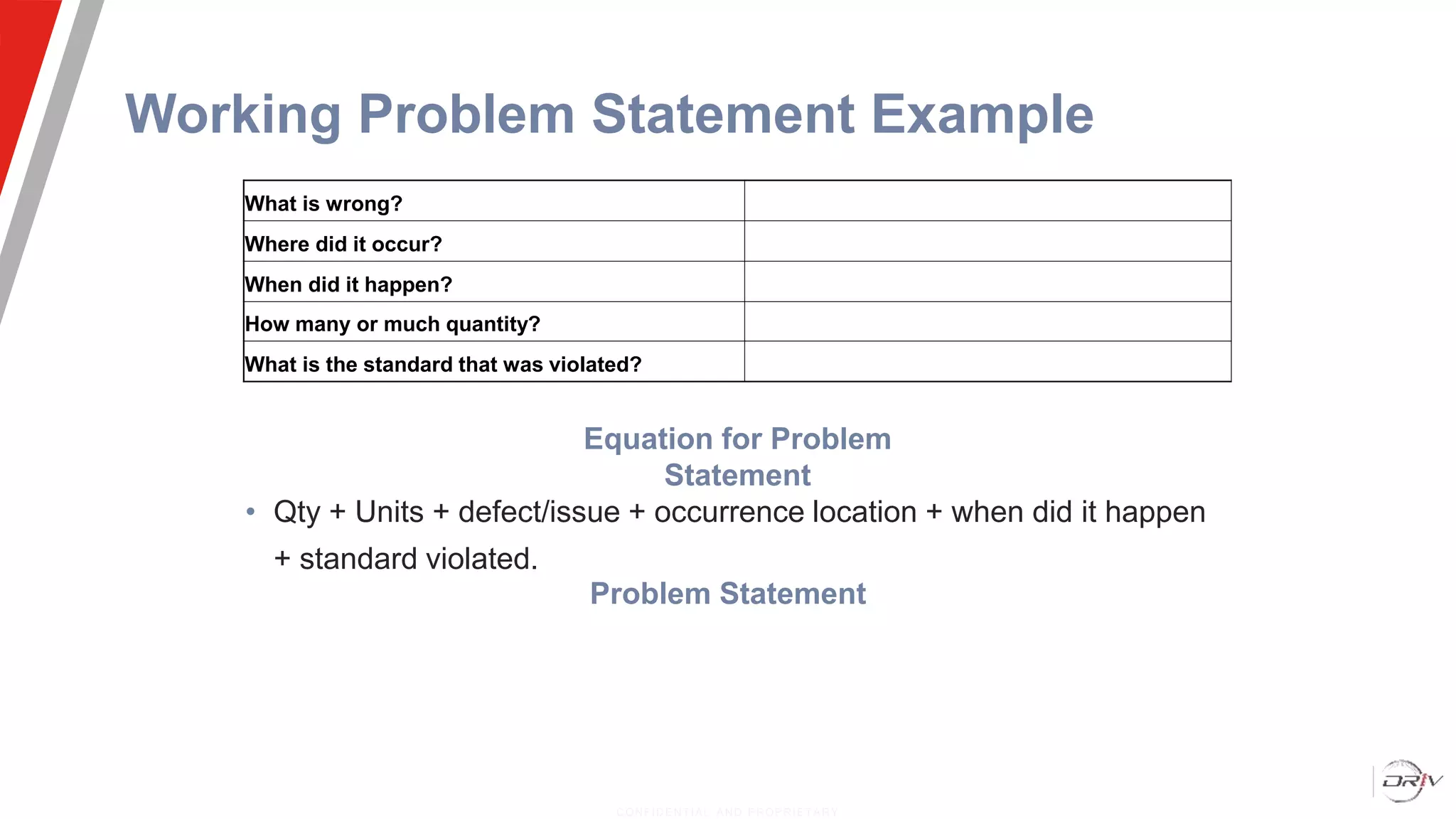
Working Problem Statement Example
• Qty + Units + defect/issue + occurrence location + when did it happen
+ standard violated.
CONFIDENT IAL AND PROPRIETARY
What is wrong?
Where did it occur?
When did it happen?
How many or much quantity?
What is the standard that was violated?
Equation for Problem
Statement
Problem Statement
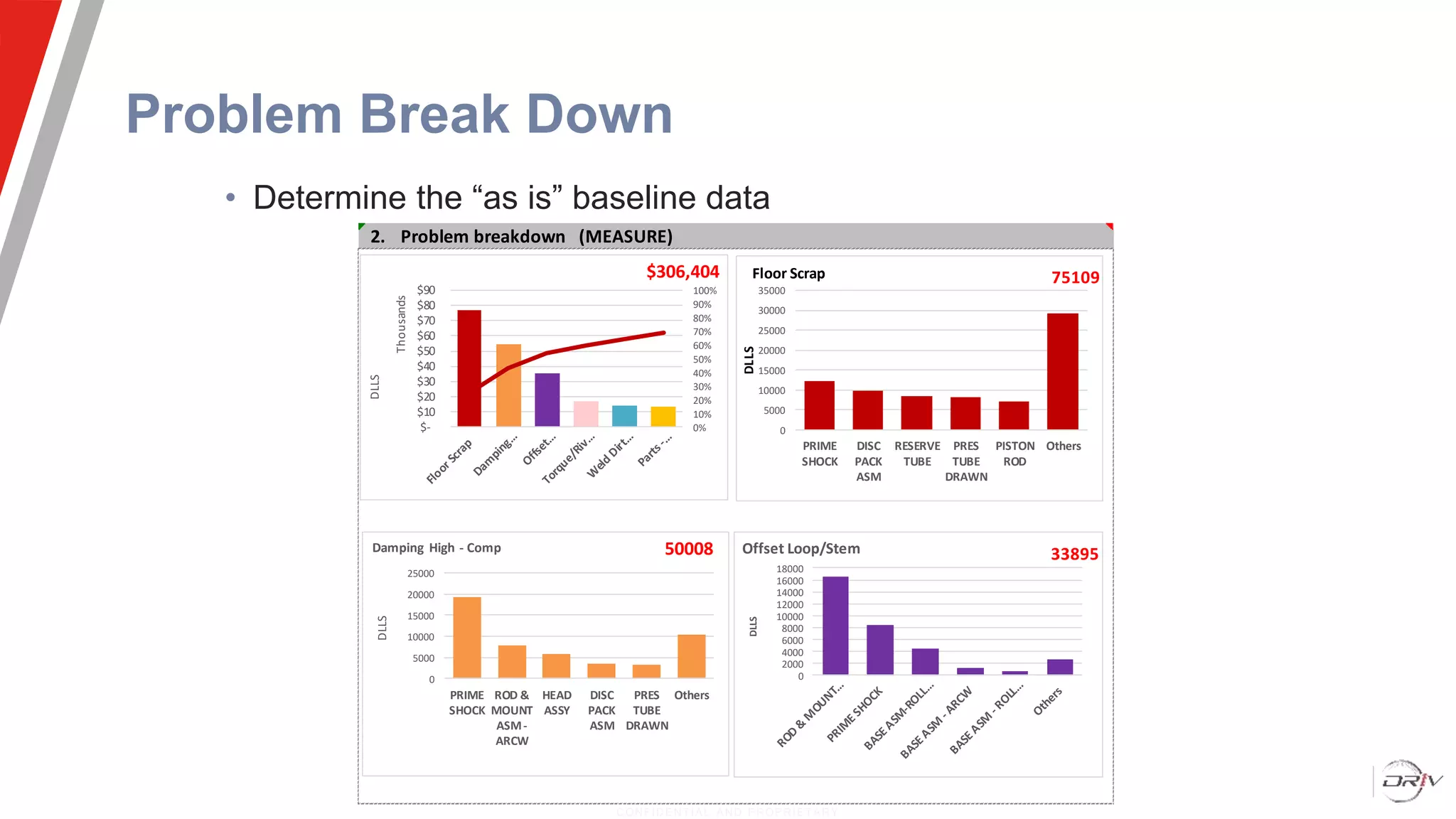
Problem Break Down
• Determine the “as is” baseline data
CONFIDENT IAL AND PROPRIETARY
2. Problem breakdown (MEASURE)
0%
10%
20%
30%
40%
50%
60%
70%
80%
90%
100%
$-
$10
$20
$30
$40
$50
$60
$70
$80
$90
DLLS
Thousands
$306,404
0
5000
10000
15000
20000
25000
30000
35000
PRIME
SHOCK
DISC
PACK
ASM
RESERVE
TUBE
PRES
TUBE
DRAWN
PISTON
ROD
Others
DLLS
75109
Floor Scrap
0
5000
10000
15000
20000
25000
PRIME
SHOCK
ROD &
MOUNT
ASM-
ARCW
HEAD
ASSY
DISC
PACK
ASM
PRES
TUBE
DRAWN
Others
DLLS
50008
Damping High - Comp
0
2000
4000
6000
8000
10000
12000
14000
16000
18000
DLLS
33895
Offset Loop/Stem
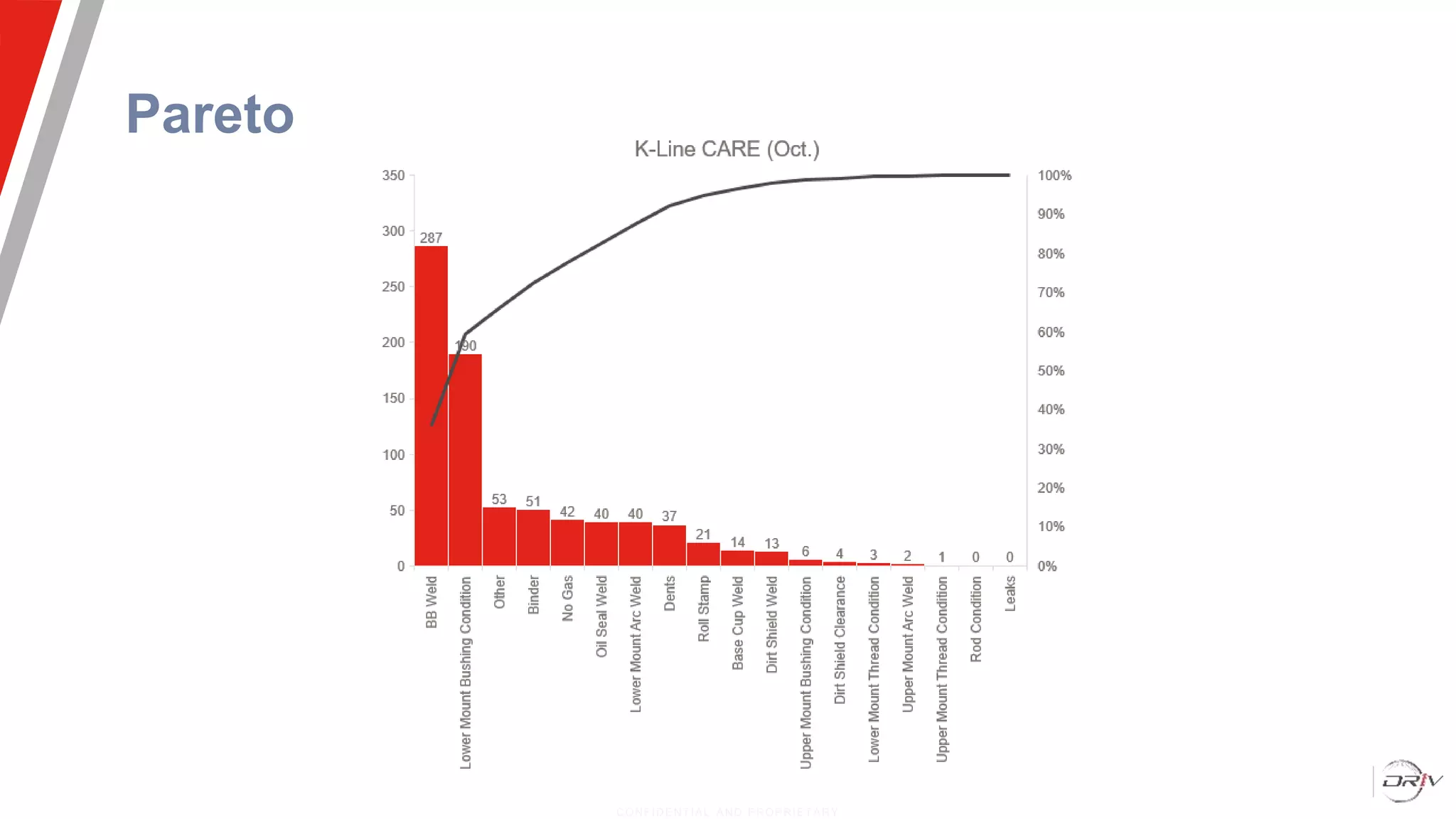
Pareto
CONFIDENT IAL AND PROPRIETARY
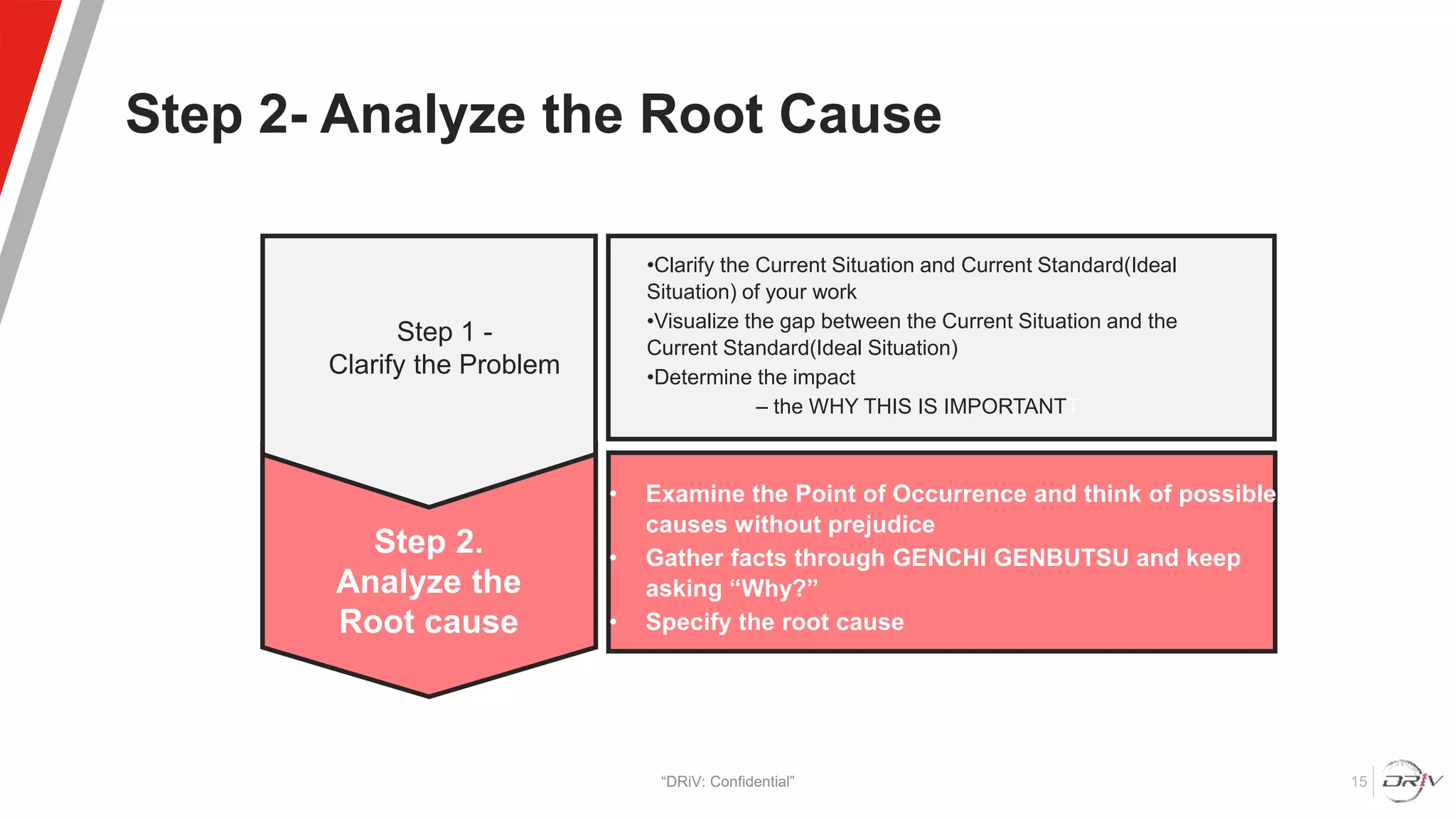
Step 2- Analyze the Root Cause
“DRiV: Confidential” 15
• Examine the Point of Occurrence and think of possible
causes without prejudice
• Gather facts through GENCHI GENBUTSU and keep
asking “Why?”
• Specify the root cause
Step 2.
Analyze the
Root cause
Step 1 -
Clarify the Problem
•Clarify the Current Situation and Current Standard(Ideal
Situation) of your work
•Visualize the gap between the Current Situation and the
Current Standard(Ideal Situation)
•Determine the impact
– the WHY THIS IS IMPORTANTT
16
Root Cause Brain Storming
Without any prejudice:
• Utilize your experiences and intuition as a reference when you make
considerations.
• Do not make decisions based solely on experiences and intuition without
thinking deeply.
• Make determinations based on facts.
•While listening to others clarify whether you are hearing an opinion or
actual facts
Examine the Prioritized Problem at the Point of Occurrence and
determine possible causes without prejudice
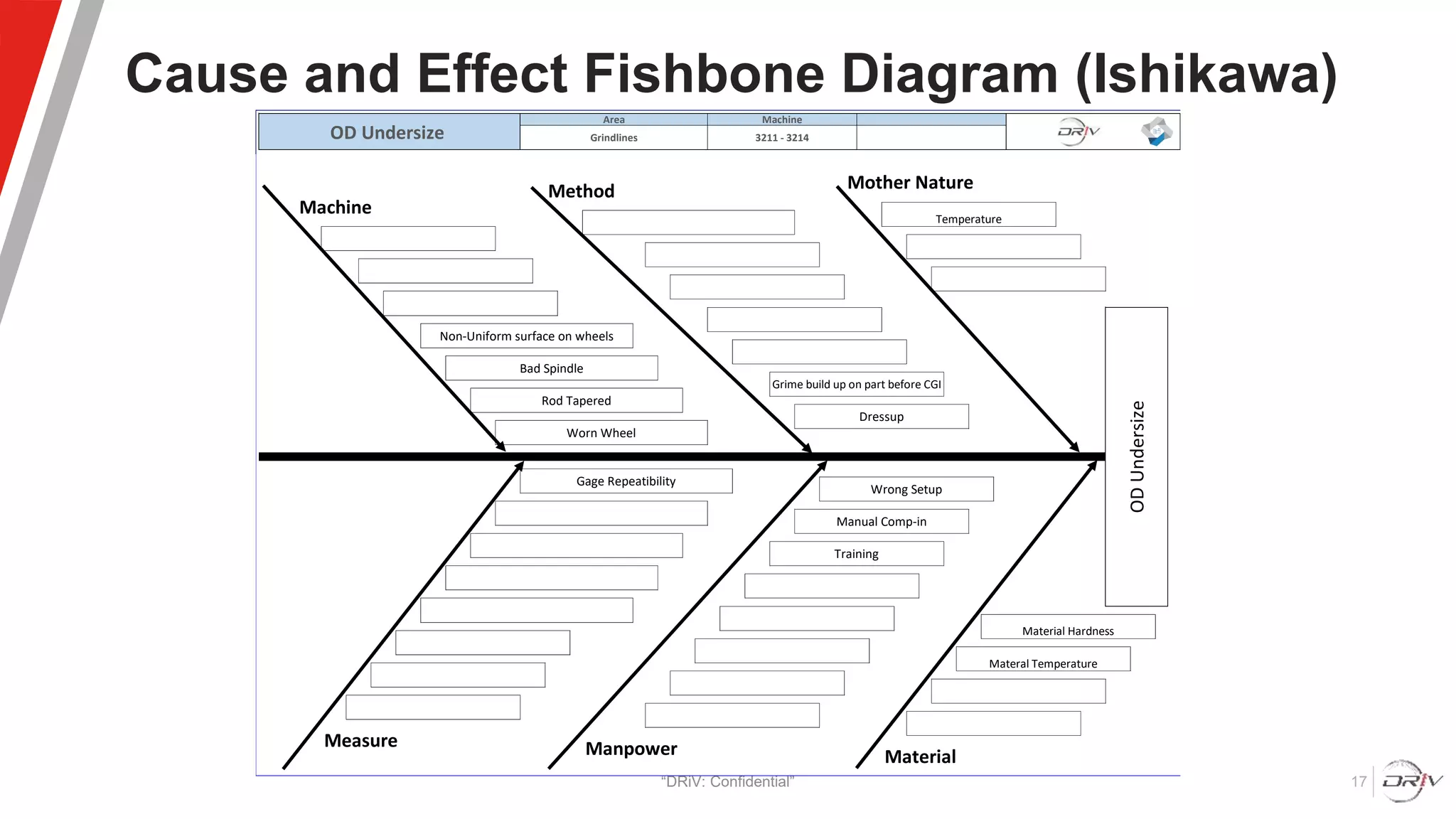
Cause and Effect Fishbone Diagram (Ishikawa)
“DRiV: Confidential” 17
Manpower Material
Measure
Worn Wheel
Rod Tapered
Bad Spindle
Non-Uniform surface on wheels
Temperature
Dressup
Gage Repeatibility
Grime build up on part before CGI
Wrong Setup
Manual Comp-in
Training
Material Hardness
Materal Temperature
OD
Undersize
Machine
Grindlines 3211 - 3214
Area
Method
Machine
OD Undersize
Mother Nature
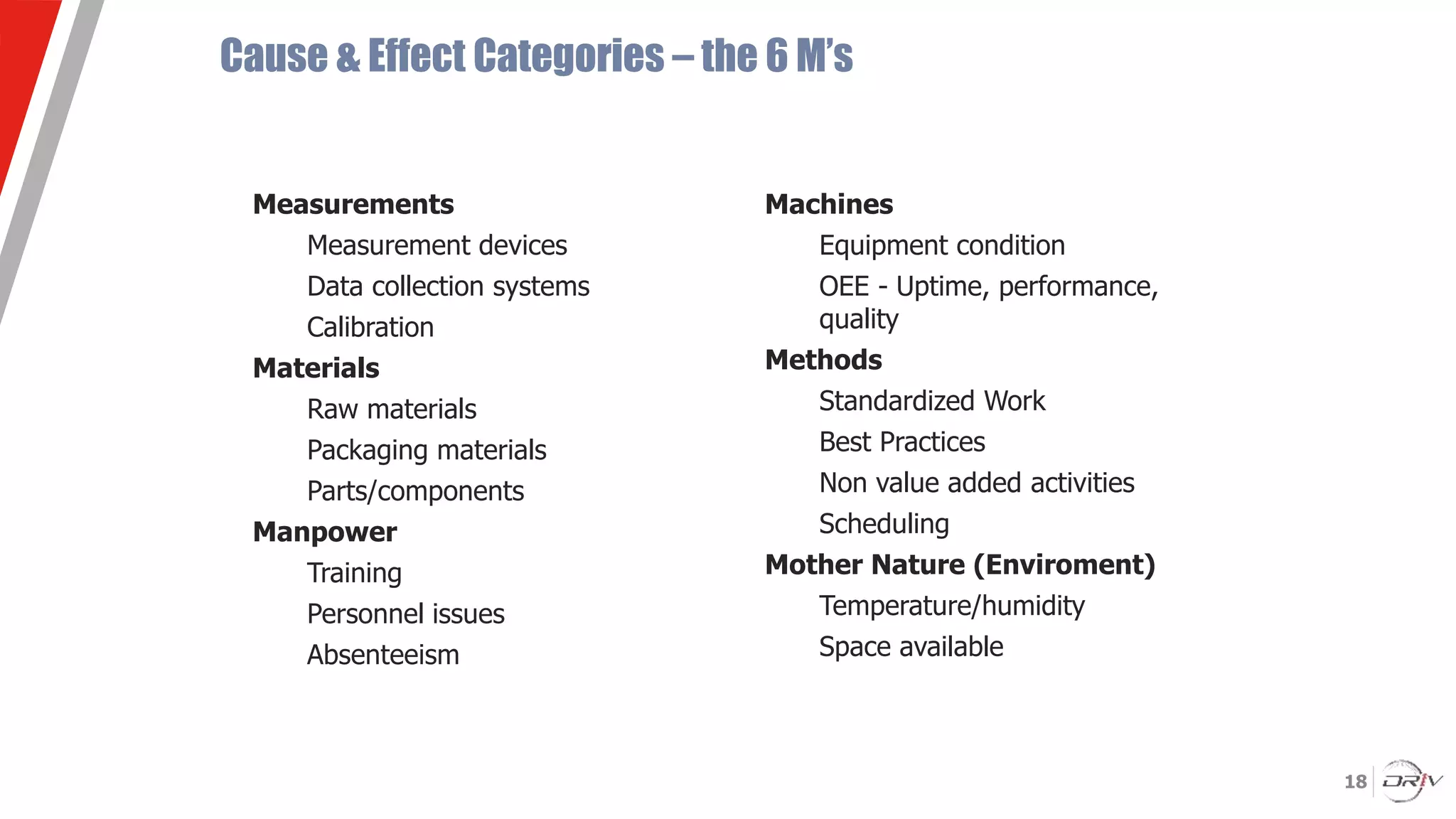
18
Measurements
Measurement devices
Data collection systems
Calibration
Materials
Raw materials
Packaging materials
Parts/components
Manpower
Training
Personnel issues
Absenteeism
Machines
Equipment condition
OEE - Uptime, performance,
quality
Methods
Standardized Work
Best Practices
Non value added activities
Scheduling
Mother Nature (Enviroment)
Temperature/humidity
Space available
Cause & Effect Categories – the 6 M’s
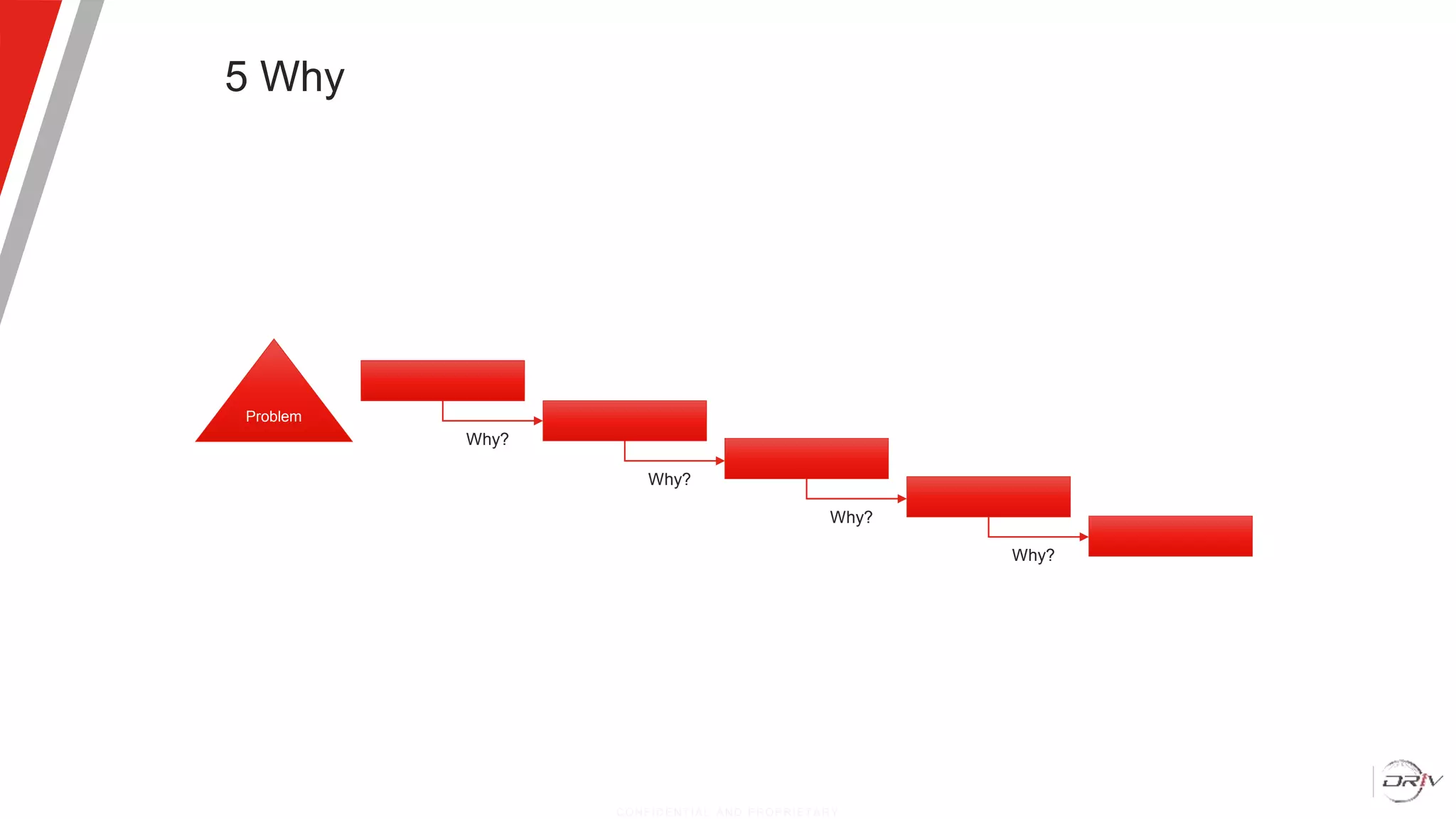
5 Why
CONFIDENT IAL AND PROPRIETARY
Problem
Why?
Why?
Why?
Why?
20
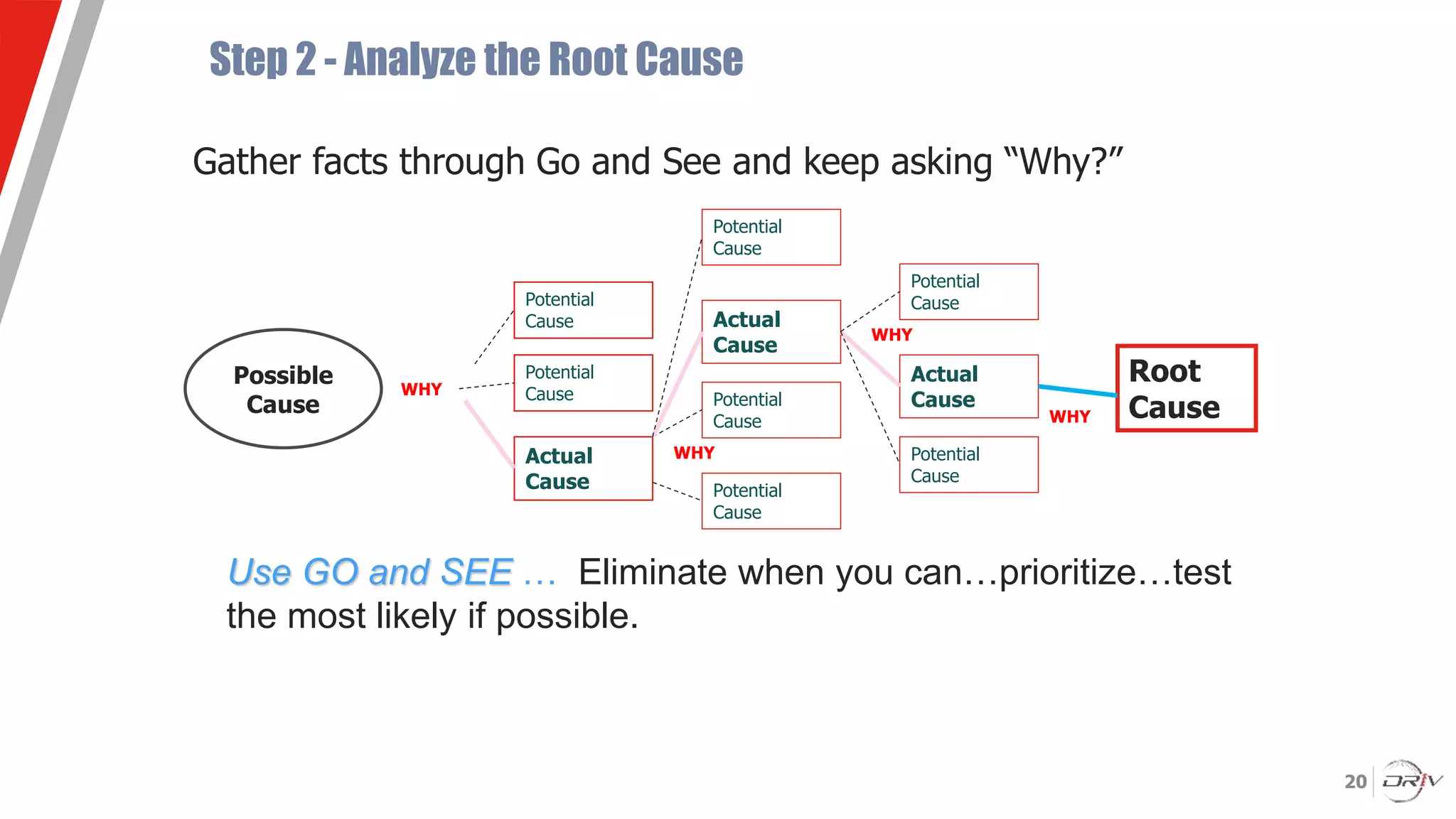
WHY
Potential
Cause
Potential
Cause
Actual
Cause
Potential
Cause
Actual
Cause
Potential
Cause
Potential
Cause
Potential
Cause
Actual
Cause
Potential
Cause
Root
Cause
WHY
WHY
WHY
Possible
Cause
Step 2 - Analyze the Root Cause
Gather facts through Go and See and keep asking “Why?”
Use GO and SEE … Eliminate when you can…prioritize…test
the most likely if possible.
5-WhY…Get to the root cause
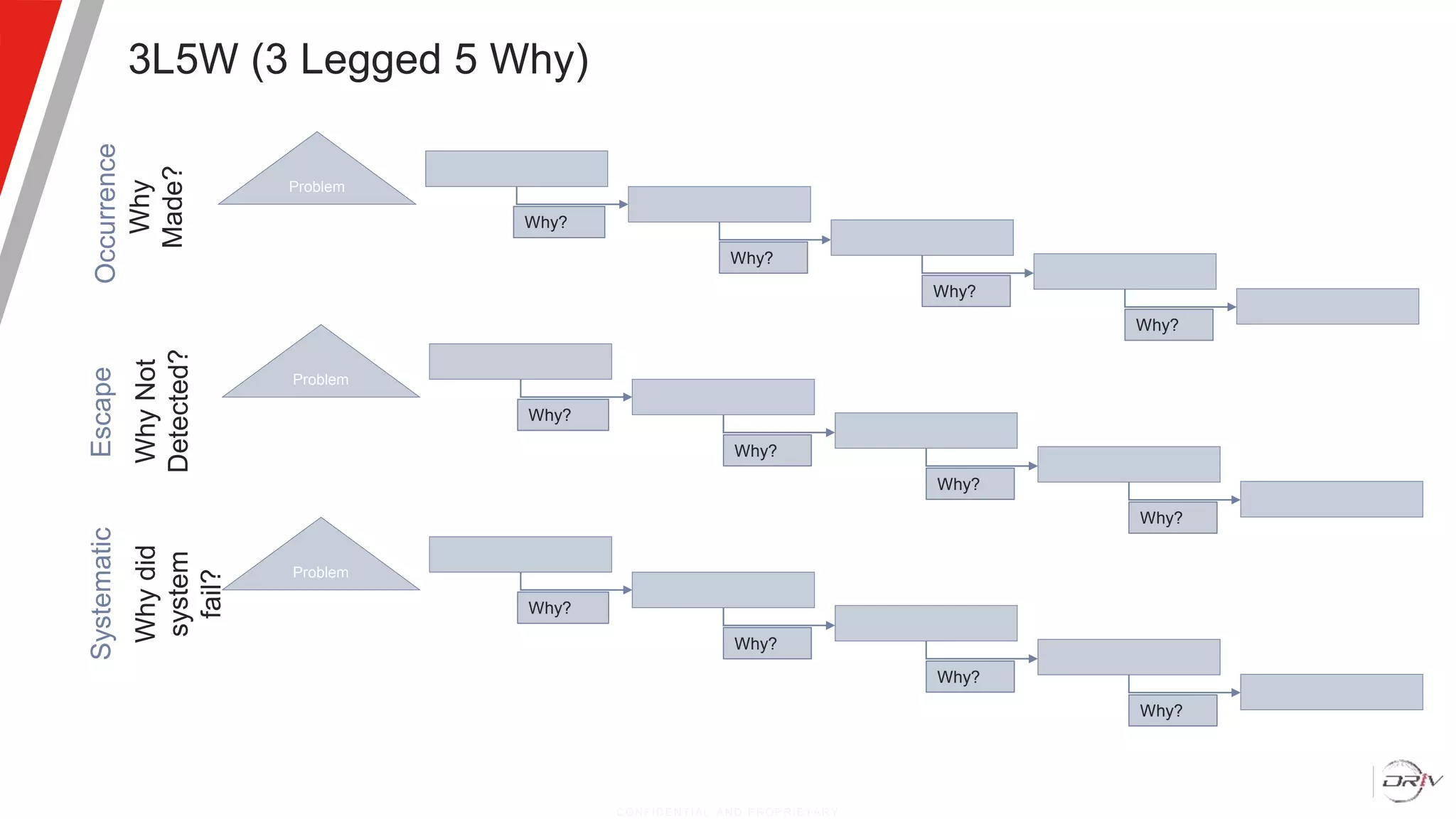
3L5W (3 Legged 5 Why)
CONFIDENT IAL AND PROPRIETARY
Why
Made?
Why
Not
Detected?
Why
did
system
fail?
Occurrence
Escape
Systematic
Problem
Why?
Why?
Why?
Why?
Problem
Why?
Why?
Why?
Why?
Problem
Why?
Why?
Why?
Why?
23
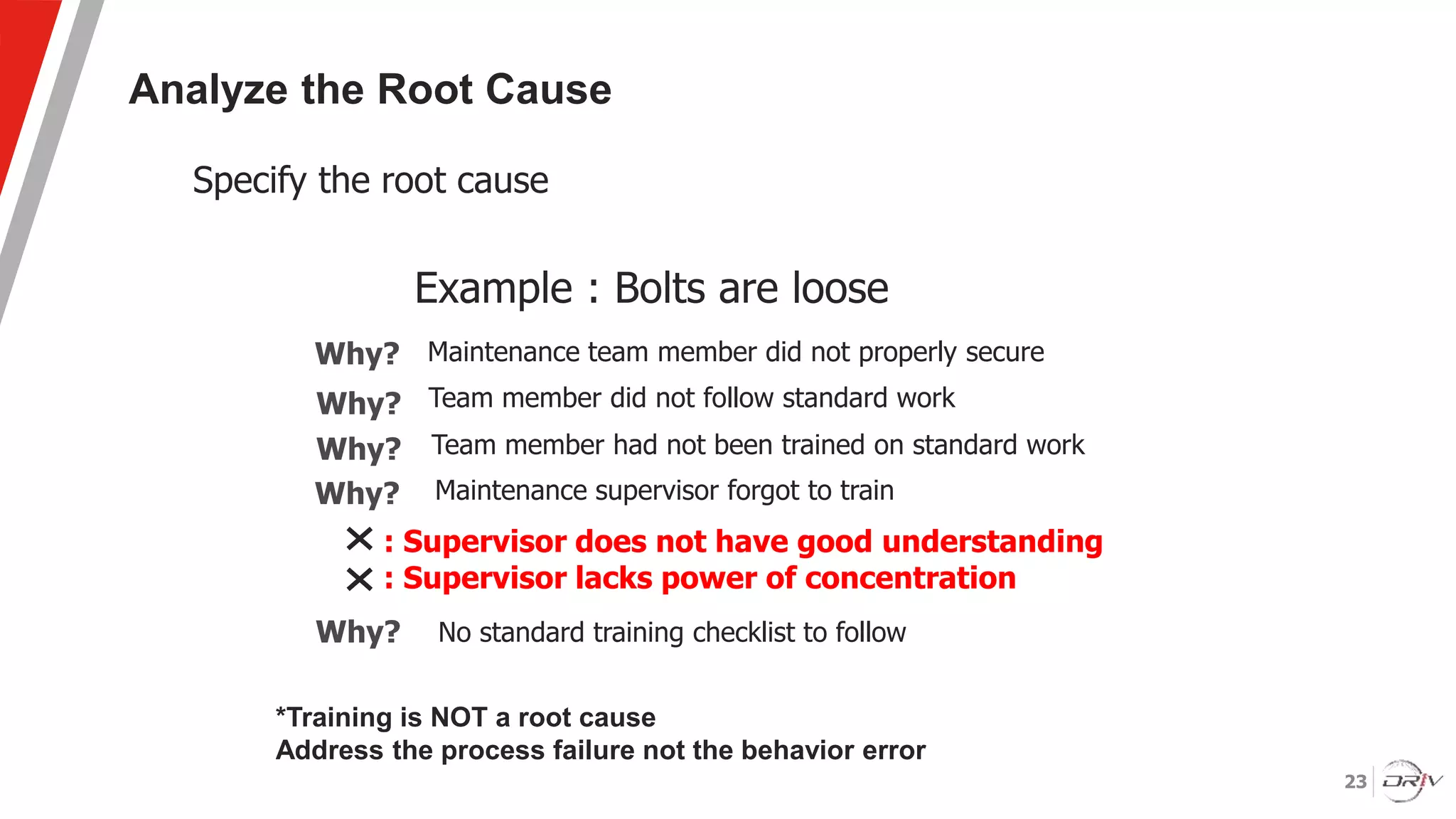
Analyze the Root Cause
Maintenance team member did not properly secure
Why?
Example : Bolts are loose
Why?
: Supervisor does not have good understanding
: Supervisor lacks power of concentration
Specify the root cause
Team member did not follow standard work
Team member had not been trained on standard work
Why?
Why?
Why?
Maintenance supervisor forgot to train
No standard training checklist to follow
*Training is NOT a root cause
Address the process failure not the behavior error
24
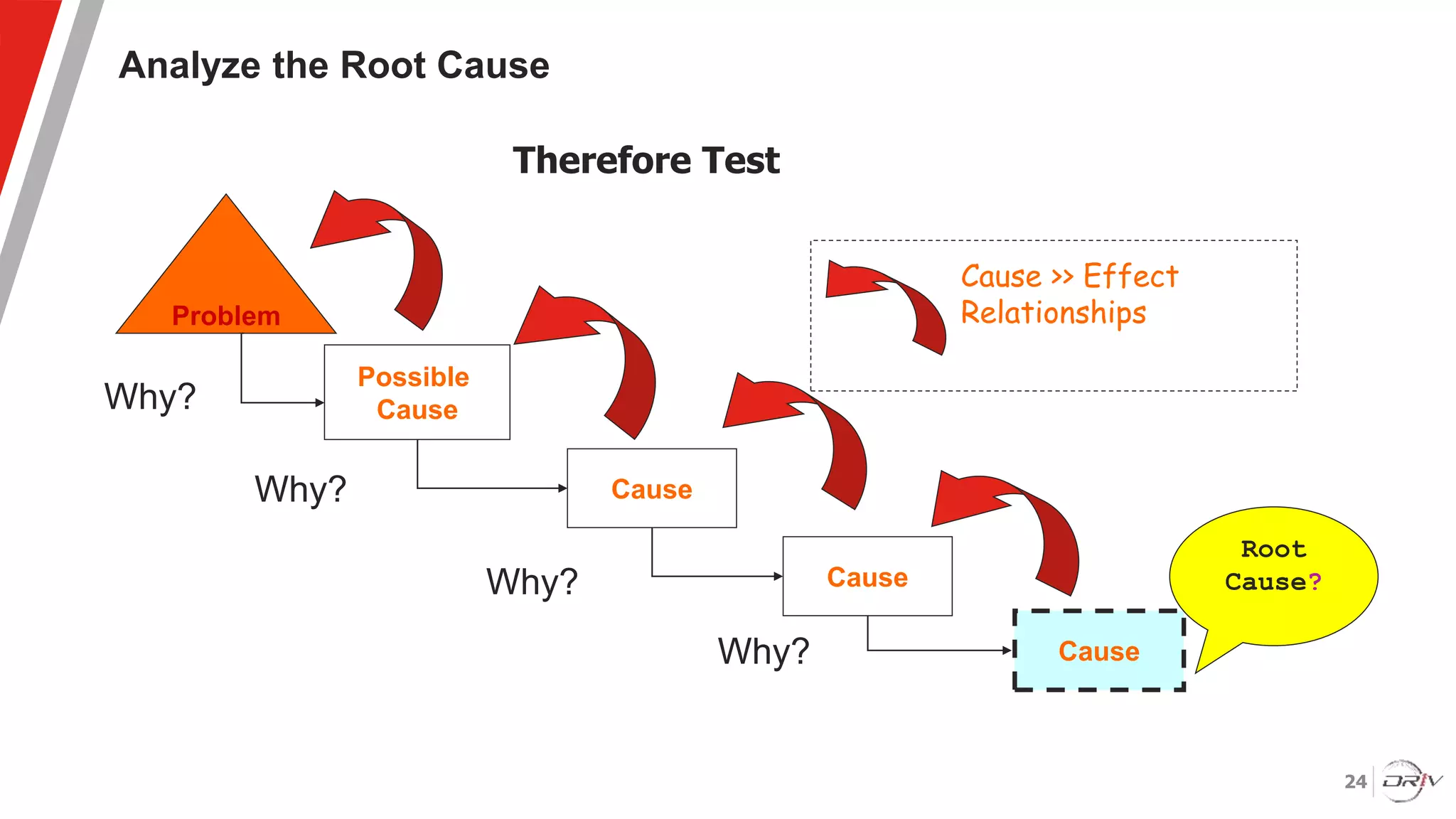
Analyze the Root Cause
Problem
Possible
Cause
Cause
Cause
Cause
Root
Cause?
Why?
Why?
Why?
Why?
Cause >> Effect
Relationships
Therefore Test
25
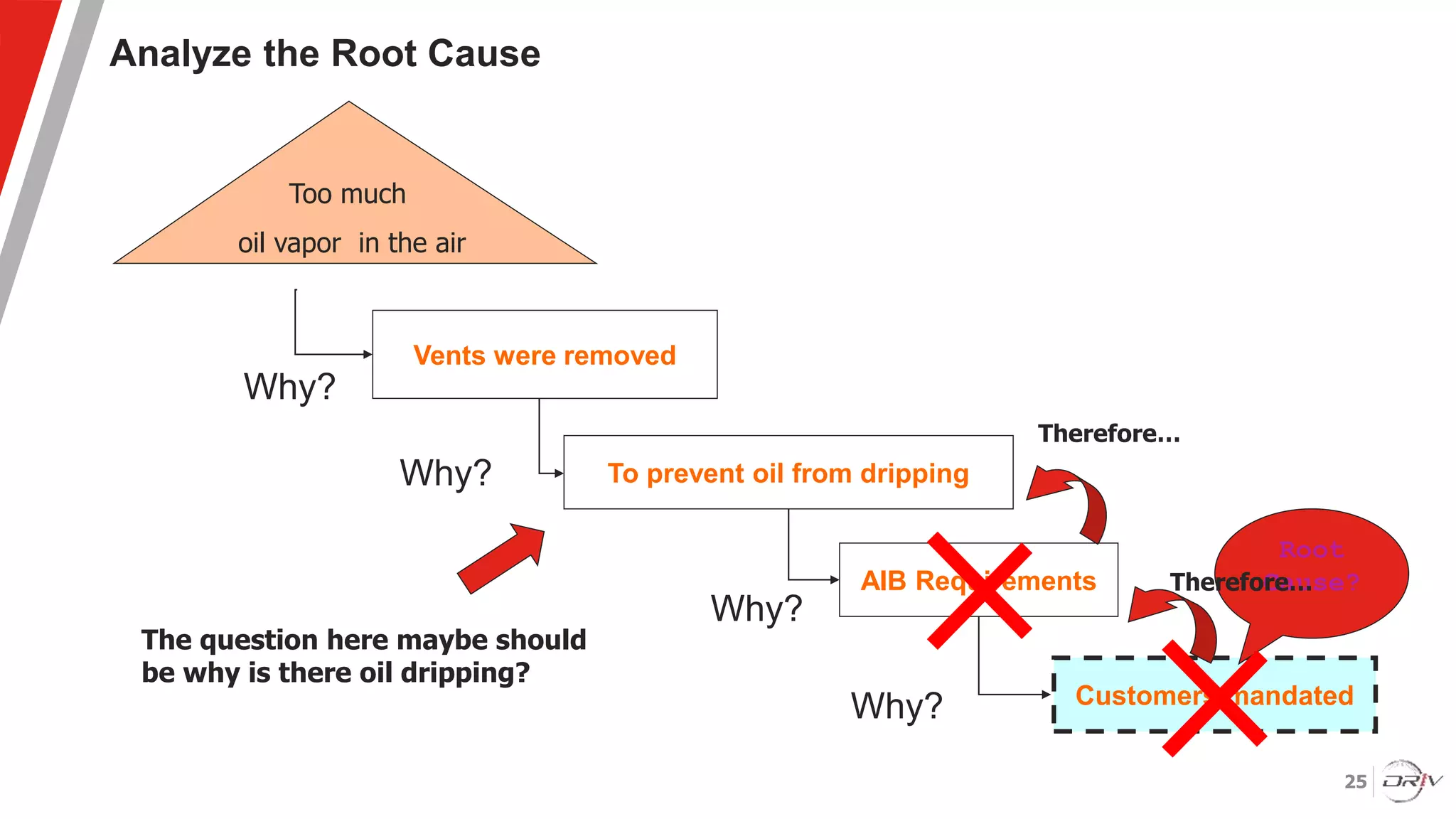
Analyze the Root Cause
Too much
oil vapor in the air
Vents were removed
To prevent oil from dripping
AIB Requirements
Customers mandated
Root
Cause?
Why?
Why?
Why?
Why?
Therefore…
Therefore…
The question here maybe should
be why is there oil dripping?
26
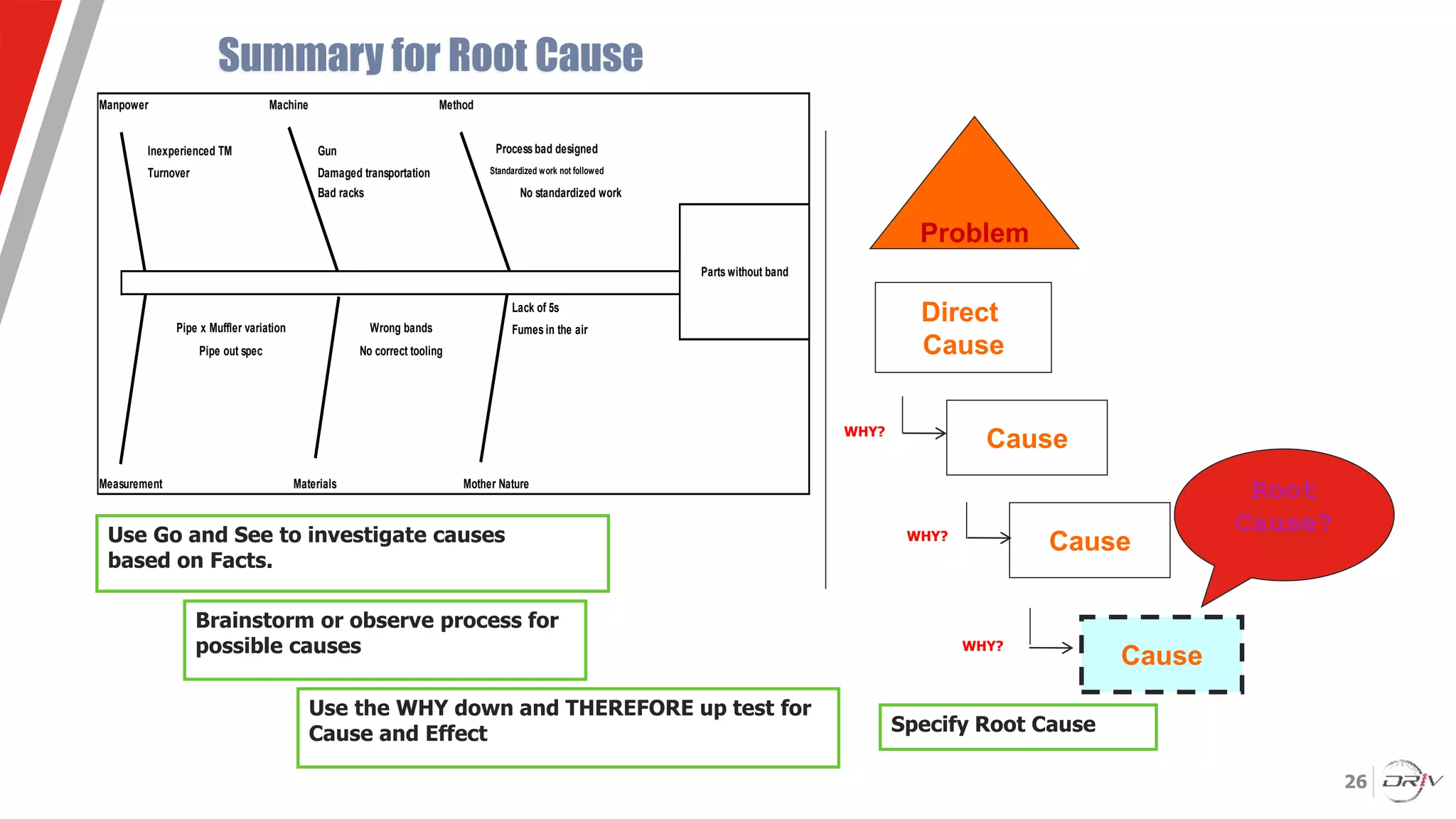
Summary for Root Cause
Brainstorm or observe process for
possible causes
Use Go and See to investigate causes
based on Facts.
Use the WHY down and THEREFORE up test for
Cause and Effect Specify Root Cause
WHY?
Problem
Direct
Cause
Cause
Cause
Cause
Root
Cause?
WHY?
WHY?
Manpower Machine Method
Measurement Materials Mother Nature
Lack of 5s
Pipe x Muffler variation Wrong bands Fumes in the air
Pipe out spec
Parts without band
Standardized work not followed
Gun
Damaged transportation
Bad racks
Inexperienced TM
Turnover
No correct tooling
No standardized work
Process bad designed
27
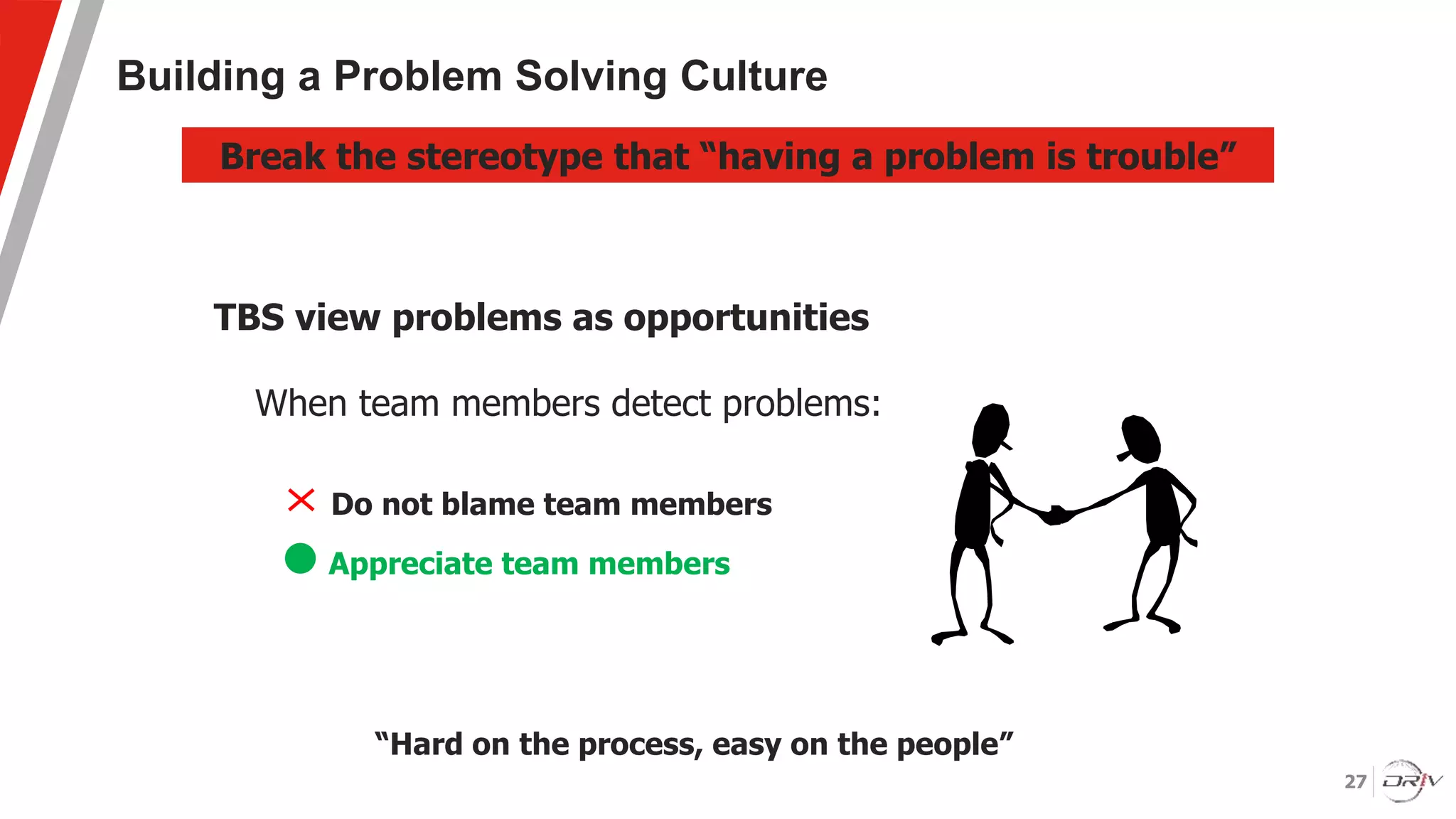
Building a Problem Solving Culture
Break the stereotype that “having a problem is trouble”
TBS view problems as opportunities
When team members detect problems:
Do not blame team members
Appreciate team members
“Hard on the process, easy on the people”
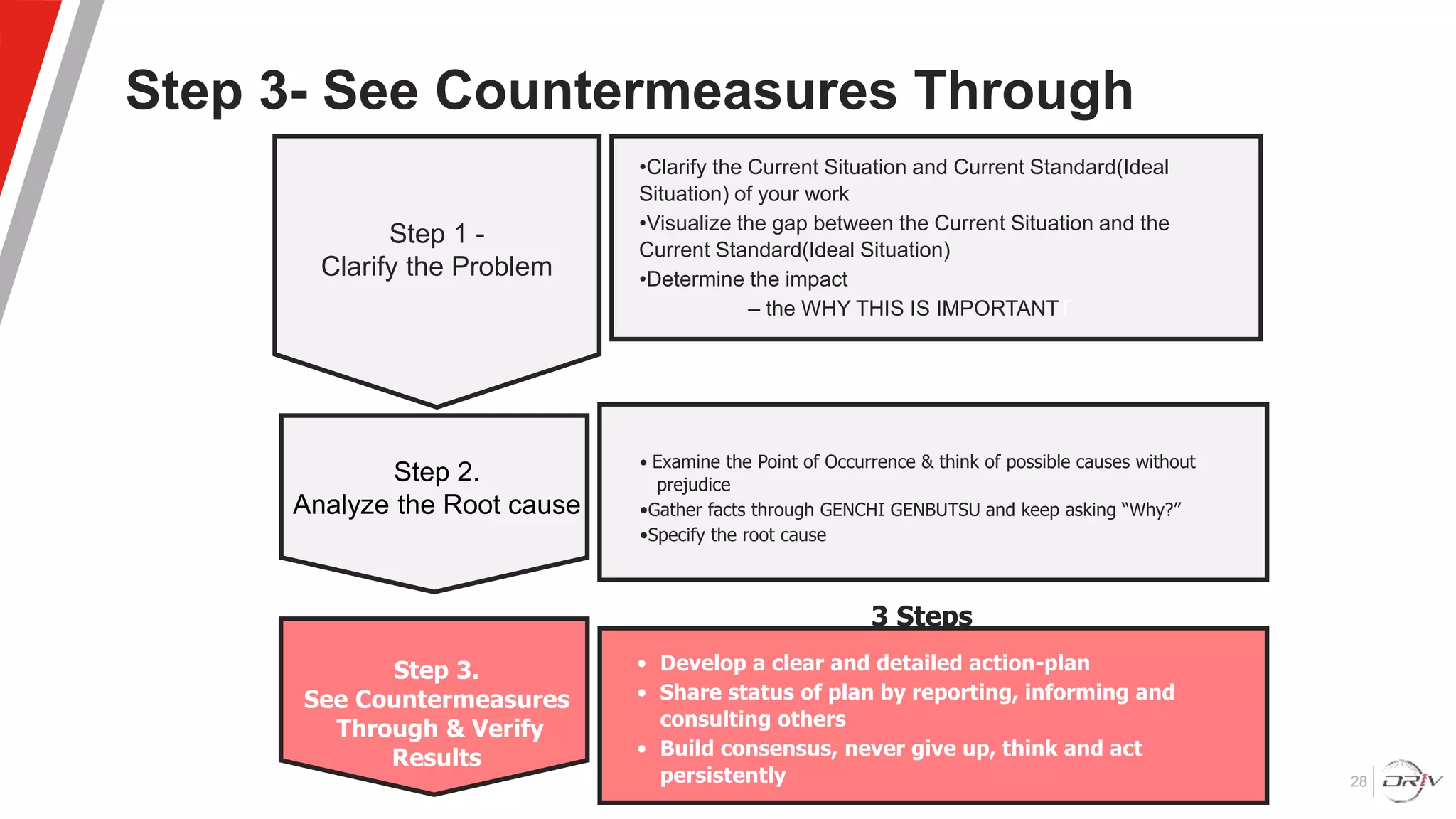
Step 3- See Countermeasures Through
“DRiV: Confidential” 28
3 Steps
• Develop a clear and detailed action-plan
• Share status of plan by reporting, informing and
consulting others
• Build consensus, never give up, think and act
persistently
Step 3.
See Countermeasures
Through & Verify
Results
Step 2.
Analyze the Root cause
• Examine the Point of Occurrence & think of possible causes without
prejudice
•Gather facts through GENCHI GENBUTSU and keep asking “Why?”
•Specify the root cause
Step 1 -
Clarify the Problem
•Clarify the Current Situation and Current Standard(Ideal
Situation) of your work
•Visualize the gap between the Current Situation and the
Current Standard(Ideal Situation)
•Determine the impact
– the WHY THIS IS IMPORTANTT
29
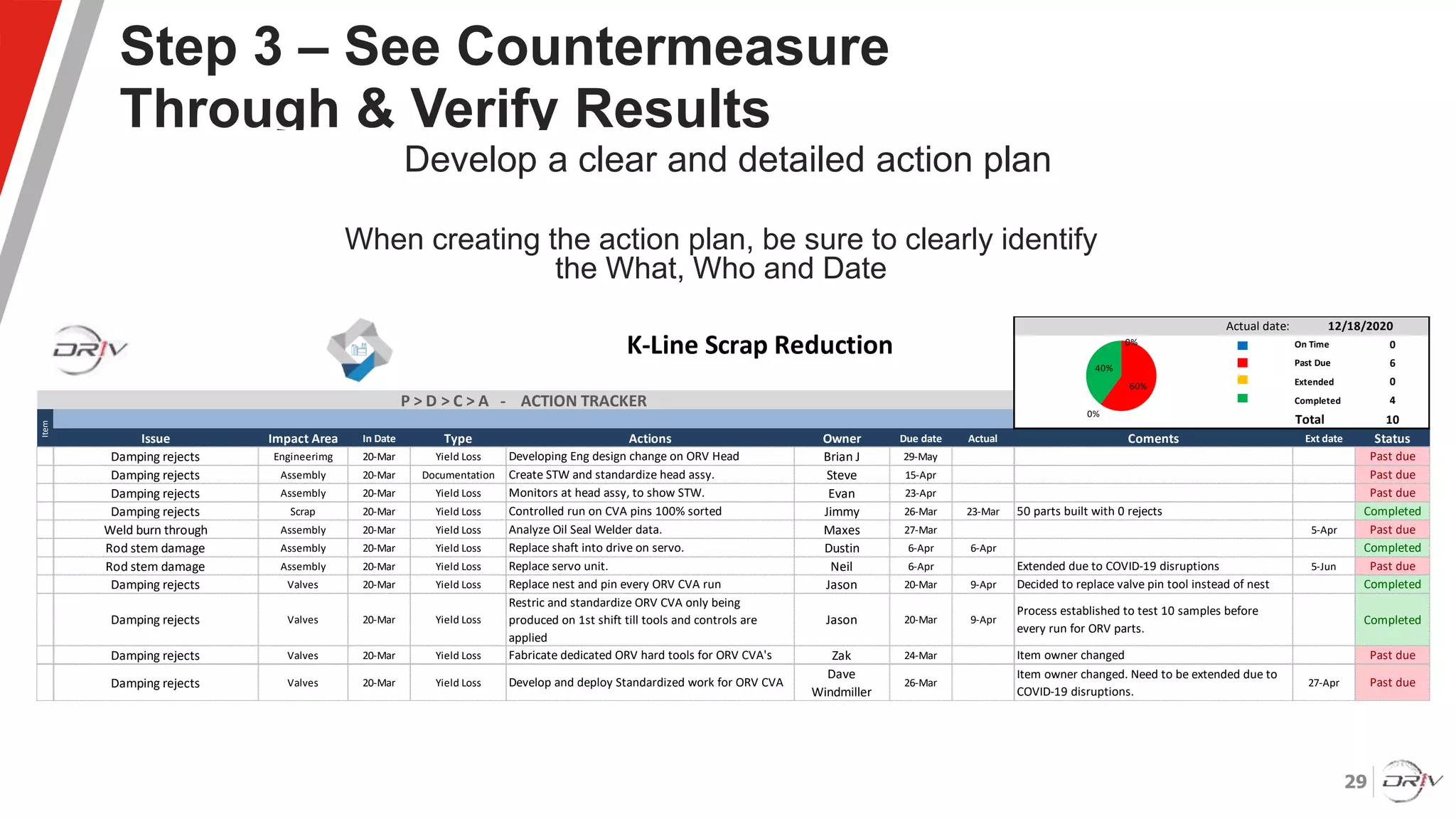
Step 3 – See Countermeasure
Through & Verify Results
Develop a clear and detailed action plan
When creating the action plan, be sure to clearly identify
the What, Who and Date
On Time 0
Past Due 6
Extended 0
Completed 4
Total 10
Issue Impact Area In Date Type Actions Owner Due date Actual Coments Ext date Status
Damping rejects Engineerimg 20-Mar Yield Loss Developing Eng design change on ORV Head Brian J 29-May Past due
Damping rejects Assembly 20-Mar Documentation Create STW and standardize head assy. Steve 15-Apr Past due
Damping rejects Assembly 20-Mar Yield Loss Monitors at head assy, to show STW. Evan 23-Apr Past due
Damping rejects Scrap 20-Mar Yield Loss Controlled run on CVA pins 100% sorted Jimmy 26-Mar 23-Mar 50 parts built with 0 rejects Completed
Weld burn through Assembly 20-Mar Yield Loss Analyze Oil Seal Welder data. Maxes 27-Mar 5-Apr Past due
Rod stem damage Assembly 20-Mar Yield Loss Replace shaft into drive on servo. Dustin 6-Apr 6-Apr Completed
Rod stem damage Assembly 20-Mar Yield Loss Replace servo unit. Neil 6-Apr Extended due to COVID-19 disruptions 5-Jun Past due
Damping rejects Valves 20-Mar Yield Loss Replace nest and pin every ORV CVA run Jason 20-Mar 9-Apr Decided to replace valve pin tool instead of nest Completed
Damping rejects Valves 20-Mar Yield Loss
Restric and standardize ORV CVA only being
produced on 1st shift till tools and controls are
applied
Jason 20-Mar 9-Apr
Process established to test 10 samples before
every run for ORV parts.
Completed
Damping rejects Valves 20-Mar Yield Loss Fabricate dedicated ORV hard tools for ORV CVA's Zak 24-Mar Item owner changed Past due
Damping rejects Valves 20-Mar Yield Loss Develop and deploy Standardized work for ORV CVA
Dave
Windmiller
26-Mar
Item owner changed. Need to be extended due to
COVID-19 disruptions.
27-Apr Past due
Item
K-Line Scrap Reduction
Actual date: 12/18/2020
P > D > C > A - ACTION TRACKER
0%
60%
0%
40%
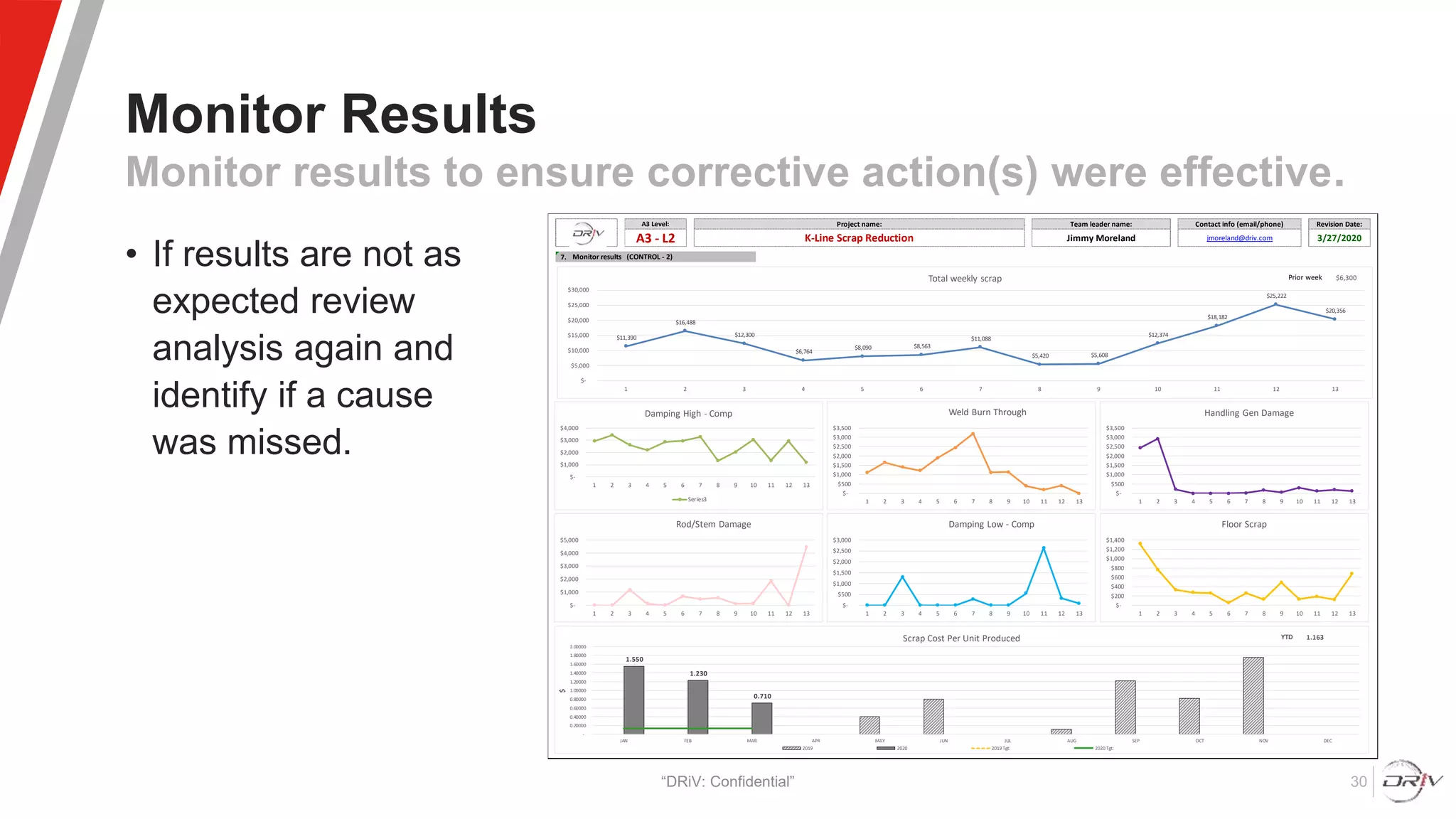
Monitor Results
“DRiV: Confidential” 30
Monitor results to ensure corrective action(s) were effective.
• If results are not as
expected review
analysis again and
identify if a cause
was missed.
A3 Level: Project name: Team leader name: Contact info (email/phone) Revision Date:
A3 - L2 K-Line Scrap Reduction Jimmy Moreland jmoreland@driv.com 3/27/2020
7. Monitor results (CONTROL - 2)
$-
$1,000
$2,000
$3,000
$4,000
1 2 3 4 5 6 7 8 9 10 11 12 13
Damping High - Comp
Series3
$-
$500
$1,000
$1,500
$2,000
$2,500
$3,000
$3,500
1 2 3 4 5 6 7 8 9 10 11 12 13
Weld Burn Through
$-
$500
$1,000
$1,500
$2,000
$2,500
$3,000
$3,500
1 2 3 4 5 6 7 8 9 10 11 12 13
Handling Gen Damage
$-
$1,000
$2,000
$3,000
$4,000
$5,000
1 2 3 4 5 6 7 8 9 10 11 12 13
Rod/Stem Damage
$-
$500
$1,000
$1,500
$2,000
$2,500
$3,000
1 2 3 4 5 6 7 8 9 10 11 12 13
Damping Low - Comp
$-
$200
$400
$600
$800
$1,000
$1,200
$1,400
1 2 3 4 5 6 7 8 9 10 11 12 13
Floor Scrap
$11,390
$16,488
$12,300
$6,764
$8,090 $8,563
$11,088
$5,420 $5,608
$12,374
$18,182
$25,222
$20,356
$-
$5,000
$10,000
$15,000
$20,000
$25,000
$30,000
1 2 3 4 5 6 7 8 9 10 11 12 13
$6,300
Total weekly scrap Prior week
1.550
1.230
0.710
-
0.20000
0.40000
0.60000
0.80000
1.00000
1.20000
1.40000
1.60000
1.80000
2.00000
JAN FEB MAR APR MAY JUN JUL AUG SEP OCT NOV DEC
$
1.163
Scrap Cost Per Unit Produced
2019 2020 2019 Tgt: 2020 Tgt:
YTD
31
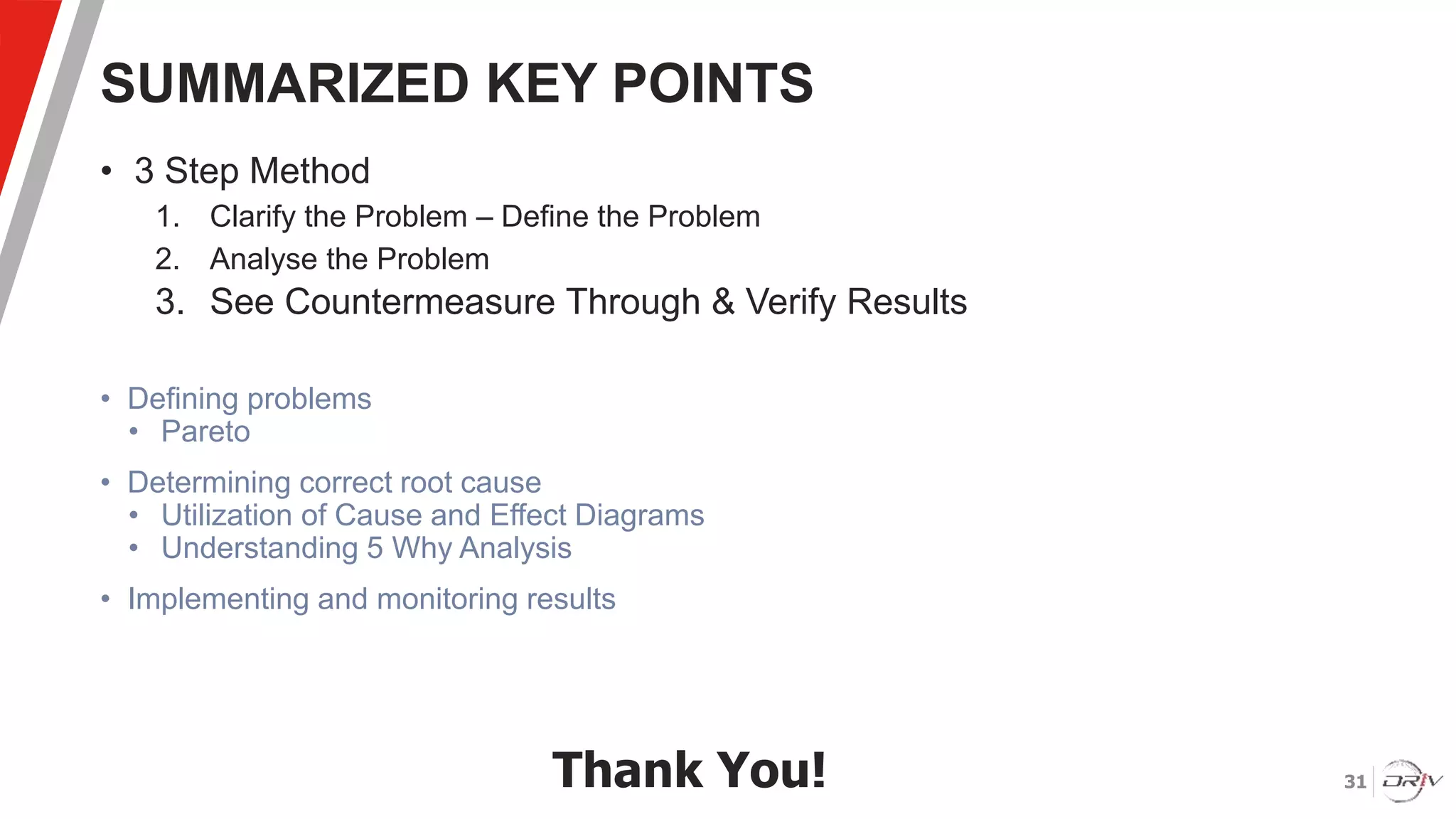
SUMMARIZED KEY POINTS
• 3 Step Method
1. Clarify the Problem – Define the Problem
2. Analyse the Problem
3. See Countermeasure Through & Verify Results
• Defining problems
• Pareto
• Determining correct root cause
• Utilization of Cause and Effect Diagrams
• Understanding 5 Why Analysis
• Implementing and monitoring results
Thank You!
Q & A

A3 Problem Solving DRiV.pptx

  • 1.
  • 2.
    Key Learning Objective •To learn how to solve basic problems using the 3 step method. What makes up a problem • 3 Step Method 1. Clarify the Problem – Define the Problem 2. Analyse the Problem 3. See Countermeasure Through & Verify Results • Summarized Key Points • Q&A Agenda 2
  • 3.
    • Defining problems •Pareto • Determining correct root cause • Utilization of Cause and Effect Diagrams • Understanding 5 Why Analysis • Implementing and monitoring results Key Learning Objective 3
  • 4.
    • A3 isa paper size • A3 were originally used because it was the largest size of paper that could be faxed What is an A3? CONFIDENT IAL AND PROPRIETARY
  • 5.
    A3 Overview • A3is a structured problem solving method 5 Gap towards Ideal
  • 6.
    6 What Defines aSafe Environment? “Problems” improve our worksite and the work itself. “No one has more trouble than the person who claims to have no trouble.” (Having no problem is the biggest problem of all.) by Taiichi Ohno
  • 7.
    Step 1- Clarifyingthe Problem “DRiV: Confidential” 7 Step 1 - Clarify the Problem – Define the problem • Clarify the Current Situation and Current Standard(Ideal Situation) of your work • Visualize the gap between the Current Situation and the Current Standard(Ideal Situation) • Determine the impact – the WHY THIS IS IMPORTANT
  • 8.
    8 What is aproblem? 3 1 2 5 4 Aug Sep Oct Nov The Ideal/Standard The Current Situation Defects Visualize the gap between the “Current” and the “Standard” or Ideal Situation Problem 6 2 types of Problem: Type 1 and 2 Type 1: deviation from standard Type 2: deviation from true north
  • 9.
    Obstacles to ProblemSolving Assumptions • Believing we understand the problem or what the problem is • Knowing how to fix the problem without know the real cause • The fix we put in place solved the problem without monitoring results
  • 10.
    How to Developa Problem Statement • What? • Where? • When? • How many? • What is the standard that was violated? CONFIDENT IAL AND PROPRIETARY
  • 11.
    How to Developa Problem Statement Example • Qty + Units + defect/issue + occurrence location + when did it happen + standard violated. • $ 1.30 Scrap CPU on Assembly Line 10 during Q1 2020 vs $ 0.133 CPU AOP. This is $ 1.17 CPU above target. CONFIDENT IAL AND PROPRIETARY What is wrong? Scrap out of target Where did it occur? Line-10, Assembly DRiV Kettering Plant RC NA When did it happen? Q1 2020 How many or much quantity? $ 1.30 CPU What is the standard that was violated? $ 0.133 CPU Equation for Problem Statement Problem Statement
  • 12.
    Working Problem StatementExample • Qty + Units + defect/issue + occurrence location + when did it happen + standard violated. CONFIDENT IAL AND PROPRIETARY What is wrong? Where did it occur? When did it happen? How many or much quantity? What is the standard that was violated? Equation for Problem Statement Problem Statement
  • 13.
    Problem Break Down •Determine the “as is” baseline data CONFIDENT IAL AND PROPRIETARY 2. Problem breakdown (MEASURE) 0% 10% 20% 30% 40% 50% 60% 70% 80% 90% 100% $- $10 $20 $30 $40 $50 $60 $70 $80 $90 DLLS Thousands $306,404 0 5000 10000 15000 20000 25000 30000 35000 PRIME SHOCK DISC PACK ASM RESERVE TUBE PRES TUBE DRAWN PISTON ROD Others DLLS 75109 Floor Scrap 0 5000 10000 15000 20000 25000 PRIME SHOCK ROD & MOUNT ASM- ARCW HEAD ASSY DISC PACK ASM PRES TUBE DRAWN Others DLLS 50008 Damping High - Comp 0 2000 4000 6000 8000 10000 12000 14000 16000 18000 DLLS 33895 Offset Loop/Stem
  • 14.
  • 15.
    Step 2- Analyzethe Root Cause “DRiV: Confidential” 15 • Examine the Point of Occurrence and think of possible causes without prejudice • Gather facts through GENCHI GENBUTSU and keep asking “Why?” • Specify the root cause Step 2. Analyze the Root cause Step 1 - Clarify the Problem •Clarify the Current Situation and Current Standard(Ideal Situation) of your work •Visualize the gap between the Current Situation and the Current Standard(Ideal Situation) •Determine the impact – the WHY THIS IS IMPORTANTT
  • 16.
    16 Root Cause BrainStorming Without any prejudice: • Utilize your experiences and intuition as a reference when you make considerations. • Do not make decisions based solely on experiences and intuition without thinking deeply. • Make determinations based on facts. •While listening to others clarify whether you are hearing an opinion or actual facts Examine the Prioritized Problem at the Point of Occurrence and determine possible causes without prejudice
  • 17.
    Cause and EffectFishbone Diagram (Ishikawa) “DRiV: Confidential” 17 Manpower Material Measure Worn Wheel Rod Tapered Bad Spindle Non-Uniform surface on wheels Temperature Dressup Gage Repeatibility Grime build up on part before CGI Wrong Setup Manual Comp-in Training Material Hardness Materal Temperature OD Undersize Machine Grindlines 3211 - 3214 Area Method Machine OD Undersize Mother Nature
  • 18.
    18 Measurements Measurement devices Data collectionsystems Calibration Materials Raw materials Packaging materials Parts/components Manpower Training Personnel issues Absenteeism Machines Equipment condition OEE - Uptime, performance, quality Methods Standardized Work Best Practices Non value added activities Scheduling Mother Nature (Enviroment) Temperature/humidity Space available Cause & Effect Categories – the 6 M’s
  • 19.
    5 Why CONFIDENT IALAND PROPRIETARY Problem Why? Why? Why? Why?
  • 20.
    20 WHY Potential Cause Potential Cause Actual Cause Potential Cause Actual Cause Potential Cause Potential Cause Potential Cause Actual Cause Potential Cause Root Cause WHY WHY WHY Possible Cause Step 2 -Analyze the Root Cause Gather facts through Go and See and keep asking “Why?” Use GO and SEE … Eliminate when you can…prioritize…test the most likely if possible.
  • 21.
  • 22.
    3L5W (3 Legged5 Why) CONFIDENT IAL AND PROPRIETARY Why Made? Why Not Detected? Why did system fail? Occurrence Escape Systematic Problem Why? Why? Why? Why? Problem Why? Why? Why? Why? Problem Why? Why? Why? Why?
  • 23.
    23 Analyze the RootCause Maintenance team member did not properly secure Why? Example : Bolts are loose Why? : Supervisor does not have good understanding : Supervisor lacks power of concentration Specify the root cause Team member did not follow standard work Team member had not been trained on standard work Why? Why? Why? Maintenance supervisor forgot to train No standard training checklist to follow *Training is NOT a root cause Address the process failure not the behavior error
  • 24.
    24 Analyze the RootCause Problem Possible Cause Cause Cause Cause Root Cause? Why? Why? Why? Why? Cause >> Effect Relationships Therefore Test
  • 25.
    25 Analyze the RootCause Too much oil vapor in the air Vents were removed To prevent oil from dripping AIB Requirements Customers mandated Root Cause? Why? Why? Why? Why? Therefore… Therefore… The question here maybe should be why is there oil dripping?
  • 26.
    26 Summary for RootCause Brainstorm or observe process for possible causes Use Go and See to investigate causes based on Facts. Use the WHY down and THEREFORE up test for Cause and Effect Specify Root Cause WHY? Problem Direct Cause Cause Cause Cause Root Cause? WHY? WHY? Manpower Machine Method Measurement Materials Mother Nature Lack of 5s Pipe x Muffler variation Wrong bands Fumes in the air Pipe out spec Parts without band Standardized work not followed Gun Damaged transportation Bad racks Inexperienced TM Turnover No correct tooling No standardized work Process bad designed
  • 27.
    27 Building a ProblemSolving Culture Break the stereotype that “having a problem is trouble” TBS view problems as opportunities When team members detect problems: Do not blame team members Appreciate team members “Hard on the process, easy on the people”
  • 28.
    Step 3- SeeCountermeasures Through “DRiV: Confidential” 28 3 Steps • Develop a clear and detailed action-plan • Share status of plan by reporting, informing and consulting others • Build consensus, never give up, think and act persistently Step 3. See Countermeasures Through & Verify Results Step 2. Analyze the Root cause • Examine the Point of Occurrence & think of possible causes without prejudice •Gather facts through GENCHI GENBUTSU and keep asking “Why?” •Specify the root cause Step 1 - Clarify the Problem •Clarify the Current Situation and Current Standard(Ideal Situation) of your work •Visualize the gap between the Current Situation and the Current Standard(Ideal Situation) •Determine the impact – the WHY THIS IS IMPORTANTT
  • 29.
    29 Step 3 –See Countermeasure Through & Verify Results Develop a clear and detailed action plan When creating the action plan, be sure to clearly identify the What, Who and Date On Time 0 Past Due 6 Extended 0 Completed 4 Total 10 Issue Impact Area In Date Type Actions Owner Due date Actual Coments Ext date Status Damping rejects Engineerimg 20-Mar Yield Loss Developing Eng design change on ORV Head Brian J 29-May Past due Damping rejects Assembly 20-Mar Documentation Create STW and standardize head assy. Steve 15-Apr Past due Damping rejects Assembly 20-Mar Yield Loss Monitors at head assy, to show STW. Evan 23-Apr Past due Damping rejects Scrap 20-Mar Yield Loss Controlled run on CVA pins 100% sorted Jimmy 26-Mar 23-Mar 50 parts built with 0 rejects Completed Weld burn through Assembly 20-Mar Yield Loss Analyze Oil Seal Welder data. Maxes 27-Mar 5-Apr Past due Rod stem damage Assembly 20-Mar Yield Loss Replace shaft into drive on servo. Dustin 6-Apr 6-Apr Completed Rod stem damage Assembly 20-Mar Yield Loss Replace servo unit. Neil 6-Apr Extended due to COVID-19 disruptions 5-Jun Past due Damping rejects Valves 20-Mar Yield Loss Replace nest and pin every ORV CVA run Jason 20-Mar 9-Apr Decided to replace valve pin tool instead of nest Completed Damping rejects Valves 20-Mar Yield Loss Restric and standardize ORV CVA only being produced on 1st shift till tools and controls are applied Jason 20-Mar 9-Apr Process established to test 10 samples before every run for ORV parts. Completed Damping rejects Valves 20-Mar Yield Loss Fabricate dedicated ORV hard tools for ORV CVA's Zak 24-Mar Item owner changed Past due Damping rejects Valves 20-Mar Yield Loss Develop and deploy Standardized work for ORV CVA Dave Windmiller 26-Mar Item owner changed. Need to be extended due to COVID-19 disruptions. 27-Apr Past due Item K-Line Scrap Reduction Actual date: 12/18/2020 P > D > C > A - ACTION TRACKER 0% 60% 0% 40%
  • 30.
    Monitor Results “DRiV: Confidential”30 Monitor results to ensure corrective action(s) were effective. • If results are not as expected review analysis again and identify if a cause was missed. A3 Level: Project name: Team leader name: Contact info (email/phone) Revision Date: A3 - L2 K-Line Scrap Reduction Jimmy Moreland jmoreland@driv.com 3/27/2020 7. Monitor results (CONTROL - 2) $- $1,000 $2,000 $3,000 $4,000 1 2 3 4 5 6 7 8 9 10 11 12 13 Damping High - Comp Series3 $- $500 $1,000 $1,500 $2,000 $2,500 $3,000 $3,500 1 2 3 4 5 6 7 8 9 10 11 12 13 Weld Burn Through $- $500 $1,000 $1,500 $2,000 $2,500 $3,000 $3,500 1 2 3 4 5 6 7 8 9 10 11 12 13 Handling Gen Damage $- $1,000 $2,000 $3,000 $4,000 $5,000 1 2 3 4 5 6 7 8 9 10 11 12 13 Rod/Stem Damage $- $500 $1,000 $1,500 $2,000 $2,500 $3,000 1 2 3 4 5 6 7 8 9 10 11 12 13 Damping Low - Comp $- $200 $400 $600 $800 $1,000 $1,200 $1,400 1 2 3 4 5 6 7 8 9 10 11 12 13 Floor Scrap $11,390 $16,488 $12,300 $6,764 $8,090 $8,563 $11,088 $5,420 $5,608 $12,374 $18,182 $25,222 $20,356 $- $5,000 $10,000 $15,000 $20,000 $25,000 $30,000 1 2 3 4 5 6 7 8 9 10 11 12 13 $6,300 Total weekly scrap Prior week 1.550 1.230 0.710 - 0.20000 0.40000 0.60000 0.80000 1.00000 1.20000 1.40000 1.60000 1.80000 2.00000 JAN FEB MAR APR MAY JUN JUL AUG SEP OCT NOV DEC $ 1.163 Scrap Cost Per Unit Produced 2019 2020 2019 Tgt: 2020 Tgt: YTD
  • 31.
    31 SUMMARIZED KEY POINTS •3 Step Method 1. Clarify the Problem – Define the Problem 2. Analyse the Problem 3. See Countermeasure Through & Verify Results • Defining problems • Pareto • Determining correct root cause • Utilization of Cause and Effect Diagrams • Understanding 5 Why Analysis • Implementing and monitoring results Thank You!
  • 32.

Editor's Notes

  • #3 A3 Problem Solving Methods Define Analyze Implement and Verify
  • #6 Wiki definition=- A3 problem solving is a structured problem-solving and continuous-improvement approach, first employed at Toyota and typically used by lean manufacturing practitioners.[1] It provides a simple and strict procedure that guides problem solving by workers. The approach typically uses a single sheet of ISO A3-size paper, which is the source of its name
  • #7 V12.4.2010
  • #9 V12.4.2010
  • #10 V12.4.2010
  • #12 Importance of making a focused problem statement is to make sure the problem is not so broad as to solve world hunger
  • #13 Discuss a current problem and walk thru developing a problem statement
  • #15 80/20 Rule 80% of the effects are caused by 20% of the
  • #17 V12.4.2010
  • #19 V12.4.2010
  • #20 5 Whys can be more or less than 5 steps They can also have multiple legs
  • #21 Review slide Key Points: Based on facts hypothesize the most likely direct cause (1st why) of the problem to tackle Confirm the facts of the possible causes at worksite through Go and See. Continue to question “Why?” Ask the next “Why”, when the initial cause has been confirmed by facts.
  • #24 V12.4.2010
  • #25 V12.4.2010
  • #26 V12.4.2010
  • #27 This slide’s intention is to give an overview of step 4. Walk through process. KEY POINTS: As you go down on the why’s must confirm with facts…if cannot confirm with facts you stop. It is not always that obvious. Some trainers make it look like the 5 Whys are straight forward and root cause found on a linear path and can be completed in very short time. The fact is that it may take you some time to do it. Each potential cause could have a sub-set of causes. Go See – involve the people performing the process or working in the area. Prove out the “why”. Is it a fact? (don’t let your prejudice affect you)
  • #28 V12.4.2010
  • #30 V12.4.2010
  • #32 V12.4.2010