


Problem Solving Tools –
Quick & Easy
www.optimumfx.com
Quick and easy tools
When you want to implement a simple problem solving
process on the production floor that can be used in real
time by your team
5 Whys
• Basic process ideal for application on production lines. Suitable for use in Short Interval Control
meetings
My car will not start. (the problem)
• Why? - The battery is dead. (first why)
• Why? - The alternator is not functioning. (second why)
• Why? - The alternator belt has broken. (third why)
• Why? - The alternator belt was well beyond its useful service life and has never been replaced. (fourth
why)
• Why? - I have not been maintaining my car according to the recommended service schedule. (fifth
why, a root cause)
• Potential issues:
– Tendency for investigators to stop at symptoms rather than going on to lower level root causes.
– Inability to go beyond the investigator's current knowledge - can't find causes that they don't already know
– Lack of support to help the investigator to ask the right "why" questions.
– Results aren't repeatable - different people using 5 Whys come up with different causes for the same problem.
– The tendency to isolate a single root cause, whereas each question could elicit many different root causes
One-Point Lesson
Topic: Conducting 5 Why Analysis
1. Ask colleague to describe a problem that they are
familiar with
2. Write it in the situation box
3. Ask your colleague a question about situation,
writing it in the Question Box
4. Write their answer in the Answer Box
5. Ask a question about the answer and write it in
the next Question Box
Directions:
Situation:
Question 1: Answer:
Question 2: Answer:
Question 3: Answer:
Question 4: Answer:
Question 5: Answer:
Ishikawa – Cause and Effect diagram
• A divergent thought process used to identify potential causes for a specific event
• With ideas created teams use a convergent thought process to identify probable cause or highest
priority contributors
• Causes are grouped into predefined categories to guide the user to examine specific areas
• Highly visual tool ideal for application on a factory floor – very frequently used in automotive
sectors.
– Can be built into line-based notice boards to be used as a “Live” problem solving tool which teams use to
add bones as they go through the day
• Typical “Main Bones” for manufacturing problem solving – 4 M’s
– Machine, Method, Material, Man Power
• Potential issues:
– Tendency for investigators to stop at symptoms rather than going on to lower level root causes.
– Inability to go beyond the investigator's current knowledge - can't find causes that they don't already know
Building your Ishikawa diagram
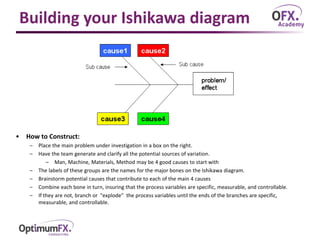
• How to Construct:
– Place the main problem under investigation in a box on the right.
– Have the team generate and clarify all the potential sources of variation.
– Man, Machine, Materials, Method may be 4 good causes to start with
– The labels of these groups are the names for the major bones on the Ishikawa diagram.
– Brainstorm potential causes that contribute to each of the main 4 causes
– Combine each bone in turn, insuring that the process variables are specific, measurable, and controllable.
– If they are not, branch or "explode" the process variables until the ends of the branches are specific,
measurable, and controllable.
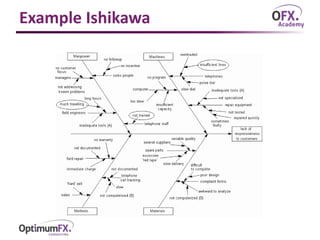
Example Ishikawa

Quick & easy problem solving tools

  • 1.
    Problem Solving Tools– Quick & Easy www.optimumfx.com
  • 2.
    Quick and easytools When you want to implement a simple problem solving process on the production floor that can be used in real time by your team
  • 3.
    5 Whys • Basicprocess ideal for application on production lines. Suitable for use in Short Interval Control meetings My car will not start. (the problem) • Why? - The battery is dead. (first why) • Why? - The alternator is not functioning. (second why) • Why? - The alternator belt has broken. (third why) • Why? - The alternator belt was well beyond its useful service life and has never been replaced. (fourth why) • Why? - I have not been maintaining my car according to the recommended service schedule. (fifth why, a root cause) • Potential issues: – Tendency for investigators to stop at symptoms rather than going on to lower level root causes. – Inability to go beyond the investigator's current knowledge - can't find causes that they don't already know – Lack of support to help the investigator to ask the right "why" questions. – Results aren't repeatable - different people using 5 Whys come up with different causes for the same problem. – The tendency to isolate a single root cause, whereas each question could elicit many different root causes
  • 4.
    One-Point Lesson Topic: Conducting5 Why Analysis 1. Ask colleague to describe a problem that they are familiar with 2. Write it in the situation box 3. Ask your colleague a question about situation, writing it in the Question Box 4. Write their answer in the Answer Box 5. Ask a question about the answer and write it in the next Question Box Directions: Situation: Question 1: Answer: Question 2: Answer: Question 3: Answer: Question 4: Answer: Question 5: Answer:
  • 5.
    Ishikawa – Causeand Effect diagram • A divergent thought process used to identify potential causes for a specific event • With ideas created teams use a convergent thought process to identify probable cause or highest priority contributors • Causes are grouped into predefined categories to guide the user to examine specific areas • Highly visual tool ideal for application on a factory floor – very frequently used in automotive sectors. – Can be built into line-based notice boards to be used as a “Live” problem solving tool which teams use to add bones as they go through the day • Typical “Main Bones” for manufacturing problem solving – 4 M’s – Machine, Method, Material, Man Power • Potential issues: – Tendency for investigators to stop at symptoms rather than going on to lower level root causes. – Inability to go beyond the investigator's current knowledge - can't find causes that they don't already know
  • 6.
    Building your Ishikawadiagram • How to Construct: – Place the main problem under investigation in a box on the right. – Have the team generate and clarify all the potential sources of variation. – Man, Machine, Materials, Method may be 4 good causes to start with – The labels of these groups are the names for the major bones on the Ishikawa diagram. – Brainstorm potential causes that contribute to each of the main 4 causes – Combine each bone in turn, insuring that the process variables are specific, measurable, and controllable. – If they are not, branch or "explode" the process variables until the ends of the branches are specific, measurable, and controllable.
  • 7.