Applying self-study approach
to evaluate a distance online
course

                                  Hery The
      Department of Educational Technology
             University of Hawaii at Manoa
Organization of this presentation:

•   Self-study and the conceptual
    framework
•   Autobiography
•   Instructional analysis
•   The course content and delivery
•   Reflection and evaluation
What self-study teacher
research IS NOT
•   Anastasia Samaras. (2010). Self-Study Teacher Research: Improving Your Practice

•   Through Collaborative Inquiry. US: Sage Publishing.
    Anastasia Samaras. (2010). Student study site for Self-Study Teacher Research:
    Improving Your Practice Through Collaborative Inquiry. Retrieved from
    http://www.sagepub.com/samaras/default.htm


     o Self-study is not about your studying
       others' personal inquiries.
     o Self-study is not all about you and only
       about you.
     o Self-study is not conducted alone.
     o Self-study research is not merely
       reflection.
     o Self-study is not only about personal
       knowledge.
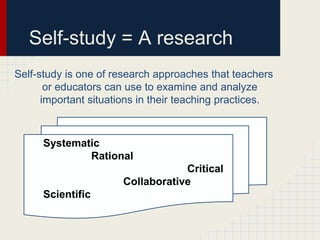
Self-study = A research
Self-study is one of research approaches that teachers
       or educators can use to examine and analyze
      important situations in their teaching practices.


      Systematic
              Rational
                                   Critical
                       Collaborative
      Scientific
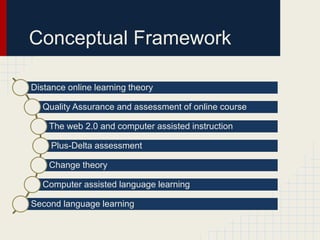
Conceptual Framework

Distance online learning theory

  Quality Assurance and assessment of online course

    The web 2.0 and computer assisted instruction

     Plus-Delta assessment

    Change theory

  Computer assisted language learning

Second language learning
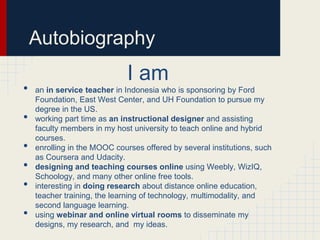
Autobiography
                              I am
•   an in service teacher in Indonesia who is sponsoring by Ford
    Foundation, East West Center, and UH Foundation to pursue my
    degree in the US.
•   working part time as an instructional designer and assisting
    faculty members in my host university to teach online and hybrid
    courses.
•   enrolling in the MOOC courses offered by several institutions, such
    as Coursera and Udacity.
•   designing and teaching courses online using Weebly, WizIQ,
    Schoology, and many other online free tools.
•   interesting in doing research about distance online education,
    teacher training, the learning of technology, multimodality, and
    second language learning.
•   using webinar and online virtual rooms to disseminate my
    designs, my research, and my ideas.
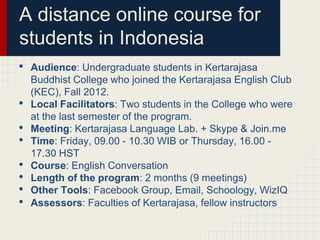
A distance online course for
students in Indonesia
•   Audience: Undergraduate students in Kertarajasa
    Buddhist College who joined the Kertarajasa English Club
    (KEC), Fall 2012.
•   Local Facilitators: Two students in the College who were
    at the last semester of the program.
•   Meeting: Kertarajasa Language Lab. + Skype & Join.me
•   Time: Friday, 09.00 - 10.30 WIB or Thursday, 16.00 -
    17.30 HST
•   Course: English Conversation
•   Length of the program: 2 months (9 meetings)
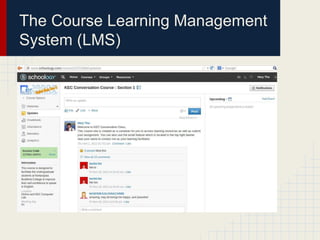
•   Other Tools: Facebook Group, Email, Schoology, WizIQ
•   Assessors: Faculties of Kertarajasa, fellow instructors
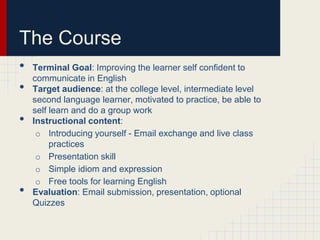
The Course
•   Terminal Goal: Improving the learner self confident to
    communicate in English
•   Target audience: at the college level, intermediate level
    second language learner, motivated to practice, be able to
    self learn and do a group work
•   Instructional content:
     o Introducing yourself - Email exchange and live class
         practices
     o Presentation skill
     o Simple idiom and expression
     o Free tools for learning English
•   Evaluation: Email submission, presentation, optional
    Quizzes
The Course Learning Management
System (LMS)
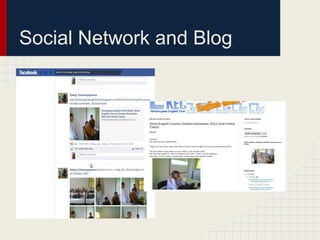
Social Network and Blog
Ideal Condition

                    Good design

Assurance Quality
                          Some technical obstacles

               Progressive change

Facilitators and students are well prepared

                    Independent and active learning
Challenges
         Schedule and workload

         The Internet bandwidth

     Students access to the Internet

    Student preparedness versus my
               expectation

Ideal language proficiency versus the real
                 condition
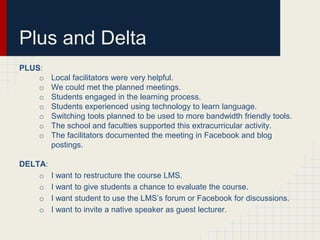
Plus and Delta
PLUS:
    o    Local facilitators were very helpful.
    o    We could met the planned meetings.
    o    Students engaged in the learning process.
    o    Students experienced using technology to learn language.
    o    Switching tools planned to be used to more bandwidth friendly tools.
    o    The school and faculties supported this extracurricular activity.
    o    The facilitators documented the meeting in Facebook and blog
         postings.

DELTA:
    o    I want   to restructure the course LMS.
    o    I want   to give students a chance to evaluate the course.
    o    I want   student to use the LMS’s forum or Facebook for discussions.
    o    I want   to invite a native speaker as guest lecturer.
Contact

          Hery Yanto The

             hery@hawaii.edu or
            herythe@outlook.com
    https://www.linkedin.com/in/herythe
 East West Center Degree Fellow 2012 - 2014
   Department of Educational Technology
        University of Hawaii at Manoa

Applying self-study approach to evaluate a distance online course

  • 1.
    Applying self-study approach toevaluate a distance online course Hery The Department of Educational Technology University of Hawaii at Manoa
  • 2.
    Organization of thispresentation: • Self-study and the conceptual framework • Autobiography • Instructional analysis • The course content and delivery • Reflection and evaluation
  • 3.
    What self-study teacher researchIS NOT • Anastasia Samaras. (2010). Self-Study Teacher Research: Improving Your Practice • Through Collaborative Inquiry. US: Sage Publishing. Anastasia Samaras. (2010). Student study site for Self-Study Teacher Research: Improving Your Practice Through Collaborative Inquiry. Retrieved from http://www.sagepub.com/samaras/default.htm o Self-study is not about your studying others' personal inquiries. o Self-study is not all about you and only about you. o Self-study is not conducted alone. o Self-study research is not merely reflection. o Self-study is not only about personal knowledge.
  • 4.
    Self-study = Aresearch Self-study is one of research approaches that teachers or educators can use to examine and analyze important situations in their teaching practices. Systematic Rational Critical Collaborative Scientific
  • 5.
    Conceptual Framework Distance onlinelearning theory Quality Assurance and assessment of online course The web 2.0 and computer assisted instruction Plus-Delta assessment Change theory Computer assisted language learning Second language learning
  • 6.
    Autobiography I am • an in service teacher in Indonesia who is sponsoring by Ford Foundation, East West Center, and UH Foundation to pursue my degree in the US. • working part time as an instructional designer and assisting faculty members in my host university to teach online and hybrid courses. • enrolling in the MOOC courses offered by several institutions, such as Coursera and Udacity. • designing and teaching courses online using Weebly, WizIQ, Schoology, and many other online free tools. • interesting in doing research about distance online education, teacher training, the learning of technology, multimodality, and second language learning. • using webinar and online virtual rooms to disseminate my designs, my research, and my ideas.
  • 7.
    A distance onlinecourse for students in Indonesia • Audience: Undergraduate students in Kertarajasa Buddhist College who joined the Kertarajasa English Club (KEC), Fall 2012. • Local Facilitators: Two students in the College who were at the last semester of the program. • Meeting: Kertarajasa Language Lab. + Skype & Join.me • Time: Friday, 09.00 - 10.30 WIB or Thursday, 16.00 - 17.30 HST • Course: English Conversation • Length of the program: 2 months (9 meetings) • Other Tools: Facebook Group, Email, Schoology, WizIQ • Assessors: Faculties of Kertarajasa, fellow instructors
  • 8.
    The Course • Terminal Goal: Improving the learner self confident to communicate in English • Target audience: at the college level, intermediate level second language learner, motivated to practice, be able to self learn and do a group work • Instructional content: o Introducing yourself - Email exchange and live class practices o Presentation skill o Simple idiom and expression o Free tools for learning English • Evaluation: Email submission, presentation, optional Quizzes
  • 9.
    The Course LearningManagement System (LMS)
  • 10.
  • 11.
    Ideal Condition Good design Assurance Quality Some technical obstacles Progressive change Facilitators and students are well prepared Independent and active learning
  • 12.
    Challenges Schedule and workload The Internet bandwidth Students access to the Internet Student preparedness versus my expectation Ideal language proficiency versus the real condition
  • 13.
    Plus and Delta PLUS: o Local facilitators were very helpful. o We could met the planned meetings. o Students engaged in the learning process. o Students experienced using technology to learn language. o Switching tools planned to be used to more bandwidth friendly tools. o The school and faculties supported this extracurricular activity. o The facilitators documented the meeting in Facebook and blog postings. DELTA: o I want to restructure the course LMS. o I want to give students a chance to evaluate the course. o I want student to use the LMS’s forum or Facebook for discussions. o I want to invite a native speaker as guest lecturer.
  • 14.
    Contact Hery Yanto The hery@hawaii.edu or herythe@outlook.com https://www.linkedin.com/in/herythe East West Center Degree Fellow 2012 - 2014 Department of Educational Technology University of Hawaii at Manoa