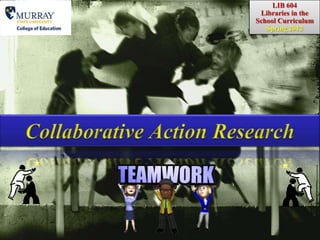
LIB 604
 Libraries in the
School Curriculum
   Spring 2012
2
                        What is it?

 What is Collaborative Action Research?
– a process in which participants systematically
  examine their own educational practice using the
  techniques of research, for the purpose
  of increasing learning of students, their teachers, and
  other interested parties.
   • Caro-Bruce. (2000). Action Researcher: Facilitator’s
     Handbook. National Council of Staff Development.
3
                   How does it work?

 Teamwork
– According to Sagor (1992), collaborative action
  research involves “people who want to do something
  to improve their own situation” (p. 7) taking action.
  The focus of the research process is “teams of
  practitioners who have common interests” (p. 10)
  working together to investigate issues relevant to
  their interests.
   • Collaborative action research and school counselors.
     From: Professional School Counseling | Date:
     10/1/2005 | Author: Rowell, Lonnie L.
4
             But what is action research?

 What is Action Research?
– Action Research is a process in which participants
  examine their own educational practice
  systematically and carefully using the techniques of
  research.
   • Heidi Watts, Antioch Graduate School, same definition as
     cited in Action Research, by Eileen Ferrance
5
           Assumptions behind action
           research
– teachers and principals work best on problems
  they have identified for themselves;
– teachers and principals become more effective
  when encouraged to examine and assess their own
  work and then consider ways of working
  differently;
– teachers and principals help each other by
  working collaboratively;
– working with colleagues helps teachers and
  principals in their professional development.
  • What is Action Research? Heidi Watts, Antioch Graduate School
6
                  Another definition

 Action research
– is the process through which teachers
  collaborate in evaluating their
  practice jointly; raise awareness of
  their personal theory; articulate a shared conception of
  values; try out new strategies to render the values
  expressed in their practice more consistent with the
  educational values they espouse; record their work in a
  form which is readily available to and understandable by
  other teachers; and thus develop a shared theory of
  teaching by researching practice.
    • John Elliott
7
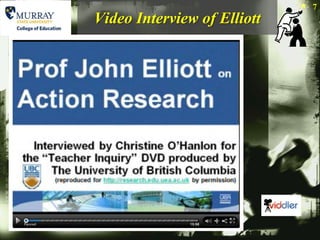
Video Interview of Elliott
8

                          Why action?
   The Meaning of “Action”
– Traditionally, scientific research has been conducted by
  professional full-time researchers. They generally choose their
  topics based on their personal predilections or the preference of
  journal editors, and they publish reports of their work with the
  hope that someone will someday make use of it. But even if no one
  does, their work is usually complete upon publication of their
  report.
– Action research, on the other hand, is conducted by people who
  want to do something to improve their own situation. When other
  people read about their work, notice it, or make use of it, that is
  simply icing on the cake. Action researchers undertake a study
  because they want to know whether they can do something in a
  better way.
      • Sagor, How to Conduct Collaborative Action Research,
        Chapter 2. Defining Collaborative Action Research
9

                 A Related Concept

 collaborative inquiry
– Inquiry is the investigation of users and their
  context in order to understand their problem space,
  their goals, and associated design constraints,
  usually by observational methods, surveys, and
  interviews. Collaborative inquiry involves the users
  (or potential users) of an application in the
  investigation, relying on them as collaborators for
  their domain knowledge and appreciation of user
  needs.
   • Glossary » collaborative inquiry
10
                 Why collaborative?

There are least two reasons for advocating CAR:

– Firstly, . . . many teachers lack the necessary expertise
  to engage in action research.
– Our second reason for advocating CAR is that
  collaboration provides an avenue for discussion.
   • Abdullah, K. I . and Hashim, A .
     Collaborative action research
     Australian Association for Research in Education 1996 –
     Singapore Joint ERA/AARE Conference
11
            Why Collaborative Inquiry?


 Rationale for collaborative inquiry:
– . . . this argument posits that research knowledge and
  evaluation data are valid only when informed by
  practitioner perspectives.
12


Five Phases of Action Research

    Phase I - Problem Identification

    Phase II - Plan of Action

    Phase III - Data Collection

    Phase IV - Analysis of Data

    Phase V - Plan for Future Action
    – Adapted from the St. Louis Action Research Evaluation Committee
13
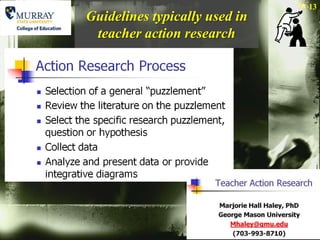
Guidelines typically used in
 teacher action research
14


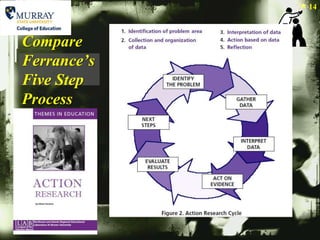
Compare
Ferrance’s
Five Step
Process
15

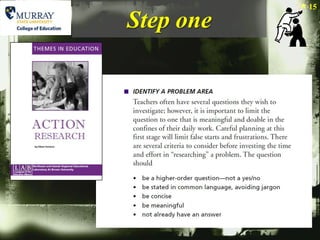
Step one
16
              Step 1:
              Importance of
              the problem
              statement
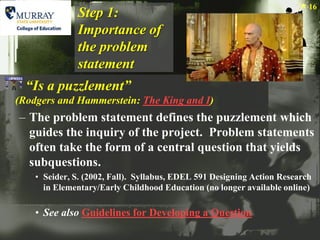
  “Is a puzzlement”
(Rodgers and Hammerstein: The King and I)
– The problem statement defines the puzzlement which
  guides the inquiry of the project. Problem statements
  often take the form of a central question that yields
  subquestions.
    • Seider, S. (2002, Fall). Syllabus, EDEL 591 Designing Action Research
      in Elementary/Early Childhood Education (no longer available online)

    • See also Guidelines for Developing a Question
17
             Step 1:
             Problem formulation
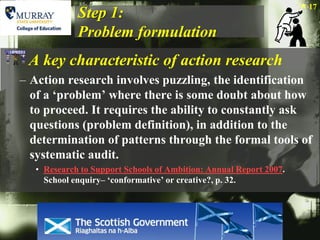
 A key characteristic of action research
– Action research involves puzzling, the identification
  of a „problem‟ where there is some doubt about how
  to proceed. It requires the ability to constantly ask
  questions (problem definition), in addition to the
  determination of patterns through the formal tools of
  systematic audit.
   • Research to Support Schools of Ambition: Annual Report 2007.
     School enquiry– „conformative‟ or creative?, p. 32.
18


Step 1:
How do I choose a research question to study?
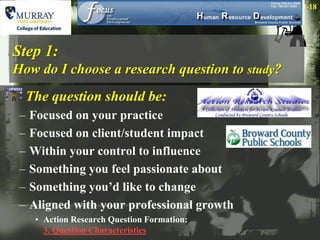
     The question should be:
 –   Focused on your practice
 –   Focused on client/student impact
 –   Within your control to influence
 –   Something you feel passionate about
 –   Something you‟d like to change
 –   Aligned with your professional growth
      • Action Research Question Formation:
        3. Question Characteristics
19
Step Two
20
                                 Step Three


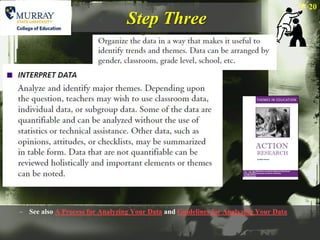
– See also A Process for Analyzing Your Data and Guidelines for Analyzing Your Data
21
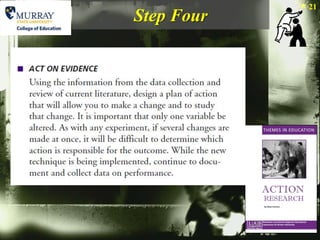
Step Four
22
          The Structure of an Action
              Research Report

Introduction
A description of the research process
An analysis of the data
An action plan
    – [AKA Action Planning, i.e. the plan you create in
      Ferrance‟s Step Five (Reflection) for what comes next as
      a result of what you‟ve discovered]
 • Sagor, How to Conduct Collaborative Action Research, ch. 6
23


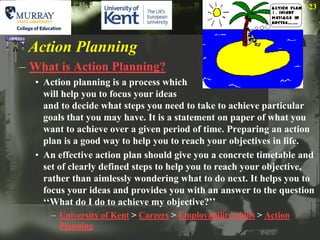
 Action Planning
– What is Action Planning?
  • Action planning is a process which
    will help you to focus your ideas
    and to decide what steps you need to take to achieve particular
    goals that you may have. It is a statement on paper of what you
    want to achieve over a given period of time. Preparing an action
    plan is a good way to help you to reach your objectives in life.
  • An effective action plan should give you a concrete timetable and
    set of clearly defined steps to help you to reach your objective,
    rather than aimlessly wondering what to do next. It helps you to
    focus your ideas and provides you with an answer to the question
    „„What do I do to achieve my objective?‟‟
     – University of Kent > Careers > Employability Skills > Action
       Planning
24


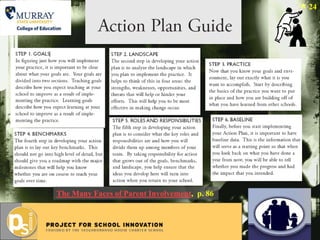
The Many Faces of Parent Involvement, p. 86
25
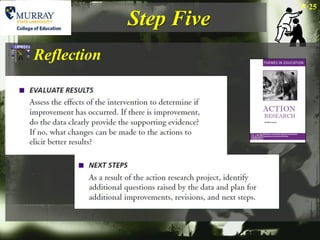
             Step Five
Reflection

Collaborative action research

  • 1.
    LIB 604 Librariesin the School Curriculum Spring 2012
  • 2.
    2 What is it? What is Collaborative Action Research? – a process in which participants systematically examine their own educational practice using the techniques of research, for the purpose of increasing learning of students, their teachers, and other interested parties. • Caro-Bruce. (2000). Action Researcher: Facilitator’s Handbook. National Council of Staff Development.
  • 3.
    3 How does it work? Teamwork – According to Sagor (1992), collaborative action research involves “people who want to do something to improve their own situation” (p. 7) taking action. The focus of the research process is “teams of practitioners who have common interests” (p. 10) working together to investigate issues relevant to their interests. • Collaborative action research and school counselors. From: Professional School Counseling | Date: 10/1/2005 | Author: Rowell, Lonnie L.
  • 4.
    4 But what is action research? What is Action Research? – Action Research is a process in which participants examine their own educational practice systematically and carefully using the techniques of research. • Heidi Watts, Antioch Graduate School, same definition as cited in Action Research, by Eileen Ferrance
  • 5.
    5 Assumptions behind action research – teachers and principals work best on problems they have identified for themselves; – teachers and principals become more effective when encouraged to examine and assess their own work and then consider ways of working differently; – teachers and principals help each other by working collaboratively; – working with colleagues helps teachers and principals in their professional development. • What is Action Research? Heidi Watts, Antioch Graduate School
  • 6.
    6 Another definition Action research – is the process through which teachers collaborate in evaluating their practice jointly; raise awareness of their personal theory; articulate a shared conception of values; try out new strategies to render the values expressed in their practice more consistent with the educational values they espouse; record their work in a form which is readily available to and understandable by other teachers; and thus develop a shared theory of teaching by researching practice. • John Elliott
  • 7.
  • 8.
    8 Why action? The Meaning of “Action” – Traditionally, scientific research has been conducted by professional full-time researchers. They generally choose their topics based on their personal predilections or the preference of journal editors, and they publish reports of their work with the hope that someone will someday make use of it. But even if no one does, their work is usually complete upon publication of their report. – Action research, on the other hand, is conducted by people who want to do something to improve their own situation. When other people read about their work, notice it, or make use of it, that is simply icing on the cake. Action researchers undertake a study because they want to know whether they can do something in a better way. • Sagor, How to Conduct Collaborative Action Research, Chapter 2. Defining Collaborative Action Research
  • 9.
    9 A Related Concept collaborative inquiry – Inquiry is the investigation of users and their context in order to understand their problem space, their goals, and associated design constraints, usually by observational methods, surveys, and interviews. Collaborative inquiry involves the users (or potential users) of an application in the investigation, relying on them as collaborators for their domain knowledge and appreciation of user needs. • Glossary » collaborative inquiry
  • 10.
    10 Why collaborative? There are least two reasons for advocating CAR: – Firstly, . . . many teachers lack the necessary expertise to engage in action research. – Our second reason for advocating CAR is that collaboration provides an avenue for discussion. • Abdullah, K. I . and Hashim, A . Collaborative action research Australian Association for Research in Education 1996 – Singapore Joint ERA/AARE Conference
  • 11.
    11 Why Collaborative Inquiry? Rationale for collaborative inquiry: – . . . this argument posits that research knowledge and evaluation data are valid only when informed by practitioner perspectives.
  • 12.
    12 Five Phases ofAction Research Phase I - Problem Identification Phase II - Plan of Action Phase III - Data Collection Phase IV - Analysis of Data Phase V - Plan for Future Action – Adapted from the St. Louis Action Research Evaluation Committee
  • 13.
    13 Guidelines typically usedin teacher action research
  • 14.
  • 15.
  • 16.
    16 Step 1: Importance of the problem statement “Is a puzzlement” (Rodgers and Hammerstein: The King and I) – The problem statement defines the puzzlement which guides the inquiry of the project. Problem statements often take the form of a central question that yields subquestions. • Seider, S. (2002, Fall). Syllabus, EDEL 591 Designing Action Research in Elementary/Early Childhood Education (no longer available online) • See also Guidelines for Developing a Question
  • 17.
    17 Step 1: Problem formulation A key characteristic of action research – Action research involves puzzling, the identification of a „problem‟ where there is some doubt about how to proceed. It requires the ability to constantly ask questions (problem definition), in addition to the determination of patterns through the formal tools of systematic audit. • Research to Support Schools of Ambition: Annual Report 2007. School enquiry– „conformative‟ or creative?, p. 32.
  • 18.
    18 Step 1: How doI choose a research question to study? The question should be: – Focused on your practice – Focused on client/student impact – Within your control to influence – Something you feel passionate about – Something you‟d like to change – Aligned with your professional growth • Action Research Question Formation: 3. Question Characteristics
  • 19.
  • 20.
    20 Step Three – See also A Process for Analyzing Your Data and Guidelines for Analyzing Your Data
  • 21.
  • 22.
    22 The Structure of an Action Research Report Introduction A description of the research process An analysis of the data An action plan – [AKA Action Planning, i.e. the plan you create in Ferrance‟s Step Five (Reflection) for what comes next as a result of what you‟ve discovered] • Sagor, How to Conduct Collaborative Action Research, ch. 6
  • 23.
    23 Action Planning –What is Action Planning? • Action planning is a process which will help you to focus your ideas and to decide what steps you need to take to achieve particular goals that you may have. It is a statement on paper of what you want to achieve over a given period of time. Preparing an action plan is a good way to help you to reach your objectives in life. • An effective action plan should give you a concrete timetable and set of clearly defined steps to help you to reach your objective, rather than aimlessly wondering what to do next. It helps you to focus your ideas and provides you with an answer to the question „„What do I do to achieve my objective?‟‟ – University of Kent > Careers > Employability Skills > Action Planning
  • 24.
    24 The Many Facesof Parent Involvement, p. 86
  • 25.
    25 Step Five Reflection