CLASSROOM-BASED
ACTION RESEARCH
Gamayot, Mack Arthur C.
Action Research
•is designed and conducted by
practitioners who analyze the
data to improve their own
practice.
• “The idea of action research
is that educational problems
and issues are best identified
and investigated where the
action is; at the classroom
and school level.”
Action Research
•By integrating research into these
settings and engaging those who
work at this level in research
activities, findings can be applied
immediately and problems solved
more quickly” (Guskey, 2000).
• Use action research when you want to evaluate whether
what you are doing is influencing your own or other
people’s learning, or whether you need to do something
different to ensure that it is.
• ‘What am I doing?
• What do I need to improve?
• How do I improve it?’
• It is done by practitioners themselves rather than a
professional researcher
• Action researchers, are insider researchers. They see themselves as part of
the situation they are investigating, and ask, individually and collectively,
• ‘Is my work going as I wish?
• How do we improve it where necessary?
• Social scientists tend to stand outside a situation and ask,
• ‘What are those people over there doing?
• How do we understand and explain what they are doing?’
• Social Scientist is often called spectator researchers, and is usually
outsider research.
What does action research prove?
•While experimental research finds validity
in large numbers, in random samples, and
in control groups, action research finds
validity in the human story, in rich detail, in
multiple perspectives.
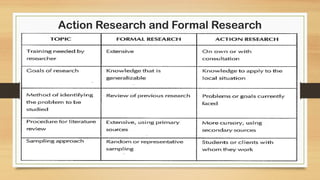
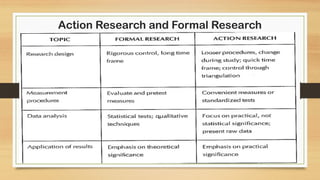
Action Research and Formal Research
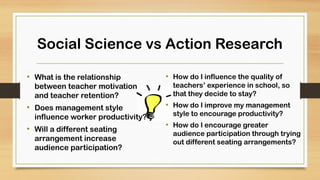
Social Science vs Action Research
• What is the relationship
between teacher motivation
and teacher retention?
• Does management style
influence worker productivity?
• Will a different seating
arrangement increase
audience participation?
• How do I influence the quality of
teachers’ experience in school, so
that they decide to stay?
• How do I improve my management
style to encourage productivity?
• How do I encourage greater
audience participation through trying
out different seating arrangements?
• Do not use action research if
you want to draw
comparisons, show statistical
correlations, or demonstrate a
cause and effect relationship.
ACTION RESEARCH is NOT
writing a research paper!
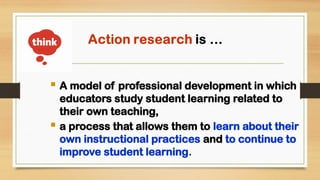
 A model of professional development in which
educators study student learning related to
their own teaching,
 a process that allows them to learn about their
own instructional practices and to continue to
improve student learning.
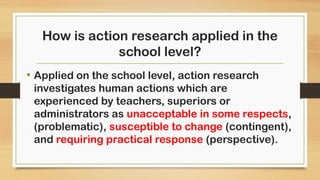
How is action research applied in the
school level?
• Applied on the school level, action research
investigates human actions which are
experienced by teachers, superiors or
administrators as unacceptable in some respects,
(problematic), susceptible to change (contingent),
and requiring practical response (perspective).
Teacher - Action Research
•A teacher focuses on an
area of concern in his or
her classroom.
• What impact can daily phonemic awareness activities
have on my kindergarten students’ oral language
development? (Kindergarten teacher)
• How can using concrete objectives (manipulatives)
improve my students’ ability to identify and extend
patterns in mathematics? (Grade 5 teacher)
A problem or issue within a
single classroom to study
Collaborative Action Research
• Co-teachers
• in one classroom instructing a specific group of students
• Team of teachers
• focusing on a grade level issue
• Teacher and district, educational agency, or university personnel
• learning and studying a particular instructional practice
• Group of teachers
• in the same school studying the same instructional concern
School-wide action research is a
school reform initiative.
Every faculty member of the school
is involved in studying a specific
issue identified from school data.
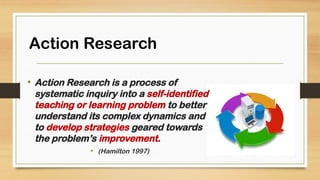
• Action Research is a process of
systematic inquiry into a self-identified
teaching or learning problem to better
understand its complex dynamics and
to develop strategies geared towards
the problem’s improvement.
• (Hamilton 1997)
How can I
improve my
students’ spelling
strategies?
Can high school
achievement be
enhanced through
the use of
portfolios?
Will using a
graphing calculator
improve students’
understanding of
math?
What can we do
to eliminate
bullying in the
school?
Action Research can focus on the
teaching and learning process.
Action Research can be used to solve
a problem or institute a change.
Action Research can be used to document
teacher professional growth.
Classroom-based Action Research
•Action research is concerned with the
everyday practical problems experienced
by teachers, rather than the “theoretical
problems” defined by pure researchers
within a discipline of knowledge.
First Step in Action Research
• When you conduct action research, you start out with
assumptions.
• These assumptions may be right or wrong, but slowly, you
will see how your assumptions shape your decisions and
your responses and you become able to contemplate
alternate ways.
• It starts with a problem/question teachers identify that calls
for change
Developing a Research Question
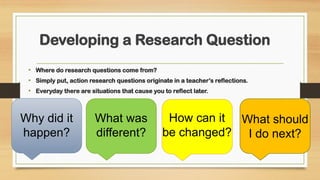
• Where do research questions come from?
• Simply put, action research questions originate in a teacher’s reflections.
• Everyday there are situations that cause you to reflect later.
Why did it
happen?
What was
different?
How can it
be changed?
What should
I do next?
Reflect on your
Questions!
Is it …
a problem, an issue, a
trigger, out of curiosity,
or a wish?
Is it …
Limiting or enabling?
Indifferent or committed?
Status quo or Change?
Formulating Research Questions
• Focus on your classroom or role in the school
and complete the following sentence stems:
• One thing I would like to change is...
Sentence Stems
Focus on your classroom or role in the school and complete the
following sentence stems. One thing I would like to change is...
• My practice could be improved by...
• The students I work with need...
• I would like to know...
• I wonder why...
• The most important thing about teaching is...
• The best learning environment for students is...
• I need to learn how to...
• My students would do better if...
Points to consider in
developing a good question
• Studying this question will enhance my
professional practice.
• This question will be of value to my
classroom, school and/or colleagues.
• The climate of my classroom and school
will be supportive of this question.
ACTION PLANNING
The Action
Research Process
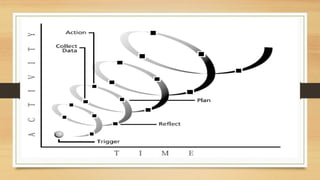
•The action research process can
generally be described as a series
of four steps: planning, action,
observing and reflecting on the
results of the action.
Observation Example
(Individual Action Research)
• Step 1: Identify the Problem
• You are a grade 5 teacher and have identified a problem in your classroom. The
problem is that your students do not have much experience working in task groups,
and you believe that they need to have more opportunities to do so. You want to
assess the skill set of your students and observe their overall approach to group
work. By doing this, you feel that next time you offer group work, you will have some
new insight into what works well and what needs improvement regarding conducting
group work in your class.
• Step 2: Devise a Plan
• Your plan includes having your students work together in groups for
their upcoming science project. By doing this, you hope to explore a
variety of information, such as how the students brainstorm together,
how they interact with each other and how they distribute work among
the task groups. You provide them an instruction sheet and a time frame
to work from.
Observation Example
(Individual Action Research)
• Step 3: Act to Implement a Plan
• You act by assigning your students
into groups and having them work
through their science projects. This
step can also be thought of as
initiating and carrying out the plan.
Observation Example
(Individual Action Research)
• Step 4: Observe
• During this step of the action research process, you
observe the groups of students working together. You
take note on how they are progressing and what types of
issues they are having, watch them brainstorm and form
interesting ideas and even observe some students not
getting along, arguing and not participating altogether.
This is the observation and data collection phase.
Observation Example
(Individual Action Research)
• Step 5: Reflect and Share
• This final step is the end point of action research. . .
however, it also might be the beginning! You have noticed
that throughout the whole week of observing and watching
your students work together, there were some things that
just weren't working. You have also noticed some things that
were working really well! Either way, this is the step where
you determine if the plan needs to be observed again with
some modifications or if the plan worked perfectly.
Observation Example
(Individual Action Research)
• Action research is an open-ended, ongoing,
cyclical process. The solution one develops
to the initial problem will generate the next
problem to be addressed. This is the
catalyst to continuous professional
improvement. (Halsall and Hosack 1996, 16)
What is next?
Sample Outline for a Report
• Introduction
– what was the research question?
– why is this question important to me?
– what was the context of the study?
• Review of the Literature
– what did I learn from my investigation of the topic?
- what possible solutions are you proposing?
• Methodology
– what was my research plan?
– what data collection methods were used?
• Results and Conclusions
– summarize the data collected.
– discuss your conclusions based on the data collected.
Sample Outline for a Report
• Implications and Recommendations
– what have you learned from doing this study?
– how can this information be useful to others?
– if you repeated the study, what would you do
differently?
Sample Outline for a Report
Action Planning
Sample Action Plan Template
Objectives
/ Target
Activity /
tasks
Time
Frame
Persons
Responsi
ble
Data /
Resources
Needed / How
data will be
gathered
Output
Expected
Data
Analysis
HOW CAN I HELP MY STUDENTS TO IMPROVE THEIR
MOTIVATION IN SPEAKING?
Outline of my report
My context
Action research is important to me because it has helped me begin my teaching
career as a learner. I have been able to encourage my students’ learning and my
own.
What is my concern?
I want to encourage my English majors students to practice speaking. I will focus
on Jin Guoliang and Li Fang as key participants.
Why am I concerned?
I believe that speaking is essential to the whole learning process. It is obviously a
big problem for my students.
HOW CAN I HELP MY STUDENTS TO IMPROVE THEIR
MOTIVATION IN SPEAKING?
How can I improve the situation?
Make speaking a rule:
• Ask each student to do a morning report.
• Ask different people to be the ‘speaker’ during group discussions.
Vary speaking activities:
• Individual presentations. The morning speech – change from ‘recitation’ to
‘interviewing’ and so to ‘impromptu’ talk.
• Group work.
• Encourage students to ‘show off’.
HOW CAN I HELP MY STUDENTS TO IMPROVE THEIR
MOTIVATION IN SPEAKING?
Who can help me and how?
• Dr Moira Laidlaw and Dean Tian, by giving me advice, listening to
my concerns, and encouraging me.
• My students, by participating in the research.
• My colleagues, through discussions and suggestions.
• Reading relevant books and online information.
HOW CAN I HELP MY STUDENTS TO IMPROVE THEIR
MOTIVATION IN SPEAKING?
What have I learned?
• Studying my practice has enabled me to be more confident in teaching.
• It has helped my professional development.
• It has helped my personal life.
HOW CAN I HELP MY STUDENTS TO IMPROVE THEIR
MOTIVATION IN SPEAKING?
ACTION RESEARCH writing
HOW CAN I HELP MY STUDENTS TO IMPROVE THEIR
MOTIVATION IN SPEAKING?
My context
I very much enjoy teaching. I enjoy helping my students learn English. I was therefore especially
disappointed when my students said that learning English was a headache. I was at a loss to know what to
do, until I met Moira Laidlaw and her ideas about action research. I began learning to teach. The project
has been going on for a year, and already I feel more confident in teaching and have seen improvements in
both my students and myself. Here is a brief account of my research.
What is my concern?
I have a class of 28 English major students. They are my first teaching group. They are meant to be good
language learners and users, but unfortunately seem capable of only reading and memorizing rather than
speaking. Most don’t speak in class. My question became how I could help them improve their motivation
in speaking. I aimed to help the whole class, but concentrated on Jin Guoliang and Li Fang, two of the most
passive students, as key participants.
HOW CAN I HELP MY STUDENTS TO IMPROVE THEIR
MOTIVATION IN SPEAKING?
Why am I concerned?
I believe that active practice is central to the whole learning process. My students (and I) had got into the
habit in school of learning ‘mute’ English. From a questionnaire I distributed at the beginning of term, I
knew that my students had the same concern. Ninety-five per cent said that their biggest problems were
speaking and listening.
How can I improve it?
I tried a range of strategies: Offering equal and sufficient opportunities for speaking : I negotiated with my
students that we would all talk in class. We agreed that each student would give a morning report. Varying
speaking activities : I encouraged an atmosphere of interested activity by encouraging individual
presentations, group work, and ‘showing off’. This meant that I made every opportunity for students to
shine, and I encouraged them every time they succeeded, even if it was simply a matter of good
pronunciation. For the first time ever, Jin Guoliang stood up and asked the speaker a question. I noticed
that Li Fang had begun to discuss ideas actively with others. On one occasion, Jin Guoliang told me, ‘I was
afraid to speak in public, but after I tried once, I felt it was not so difficult. I feel more comfortable in
speaking now.’
HOW CAN I HELP MY STUDENTS TO IMPROVE THEIR
MOTIVATION IN SPEAKING?
My efforts paid off. I believe I am justified in claiming that I have achieved my goals of motivating some of
my students to speak because
• My students have begun to participate actively in every class.
• Those who never volunteered before, such as Li Fang and Jin Guoliang, began to participate
actively. Furthermore, Jin Guoliang took part in the English speaking contest. Prior to the event, several
students told me that they were too nervous to go on. Finally, however, they stepped
onto the stage, and three of them even got prizes.
Who helped me and how?
Moira Laidlaw and Dean Tian helped most of all. Moira visited my class and offered helpful advice. My
students helped significantly. They gave me feedback and direction. Other colleagues helped me by visiting
my class and inviting me to visit theirs. I learned much from them when attending action research meetings,
especially about the need for validating action research reports. The key aspect I learned here was the
importance of finding evidence for my claims. Books, online and television services helped me find further
information and ideas.
HOW CAN I HELP MY STUDENTS TO IMPROVE THEIR
MOTIVATION IN SPEAKING?
What have I learned?
Action research has become a way of life.
• I am more confident in teaching in the sense that I have learned more about my students and myself and
the relationship between us. I realize how important it is to encourage them to be the center of class.
• I have developed professionally by coming to reflect on my teaching more systematically and find my own
answers.
• I have learned how to generate evidence, which has encouraged me also to become more responsible.
• I have learned to work collaboratively with others. I enjoy the scholarly and open minded atmosphere at
work. Work itself has become a form of research. I have tried to create the same atmosphere in my class.
I believe that the warmth and strength of collaboration is beneficial not only to my students’ study but to
their lives as well.
In summary I can say that I have not only achieved my initial goals, but learned and grown professionally as
a teacher, while encouraging my students to do the same.
Thank you

Action-Research...Classroom Based Action Research

  • 1.
  • 2.
    Action Research •is designedand conducted by practitioners who analyze the data to improve their own practice.
  • 3.
    • “The ideaof action research is that educational problems and issues are best identified and investigated where the action is; at the classroom and school level.” Action Research
  • 4.
    •By integrating researchinto these settings and engaging those who work at this level in research activities, findings can be applied immediately and problems solved more quickly” (Guskey, 2000).
  • 5.
    • Use actionresearch when you want to evaluate whether what you are doing is influencing your own or other people’s learning, or whether you need to do something different to ensure that it is. • ‘What am I doing? • What do I need to improve? • How do I improve it?’ • It is done by practitioners themselves rather than a professional researcher
  • 6.
    • Action researchers,are insider researchers. They see themselves as part of the situation they are investigating, and ask, individually and collectively, • ‘Is my work going as I wish? • How do we improve it where necessary? • Social scientists tend to stand outside a situation and ask, • ‘What are those people over there doing? • How do we understand and explain what they are doing?’ • Social Scientist is often called spectator researchers, and is usually outsider research.
  • 7.
    What does actionresearch prove? •While experimental research finds validity in large numbers, in random samples, and in control groups, action research finds validity in the human story, in rich detail, in multiple perspectives.
  • 8.
    Action Research andFormal Research
  • 9.
    Action Research andFormal Research
  • 10.
    Social Science vsAction Research • What is the relationship between teacher motivation and teacher retention? • Does management style influence worker productivity? • Will a different seating arrangement increase audience participation? • How do I influence the quality of teachers’ experience in school, so that they decide to stay? • How do I improve my management style to encourage productivity? • How do I encourage greater audience participation through trying out different seating arrangements?
  • 11.
    • Do notuse action research if you want to draw comparisons, show statistical correlations, or demonstrate a cause and effect relationship. ACTION RESEARCH is NOT writing a research paper!
  • 12.
     A modelof professional development in which educators study student learning related to their own teaching,  a process that allows them to learn about their own instructional practices and to continue to improve student learning.
  • 13.
    How is actionresearch applied in the school level? • Applied on the school level, action research investigates human actions which are experienced by teachers, superiors or administrators as unacceptable in some respects, (problematic), susceptible to change (contingent), and requiring practical response (perspective).
  • 14.
    Teacher - ActionResearch •A teacher focuses on an area of concern in his or her classroom.
  • 15.
    • What impactcan daily phonemic awareness activities have on my kindergarten students’ oral language development? (Kindergarten teacher) • How can using concrete objectives (manipulatives) improve my students’ ability to identify and extend patterns in mathematics? (Grade 5 teacher) A problem or issue within a single classroom to study
  • 16.
    Collaborative Action Research •Co-teachers • in one classroom instructing a specific group of students • Team of teachers • focusing on a grade level issue • Teacher and district, educational agency, or university personnel • learning and studying a particular instructional practice • Group of teachers • in the same school studying the same instructional concern
  • 17.
    School-wide action researchis a school reform initiative. Every faculty member of the school is involved in studying a specific issue identified from school data.
  • 18.
    • Action Researchis a process of systematic inquiry into a self-identified teaching or learning problem to better understand its complex dynamics and to develop strategies geared towards the problem’s improvement. • (Hamilton 1997)
  • 19.
    How can I improvemy students’ spelling strategies? Can high school achievement be enhanced through the use of portfolios? Will using a graphing calculator improve students’ understanding of math? What can we do to eliminate bullying in the school?
  • 20.
    Action Research canfocus on the teaching and learning process. Action Research can be used to solve a problem or institute a change. Action Research can be used to document teacher professional growth.
  • 21.
    Classroom-based Action Research •Actionresearch is concerned with the everyday practical problems experienced by teachers, rather than the “theoretical problems” defined by pure researchers within a discipline of knowledge.
  • 22.
    First Step inAction Research • When you conduct action research, you start out with assumptions. • These assumptions may be right or wrong, but slowly, you will see how your assumptions shape your decisions and your responses and you become able to contemplate alternate ways. • It starts with a problem/question teachers identify that calls for change
  • 23.
    Developing a ResearchQuestion • Where do research questions come from? • Simply put, action research questions originate in a teacher’s reflections. • Everyday there are situations that cause you to reflect later. Why did it happen? What was different? How can it be changed? What should I do next?
  • 24.
    Reflect on your Questions! Isit … a problem, an issue, a trigger, out of curiosity, or a wish? Is it … Limiting or enabling? Indifferent or committed? Status quo or Change?
  • 25.
    Formulating Research Questions •Focus on your classroom or role in the school and complete the following sentence stems: • One thing I would like to change is...
  • 26.
    Sentence Stems Focus onyour classroom or role in the school and complete the following sentence stems. One thing I would like to change is... • My practice could be improved by... • The students I work with need... • I would like to know... • I wonder why... • The most important thing about teaching is... • The best learning environment for students is... • I need to learn how to... • My students would do better if...
  • 27.
    Points to considerin developing a good question • Studying this question will enhance my professional practice. • This question will be of value to my classroom, school and/or colleagues. • The climate of my classroom and school will be supportive of this question.
  • 28.
  • 29.
    The Action Research Process •Theaction research process can generally be described as a series of four steps: planning, action, observing and reflecting on the results of the action.
  • 30.
    Observation Example (Individual ActionResearch) • Step 1: Identify the Problem • You are a grade 5 teacher and have identified a problem in your classroom. The problem is that your students do not have much experience working in task groups, and you believe that they need to have more opportunities to do so. You want to assess the skill set of your students and observe their overall approach to group work. By doing this, you feel that next time you offer group work, you will have some new insight into what works well and what needs improvement regarding conducting group work in your class.
  • 31.
    • Step 2:Devise a Plan • Your plan includes having your students work together in groups for their upcoming science project. By doing this, you hope to explore a variety of information, such as how the students brainstorm together, how they interact with each other and how they distribute work among the task groups. You provide them an instruction sheet and a time frame to work from. Observation Example (Individual Action Research)
  • 32.
    • Step 3:Act to Implement a Plan • You act by assigning your students into groups and having them work through their science projects. This step can also be thought of as initiating and carrying out the plan. Observation Example (Individual Action Research)
  • 33.
    • Step 4:Observe • During this step of the action research process, you observe the groups of students working together. You take note on how they are progressing and what types of issues they are having, watch them brainstorm and form interesting ideas and even observe some students not getting along, arguing and not participating altogether. This is the observation and data collection phase. Observation Example (Individual Action Research)
  • 34.
    • Step 5:Reflect and Share • This final step is the end point of action research. . . however, it also might be the beginning! You have noticed that throughout the whole week of observing and watching your students work together, there were some things that just weren't working. You have also noticed some things that were working really well! Either way, this is the step where you determine if the plan needs to be observed again with some modifications or if the plan worked perfectly. Observation Example (Individual Action Research)

  • 36.
    • Action researchis an open-ended, ongoing, cyclical process. The solution one develops to the initial problem will generate the next problem to be addressed. This is the catalyst to continuous professional improvement. (Halsall and Hosack 1996, 16) What is next?
  • 37.
    Sample Outline fora Report • Introduction – what was the research question? – why is this question important to me? – what was the context of the study? • Review of the Literature – what did I learn from my investigation of the topic? - what possible solutions are you proposing?
  • 38.
    • Methodology – whatwas my research plan? – what data collection methods were used? • Results and Conclusions – summarize the data collected. – discuss your conclusions based on the data collected. Sample Outline for a Report
  • 39.
    • Implications andRecommendations – what have you learned from doing this study? – how can this information be useful to others? – if you repeated the study, what would you do differently? Sample Outline for a Report
  • 40.
    Action Planning Sample ActionPlan Template Objectives / Target Activity / tasks Time Frame Persons Responsi ble Data / Resources Needed / How data will be gathered Output Expected Data Analysis
  • 41.
    HOW CAN IHELP MY STUDENTS TO IMPROVE THEIR MOTIVATION IN SPEAKING? Outline of my report My context Action research is important to me because it has helped me begin my teaching career as a learner. I have been able to encourage my students’ learning and my own. What is my concern? I want to encourage my English majors students to practice speaking. I will focus on Jin Guoliang and Li Fang as key participants. Why am I concerned? I believe that speaking is essential to the whole learning process. It is obviously a big problem for my students.
  • 42.
    HOW CAN IHELP MY STUDENTS TO IMPROVE THEIR MOTIVATION IN SPEAKING? How can I improve the situation? Make speaking a rule: • Ask each student to do a morning report. • Ask different people to be the ‘speaker’ during group discussions. Vary speaking activities: • Individual presentations. The morning speech – change from ‘recitation’ to ‘interviewing’ and so to ‘impromptu’ talk. • Group work. • Encourage students to ‘show off’.
  • 43.
    HOW CAN IHELP MY STUDENTS TO IMPROVE THEIR MOTIVATION IN SPEAKING? Who can help me and how? • Dr Moira Laidlaw and Dean Tian, by giving me advice, listening to my concerns, and encouraging me. • My students, by participating in the research. • My colleagues, through discussions and suggestions. • Reading relevant books and online information.
  • 44.
    HOW CAN IHELP MY STUDENTS TO IMPROVE THEIR MOTIVATION IN SPEAKING? What have I learned? • Studying my practice has enabled me to be more confident in teaching. • It has helped my professional development. • It has helped my personal life.
  • 45.
    HOW CAN IHELP MY STUDENTS TO IMPROVE THEIR MOTIVATION IN SPEAKING? ACTION RESEARCH writing
  • 46.
    HOW CAN IHELP MY STUDENTS TO IMPROVE THEIR MOTIVATION IN SPEAKING? My context I very much enjoy teaching. I enjoy helping my students learn English. I was therefore especially disappointed when my students said that learning English was a headache. I was at a loss to know what to do, until I met Moira Laidlaw and her ideas about action research. I began learning to teach. The project has been going on for a year, and already I feel more confident in teaching and have seen improvements in both my students and myself. Here is a brief account of my research. What is my concern? I have a class of 28 English major students. They are my first teaching group. They are meant to be good language learners and users, but unfortunately seem capable of only reading and memorizing rather than speaking. Most don’t speak in class. My question became how I could help them improve their motivation in speaking. I aimed to help the whole class, but concentrated on Jin Guoliang and Li Fang, two of the most passive students, as key participants.


  • 47.
    HOW CAN IHELP MY STUDENTS TO IMPROVE THEIR MOTIVATION IN SPEAKING? Why am I concerned? I believe that active practice is central to the whole learning process. My students (and I) had got into the habit in school of learning ‘mute’ English. From a questionnaire I distributed at the beginning of term, I knew that my students had the same concern. Ninety-five per cent said that their biggest problems were speaking and listening. How can I improve it? I tried a range of strategies: Offering equal and sufficient opportunities for speaking : I negotiated with my students that we would all talk in class. We agreed that each student would give a morning report. Varying speaking activities : I encouraged an atmosphere of interested activity by encouraging individual presentations, group work, and ‘showing off’. This meant that I made every opportunity for students to shine, and I encouraged them every time they succeeded, even if it was simply a matter of good pronunciation. For the first time ever, Jin Guoliang stood up and asked the speaker a question. I noticed that Li Fang had begun to discuss ideas actively with others. On one occasion, Jin Guoliang told me, ‘I was afraid to speak in public, but after I tried once, I felt it was not so difficult. I feel more comfortable in speaking now.’
  • 48.
    HOW CAN IHELP MY STUDENTS TO IMPROVE THEIR MOTIVATION IN SPEAKING? My efforts paid off. I believe I am justified in claiming that I have achieved my goals of motivating some of my students to speak because • My students have begun to participate actively in every class. • Those who never volunteered before, such as Li Fang and Jin Guoliang, began to participate actively. Furthermore, Jin Guoliang took part in the English speaking contest. Prior to the event, several students told me that they were too nervous to go on. Finally, however, they stepped onto the stage, and three of them even got prizes. Who helped me and how? Moira Laidlaw and Dean Tian helped most of all. Moira visited my class and offered helpful advice. My students helped significantly. They gave me feedback and direction. Other colleagues helped me by visiting my class and inviting me to visit theirs. I learned much from them when attending action research meetings, especially about the need for validating action research reports. The key aspect I learned here was the importance of finding evidence for my claims. Books, online and television services helped me find further information and ideas.
  • 49.
    HOW CAN IHELP MY STUDENTS TO IMPROVE THEIR MOTIVATION IN SPEAKING? What have I learned? Action research has become a way of life. • I am more confident in teaching in the sense that I have learned more about my students and myself and the relationship between us. I realize how important it is to encourage them to be the center of class. • I have developed professionally by coming to reflect on my teaching more systematically and find my own answers. • I have learned how to generate evidence, which has encouraged me also to become more responsible. • I have learned to work collaboratively with others. I enjoy the scholarly and open minded atmosphere at work. Work itself has become a form of research. I have tried to create the same atmosphere in my class. I believe that the warmth and strength of collaboration is beneficial not only to my students’ study but to their lives as well. In summary I can say that I have not only achieved my initial goals, but learned and grown professionally as a teacher, while encouraging my students to do the same.

  • 50.