Basic English Grammar For English
Language Learners
Meeting #9

Hery Yanto The
English 3.0 Series, Summer 2012
July 16, 2012
PART I


TEACHING & LEARNING ENGLISH
ABROAD
What you have to consider?
                               • Culture
                               • Certification/Training
                               • Proficiency
                                   • Pedagogy
                                   • Theory
                               • Permanent or temporal
                               • Provide services to
                                 your customer


                                        Pre-requisite
                                           Both for
                                     Native & Non-native
                                      ESL/EFL teachers


Text used from teflinstitute
The training centers are helping
the application & placement
                      • Job search directory
                      • Online application
                      • Phone interview
                      • Preparing documents and
                        pre-departure
                      • Connecting with host
                        country representative
                      • Placing and arranging new
                        place to begin your career


                     Text used from Tesol International
                     Association
Where to go?


Text used from Tesolexpressonline
Benefits


 Text used from Tesolexpressonline
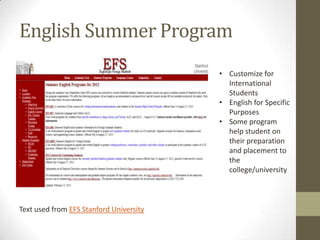
English Summer Program
                                         • Customize for
                                           International
                                           Students
                                         • English for Specific
                                           Purposes
                                         • Some program
                                           help student on
                                           their preparation
                                           and placement to
                                           the
                                           college/university


Text used from EFS Stanford University
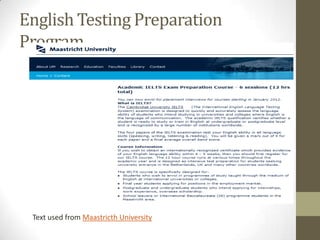
English Testing Preparation
Program


 Text used from Maastricth University
Student Exchange Program


Text used from The Indonesian International Education Foundation
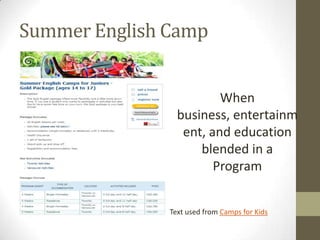
Summer English Camp


                         When
                 business, entertainm
                  ent, and education
                     blended in a
                        Program


               Text used from Camps for Kids
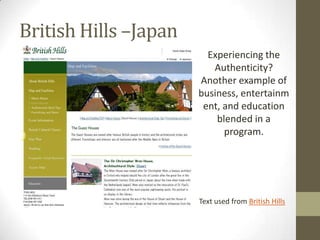
British Hills –Japan
                         Experiencing the
                          Authenticity?
                       Another example of
                       business, entertainm
                        ent, and education
                           blended in a
                             program.


                       Text used from British Hills
PART II


INTRODUCTION TO SENTENCE
STRUCTURE
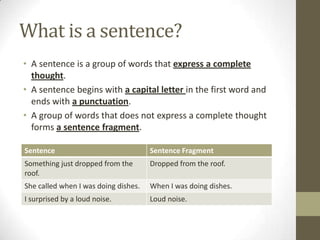
What is a sentence?
• A sentence is a group of words that express a complete
  thought.
• A sentence begins with a capital letter in the first word and
  ends with a punctuation.
• A group of words that does not express a complete thought
  forms a sentence fragment.

Sentence                              Sentence Fragment
Something just dropped from the       Dropped from the roof.
roof.
She called when I was doing dishes.   When I was doing dishes.
I surprised by a loud noise.          Loud noise.
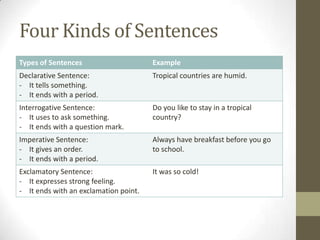
Four Kinds of Sentences
Types of Sentences                     Example
Declarative Sentence:                  Tropical countries are humid.
- It tells something.
- It ends with a period.
Interrogative Sentence:                Do you like to stay in a tropical
- It uses to ask something.            country?
- It ends with a question mark.
Imperative Sentence:                   Always have breakfast before you go
- It gives an order.                   to school.
- It ends with a period.
Exclamatory Sentence:                  It was so cold!
- It expresses strong feeling.
- It ends with an exclamation point.
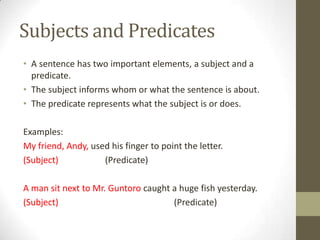
Subjects and Predicates
• A sentence has two important elements, a subject and a
  predicate.
• The subject informs whom or what the sentence is about.
• The predicate represents what the subject is or does.

Examples:
My friend, Andy, used his finger to point the letter.
(Subject)           (Predicate)

A man sit next to Mr. Guntoro caught a huge fish yesterday.
(Subject)                            (Predicate)
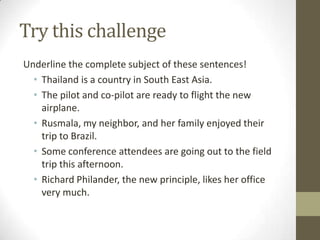
Try this challenge
Underline the complete subject of these sentences!
  • Thailand is a country in South East Asia.
  • The pilot and co-pilot are ready to flight the new
    airplane.
  • Rusmala, my neighbor, and her family enjoyed their
    trip to Brazil.
  • Some conference attendees are going out to the field
    trip this afternoon.
  • Richard Philander, the new principle, likes her office
    very much.
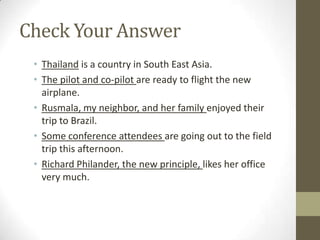
Check Your Answer
 • Thailand is a country in South East Asia.
 • The pilot and co-pilot are ready to flight the new
   airplane.
 • Rusmala, my neighbor, and her family enjoyed their
   trip to Brazil.
 • Some conference attendees are going out to the field
   trip this afternoon.
 • Richard Philander, the new principle, likes her office
   very much.
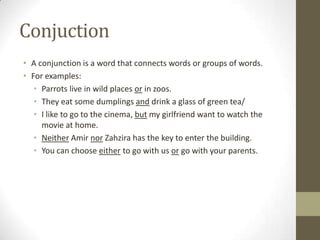
Conjuction
• A conjunction is a word that connects words or groups of words.
• For examples:
   • Parrots live in wild places or in zoos.
   • They eat some dumplings and drink a glass of green tea/
   • I like to go to the cinema, but my girlfriend want to watch the
     movie at home.
   • Neither Amir nor Zahzira has the key to enter the building.
   • You can choose either to go with us or go with your parents.
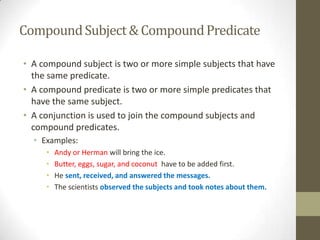
Compound Subject & Compound Predicate

• A compound subject is two or more simple subjects that have
  the same predicate.
• A compound predicate is two or more simple predicates that
  have the same subject.
• A conjunction is used to join the compound subjects and
  compound predicates.
  • Examples:
     •   Andy or Herman will bring the ice.
     •   Butter, eggs, sugar, and coconut have to be added first.
     •   He sent, received, and answered the messages.
     •   The scientists observed the subjects and took notes about them.
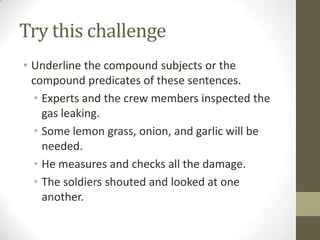
Try this challenge
• Underline the compound subjects or the
  compound predicates of these sentences.
  • Experts and the crew members inspected the
    gas leaking.
  • Some lemon grass, onion, and garlic will be
    needed.
  • He measures and checks all the damage.
  • The soldiers shouted and looked at one
    another.
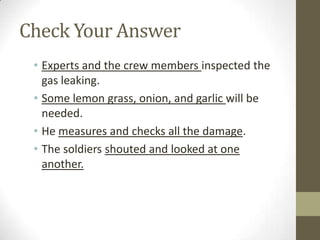
Check Your Answer
 • Experts and the crew members inspected the
   gas leaking.
 • Some lemon grass, onion, and garlic will be
   needed.
 • He measures and checks all the damage.
 • The soldiers shouted and looked at one
   another.
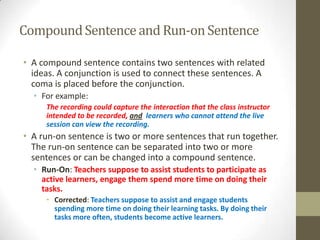
Compound Sentence and Run-on Sentence

• A compound sentence contains two sentences with related
  ideas. A conjunction is used to connect these sentences. A
  coma is placed before the conjunction.
  • For example:
     The recording could capture the interaction that the class instructor
     intended to be recorded, and learners who cannot attend the live
     session can view the recording.
• A run-on sentence is two or more sentences that run together.
  The run-on sentence can be separated into two or more
  sentences or can be changed into a compound sentence.
  • Run-On: Teachers suppose to assist students to participate as
    active learners, engage them spend more time on doing their
    tasks.
     • Corrected: Teachers suppose to assist and engage students
       spending more time on doing their learning tasks. By doing their
       tasks more often, students become active learners.
Closing Notes
• Send an email to the facilitator for enrolling to the course.
  Write your full name and your country of origin. For example:
  Ahmad Faisal, Nigeria.
• The facilitator email address is herythe@hotmail.co.uk
• Star to learn from the course website:
  http://basicenglishgrammar.weebly.com
• Help us to improve the lesson/course by filling out a survey
  here: BEG Survey

Basic English Grammar Meeting 9

  • 1.
    Basic English GrammarFor English Language Learners Meeting #9 Hery Yanto The English 3.0 Series, Summer 2012 July 16, 2012
  • 2.
    PART I TEACHING &LEARNING ENGLISH ABROAD
  • 3.
    What you haveto consider? • Culture • Certification/Training • Proficiency • Pedagogy • Theory • Permanent or temporal • Provide services to your customer Pre-requisite Both for Native & Non-native ESL/EFL teachers Text used from teflinstitute
  • 4.
    The training centersare helping the application & placement • Job search directory • Online application • Phone interview • Preparing documents and pre-departure • Connecting with host country representative • Placing and arranging new place to begin your career Text used from Tesol International Association
  • 5.
    Where to go? Textused from Tesolexpressonline
  • 6.
    Benefits Text usedfrom Tesolexpressonline
  • 7.
    English Summer Program • Customize for International Students • English for Specific Purposes • Some program help student on their preparation and placement to the college/university Text used from EFS Stanford University
  • 8.
    English Testing Preparation Program Text used from Maastricth University
  • 9.
    Student Exchange Program Textused from The Indonesian International Education Foundation
  • 10.
    Summer English Camp When business, entertainm ent, and education blended in a Program Text used from Camps for Kids
  • 11.
    British Hills –Japan Experiencing the Authenticity? Another example of business, entertainm ent, and education blended in a program. Text used from British Hills
  • 12.
    PART II INTRODUCTION TOSENTENCE STRUCTURE
  • 13.
    What is asentence? • A sentence is a group of words that express a complete thought. • A sentence begins with a capital letter in the first word and ends with a punctuation. • A group of words that does not express a complete thought forms a sentence fragment. Sentence Sentence Fragment Something just dropped from the Dropped from the roof. roof. She called when I was doing dishes. When I was doing dishes. I surprised by a loud noise. Loud noise.
  • 14.
    Four Kinds ofSentences Types of Sentences Example Declarative Sentence: Tropical countries are humid. - It tells something. - It ends with a period. Interrogative Sentence: Do you like to stay in a tropical - It uses to ask something. country? - It ends with a question mark. Imperative Sentence: Always have breakfast before you go - It gives an order. to school. - It ends with a period. Exclamatory Sentence: It was so cold! - It expresses strong feeling. - It ends with an exclamation point.
  • 15.
    Subjects and Predicates •A sentence has two important elements, a subject and a predicate. • The subject informs whom or what the sentence is about. • The predicate represents what the subject is or does. Examples: My friend, Andy, used his finger to point the letter. (Subject) (Predicate) A man sit next to Mr. Guntoro caught a huge fish yesterday. (Subject) (Predicate)
  • 16.
    Try this challenge Underlinethe complete subject of these sentences! • Thailand is a country in South East Asia. • The pilot and co-pilot are ready to flight the new airplane. • Rusmala, my neighbor, and her family enjoyed their trip to Brazil. • Some conference attendees are going out to the field trip this afternoon. • Richard Philander, the new principle, likes her office very much.
  • 17.
    Check Your Answer • Thailand is a country in South East Asia. • The pilot and co-pilot are ready to flight the new airplane. • Rusmala, my neighbor, and her family enjoyed their trip to Brazil. • Some conference attendees are going out to the field trip this afternoon. • Richard Philander, the new principle, likes her office very much.
  • 18.
    Conjuction • A conjunctionis a word that connects words or groups of words. • For examples: • Parrots live in wild places or in zoos. • They eat some dumplings and drink a glass of green tea/ • I like to go to the cinema, but my girlfriend want to watch the movie at home. • Neither Amir nor Zahzira has the key to enter the building. • You can choose either to go with us or go with your parents.
  • 19.
    Compound Subject &Compound Predicate • A compound subject is two or more simple subjects that have the same predicate. • A compound predicate is two or more simple predicates that have the same subject. • A conjunction is used to join the compound subjects and compound predicates. • Examples: • Andy or Herman will bring the ice. • Butter, eggs, sugar, and coconut have to be added first. • He sent, received, and answered the messages. • The scientists observed the subjects and took notes about them.
  • 20.
    Try this challenge •Underline the compound subjects or the compound predicates of these sentences. • Experts and the crew members inspected the gas leaking. • Some lemon grass, onion, and garlic will be needed. • He measures and checks all the damage. • The soldiers shouted and looked at one another.
  • 21.
    Check Your Answer • Experts and the crew members inspected the gas leaking. • Some lemon grass, onion, and garlic will be needed. • He measures and checks all the damage. • The soldiers shouted and looked at one another.
  • 22.
    Compound Sentence andRun-on Sentence • A compound sentence contains two sentences with related ideas. A conjunction is used to connect these sentences. A coma is placed before the conjunction. • For example: The recording could capture the interaction that the class instructor intended to be recorded, and learners who cannot attend the live session can view the recording. • A run-on sentence is two or more sentences that run together. The run-on sentence can be separated into two or more sentences or can be changed into a compound sentence. • Run-On: Teachers suppose to assist students to participate as active learners, engage them spend more time on doing their tasks. • Corrected: Teachers suppose to assist and engage students spending more time on doing their learning tasks. By doing their tasks more often, students become active learners.
  • 23.
    Closing Notes • Sendan email to the facilitator for enrolling to the course. Write your full name and your country of origin. For example: Ahmad Faisal, Nigeria. • The facilitator email address is herythe@hotmail.co.uk • Star to learn from the course website: http://basicenglishgrammar.weebly.com • Help us to improve the lesson/course by filling out a survey here: BEG Survey