A QUALITATIVE PHENOMENOLOGICAL
STUDY ON PRISON VOLUNTEERS IN
CALIFORNIA’S CORRECTIONAL SYSTEM
Donna Madison-Bell, Ed.D
October 7, 2014
University of Phoenix
Dissertation Oral Defense
DISSERTATION TEAM
Chair: Leslie Kille, Ed.D.
Committee: John C. Sienrukos, Ph.D.
Committee: Theresa Fox, Ed.D.
Outline of Today’s Dissertation
Defense Presentation
 Researcher’s Background
 Background of the Study
 Statement of the Problem
 Purpose Statement
 Research Questions
 Research Gap
 Significance of the Study
 Theoretical Framework
 Method and Design Appropriateness
 Pilot Study
 Population and Sampling
 Data Collection
 Data Analysis
 Findings
 Implications
 Recommendations
 Conclusion
 Questions
3
Researcher’s Background
4
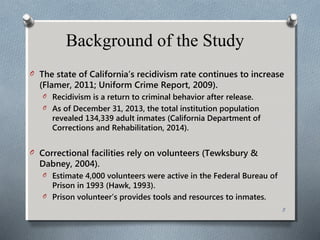
Background of the Study
O The state of California’s recidivism rate continues to increase
(Flamer, 2011; Uniform Crime Report, 2009).
O Recidivism is a return to criminal behavior after release.
O As of December 31, 2013, the total institution population
revealed 134,339 adult inmates (California Department of
Corrections and Rehabilitation, 2014).
O Correctional facilities rely on volunteers (Tewksbury &
Dabney, 2004).
O Estimate 4,000 volunteers were active in the Federal Bureau of
Prison in 1993 (Hawk, 1993).
O Prison volunteer’s provides tools and resources to inmates.
5
General Problem
O Most inmates released from
California prisons did not
successfully reenter the
community (Haas &
DeTardo-Bora, 2009; Zgoba,
Haugebrook, & Jenkins,
2008).
O Volunteers experiencing budget cuts that
provide services and resources in
correctional facilities has shown limited
reduction in recidivism (The Pew Center
on the States, 2012).
Specific Problem
Statement of the Problem
6
Purpose Statement
O Explore and understand the lived experiences of prison
volunteers who witnessed the decline of reentry services,
educational programs, and prison funding in California and
the meaning they ascribed to that experience.
7
Research Questions
RQ: What are the lived experiences of prison volunteers
relative to reentry, educational programs, and to budget
cuts in California?
SQ 1: What are the motivational factors that inspired
leadership roles associated with prison volunteers and
prison programs?
SQ 2: What personal motivational factors inspire individuals
to volunteer in prisons?
SQ 3: How does the characteristic of transformational and
servant leadership influence volunteers to involve others to
volunteer in a correctional facility?
8
Research Gap
O Addressing prison volunteers personal experience in a
correctional facility (Anheier & Salamon, 2001; Morrow-Howell
et al., 2009; Tewksbury & Dabney, 2004).
O Evaluating prison programs, specifically reentry and education
(Foley & Gao, 2004; Werth & Summer, 2006; Seiter & Kadela,
2003; Tewksbury & Dabney, 2005; United States Department of
Education 2011).
O Influential factors of leadership on prison volunteers (Meier,
Singletary, & Hill, 2012; Stirling, Kilpatrick, & Orpin, 2011).
O Tracking the success of inmates after released from prison
(Duwe & Clark, 2013; Klein, Tolbert, Bugarin, Cataldi, &
Tauschek, 2004; Lattimore & Visher, 2009; Zhang, Roberts, &
McCollister, 2011). 9
Significance of Study
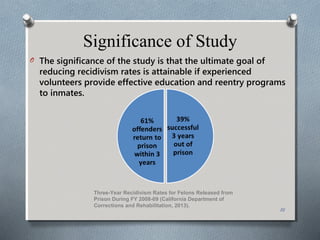
O The significance of the study is that the ultimate goal of
reducing recidivism rates is attainable if experienced
volunteers provide effective education and reentry programs
to inmates.
Three-Year Recidivism Rates for Felons Released from
Prison During FY 2008-09 (California Department of
Corrections and Rehabilitation, 2013).
10
Theoretical Framework
O Maslow’s Hierarchy of Needs:
O Maslow’s hierarchy of needs is a motivational theory in
psychology where individuals pursue to meet greater needs in
the form of a hierarchy (Maslow, 1943).
O Servant Leadership:
O Servant leadership theory Greenleaf (1973) has since been
supported by many leadership practitioners and researchers as
a model that focuses on serving others as the main priority of
leaders (Hesselbein, Goldsmith, & Beckhard, 2006).
O Transformational Leadership:
O The focus of transformational leadership is to positively
transform and change individuals (Northouse, 2001). 11
Method & Design
Appropriateness
O Qualitative phenomenological “explores an in-depth
understanding about a social construction of reality”
(Christensen, Johnson, & Turner, 2010, p. 368).
O Empirical phenomenological requires a protocol to
collect descriptive accounts of participants lived
experiences (Moustakas, 1994).
12
Pilot Study
O Three participants, (a director of a community-based
organization and two prison volunteers)
O The pilot interviews lasted 45-60 minutes
O Pilot study participants:
O reviewed the draft interview questions and provided
feedback
O test the instrument (interview questions) prior to carrying
out the full study
O aided in evaluating the instrument aligned with the research
questions
O participants were not part of the study
13
Population & Sample
O Sample:
O 47 e-mail invitations
O 20 participants met the sampling criteria
O data saturation did occur
O Criteria of Sampling Population:
O (a) active prison volunteer, both male and female
O (b) between the ages 18 and older
O (c) demonstrated more than 6 months volunteer
experience in a prison facility
O (d) California resident
14
Data Collection
Interviews
O 35 – 60 minutes face-to-face interview took place in
Northern and Southern California.
O Interview were digitally audio-recorded.
O Verbatim data was manually transcribed onto Microsoft
Word document.
O Codes identified as RP1 through RP20 used to represent
each participant’s responses.
15
Data Analysis
O Applied the van Kaam method (Moustakas, 1994) to
achieve a systemic discovery of:
O Patterns
O Themes
O Meaning in the participants responses
O Used NVivo™ 10 software:
O Manage
O Organize
O Analyze
O Collected non-numerical
O Unstructured data
16
Data Analysis
Emergent Themes
OInternal Themes related to lived experiences of prison volunteers:
O key motivational factors
O personal growth and achievements
O benefits of volunteering
O personal challenges
O personal perception of leadership characteristics
OExternal Themes related to prison programs and community-based
organizations:
O the need for change
O identifying community-based organizations challenges & issues
in in a correctional facility
O critical factors for improving volunteer training
17
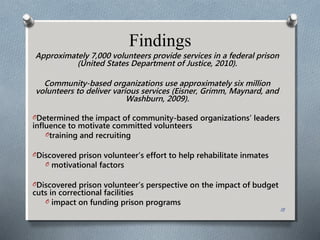
Findings
Approximately 7,000 volunteers provide services in a federal prison
(United States Department of Justice, 2010).
Community-based organizations use approximately six million
volunteers to deliver various services (Eisner, Grimm, Maynard, and
Washburn, 2009).
ODetermined the impact of community-based organizations’ leaders
influence to motivate committed volunteers
Otraining and recruiting
ODiscovered prison volunteer’s effort to help rehabilitate inmates
O motivational factors
ODiscovered prison volunteer’s perspective on the impact of budget
cuts in correctional facilities
O impact on funding prison programs
18
Findings
Research Questions
RQ: What are the lived experiences of prison volunteers
relative to reentry, educational programs, and to budget
cuts in California?
SQ 1: What are the motivational factors that inspired
leadership roles associated with prison volunteers and
prison programs?
SQ 2: What personal motivational factors inspire individuals
to volunteer in prisons?
SQ 3: How does the characteristic of transformational and
servant leadership influence volunteers to involve others to
volunteer in a correctional facility?
19
Implications
O Considerable strategies toward:
O improving training and recruiting
O decrease prison volunteer turnover
O helping an underserved population
O Leaders of community-based organizations promote:
O leadership ability to potential prison volunteers
O Adequate funding and reassessing prison programs:
O community-based organization's prison programs
O tracking system on released inmates
O policies toward the impact of funding 20
Recommendations
O Leaders of community-based organizations:
O examine the relationship of leadership role toward prison
volunteers
O explore strategies toward funding prison programs
O Prison Volunteers:
O explore motivational factors
O explore demonstrating the characteristics of servant and
transformational leadership
O Future Research:
O replicate this study in other regions and areas within the
correctional system 21
O The study findings could offer various sources beyond the
dissertation:
O a need to explore and understand lived experiences of
prison volunteers
O a need to set guidelines of community-based
organizations expectations of prison volunteers
O effective methods on improving leadership
communication skills with prison volunteers
O become a leader who influences and inspire others
O Scholar, Practitioner, Leader Model
Conclusion
22
Questions and Comments
Thank you for your support and your participation
during this presentation.
23
References
24
Anheier, H. K., & Salamon, L. M. (2001). Volunteering in cross-
national perspective: Initial comparisons. Law and
Contemporary Problems, 62(4), 43-65. [Civil Society
Working Paper 10]. Retrieved from
http://eprints.lse.ac.uk/29049/1/CSWP_10_web.pdf
California Department of Rehabilitation and Corrections [CDCR].
(2013). New reports show California recidivism decline again
this year. [Official CDCR blog website]. Retrieved from
http://cdcrtoday.blogspot.com/2014/01/new-report-shows-
californias-recidivism.html
California Department of Rehabilitation and Corrections [CDCR].
(2014). New reports show California recidivism decline again
this year. [Official CDCR blog website]. Retrieved from
http://cdcrtoday.blogspot.com/2014/01/new-report-shows-
californias-recidivism.html
Christensen, L. B., Johnson, R. B., & Turner, L. A. (2010).
Research methods, design, and analysis (11th ed.). Boston,
MA: Allyn & Bacon.
References
25
Duwe, G., & Clark, V. (2013). Blessed be the social tie that binds
the effects of prison visitation on offender recidivism. Criminal
Justice Policy Review, 24(3), 271-296. doi:
10.1177/0887403411429724
Eisner, D., Grimm, R. T., Maynard, S., & Washburn, S. (2009,
Winter). The new volunteer workforce. Stanford Social
Innovation Review, 7(1), 32-37. Retrieved from
http://www.hava.org/resources/HR_Summit_-
_The_New_Volunteer_Workforce_volunteer_managementchall
enge.pdf
Flamer, E. S. (2011). Recidivism, disciplinary history, and
institutional Adjustment: A qualitative study examining
correctional education programs [Doctoral dissertation,
University of Phoenix]. Available from ProQuest Dissertation
and Theses Database. (UMI Number: 3529281)
References
26
Foley, R. M., & Gao, J. (2004). Correctional education: Characteristics
of academic programs serving incarcerated adults. Journal of
Correctional Education, 55(1), 6-21.
Greenleaf, R. K. (1973). The servant as leader. Cambridge, MA:
Center for Applied Studies.
Haas, S. M., & DeTardo-Bora, K. A. (2009). Inmate reentry and the
utility of the LSI-R in case planning. Corrections Compendium,
34(1), 11-16.
Hawk, K. (1993). 4,000 BOP volunteers are committed to working
within the federal system. Corrections Today 55(5), 72.
Klein, S., Tolbert, M., Bugarin, R., Cataldi, E. F., & Tauschek, G.
(2004). Correctional education: Assessing the status of prison
programs and information needs [United States Department of
Education, Office of Safe and Drug-Free Schools Report No. ED-
99-CO-0160]. Retrieved from
http://files.eric.ed.gov/fulltext/ED543577.pdf
References
27
Lattimore, P. K., & Visher, C. A. (2009). The multi-site evaluation
of SVORI: Summary and synthesis [U. S. Department of
Justice Research Report #230421]. Retrieved from
https://www.ncjrs.gov/pdffiles1/nij/grants/230421.pdf
Maslow, A. H. (1943). A theory of human motivation. Psychological
Review, 50, 370-396.
Meier, A., Singletary, L., & Hill, G. (2012). Measuring the impacts
of a volunteer-based community development program in
developing volunteers' leadership skills. Journal of Extension,
50(2), 1-10. Retrieved from http://www.joe.org
Morrow-Howell, N., Hong, S. I., & Tang, F. (2009). Who benefits
from volunteering? Variations in perceived benefits. The
Gerontologist, 49(1), 91-102. doi:10.1093/geront/gnp007
References
28
Moustakas, C. (1994). Phenomenological research methods.
Thousand Oaks, CA: Sage.
Northouse, P. G. (2001). Leadership Theory and Practice (2nd ed.).
Thousand Oaks, CA: Sage.
The Pew Center on the States. (2012). Reducing Recidivism:
Corrections directors in five states share lessons learned [Issue
Brief]. Retrieved from
http://www.doc.ri.gov/documents/reentry/Pew_Reducing_Recidivi
sm.pdf
Seiter, R. P., & Kadela, K. R. (2003). Prisoner reentry: What works,
what does not, and what is promising. Crime & Delinquency,
49(3), 360-388. doi:10.1177/0011128703049003002
References
29
Stirling, C., Kilpatrick, S., & Orpin, P. (2011). A psychological contract
perspective to the link between non-profit organizations'
management practices and volunteer sustainability. Human
Resource Development International, 14(3), 321-336.
doi:10.1080/13678868.2011.585066
Tewksbury, R., & Dabney, D. (2004). Prison volunteers: Profiles,
motivations, satisfaction. Journal of Offender Rehabilitation,
40(1/2), 173-183. doi:10.1300/J076v40n01-09
Tewksbury, R., & Collins, S.C. (2005). Prison chapel volunteers.
Federal Probation, 69(1), 26-30.
Uniform Crime Report. (2011). Statistical overview [Federal Bureau of
Investigation Webpage]. Retrieved from http://www.fbi.gov/
ucr/ucr.htm
References
30
United States Department of Education. [USDOE]. (2011).
Community-based correctional education [Office of Vocational and
Adult Education Research Report]. Retrieved from
http://www2.ed.gov/about/offices/list/ovae/pi/AdultEd/cbce-report-
2011.pdf
United States Department of Justice [DOJ]. (2010). State of the Bureau
2010 [Federal Bureau of Prisons Report]. Retrieved from
http://301z4m21kc2l2h4qst3x6g1z3kj.wpengine.netdna-
cdn.com/wp-content/uploads/2013/10/State-of-the-Bureau.pdf
Werth, R., & Summer, J. (2006). Inside California’s prisons and
beyond: A snapshot of in-prison and re-entry programs [Report].
Retrieved from
http://ucicorrections.seweb.uci.edu/files/2013/06/WorkingPaperRe-
entry_d.pdf
References
31
Zgoba, K. M., Haugebrook, S., & Jenkins, K. (2008). The influence
of GED obtainment on inmate release outcome. Criminal
Justice and Behavior, 35(3), 375-387. doi:
10.1177/0093854807311853
Zhang, S. X., Roberts, R. E., & McCollister, K. E. (2011).
Therapeutic community in a California prison: Treatment
outcomes after 5 years. Crime & Delinquency, 57(1), 82-101.
doi: 10.1177/0011128708327035

A Qualitative Phenomenological Study on Prison Volunteers in California’s Correctional System

  • 1.
    A QUALITATIVE PHENOMENOLOGICAL STUDYON PRISON VOLUNTEERS IN CALIFORNIA’S CORRECTIONAL SYSTEM Donna Madison-Bell, Ed.D October 7, 2014 University of Phoenix Dissertation Oral Defense
  • 2.
    DISSERTATION TEAM Chair: LeslieKille, Ed.D. Committee: John C. Sienrukos, Ph.D. Committee: Theresa Fox, Ed.D.
  • 3.
    Outline of Today’sDissertation Defense Presentation  Researcher’s Background  Background of the Study  Statement of the Problem  Purpose Statement  Research Questions  Research Gap  Significance of the Study  Theoretical Framework  Method and Design Appropriateness  Pilot Study  Population and Sampling  Data Collection  Data Analysis  Findings  Implications  Recommendations  Conclusion  Questions 3
  • 4.
  • 5.
    Background of theStudy O The state of California’s recidivism rate continues to increase (Flamer, 2011; Uniform Crime Report, 2009). O Recidivism is a return to criminal behavior after release. O As of December 31, 2013, the total institution population revealed 134,339 adult inmates (California Department of Corrections and Rehabilitation, 2014). O Correctional facilities rely on volunteers (Tewksbury & Dabney, 2004). O Estimate 4,000 volunteers were active in the Federal Bureau of Prison in 1993 (Hawk, 1993). O Prison volunteer’s provides tools and resources to inmates. 5
  • 6.
    General Problem O Mostinmates released from California prisons did not successfully reenter the community (Haas & DeTardo-Bora, 2009; Zgoba, Haugebrook, & Jenkins, 2008). O Volunteers experiencing budget cuts that provide services and resources in correctional facilities has shown limited reduction in recidivism (The Pew Center on the States, 2012). Specific Problem Statement of the Problem 6
  • 7.
    Purpose Statement O Exploreand understand the lived experiences of prison volunteers who witnessed the decline of reentry services, educational programs, and prison funding in California and the meaning they ascribed to that experience. 7
  • 8.
    Research Questions RQ: Whatare the lived experiences of prison volunteers relative to reentry, educational programs, and to budget cuts in California? SQ 1: What are the motivational factors that inspired leadership roles associated with prison volunteers and prison programs? SQ 2: What personal motivational factors inspire individuals to volunteer in prisons? SQ 3: How does the characteristic of transformational and servant leadership influence volunteers to involve others to volunteer in a correctional facility? 8
  • 9.
    Research Gap O Addressingprison volunteers personal experience in a correctional facility (Anheier & Salamon, 2001; Morrow-Howell et al., 2009; Tewksbury & Dabney, 2004). O Evaluating prison programs, specifically reentry and education (Foley & Gao, 2004; Werth & Summer, 2006; Seiter & Kadela, 2003; Tewksbury & Dabney, 2005; United States Department of Education 2011). O Influential factors of leadership on prison volunteers (Meier, Singletary, & Hill, 2012; Stirling, Kilpatrick, & Orpin, 2011). O Tracking the success of inmates after released from prison (Duwe & Clark, 2013; Klein, Tolbert, Bugarin, Cataldi, & Tauschek, 2004; Lattimore & Visher, 2009; Zhang, Roberts, & McCollister, 2011). 9
  • 10.
    Significance of Study OThe significance of the study is that the ultimate goal of reducing recidivism rates is attainable if experienced volunteers provide effective education and reentry programs to inmates. Three-Year Recidivism Rates for Felons Released from Prison During FY 2008-09 (California Department of Corrections and Rehabilitation, 2013). 10
  • 11.
    Theoretical Framework O Maslow’sHierarchy of Needs: O Maslow’s hierarchy of needs is a motivational theory in psychology where individuals pursue to meet greater needs in the form of a hierarchy (Maslow, 1943). O Servant Leadership: O Servant leadership theory Greenleaf (1973) has since been supported by many leadership practitioners and researchers as a model that focuses on serving others as the main priority of leaders (Hesselbein, Goldsmith, & Beckhard, 2006). O Transformational Leadership: O The focus of transformational leadership is to positively transform and change individuals (Northouse, 2001). 11
  • 12.
    Method & Design Appropriateness OQualitative phenomenological “explores an in-depth understanding about a social construction of reality” (Christensen, Johnson, & Turner, 2010, p. 368). O Empirical phenomenological requires a protocol to collect descriptive accounts of participants lived experiences (Moustakas, 1994). 12
  • 13.
    Pilot Study O Threeparticipants, (a director of a community-based organization and two prison volunteers) O The pilot interviews lasted 45-60 minutes O Pilot study participants: O reviewed the draft interview questions and provided feedback O test the instrument (interview questions) prior to carrying out the full study O aided in evaluating the instrument aligned with the research questions O participants were not part of the study 13
  • 14.
    Population & Sample OSample: O 47 e-mail invitations O 20 participants met the sampling criteria O data saturation did occur O Criteria of Sampling Population: O (a) active prison volunteer, both male and female O (b) between the ages 18 and older O (c) demonstrated more than 6 months volunteer experience in a prison facility O (d) California resident 14
  • 15.
    Data Collection Interviews O 35– 60 minutes face-to-face interview took place in Northern and Southern California. O Interview were digitally audio-recorded. O Verbatim data was manually transcribed onto Microsoft Word document. O Codes identified as RP1 through RP20 used to represent each participant’s responses. 15
  • 16.
    Data Analysis O Appliedthe van Kaam method (Moustakas, 1994) to achieve a systemic discovery of: O Patterns O Themes O Meaning in the participants responses O Used NVivo™ 10 software: O Manage O Organize O Analyze O Collected non-numerical O Unstructured data 16
  • 17.
    Data Analysis Emergent Themes OInternalThemes related to lived experiences of prison volunteers: O key motivational factors O personal growth and achievements O benefits of volunteering O personal challenges O personal perception of leadership characteristics OExternal Themes related to prison programs and community-based organizations: O the need for change O identifying community-based organizations challenges & issues in in a correctional facility O critical factors for improving volunteer training 17
  • 18.
    Findings Approximately 7,000 volunteersprovide services in a federal prison (United States Department of Justice, 2010). Community-based organizations use approximately six million volunteers to deliver various services (Eisner, Grimm, Maynard, and Washburn, 2009). ODetermined the impact of community-based organizations’ leaders influence to motivate committed volunteers Otraining and recruiting ODiscovered prison volunteer’s effort to help rehabilitate inmates O motivational factors ODiscovered prison volunteer’s perspective on the impact of budget cuts in correctional facilities O impact on funding prison programs 18
  • 19.
    Findings Research Questions RQ: Whatare the lived experiences of prison volunteers relative to reentry, educational programs, and to budget cuts in California? SQ 1: What are the motivational factors that inspired leadership roles associated with prison volunteers and prison programs? SQ 2: What personal motivational factors inspire individuals to volunteer in prisons? SQ 3: How does the characteristic of transformational and servant leadership influence volunteers to involve others to volunteer in a correctional facility? 19
  • 20.
    Implications O Considerable strategiestoward: O improving training and recruiting O decrease prison volunteer turnover O helping an underserved population O Leaders of community-based organizations promote: O leadership ability to potential prison volunteers O Adequate funding and reassessing prison programs: O community-based organization's prison programs O tracking system on released inmates O policies toward the impact of funding 20
  • 21.
    Recommendations O Leaders ofcommunity-based organizations: O examine the relationship of leadership role toward prison volunteers O explore strategies toward funding prison programs O Prison Volunteers: O explore motivational factors O explore demonstrating the characteristics of servant and transformational leadership O Future Research: O replicate this study in other regions and areas within the correctional system 21
  • 22.
    O The studyfindings could offer various sources beyond the dissertation: O a need to explore and understand lived experiences of prison volunteers O a need to set guidelines of community-based organizations expectations of prison volunteers O effective methods on improving leadership communication skills with prison volunteers O become a leader who influences and inspire others O Scholar, Practitioner, Leader Model Conclusion 22
  • 23.
    Questions and Comments Thankyou for your support and your participation during this presentation. 23
  • 24.
    References 24 Anheier, H. K.,& Salamon, L. M. (2001). Volunteering in cross- national perspective: Initial comparisons. Law and Contemporary Problems, 62(4), 43-65. [Civil Society Working Paper 10]. Retrieved from http://eprints.lse.ac.uk/29049/1/CSWP_10_web.pdf California Department of Rehabilitation and Corrections [CDCR]. (2013). New reports show California recidivism decline again this year. [Official CDCR blog website]. Retrieved from http://cdcrtoday.blogspot.com/2014/01/new-report-shows- californias-recidivism.html California Department of Rehabilitation and Corrections [CDCR]. (2014). New reports show California recidivism decline again this year. [Official CDCR blog website]. Retrieved from http://cdcrtoday.blogspot.com/2014/01/new-report-shows- californias-recidivism.html Christensen, L. B., Johnson, R. B., & Turner, L. A. (2010). Research methods, design, and analysis (11th ed.). Boston, MA: Allyn & Bacon.
  • 25.
    References 25 Duwe, G., &Clark, V. (2013). Blessed be the social tie that binds the effects of prison visitation on offender recidivism. Criminal Justice Policy Review, 24(3), 271-296. doi: 10.1177/0887403411429724 Eisner, D., Grimm, R. T., Maynard, S., & Washburn, S. (2009, Winter). The new volunteer workforce. Stanford Social Innovation Review, 7(1), 32-37. Retrieved from http://www.hava.org/resources/HR_Summit_- _The_New_Volunteer_Workforce_volunteer_managementchall enge.pdf Flamer, E. S. (2011). Recidivism, disciplinary history, and institutional Adjustment: A qualitative study examining correctional education programs [Doctoral dissertation, University of Phoenix]. Available from ProQuest Dissertation and Theses Database. (UMI Number: 3529281)
  • 26.
    References 26 Foley, R. M.,& Gao, J. (2004). Correctional education: Characteristics of academic programs serving incarcerated adults. Journal of Correctional Education, 55(1), 6-21. Greenleaf, R. K. (1973). The servant as leader. Cambridge, MA: Center for Applied Studies. Haas, S. M., & DeTardo-Bora, K. A. (2009). Inmate reentry and the utility of the LSI-R in case planning. Corrections Compendium, 34(1), 11-16. Hawk, K. (1993). 4,000 BOP volunteers are committed to working within the federal system. Corrections Today 55(5), 72. Klein, S., Tolbert, M., Bugarin, R., Cataldi, E. F., & Tauschek, G. (2004). Correctional education: Assessing the status of prison programs and information needs [United States Department of Education, Office of Safe and Drug-Free Schools Report No. ED- 99-CO-0160]. Retrieved from http://files.eric.ed.gov/fulltext/ED543577.pdf
  • 27.
    References 27 Lattimore, P. K.,& Visher, C. A. (2009). The multi-site evaluation of SVORI: Summary and synthesis [U. S. Department of Justice Research Report #230421]. Retrieved from https://www.ncjrs.gov/pdffiles1/nij/grants/230421.pdf Maslow, A. H. (1943). A theory of human motivation. Psychological Review, 50, 370-396. Meier, A., Singletary, L., & Hill, G. (2012). Measuring the impacts of a volunteer-based community development program in developing volunteers' leadership skills. Journal of Extension, 50(2), 1-10. Retrieved from http://www.joe.org Morrow-Howell, N., Hong, S. I., & Tang, F. (2009). Who benefits from volunteering? Variations in perceived benefits. The Gerontologist, 49(1), 91-102. doi:10.1093/geront/gnp007
  • 28.
    References 28 Moustakas, C. (1994).Phenomenological research methods. Thousand Oaks, CA: Sage. Northouse, P. G. (2001). Leadership Theory and Practice (2nd ed.). Thousand Oaks, CA: Sage. The Pew Center on the States. (2012). Reducing Recidivism: Corrections directors in five states share lessons learned [Issue Brief]. Retrieved from http://www.doc.ri.gov/documents/reentry/Pew_Reducing_Recidivi sm.pdf Seiter, R. P., & Kadela, K. R. (2003). Prisoner reentry: What works, what does not, and what is promising. Crime & Delinquency, 49(3), 360-388. doi:10.1177/0011128703049003002
  • 29.
    References 29 Stirling, C., Kilpatrick,S., & Orpin, P. (2011). A psychological contract perspective to the link between non-profit organizations' management practices and volunteer sustainability. Human Resource Development International, 14(3), 321-336. doi:10.1080/13678868.2011.585066 Tewksbury, R., & Dabney, D. (2004). Prison volunteers: Profiles, motivations, satisfaction. Journal of Offender Rehabilitation, 40(1/2), 173-183. doi:10.1300/J076v40n01-09 Tewksbury, R., & Collins, S.C. (2005). Prison chapel volunteers. Federal Probation, 69(1), 26-30. Uniform Crime Report. (2011). Statistical overview [Federal Bureau of Investigation Webpage]. Retrieved from http://www.fbi.gov/ ucr/ucr.htm
  • 30.
    References 30 United States Departmentof Education. [USDOE]. (2011). Community-based correctional education [Office of Vocational and Adult Education Research Report]. Retrieved from http://www2.ed.gov/about/offices/list/ovae/pi/AdultEd/cbce-report- 2011.pdf United States Department of Justice [DOJ]. (2010). State of the Bureau 2010 [Federal Bureau of Prisons Report]. Retrieved from http://301z4m21kc2l2h4qst3x6g1z3kj.wpengine.netdna- cdn.com/wp-content/uploads/2013/10/State-of-the-Bureau.pdf Werth, R., & Summer, J. (2006). Inside California’s prisons and beyond: A snapshot of in-prison and re-entry programs [Report]. Retrieved from http://ucicorrections.seweb.uci.edu/files/2013/06/WorkingPaperRe- entry_d.pdf
  • 31.
    References 31 Zgoba, K. M.,Haugebrook, S., & Jenkins, K. (2008). The influence of GED obtainment on inmate release outcome. Criminal Justice and Behavior, 35(3), 375-387. doi: 10.1177/0093854807311853 Zhang, S. X., Roberts, R. E., & McCollister, K. E. (2011). Therapeutic community in a California prison: Treatment outcomes after 5 years. Crime & Delinquency, 57(1), 82-101. doi: 10.1177/0011128708327035