Action Research in Education
Theory& Practice
Mohamed Hossni
Objectives
• To define what action research is
• To describe the Principles of action research
• To illustrates how to conduct an action research
• To situate the action research among other kinds of research
Defining
Action
Research
as a systematic study that combines
action and reflection with the intention
of improving practice.
a process in which practitioners study
problems scientifically, so that they can
evaluate, improve and steer decision-
making and practice
Action research is a term used to
describe professionals studying their
own practice in order to improve it.
History of Action
Research
“Kurt Lewin”
www.schoolofeducators.com
The term “action research” was coined by
Kurt Lewin, a social-psychologist
According to Kurt Lewin, social
conditions might be enhanced through the
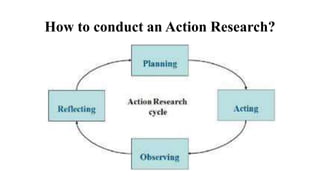
group processes that involve four steps:
Planning &Acting & Observing &
Reflecting
These steps leads to the development of
action research.
Principles and characteristics of action
research
Makes for practical
problem-solving as
well as expanding
scientific knowledge
Enhances the
experiences of
participants is
collaborative
Undertaken directly
in workplace.
Uses feedback from
data in an ongoing
cyclical process
tends to avoid the
paradigm of research
that isolates and
controls variables
is formative, such that
the definition of the
problem, the aims and
methodology may modify
during the process of
action research
How to conduct an Action Research?
phase One:
Planning for
Research
It starts with an inquiry process,
where you define a specific research
question. It needs to be something you
can test. Next, conduct a literature
review to gain a deeper understanding
of the related research.
Finally, you move into the design
process, where you determine your
data methods, consider ethical issues,
get required permissions, create
deadlines and set up systems
Phase two
Action
engage in multiple cycles of
experimentation and data
collection. Your data collection
might include:
- qualitative data, like observations,
artifacts, and interviews.
- quantitative data like rubric
scores, surveys, or achievement
data.
Phase Three
Analysis
You will often start by organizing
data with charts or graphs and
looking for trends.
- You might also discuss it with
peers, free write in a journal, or
create a cluster map before
eventually writing out your results.
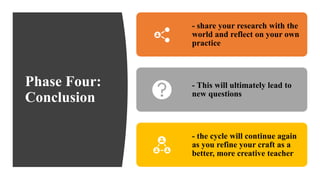
Phase Four:
Conclusion
- share your research with the
world and reflect on your own
practice
- This will ultimately lead to
new questions
- the cycle will continue again
as you refine your craft as a
better, more creative teacher
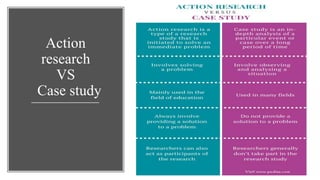
Action
research
VS
Case study
Do the
research
studies of
faculties of
education take
a place in
practice ?
- YES - NO
WHY?
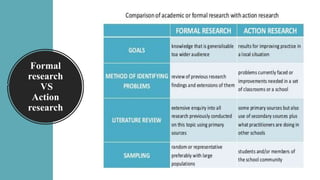
Formal
research
VS
Action
research
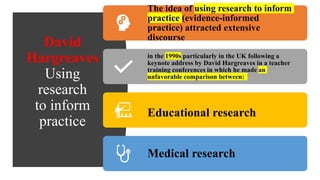
David
Hargreaves
Using
research
to inform
practice
The idea of using research to inform
practice (evidence-informed
practice) attracted extensive
discourse
in the 1990s particularly in the UK following a
keynote address by David Hargreaves in a teacher
training conferences in which he made an
unfavorable comparison between:
Educational research
Medical research
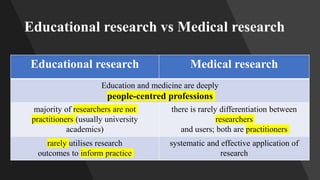
Educational research vs Medical research
Educational research Medical research
Education and medicine are deeply
people-centred professions
majority of researchers are not
practitioners (usually university
academics)
there is rarely differentiation between
researchers
and users; both are practitioners
rarely utilises research
outcomes to inform practice
systematic and effective application of
research
If you have the problem in your
school what will you do?
The absence of teachers is
increasing?
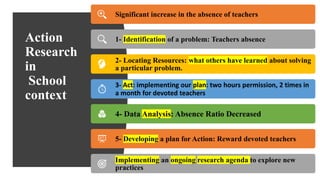
Action
Research
in
School
context
Significant increase in the absence of teachers
1- Identification of a problem: Teachers absence
2- Locating Resources: what others have learned about solving
a particular problem.
3- Act: implementing our plan: two hours permission, 2 times in
a month for devoted teachers
4- Data Analysis: Absence Ratio Decreased
5- Developing a plan for Action: Reward devoted teachers
Implementing an ongoing research agenda to explore new
practices
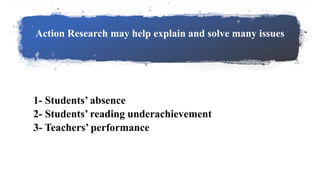
Action Research may help explain and solve many issues
1- Students’ absence
2- Students’ reading underachievement
3- Teachers’ performance
ACTION RESEARCH AS
a MASTER'S THESIS
• Minnesota State
University
• ST. KATE’S University,
Minneapolis
CONCLUSION
&
ACTIVITY
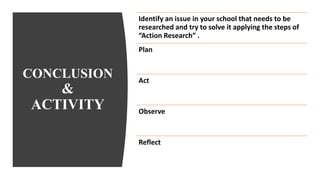
Identify an issue in your school that needs to be
researched and try to solve it applying the steps of
“Action Research” .
Plan
Act
Observe
Reflect
References
Baburoglu, O.N. and Ravn, I. (1992)"Normative Action Research."Organization
Studies (13:1),, pp. 19-34.
Davison, R.M., Martinsons, M.G., and Kock, N. (2004)“Principles of canonical
action research,” Information Systems Journal (14).
Peters, M. and Robinson, V.(ND) "The Origins and Status of Action Research,"
Journal of Applied Behavioral Science (20:2)
Stiggins, R. J. (2001) Student-Involved Classroom Assessment (third edition).
Upper Saddle River, NJ:Merrill Prentice Hall.
Trist, E. "Engaging with large-scale systems,(1994)" in Experimenting with
Organizational Life: The Action Research Approach, A. Clark (ed.), Plenum, New
York.

ActionResearch CARACTERISTICAS Y ELEMENTOS

  • 1.
    Action Research inEducation Theory& Practice Mohamed Hossni
  • 2.
    Objectives • To definewhat action research is • To describe the Principles of action research • To illustrates how to conduct an action research • To situate the action research among other kinds of research
  • 3.
    Defining Action Research as a systematicstudy that combines action and reflection with the intention of improving practice. a process in which practitioners study problems scientifically, so that they can evaluate, improve and steer decision- making and practice Action research is a term used to describe professionals studying their own practice in order to improve it.
  • 4.
    History of Action Research “KurtLewin” www.schoolofeducators.com The term “action research” was coined by Kurt Lewin, a social-psychologist According to Kurt Lewin, social conditions might be enhanced through the group processes that involve four steps: Planning &Acting & Observing & Reflecting These steps leads to the development of action research.
  • 5.
    Principles and characteristicsof action research Makes for practical problem-solving as well as expanding scientific knowledge Enhances the experiences of participants is collaborative Undertaken directly in workplace. Uses feedback from data in an ongoing cyclical process tends to avoid the paradigm of research that isolates and controls variables is formative, such that the definition of the problem, the aims and methodology may modify during the process of action research
  • 6.
    How to conductan Action Research?
  • 7.
    phase One: Planning for Research Itstarts with an inquiry process, where you define a specific research question. It needs to be something you can test. Next, conduct a literature review to gain a deeper understanding of the related research. Finally, you move into the design process, where you determine your data methods, consider ethical issues, get required permissions, create deadlines and set up systems
  • 8.
    Phase two Action engage inmultiple cycles of experimentation and data collection. Your data collection might include: - qualitative data, like observations, artifacts, and interviews. - quantitative data like rubric scores, surveys, or achievement data.
  • 9.
    Phase Three Analysis You willoften start by organizing data with charts or graphs and looking for trends. - You might also discuss it with peers, free write in a journal, or create a cluster map before eventually writing out your results.
  • 10.
    Phase Four: Conclusion - shareyour research with the world and reflect on your own practice - This will ultimately lead to new questions - the cycle will continue again as you refine your craft as a better, more creative teacher
  • 11.
  • 12.
    Do the research studies of facultiesof education take a place in practice ? - YES - NO WHY?
  • 13.
  • 14.
    David Hargreaves Using research to inform practice The ideaof using research to inform practice (evidence-informed practice) attracted extensive discourse in the 1990s particularly in the UK following a keynote address by David Hargreaves in a teacher training conferences in which he made an unfavorable comparison between: Educational research Medical research
  • 15.
    Educational research vsMedical research Educational research Medical research Education and medicine are deeply people-centred professions majority of researchers are not practitioners (usually university academics) there is rarely differentiation between researchers and users; both are practitioners rarely utilises research outcomes to inform practice systematic and effective application of research
  • 16.
    If you havethe problem in your school what will you do? The absence of teachers is increasing?
  • 17.
    Action Research in School context Significant increase inthe absence of teachers 1- Identification of a problem: Teachers absence 2- Locating Resources: what others have learned about solving a particular problem. 3- Act: implementing our plan: two hours permission, 2 times in a month for devoted teachers 4- Data Analysis: Absence Ratio Decreased 5- Developing a plan for Action: Reward devoted teachers Implementing an ongoing research agenda to explore new practices
  • 18.
    Action Research mayhelp explain and solve many issues 1- Students’ absence 2- Students’ reading underachievement 3- Teachers’ performance
  • 19.
    ACTION RESEARCH AS aMASTER'S THESIS • Minnesota State University • ST. KATE’S University, Minneapolis
  • 20.
    CONCLUSION & ACTIVITY Identify an issuein your school that needs to be researched and try to solve it applying the steps of “Action Research” . Plan Act Observe Reflect
  • 21.
    References Baburoglu, O.N. andRavn, I. (1992)"Normative Action Research."Organization Studies (13:1),, pp. 19-34. Davison, R.M., Martinsons, M.G., and Kock, N. (2004)“Principles of canonical action research,” Information Systems Journal (14). Peters, M. and Robinson, V.(ND) "The Origins and Status of Action Research," Journal of Applied Behavioral Science (20:2) Stiggins, R. J. (2001) Student-Involved Classroom Assessment (third edition). Upper Saddle River, NJ:Merrill Prentice Hall. Trist, E. "Engaging with large-scale systems,(1994)" in Experimenting with Organizational Life: The Action Research Approach, A. Clark (ed.), Plenum, New York.