ACTION
RESEARCH
Research Methods in Education 7th
Edition Chapter 18
© LOUIS COHEN, LAWRENCE MANION & KEITH MORRISON
STRUCTURE OF THE SESSION
• Defining action research
• Principles and characteristics of
action research
• Procedures for action research
• Reporting action research
ACTION RESEARCH
• Action research is a small-scale intervention
in the functioning of the real world to
address practitioners’ own issues, and a
close examination of the effects of such an
intervention.
• Kemmis and McTaggart (1992: 10): ‘to do
action research is to plan, act, observe and
reflect more carefully, more systematically,
and more rigorously than one usually does
in everyday life’.
• Action research combines diagnosis, action
and reflection.
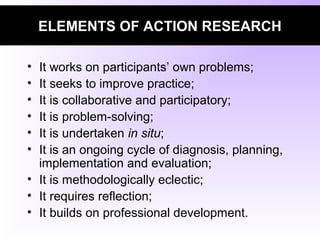
ELEMENTS OF ACTION RESEARCH
• It works on participants’ own problems;
• It seeks to improve practice;
• It is collaborative and participatory;
• It is problem-solving;
• It is undertaken in situ;
• It is an ongoing cycle of diagnosis, planning,
implementation and evaluation;
• It is methodologically eclectic;
• It requires reflection;
• It builds on professional development.
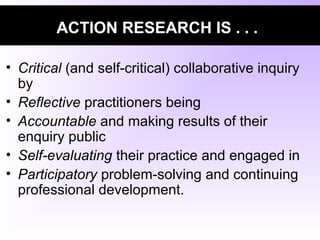
ACTION RESEARCH IS . . .
• Critical (and self-critical) collaborative inquiry
by
• Reflective practitioners being
• Accountable and making results of their
enquiry public
• Self-evaluating their practice and engaged in
• Participatory problem-solving and continuing
professional development.
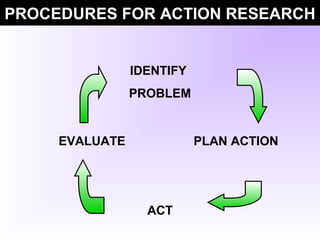
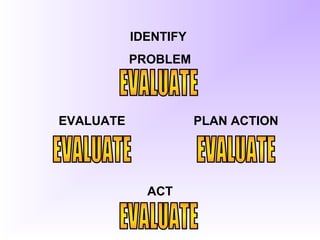
IDENTIFY
PROBLEM
PLAN ACTION
ACT
EVALUATE
PROCEDURES FOR ACTION RESEARCH
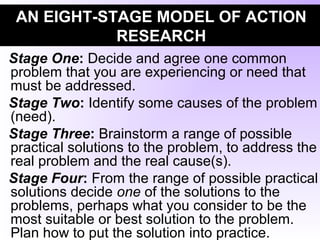
AN EIGHT-STAGE MODEL OF ACTION
RESEARCH
Stage One: Decide and agree one common
problem that you are experiencing or need that
must be addressed.
Stage Two: Identify some causes of the problem
(need).
Stage Three: Brainstorm a range of possible
practical solutions to the problem, to address the
real problem and the real cause(s).
Stage Four: From the range of possible practical
solutions decide one of the solutions to the
problems, perhaps what you consider to be the
most suitable or best solution to the problem.
Plan how to put the solution into practice.
AN EIGHT-STAGE MODEL OF ACTION
RESEARCH
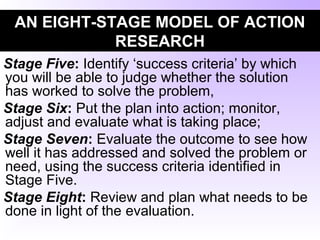
Stage Five: Identify ‘success criteria’ by which
you will be able to judge whether the solution
has worked to solve the problem,
Stage Six: Put the plan into action; monitor,
adjust and evaluate what is taking place;
Stage Seven: Evaluate the outcome to see how
well it has addressed and solved the problem or
need, using the success criteria identified in
Stage Five.
Stage Eight: Review and plan what needs to be
done in light of the evaluation.
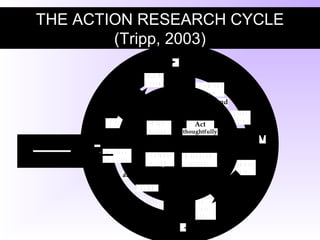
THE ACTION RESEARCH CYCLE
(Tripp, 2003)
Reconnaissance
(First Cycle)
F i r s t
P l a n
A c t i o n
T h e n P l a n
R e s e a r c h
F i r s t
P r o d u c e
D a t a
T h e n
A n a l y s e
D a t a
and
I m p l e m e n t
A c t i o n
M o n i t o r
A c t i o n
and
( s e p a r a t e l y
a n d t o g e t h e r )
( t o g e t h e r )
R e f l e c t
( o n A c t i o n )
R e v i e w
( R e s e a r c h )
P r o c e s s
P l a n
a c t i o n
R e s e a r c h
a c t i o n
E v a l u a t e
a c t i o n
Act
thoughtfully
Gathering Information and Data
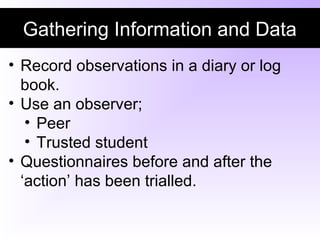
• Record observations in a diary or log
book.
• Use an observer;
• Peer
• Trusted student
• Questionnaires before and after the
‘action’ has been trialled.
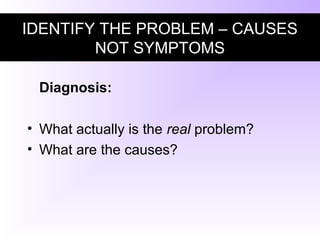
IDENTIFY THE PROBLEM – CAUSES
NOT SYMPTOMS
Diagnosis:
• What actually is the real problem?
• What are the causes?
PLAN INTERVENTIONS
Divergent Phase:
• What actions are possible?
• What alternatives are there?
• Evaluate alternatives.
Convergent Phase:
• Which intervention will be adopted?
• Decide from amongst the alternatives.
Planning:
• How will the intervention be implemented?
IMPLEMENTATION
Putting the plan into action
• Initiation
• Development
• Sustenance
• Follow-up
EVALUATION
How successfully has the intervention
addressed the issue?
• What are the success criteria?
• How will you know if the intervention has been
successful?
• What are the outcomes of the intervention?
• What ongoing monitoring will there be?
• What will you do if the intervention is not
working?
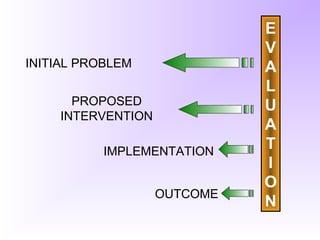
INITIAL PROBLEM
PROPOSED
INTERVENTION
IMPLEMENTATION
OUTCOME
E
V
A
L
U
A
T
I
O
N
IDENTIFY
PROBLEM
PLAN ACTION
ACT
EVALUATE
ADVICE FOR ACTION RESEARCHERS
• Stay small, stay focused;
• Identify a clear research question;
• Be realistic about what you can do;
• Plan carefully;
• Set a realistic time scale;
• Involve others (as participants, observers, validators –
including critical friends – potential researchers);
• Ensure ethical practice;
• Concentrate on learning, not on the outcomes of action;
• The focus of the research is you, in company with others;
• Beware of happy endings;
• Be aware of political issues.
REPORTING ACTION RESEARCH
Report:
• The research issue and how it came to
become a research issue in the improvement
of practice;
• The methodology of, and justification for, the
intervention, and how it was selected from
amongst other possible interventions;
• How the intervention derived from an
understanding of the situation;
• What data were collected, when, and from
whom;
• How data were collected, processed and
analyzed;
REPORTING ACTION RESEARCH
Report:
• How the ongoing intervention was monitored
and reviewed;
• How reflexivity was addressed;
• What were the standard and criteria for
success, and how these criteria were derived;
• How conclusions were reached and how
these were validated;
• What and how the researcher learnt as a
consequence of the action research;
• How practice was changed as a consequence
of the findings.
REFLEXIVITY IN ACTION RESEARCH
• A self-conscious awareness of the effects that
the participants-as-practitioners-and-
researchers are having on the research
process, how their values, attitudes,
perceptions, opinions, actions, feelings etc.
are influencing the situation being studied.
• How the researcher/practitioner may be
biasing the research.
MAKING ACTION RESEARCH WORK
Collegiality must be present, e.g.:
• Participatory approaches to decision-making;
• Democratic and consensual decision-making;
• Shared values, beliefs and goals;
• Equal rights of participation in discussion;
• Equal rights to determine policy;
• Equal voting rights on decisions;
• The deployment of sub-groups who are accountable
to the whole group;
• Shared responsibility and open accountability;
• An extended view of expertise;
• Judgements and decisions based on the power of the
argument rather than the positional power of the
advocates;
• Shared ownership of decisions and practices.

How to conduct action research

  • 1.
    ACTION RESEARCH Research Methods inEducation 7th Edition Chapter 18 © LOUIS COHEN, LAWRENCE MANION & KEITH MORRISON
  • 2.
    STRUCTURE OF THESESSION • Defining action research • Principles and characteristics of action research • Procedures for action research • Reporting action research
  • 3.
    ACTION RESEARCH • Actionresearch is a small-scale intervention in the functioning of the real world to address practitioners’ own issues, and a close examination of the effects of such an intervention. • Kemmis and McTaggart (1992: 10): ‘to do action research is to plan, act, observe and reflect more carefully, more systematically, and more rigorously than one usually does in everyday life’. • Action research combines diagnosis, action and reflection.
  • 4.
    ELEMENTS OF ACTIONRESEARCH • It works on participants’ own problems; • It seeks to improve practice; • It is collaborative and participatory; • It is problem-solving; • It is undertaken in situ; • It is an ongoing cycle of diagnosis, planning, implementation and evaluation; • It is methodologically eclectic; • It requires reflection; • It builds on professional development.
  • 5.
    ACTION RESEARCH IS. . . • Critical (and self-critical) collaborative inquiry by • Reflective practitioners being • Accountable and making results of their enquiry public • Self-evaluating their practice and engaged in • Participatory problem-solving and continuing professional development.
  • 6.
  • 7.
    AN EIGHT-STAGE MODELOF ACTION RESEARCH Stage One: Decide and agree one common problem that you are experiencing or need that must be addressed. Stage Two: Identify some causes of the problem (need). Stage Three: Brainstorm a range of possible practical solutions to the problem, to address the real problem and the real cause(s). Stage Four: From the range of possible practical solutions decide one of the solutions to the problems, perhaps what you consider to be the most suitable or best solution to the problem. Plan how to put the solution into practice.
  • 8.
    AN EIGHT-STAGE MODELOF ACTION RESEARCH Stage Five: Identify ‘success criteria’ by which you will be able to judge whether the solution has worked to solve the problem, Stage Six: Put the plan into action; monitor, adjust and evaluate what is taking place; Stage Seven: Evaluate the outcome to see how well it has addressed and solved the problem or need, using the success criteria identified in Stage Five. Stage Eight: Review and plan what needs to be done in light of the evaluation.
  • 9.
    THE ACTION RESEARCHCYCLE (Tripp, 2003) Reconnaissance (First Cycle) F i r s t P l a n A c t i o n T h e n P l a n R e s e a r c h F i r s t P r o d u c e D a t a T h e n A n a l y s e D a t a and I m p l e m e n t A c t i o n M o n i t o r A c t i o n and ( s e p a r a t e l y a n d t o g e t h e r ) ( t o g e t h e r ) R e f l e c t ( o n A c t i o n ) R e v i e w ( R e s e a r c h ) P r o c e s s P l a n a c t i o n R e s e a r c h a c t i o n E v a l u a t e a c t i o n Act thoughtfully
  • 10.
    Gathering Information andData • Record observations in a diary or log book. • Use an observer; • Peer • Trusted student • Questionnaires before and after the ‘action’ has been trialled.
  • 11.
    IDENTIFY THE PROBLEM– CAUSES NOT SYMPTOMS Diagnosis: • What actually is the real problem? • What are the causes?
  • 12.
    PLAN INTERVENTIONS Divergent Phase: •What actions are possible? • What alternatives are there? • Evaluate alternatives. Convergent Phase: • Which intervention will be adopted? • Decide from amongst the alternatives. Planning: • How will the intervention be implemented?
  • 13.
    IMPLEMENTATION Putting the planinto action • Initiation • Development • Sustenance • Follow-up
  • 14.
    EVALUATION How successfully hasthe intervention addressed the issue? • What are the success criteria? • How will you know if the intervention has been successful? • What are the outcomes of the intervention? • What ongoing monitoring will there be? • What will you do if the intervention is not working?
  • 15.
  • 16.
  • 17.
    ADVICE FOR ACTIONRESEARCHERS • Stay small, stay focused; • Identify a clear research question; • Be realistic about what you can do; • Plan carefully; • Set a realistic time scale; • Involve others (as participants, observers, validators – including critical friends – potential researchers); • Ensure ethical practice; • Concentrate on learning, not on the outcomes of action; • The focus of the research is you, in company with others; • Beware of happy endings; • Be aware of political issues.
  • 18.
    REPORTING ACTION RESEARCH Report: •The research issue and how it came to become a research issue in the improvement of practice; • The methodology of, and justification for, the intervention, and how it was selected from amongst other possible interventions; • How the intervention derived from an understanding of the situation; • What data were collected, when, and from whom; • How data were collected, processed and analyzed;
  • 19.
    REPORTING ACTION RESEARCH Report: •How the ongoing intervention was monitored and reviewed; • How reflexivity was addressed; • What were the standard and criteria for success, and how these criteria were derived; • How conclusions were reached and how these were validated; • What and how the researcher learnt as a consequence of the action research; • How practice was changed as a consequence of the findings.
  • 20.
    REFLEXIVITY IN ACTIONRESEARCH • A self-conscious awareness of the effects that the participants-as-practitioners-and- researchers are having on the research process, how their values, attitudes, perceptions, opinions, actions, feelings etc. are influencing the situation being studied. • How the researcher/practitioner may be biasing the research.
  • 21.
    MAKING ACTION RESEARCHWORK Collegiality must be present, e.g.: • Participatory approaches to decision-making; • Democratic and consensual decision-making; • Shared values, beliefs and goals; • Equal rights of participation in discussion; • Equal rights to determine policy; • Equal voting rights on decisions; • The deployment of sub-groups who are accountable to the whole group; • Shared responsibility and open accountability; • An extended view of expertise; • Judgements and decisions based on the power of the argument rather than the positional power of the advocates; • Shared ownership of decisions and practices.