Air Pollution
Esraa Hussein Mohamed 14104622
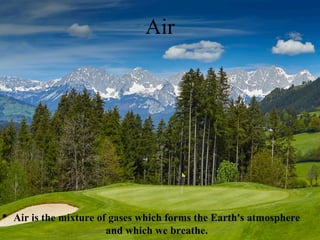
Air
• Air is the mixture of gases which forms the Earth's atmosphere
and which we breathe.
Composition
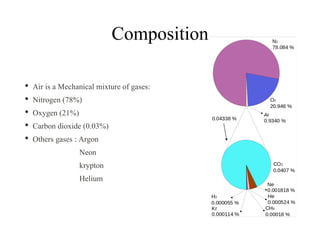
• Air is a Mechanical mixture of gases:
• Nitrogen (78%)
• Oxygen (21%)
• Carbon dioxide (0.03%)
• Others gases : Argon
Neon
krypton
Helium
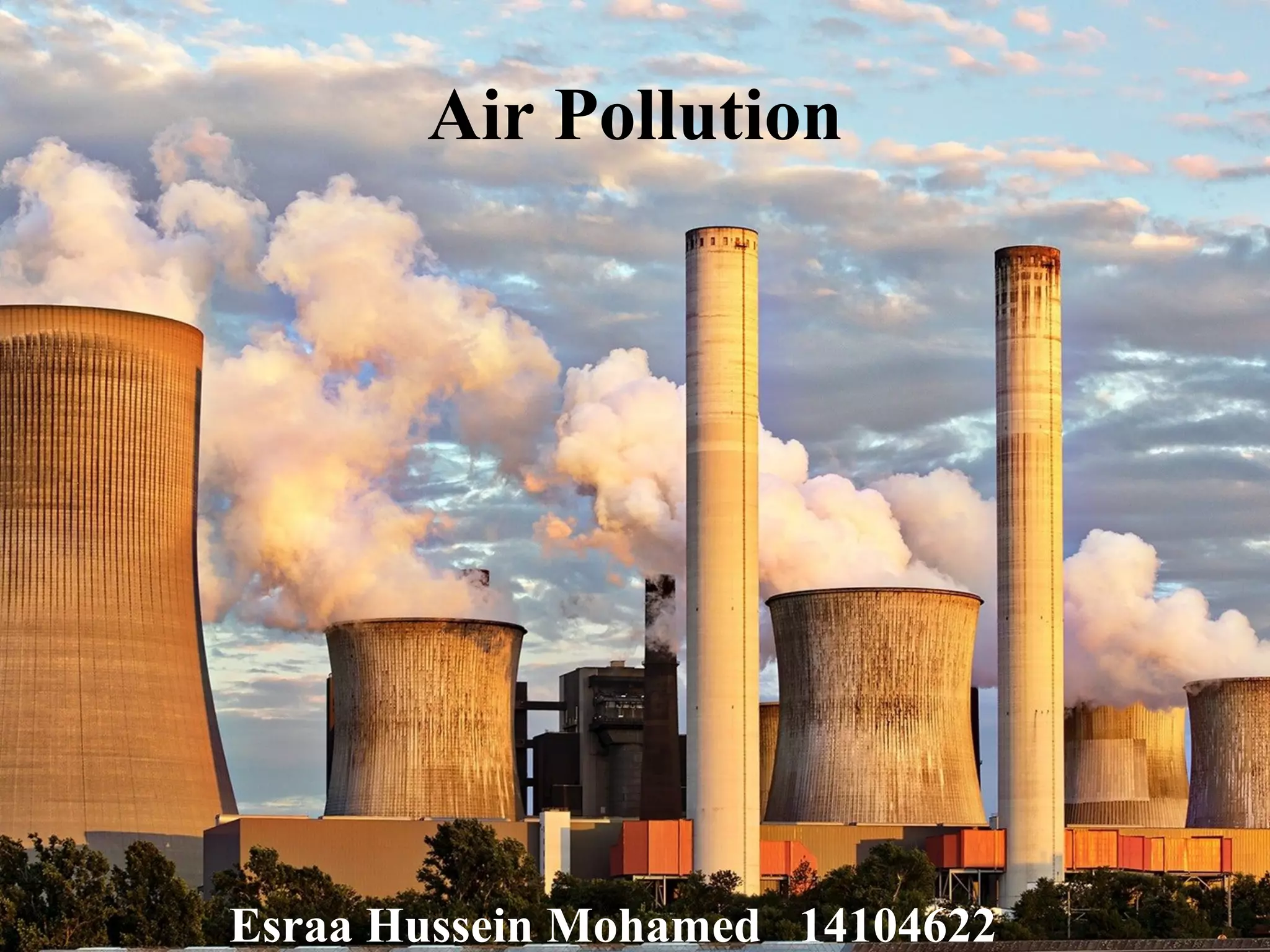
Air Pollution
• A substance in the air that can cause harm to humans and the environment is known as
an air pollutant.
• Pollutants can be in the form of solid particles, liquid droplets, or gases. In addition,
they may be natural or man-made.
•According to W.H.O : An increase in any of the constituents of the atmosphere which is
harmful to the living beings and their environment, is known as air pollution .
{W.H.O: World Health Organization}
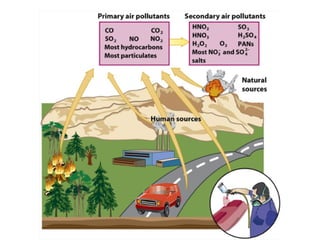
There are two types of pollutants
• Primary Pollutants
Harmful substance that is emitted directly into the atmosphere
• Secondary Pollutants
Harmful substance formed in the atmosphere when a primary air pollutant reacts
with substances normally found in the atmosphere or with other air pollutants
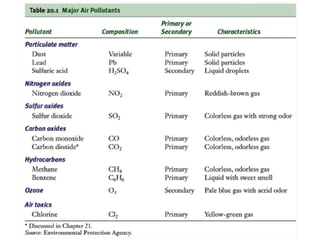
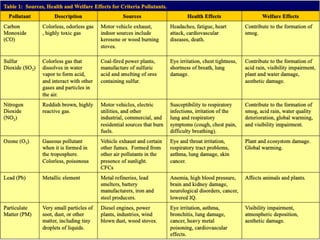
Major Pollutants
1. Carbon Monoxide
2. Sulfur Dioxide
3. Nitrogen Dioxide
4. Particulate Matter
5. Ground Level Ozone
6. lead
Particulate Matter
Size Matters
• Size is important to the behavior of PM in the atmosphere and human body to
determines the entry and absorption potential for particles in the lungs.
• Particles larger than 10 mm are trapped in the nose and throat and never reach
the lungs.
• Therefore, particles 10 mm in diameter or less are of most concern for their
effects on human health.
• Particles between 5 and 10 mm are removed by physical processes in the
throat.
• Particles smaller than 5 mm reach the bronchial tubes, while particles 2.5 mm
in diameter or smaller are breathed into the deepest portions of the lungs.
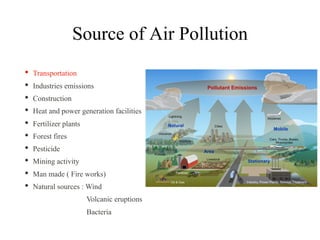
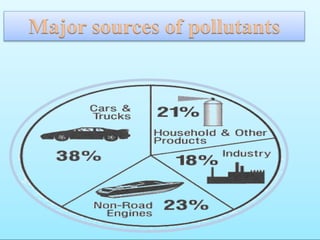
Source of Air Pollution
• Transportation
• Industries emissions
• Construction
• Heat and power generation facilities
• Fertilizer plants
• Forest fires
• Pesticide
• Mining activity
• Man made ( Fire works)
• Natural sources : Wind
Volcanic eruptions
Bacteria
Transportation
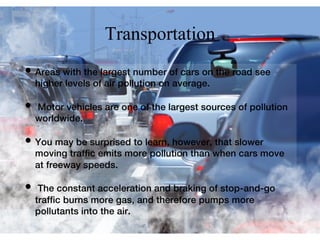
• Areas with the largest number of cars on the road see
higher levels of air pollution on average.
• Motor vehicles are one of the largest sources of pollution
worldwide.
• You may be surprised to learn, however, that slower
moving traffic emits more pollution than when cars move
at freeway speeds.
• The constant acceleration and braking of stop-and-go
traffic burns more gas, and therefore pumps more
pollutants into the air.
• The relationship between driving speed and pollution isn’t
perfectly linear, though. One study suggests that
emissions start to go up when average freeway speed
dips below 45 miles per hour (mph). They also start to go
up dramatically as the average speed goes above 65
mph. So, the “golden zone” for fuel-consumption and
emissions from your vehicle may be somewhere between
45 and 65 mph.
• The pollutants result from vehicle exhaust contain high
levels of nitrogen oxide which are toxic to humans,Sulfur
dioxide is the primary cause of acid rain, Carbon dioxide
contributes to climate change by insulating more heat
from the sun.
Advancing Technology Helps
Reduce Emissions
• We’ve already seen a large reduction in the rate of
emissions generated by a single vehicle, thanks largely to
improved car engine designs, and improved fuel
chemistry.
• We can look forward to the increasing popularity of hybrid
and electric technology for personal vehicles.
• Public transit can do a lot to reduce emissions and clear
the air.
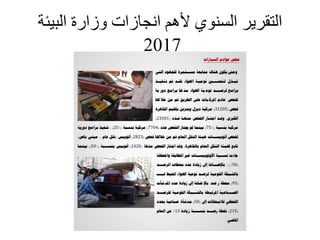
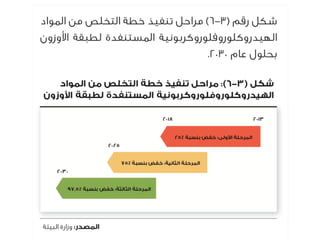
‫ا‬‫ﻟ‬‫ﺘ‬‫ﻘ‬‫ﺮ‬‫ﯾ‬‫ﺮ‬‫ا‬‫ﻟ‬‫ﺴ‬‫ﻨ‬‫ﻮ‬‫ي‬‫ﻷ‬‫ھ‬‫ﻢ‬‫ا‬‫ﻧ‬‫ﺠ‬‫ﺎ‬‫ز‬‫ا‬‫ت‬‫و‬‫ز‬‫ا‬‫ر‬‫ة‬‫ا‬‫ﻟ‬‫ﺒ‬‫ﯿ‬‫ﺌ‬‫ﺔ‬
2017
Effects of Air Pollution
• Global warming
• Acid rain
• Smog
• Ozone depletion
Global warming
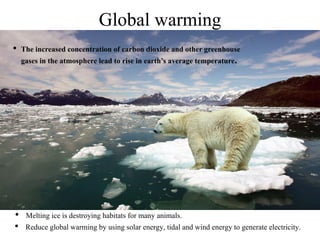
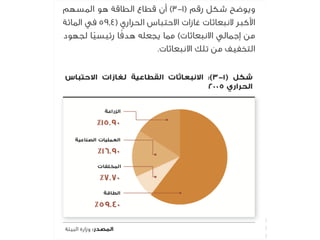
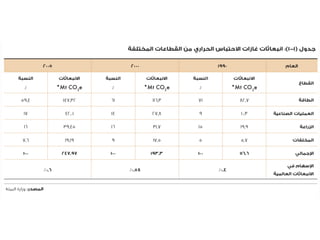
• The increased concentration of carbon dioxide and other greenhouse
gases in the atmosphere lead to rise in earth’s average temperature.
• Melting ice is destroying habitats for many animals.
• Reduce global warming by using solar energy, tidal and wind energy to generate electricity.
Acid Rain
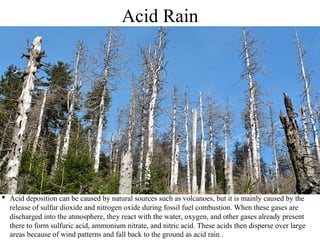
• Acid deposition can be caused by natural sources such as volcanoes, but it is mainly caused by the
release of sulfur dioxide and nitrogen oxide during fossil fuel combustion. When these gases are
discharged into the atmosphere, they react with the water, oxygen, and other gases already present
there to form sulfuric acid, ammonium nitrate, and nitric acid. These acids then disperse over large
areas because of wind patterns and fall back to the ground as acid rain .
Smog
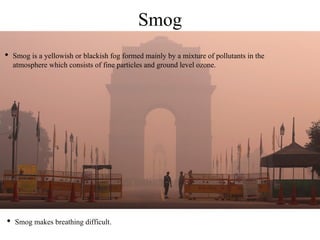
• Smog is a yellowish or blackish fog formed mainly by a mixture of pollutants in the
atmosphere which consists of fine particles and ground level ozone.
• Smog makes breathing difficult.
Smog
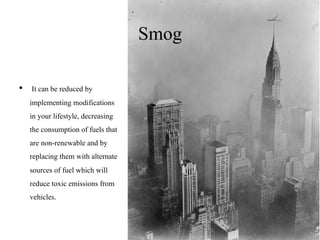
• It can be reduced by
implementing modifications
in your lifestyle, decreasing
the consumption of fuels that
are non-renewable and by
replacing them with alternate
sources of fuel which will
reduce toxic emissions from
vehicles.
Depletion of Ozone layer
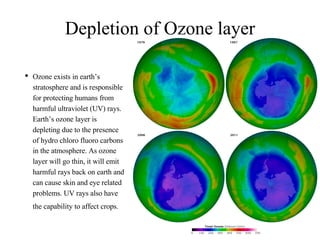
• Ozone exists in earth’s
stratosphere and is responsible
for protecting humans from
harmful ultraviolet (UV) rays.
Earth’s ozone layer is
depleting due to the presence
of hydro chloro fluoro carbons
in the atmosphere. As ozone
layer will go thin, it will emit
harmful rays back on earth and
can cause skin and eye related
problems. UV rays also have
the capability to affect crops.
Effects of Air Pollution
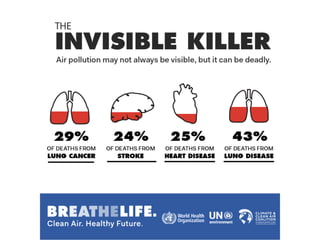
• Air pollution can cause health problems:
1. Burning eyes.
2. Breathing problems.
3. Some chemicals found in polluted air can cause cancer
4. Birth defects, brain and nerve damage
5. Long-term injury to the lungs and breathing passages
6. Above certain concentrations and durations, certain air pollutants are
extremely dangerous and can cause severe injury or death.
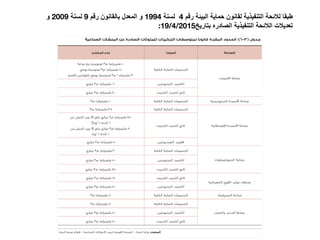
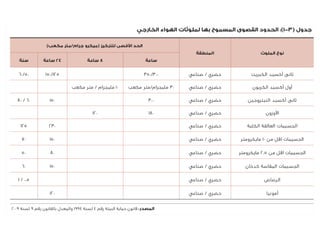
‫ط‬‫ﺒ‬‫ﻘ‬‫ﺎ‬‫ﻟ‬‫ﻼ‬‫ﺋ‬‫ﺤ‬‫ﺔ‬‫ا‬‫ﻟ‬‫ﺘ‬‫ﻨ‬‫ﻔ‬‫ﯿ‬‫ﺬ‬‫ﯾ‬‫ﺔ‬‫ﻟ‬‫ﻘ‬‫ﺎ‬‫ﻧ‬‫ﻮ‬‫ن‬‫ﺣ‬‫ﻤ‬‫ﺎ‬‫ﯾ‬‫ﺔ‬‫ا‬‫ﻟ‬‫ﺒ‬‫ﯿ‬‫ﺌ‬‫ﺔ‬‫ر‬‫ﻗ‬‫ﻢ‬4‫ﻟ‬‫ﺴ‬‫ﻨ‬‫ﺔ‬1994‫و‬‫ا‬‫ﻟ‬‫ﻤ‬‫ﻌ‬‫ﺪ‬‫ل‬‫ﺑ‬‫ﺎ‬‫ﻟ‬‫ﻘ‬‫ﺎ‬‫ﻧ‬‫ﻮ‬‫ن‬‫ر‬‫ﻗ‬‫ﻢ‬9‫ﻟ‬‫ﺴ‬‫ﻨ‬‫ﺔ‬2009‫و‬
‫ﺗ‬‫ﻌ‬‫ﺪ‬‫ﯾ‬‫ﻼ‬‫ت‬‫ا‬‫ﻟ‬‫ﻼ‬‫ﺋ‬‫ﺤ‬‫ﺔ‬‫ا‬‫ﻟ‬‫ﺘ‬‫ﻨ‬‫ﻔ‬‫ﯿ‬‫ﺬ‬‫ﯾ‬‫ﺔ‬‫ا‬‫ﻟ‬‫ﺼ‬‫ﺎ‬‫د‬‫ر‬‫ه‬‫ﺑ‬‫ﺘ‬‫ﺎ‬‫ر‬‫ﯾ‬‫ﺦ‬19/4/2015:
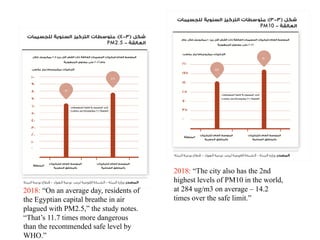
2018: “On an average day, residents of
the Egyptian capital breathe in air
plagued with PM2.5,” the study notes.
“That’s 11.7 times more dangerous
than the recommended safe level by
WHO.”
2018: “The city also has the 2nd
highest levels of PM10 in the world,
at 284 ug/m3 on average – 14.2
times over the safe limit.”
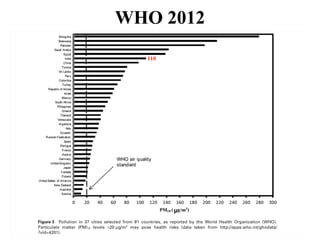
WHO 2012
110
• Cairo has been ranked as the second most polluted large city in the world, according to
a report issued by the World Health Organization (WHO), which studied air pollution
globally from 2011 until 2015.
• In 2017, the United Nations Environment Programs stated in a report that 40,000 people
in different parts of Egypt all died from pollution. The report pointed to the absence of
trees within Egypt’s capital as leading to the increase of air pollution.
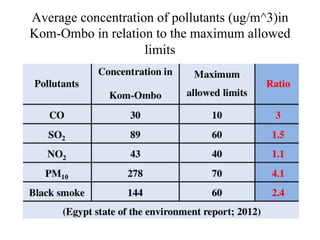
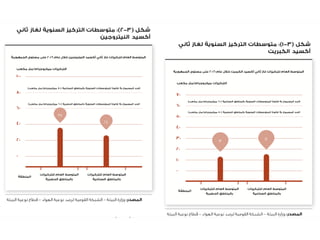
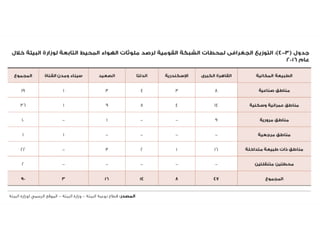
Average concentration of pollutants (ug/m^3)in
Kom-Ombo in relation to the maximum allowed
limits
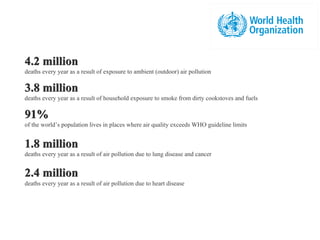
4.2 million
deaths every year as a result of exposure to ambient (outdoor) air pollution
3.8 million
deaths every year as a result of household exposure to smoke from dirty cookstoves and fuels
91%
of the world’s population lives in places where air quality exceeds WHO guideline limits
1.8 million
deaths every year as a result of air pollution due to lung disease and cancer
2.4 million
deaths every year as a result of air pollution due to heart disease
Control Air Pollution
Prevention and control of air
pollution
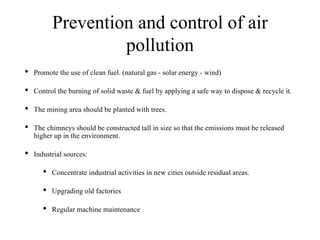
• Promote the use of clean fuel. (natural gas - solar energy - wind)
• Control the burning of solid waste & fuel by applying a safe way to dispose & recycle it.
• The mining area should be planted with trees.
• The chimneys should be constructed tall in size so that the emissions must be released
higher up in the environment.
• Industrial sources:
• Concentrate industrial activities in new cities outside residual areas.
• Upgrading old factories
• Regular machine maintenance
Prevention and control of air
pollution
• The automobiles must be designed with emission control system.
• Using public transportation helps to prevent the air pollution.
• Renewable energy.
Settling Chambers
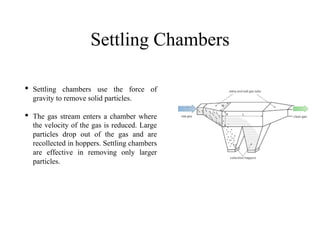
• Settling chambers use the force of
gravity to remove solid particles.
• The gas stream enters a chamber where
the velocity of the gas is reduced. Large
particles drop out of the gas and are
recollected in hoppers. Settling chambers
are effective in removing only larger
particles.
Controlling Air Pollution
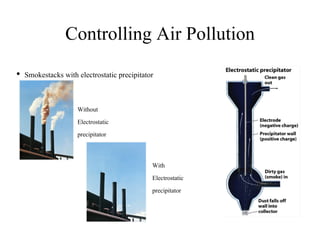
• Smokestacks with electrostatic precipitator
Without
Electrostatic
precipitator
With
Electrostatic
precipitator
References
• https://www.collinsdictionary.com/dictionary/english/air
• https://en.wikipedia.org/wiki/Atmosphere_of_Earth
• https://www.slideshare.net/itsvaibhav/air-32261746
• https://www.slideshare.net/ahmedalinasr7/effect-of-air-pollution-on-maternal-outcomes-in-upper-egypt
• https://www.slideshare.net/naveedabbasmalik35/pollution-its-causes-and-effects-by-naveedm
• https://www.slideshare.net/guest92532d/air-pollution-presentation-919606
• http://www.eeaa.gov.eg/portals/0/eeaaReports/SoE2012AR/ ‫ا‬‫ﻟ‬‫ﺒ‬‫ﺎ‬‫ب‬%20‫ا‬‫ﻷ‬‫و‬‫ل‬%20‫ا‬‫ﻟ‬‫ﮭ‬‫ﻮ‬‫ا‬‫ء‬/‫ا‬‫ﻟ‬‫ﻔ‬‫ﺼ‬‫ﻞ‬%20‫ا‬‫ﻷ‬‫و‬‫ل‬%20‫ﻧ‬‫ﻮ‬‫ع‬
‫ﯾ‬‫ﺔ‬%20‫ا‬‫ﻟ‬‫ﮭ‬‫ﻮ‬‫ا‬‫ء‬ .pdf
• Nevers, N.D. 2000. Air Pollution Control Engineering, Second Edition, Pub., McGraw Hill, New York.
Air pollution.

Air pollution.

  • 1.
  • 2.
    Air • Air isthe mixture of gases which forms the Earth's atmosphere and which we breathe.
  • 3.
    Composition • Air isa Mechanical mixture of gases: • Nitrogen (78%) • Oxygen (21%) • Carbon dioxide (0.03%) • Others gases : Argon Neon krypton Helium
  • 4.
    Air Pollution • Asubstance in the air that can cause harm to humans and the environment is known as an air pollutant. • Pollutants can be in the form of solid particles, liquid droplets, or gases. In addition, they may be natural or man-made. •According to W.H.O : An increase in any of the constituents of the atmosphere which is harmful to the living beings and their environment, is known as air pollution . {W.H.O: World Health Organization}
  • 5.
    There are twotypes of pollutants • Primary Pollutants Harmful substance that is emitted directly into the atmosphere • Secondary Pollutants Harmful substance formed in the atmosphere when a primary air pollutant reacts with substances normally found in the atmosphere or with other air pollutants
  • 8.
    Major Pollutants 1. CarbonMonoxide 2. Sulfur Dioxide 3. Nitrogen Dioxide 4. Particulate Matter 5. Ground Level Ozone 6. lead
  • 9.
    Particulate Matter Size Matters •Size is important to the behavior of PM in the atmosphere and human body to determines the entry and absorption potential for particles in the lungs. • Particles larger than 10 mm are trapped in the nose and throat and never reach the lungs. • Therefore, particles 10 mm in diameter or less are of most concern for their effects on human health. • Particles between 5 and 10 mm are removed by physical processes in the throat. • Particles smaller than 5 mm reach the bronchial tubes, while particles 2.5 mm in diameter or smaller are breathed into the deepest portions of the lungs.
  • 11.
    Source of AirPollution • Transportation • Industries emissions • Construction • Heat and power generation facilities • Fertilizer plants • Forest fires • Pesticide • Mining activity • Man made ( Fire works) • Natural sources : Wind Volcanic eruptions Bacteria
  • 13.
    Transportation • Areas withthe largest number of cars on the road see higher levels of air pollution on average. • Motor vehicles are one of the largest sources of pollution worldwide. • You may be surprised to learn, however, that slower moving traffic emits more pollution than when cars move at freeway speeds. • The constant acceleration and braking of stop-and-go traffic burns more gas, and therefore pumps more pollutants into the air.
  • 14.
    • The relationshipbetween driving speed and pollution isn’t perfectly linear, though. One study suggests that emissions start to go up when average freeway speed dips below 45 miles per hour (mph). They also start to go up dramatically as the average speed goes above 65 mph. So, the “golden zone” for fuel-consumption and emissions from your vehicle may be somewhere between 45 and 65 mph. • The pollutants result from vehicle exhaust contain high levels of nitrogen oxide which are toxic to humans,Sulfur dioxide is the primary cause of acid rain, Carbon dioxide contributes to climate change by insulating more heat from the sun.
  • 15.
    Advancing Technology Helps ReduceEmissions • We’ve already seen a large reduction in the rate of emissions generated by a single vehicle, thanks largely to improved car engine designs, and improved fuel chemistry. • We can look forward to the increasing popularity of hybrid and electric technology for personal vehicles. • Public transit can do a lot to reduce emissions and clear the air.
  • 16.
  • 17.
    Effects of AirPollution • Global warming • Acid rain • Smog • Ozone depletion
  • 18.
    Global warming • Theincreased concentration of carbon dioxide and other greenhouse gases in the atmosphere lead to rise in earth’s average temperature. • Melting ice is destroying habitats for many animals. • Reduce global warming by using solar energy, tidal and wind energy to generate electricity.
  • 19.
    Acid Rain • Aciddeposition can be caused by natural sources such as volcanoes, but it is mainly caused by the release of sulfur dioxide and nitrogen oxide during fossil fuel combustion. When these gases are discharged into the atmosphere, they react with the water, oxygen, and other gases already present there to form sulfuric acid, ammonium nitrate, and nitric acid. These acids then disperse over large areas because of wind patterns and fall back to the ground as acid rain .
  • 20.
    Smog • Smog isa yellowish or blackish fog formed mainly by a mixture of pollutants in the atmosphere which consists of fine particles and ground level ozone. • Smog makes breathing difficult.
  • 21.
    Smog • It canbe reduced by implementing modifications in your lifestyle, decreasing the consumption of fuels that are non-renewable and by replacing them with alternate sources of fuel which will reduce toxic emissions from vehicles.
  • 22.
    Depletion of Ozonelayer • Ozone exists in earth’s stratosphere and is responsible for protecting humans from harmful ultraviolet (UV) rays. Earth’s ozone layer is depleting due to the presence of hydro chloro fluoro carbons in the atmosphere. As ozone layer will go thin, it will emit harmful rays back on earth and can cause skin and eye related problems. UV rays also have the capability to affect crops.
  • 23.
    Effects of AirPollution • Air pollution can cause health problems: 1. Burning eyes. 2. Breathing problems. 3. Some chemicals found in polluted air can cause cancer 4. Birth defects, brain and nerve damage 5. Long-term injury to the lungs and breathing passages 6. Above certain concentrations and durations, certain air pollutants are extremely dangerous and can cause severe injury or death.
  • 24.
    ‫ط‬‫ﺒ‬‫ﻘ‬‫ﺎ‬‫ﻟ‬‫ﻼ‬‫ﺋ‬‫ﺤ‬‫ﺔ‬‫ا‬‫ﻟ‬‫ﺘ‬‫ﻨ‬‫ﻔ‬‫ﯿ‬‫ﺬ‬‫ﯾ‬‫ﺔ‬‫ﻟ‬‫ﻘ‬‫ﺎ‬‫ﻧ‬‫ﻮ‬‫ن‬‫ﺣ‬‫ﻤ‬‫ﺎ‬‫ﯾ‬‫ﺔ‬‫ا‬‫ﻟ‬‫ﺒ‬‫ﯿ‬‫ﺌ‬‫ﺔ‬‫ر‬‫ﻗ‬‫ﻢ‬4‫ﻟ‬‫ﺴ‬‫ﻨ‬‫ﺔ‬1994‫و‬‫ا‬‫ﻟ‬‫ﻤ‬‫ﻌ‬‫ﺪ‬‫ل‬‫ﺑ‬‫ﺎ‬‫ﻟ‬‫ﻘ‬‫ﺎ‬‫ﻧ‬‫ﻮ‬‫ن‬‫ر‬‫ﻗ‬‫ﻢ‬9‫ﻟ‬‫ﺴ‬‫ﻨ‬‫ﺔ‬2009‫و‬ ‫ﺗ‬‫ﻌ‬‫ﺪ‬‫ﯾ‬‫ﻼ‬‫ت‬‫ا‬‫ﻟ‬‫ﻼ‬‫ﺋ‬‫ﺤ‬‫ﺔ‬‫ا‬‫ﻟ‬‫ﺘ‬‫ﻨ‬‫ﻔ‬‫ﯿ‬‫ﺬ‬‫ﯾ‬‫ﺔ‬‫ا‬‫ﻟ‬‫ﺼ‬‫ﺎ‬‫د‬‫ر‬‫ه‬‫ﺑ‬‫ﺘ‬‫ﺎ‬‫ر‬‫ﯾ‬‫ﺦ‬19/4/2015:
  • 27.
    2018: “On anaverage day, residents of the Egyptian capital breathe in air plagued with PM2.5,” the study notes. “That’s 11.7 times more dangerous than the recommended safe level by WHO.” 2018: “The city also has the 2nd highest levels of PM10 in the world, at 284 ug/m3 on average – 14.2 times over the safe limit.”
  • 33.
  • 35.
    • Cairo hasbeen ranked as the second most polluted large city in the world, according to a report issued by the World Health Organization (WHO), which studied air pollution globally from 2011 until 2015. • In 2017, the United Nations Environment Programs stated in a report that 40,000 people in different parts of Egypt all died from pollution. The report pointed to the absence of trees within Egypt’s capital as leading to the increase of air pollution.
  • 36.
    Average concentration ofpollutants (ug/m^3)in Kom-Ombo in relation to the maximum allowed limits
  • 37.
    4.2 million deaths everyyear as a result of exposure to ambient (outdoor) air pollution 3.8 million deaths every year as a result of household exposure to smoke from dirty cookstoves and fuels 91% of the world’s population lives in places where air quality exceeds WHO guideline limits 1.8 million deaths every year as a result of air pollution due to lung disease and cancer 2.4 million deaths every year as a result of air pollution due to heart disease
  • 39.
  • 40.
    Prevention and controlof air pollution • Promote the use of clean fuel. (natural gas - solar energy - wind) • Control the burning of solid waste & fuel by applying a safe way to dispose & recycle it. • The mining area should be planted with trees. • The chimneys should be constructed tall in size so that the emissions must be released higher up in the environment. • Industrial sources: • Concentrate industrial activities in new cities outside residual areas. • Upgrading old factories • Regular machine maintenance
  • 41.
    Prevention and controlof air pollution • The automobiles must be designed with emission control system. • Using public transportation helps to prevent the air pollution. • Renewable energy.
  • 42.
    Settling Chambers • Settlingchambers use the force of gravity to remove solid particles. • The gas stream enters a chamber where the velocity of the gas is reduced. Large particles drop out of the gas and are recollected in hoppers. Settling chambers are effective in removing only larger particles.
  • 43.
    Controlling Air Pollution •Smokestacks with electrostatic precipitator Without Electrostatic precipitator With Electrostatic precipitator
  • 45.
    References • https://www.collinsdictionary.com/dictionary/english/air • https://en.wikipedia.org/wiki/Atmosphere_of_Earth •https://www.slideshare.net/itsvaibhav/air-32261746 • https://www.slideshare.net/ahmedalinasr7/effect-of-air-pollution-on-maternal-outcomes-in-upper-egypt • https://www.slideshare.net/naveedabbasmalik35/pollution-its-causes-and-effects-by-naveedm • https://www.slideshare.net/guest92532d/air-pollution-presentation-919606 • http://www.eeaa.gov.eg/portals/0/eeaaReports/SoE2012AR/ ‫ا‬‫ﻟ‬‫ﺒ‬‫ﺎ‬‫ب‬%20‫ا‬‫ﻷ‬‫و‬‫ل‬%20‫ا‬‫ﻟ‬‫ﮭ‬‫ﻮ‬‫ا‬‫ء‬/‫ا‬‫ﻟ‬‫ﻔ‬‫ﺼ‬‫ﻞ‬%20‫ا‬‫ﻷ‬‫و‬‫ل‬%20‫ﻧ‬‫ﻮ‬‫ع‬ ‫ﯾ‬‫ﺔ‬%20‫ا‬‫ﻟ‬‫ﮭ‬‫ﻮ‬‫ا‬‫ء‬ .pdf • Nevers, N.D. 2000. Air Pollution Control Engineering, Second Edition, Pub., McGraw Hill, New York.