1
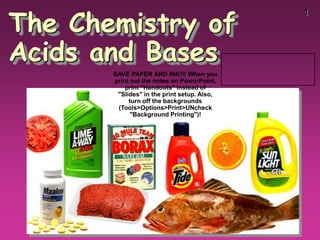
The Chemistry of
Acids and Bases
SAVE PAPER AND INK!!! When you
print out the notes on PowerPoint,
print "Handouts" instead of
"Slides" in the print setup. Also,
turn off the backgrounds
(Tools>Options>Print>UNcheck
"Background Printing")!
2
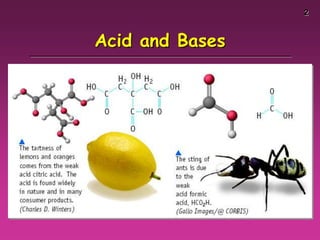
Acid and Bases
3
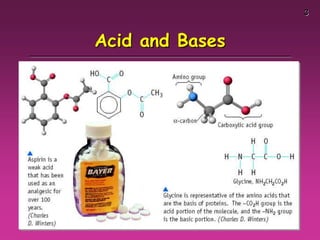
Acid and Bases
4
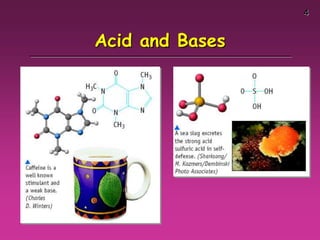
Acid and Bases
5
Acids
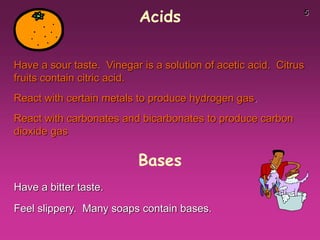
Have a sour taste. Vinegar is a solution of acetic acid. Citrus
fruits contain citric acid.
React with certain metals to produce hydrogen gas.
React with carbonates and bicarbonates to produce carbon
dioxide gas
Have a bitter taste.
Feel slippery. Many soaps contain bases.
Bases
6
Some Properties of Acids
 Produce H+ (as H3O+) ions in water (the hydronium ion is a
hydrogen ion attached to a water molecule)
 Taste sour
 Corrode metals
 Electrolytes
 React with bases to form a salt and water
 pH is less than 7
 Turns blue litmus paper to red “Blue to Red A-CID”
7
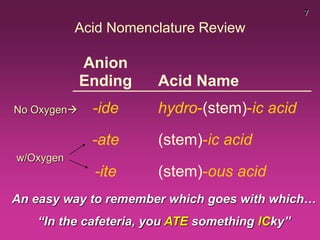
Anion
Ending Acid Name
-ide hydro-(stem)-ic acid
-ate (stem)-ic acid
-ite (stem)-ous acid
Acid Nomenclature Review
No Oxygen
w/Oxygen
An easy way to remember which goes with which…
“In the cafeteria, you ATE something ICky”
8
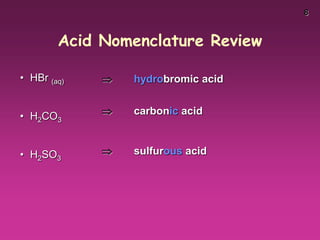
• HBr (aq)
• H2CO3
• H2SO3
 hydrobromic acid
 carbonic acid
 sulfurous acid
Acid Nomenclature Review
9
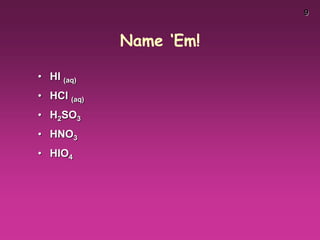
Name ‘Em!
• HI (aq)
• HCl (aq)
• H2SO3
• HNO3
• HIO4
10
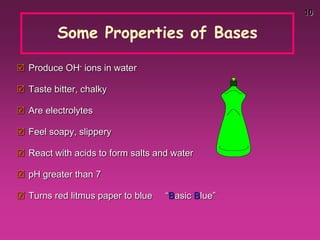
Some Properties of Bases
 Produce OH- ions in water
 Taste bitter, chalky
 Are electrolytes
 Feel soapy, slippery
 React with acids to form salts and water
 pH greater than 7
 Turns red litmus paper to blue “Basic Blue”
11
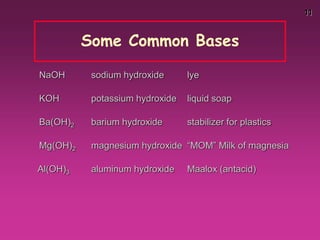
Some Common Bases
NaOH sodium hydroxide lye
KOH potassium hydroxide liquid soap
Ba(OH)2 barium hydroxide stabilizer for plastics
Mg(OH)2 magnesium hydroxide “MOM” Milk of magnesia
Al(OH)3 aluminum hydroxide Maalox (antacid)
12
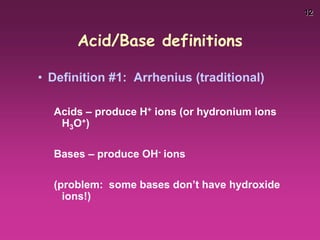
Acid/Base definitions
• Definition #1: Arrhenius (traditional)
Acids – produce H+ ions (or hydronium ions
H3O+)
Bases – produce OH- ions
(problem: some bases don’t have hydroxide
ions!)
13
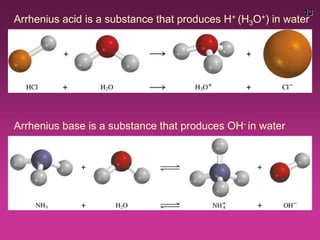
Arrhenius acid is a substance that produces H+ (H3O+) in water
Arrhenius base is a substance that produces OH- in water
14
Acid/Base Definitions
• Definition #2: Brønsted – Lowry
Acids – proton donor
Bases – proton acceptor
A “proton” is really just a hydrogen
atom that has lost it’s electron!
15
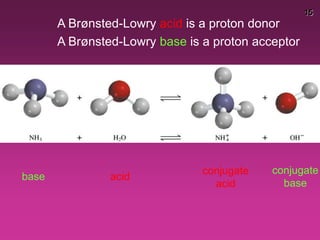
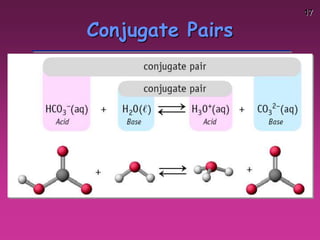
A Brønsted-Lowry acid is a proton donor
A Brønsted-Lowry base is a proton acceptor
acid
conjugate
base
base
conjugate
acid
16
ACID-BASE THEORIES
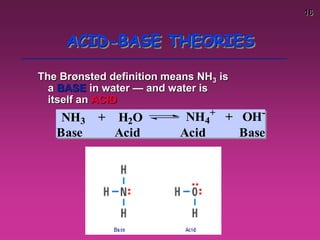
The Brønsted definition means NH3 is
a BASE in water — and water is
itself an ACID
Base
Acid
Acid
Base
NH4
+
+ OH-
NH3 + H2O
17
Conjugate Pairs
18
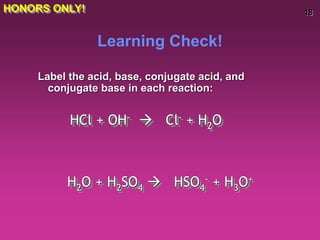
Learning Check!
Label the acid, base, conjugate acid, and
conjugate base in each reaction:
HONORS ONLY!
HCl + OH-  Cl- + H2O
H2O + H2SO4  HSO4
- + H3O+
19
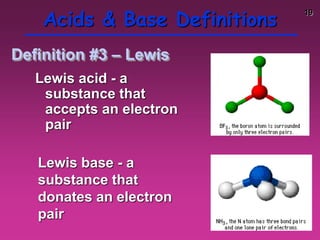
Acids & Base Definitions
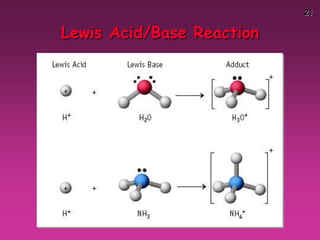
Lewis acid - a
substance that
accepts an electron
pair
Lewis base - a
substance that
donates an electron
pair
Definition #3 – Lewis
20
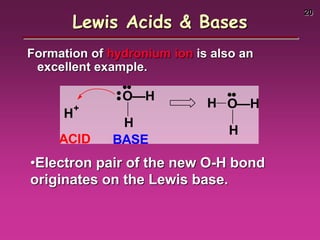
Formation of hydronium ion is also an
excellent example.
Lewis Acids & Bases
•Electron pair of the new O-H bond
originates on the Lewis base.
H
H
H
BASE
••
•
•••
O—H
O—H
H+
ACID
21
Lewis Acid/Base Reaction
22
Lewis Acid-Base Interactions
in Biology
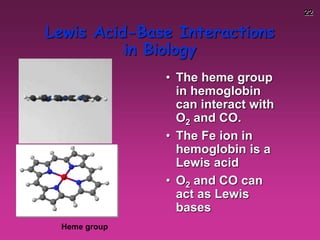
• The heme group
in hemoglobin
can interact with
O2 and CO.
• The Fe ion in
hemoglobin is a
Lewis acid
• O2 and CO can
act as Lewis
bases
Heme group
23
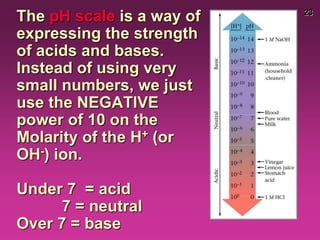
The pH scale is a way of
expressing the strength
of acids and bases.
Instead of using very
small numbers, we just
use the NEGATIVE
power of 10 on the
Molarity of the H+ (or
OH-) ion.
Under 7 = acid
7 = neutral
Over 7 = base
24
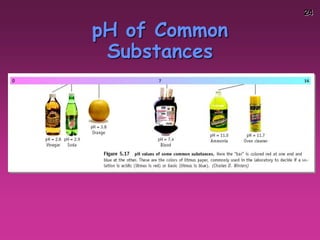
pH of Common
Substances
25
Calculating the pH
pH = - log [H+]
(Remember that the [ ] mean Molarity)
Example: If [H+] = 1 X 10⁻¹⁰
pH = - log 1 X 10⁻¹⁰
pH = - (- 10)
pH = 10
Example: If [H+] = 1.8 X 10⁻⁵
pH = - log 1.8 X 10⁻⁵
pH = - (- 4.74)
pH = 4.74
26
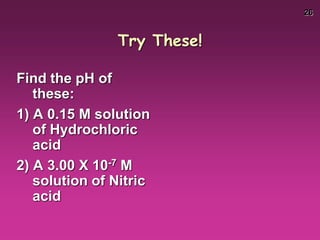
Try These!
Find the pH of
these:
1) A 0.15 M solution
of Hydrochloric
acid
2) A 3.00 X 10⁻⁷ M
solution of Nitric
acid
27
pH calculations – Solving for H+
If the pH of Coke is 3.12, [H+] = ???
Because pH = - log [H+] then
- pH = log [H+]
Take antilog (10x) of both
sides and get
10-pH = [H+]
[H+] = 10-3.12 = 7.6 x 10⁻⁴ M
*** to find antilog on your calculator, look for “Shift” or “2nd
function” and then the log button
28
pH calculations – Solving for H+
• A solution has a pH of 8.5. What is the
Molarity of hydrogen ions in the
solution?
pH = - log [H+]
8.5 = - log [H+]
-8.5 = log [H+]
Antilog -8.5 = antilog (log [H+])
10-8.5 = [H+]
3.16 X 10-9 = [H+]
29
More About Water
H2O can function as both an ACID and a BASE.
In pure water there can be AUTOIONIZATION
Equilibrium constant for water = Kw
Kw = [H3O+] [OH-] = 1.00 x 10⁻¹⁴ at 25 oC
HONORS ONLY!
30
More About Water
Kw = [H3O+] [OH-] = 1.00 x 10⁻¹⁴ at 25 oC
In a neutral solution [H3O+] = [OH-]
so Kw = [H3O+]2 = [OH-]2
and so [H3O+] = [OH-] = 1.00 x 10⁻⁷ M
OH-
H3O+
Autoionization
HONORS ONLY!
31
pOH
• Since acids and bases are
opposites, pH and pOH are
opposites!
• pOH does not really exist, but it is
useful for changing bases to pH.
• pOH looks at the perspective of a
base
pOH = - log [OH-]
Since pH and pOH are on opposite
ends,
pH + pOH = 14
32
pH [H+] [OH-] pOH
33
[H3O+], [OH-] and pH
What is the pH of the
0.0010 M NaOH solution?
[OH-] = 0.0010 (or 1.0 X 10⁻³ M)
pOH = - log 0.0010
pOH = 3
pH = 14 – 3 = 11
OR Kw = [H3O+] [OH-]
[H3O+] = 1.0 x 10⁻¹¹ M
pH = - log (1.0 x 10⁻¹¹) = 11.00
34
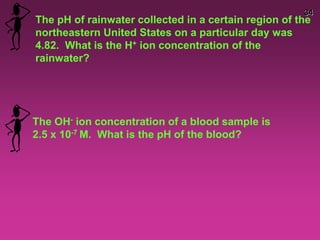
The pH of rainwater collected in a certain region of the
northeastern United States on a particular day was
4.82. What is the H+ ion concentration of the
rainwater?
The OH- ion concentration of a blood sample is
2.5 x 10⁻⁷ M. What is the pH of the blood?
35
[OH-]
[H+] pOH
pH
36
Calculating [H3O+], pH, [OH-], and pOH
Problem 1: A chemist dilutes concentrated
hydrochloric acid to make two solutions: (a) 3.0
M and (b) 0.0024 M. Calculate the [H3O+], pH,
[OH-], and pOH of the two solutions at 25°C.
Problem 2: What is the [H3O+], [OH-], and pOH
of a solution with pH = 3.67? Is this an acid,
base, or neutral?
Problem 3: Problem #2 with pH = 8.05?
37
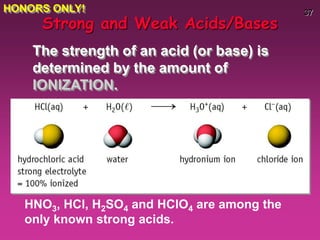
HNO3, HCl, H2SO4 and HClO4 are among the
only known strong acids.
Strong and Weak Acids/Bases
The strength of an acid (or base) is
determined by the amount of
IONIZATION.
HONORS ONLY!
38
Strong and Weak Acids/Bases
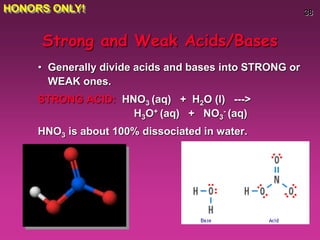
• Generally divide acids and bases into STRONG or
WEAK ones.
STRONG ACID: HNO3 (aq) + H2O (l) --->
H3O+ (aq) + NO3
- (aq)
HNO3 is about 100% dissociated in water.
HONORS ONLY!
39
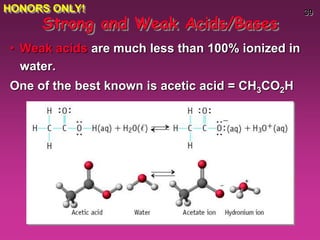
• Weak acids are much less than 100% ionized in
water.
One of the best known is acetic acid = CH3CO2H
Strong and Weak Acids/Bases
HONORS ONLY!
40
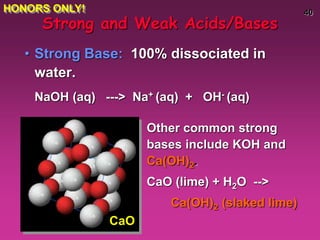
• Strong Base: 100% dissociated in
water.
NaOH (aq) ---> Na+ (aq) + OH- (aq)
Strong and Weak Acids/Bases
Other common strong
bases include KOH and
Ca(OH)2.
CaO (lime) + H2O -->
Ca(OH)2 (slaked lime)
CaO
HONORS ONLY!
41
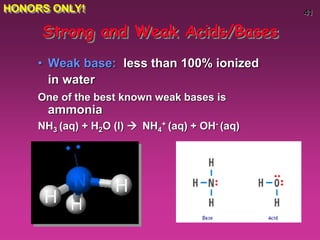
• Weak base: less than 100% ionized
in water
One of the best known weak bases is
ammonia
NH3 (aq) + H2O (l)  NH4
+ (aq) + OH- (aq)
Strong and Weak Acids/Bases
HONORS ONLY!
42
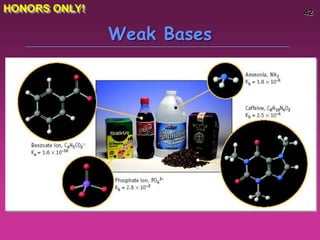
Weak Bases
HONORS ONLY!
43
Equilibria Involving
Weak Acids and Bases
Consider acetic acid, HC2H3O2 (HOAc)
HC2H3O2 + H2O  H3O+ + C2H3O2
-
Acid Conj. base
Ka 
[H3O+][OAc-]
[HOAc]
 1.8 x 10⁻⁵
(K is designated Ka for ACID)
K gives the ratio of ions (split up) to molecules
(don’t split up)
HONORS ONLY!
44
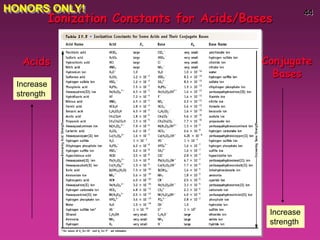
Ionization Constants for Acids/Bases
Acids Conjugate
Bases
Increase
strength
Increase
strength
HONORS ONLY!
45
Equilibrium Constants
for Weak Acids
Weak acid has Ka < 1
Leads to small [H3O+] and a pH of 2 - 7
HONORS ONLY!
46
Equilibrium Constants
for Weak Bases
Weak base has Kb < 1
Leads to small [OH-] and a pH of 12 - 7
HONORS ONLY!
47
Relation
of Ka, Kb,
[H3O+]
and pH
HONORS ONLY!
48
Equilibria Involving A Weak Acid
You have 1.00 M HOAc. Calc. the
equilibrium concs. of HOAc, H3O+, OAc-,
and the pH.
Step 1. Define equilibrium concs. in ICE
table.
[HOAc] [H3O+] [OAc-]
initial
change
equilib
1.00 0 0
-x +x +x
1.00-x x x
HONORS ONLY!
49
Equilibria Involving A Weak Acid
Step 2. Write Ka expression
You have 1.00 M HOAc. Calc. the equilibrium concs.
of HOAc, H3O+, OAc-, and the pH.
Ka  1.8 x 10-5 =
[H3O+][OAc-]
[HOAc]

x2
1.00 - x
This is a quadratic. Solve using quadratic
formula.
or you can make an approximation if x is very
small! (Rule of thumb: 10-5 or smaller is ok)
HONORS ONLY!
50
Equilibria Involving A Weak Acid
Step 3. Solve Ka expression
You have 1.00 M HOAc. Calc. the equilibrium concs.
of HOAc, H3O+, OAc-, and the pH.
Ka  1.8 x 10-5 =
[H3O+][OAc-]
[HOAc]

x2
1.00 - x
First assume x is very small because
Ka is so small.
Ka  1.8 x 10-5 =
x2
1.00
Now we can more easily solve this
approximate expression.
HONORS ONLY!
51
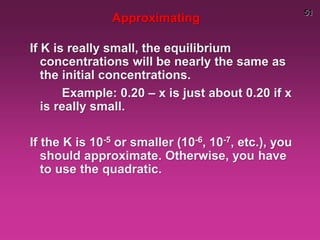
Approximating
If K is really small, the equilibrium
concentrations will be nearly the same as
the initial concentrations.
Example: 0.20 – x is just about 0.20 if x
is really small.
If the K is 10-5 or smaller (10-6, 10-7, etc.), you
should approximate. Otherwise, you have
to use the quadratic.
52
Equilibria Involving A Weak Acid
Step 3. Solve Ka approximate expression
You have 1.00 M HOAc. Calc. the equilibrium concs.
of HOAc, H3O+, OAc-, and the pH.
Ka  1.8 x 10-5 =
x2
1.00
x = [H3O+] = [OAc-] = 4.2 x 10⁻³ M
pH = - log [H3O+] = -log (4.2 x 10⁻³) = 2.37
HONORS ONLY!
53
Equilibria Involving A Weak Acid
Calculate the pH of a 0.0010 M solution of
formic acid, HCO2H.
HCO2H + H2O  HCO2
- + H3O+
Ka = 1.8 x 10⁻⁴
Approximate solution
[H3O+] = 4.2 x 10⁻⁴ M, pH = 3.37
Exact Solution
[H3O+] = [HCO2
-] = 3.4 x 10⁻⁴ M
[HCO2H] = 0.0010 - 3.4 x 10-4 = 0.0007 M
pH = 3.47
HONORS ONLY!
54
Equilibria Involving A Weak Base
You have 0.010 M NH3. Calc. the pH.
NH3 + H2O  NH4
+ + OH-
Kb = 1.8 x 10⁻⁵
Step 1. Define equilibrium concs. in ICE table
[NH3] [NH4
+] [OH-]
initial
change
equilib
0.010 0 0
-x +x +x
0.010 - x x x
HONORS ONLY!
55
Equilibria Involving A Weak Base
You have 0.010 M NH3. Calc. the pH.
NH3 + H2O  NH4
+ + OH-
Kb = 1.8 x 10⁻⁵
Step 1. Define equilibrium concs. in ICE table
[NH3] [NH4
+] [OH-]
initial
change
equilib
0.010 0 0
-x +x +x
0.010 - x x x
HONORS ONLY!
56
Equilibria Involving A Weak Base
You have 0.010 M NH3. Calc. the pH.
NH3 + H2O  NH4
+ + OH-
Kb = 1.8 x 10⁻⁵
Step 2. Solve the equilibrium expression
Kb  1.8 x 10-5 =
[NH4
+][OH-]
[NH3]
=
x2
0.010 - x
Assume x is small, so
x = [OH-] = [NH4
+] = 4.2 x 10⁻⁴ M
and [NH3] = 0.010 - 4.2 x 10⁻⁴ ≈ 0.010 M
The approximation is valid !
HONORS ONLY!
57
Equilibria Involving A Weak Base
You have 0.010 M NH3. Calc. the pH.
NH3 + H2O  NH4
+ + OH-
Kb = 1.8 x 10⁻⁵
Step 3. Calculate pH
[OH-] = 4.2 x 10⁻⁴ M
so pOH = - log [OH-] = 3.37
Because pH + pOH = 14,
pH = 10.63
HONORS ONLY!
58
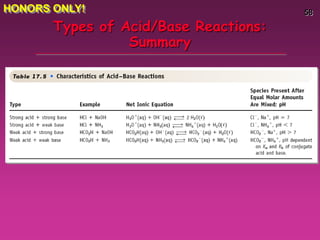
Types of Acid/Base Reactions:
Summary
HONORS ONLY!
59
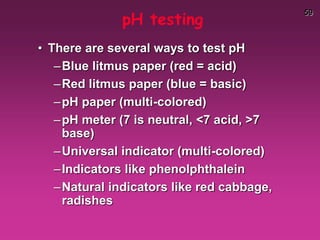
pH testing
• There are several ways to test pH
–Blue litmus paper (red = acid)
–Red litmus paper (blue = basic)
–pH paper (multi-colored)
–pH meter (7 is neutral, <7 acid, >7
base)
–Universal indicator (multi-colored)
–Indicators like phenolphthalein
–Natural indicators like red cabbage,
radishes
60
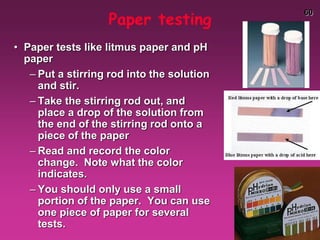
Paper testing
• Paper tests like litmus paper and pH
paper
– Put a stirring rod into the solution
and stir.
– Take the stirring rod out, and
place a drop of the solution from
the end of the stirring rod onto a
piece of the paper
– Read and record the color
change. Note what the color
indicates.
– You should only use a small
portion of the paper. You can use
one piece of paper for several
tests.
61
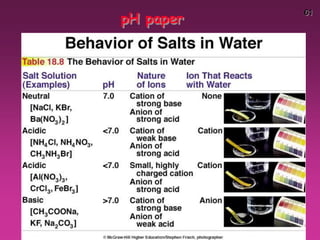
pH paper
62
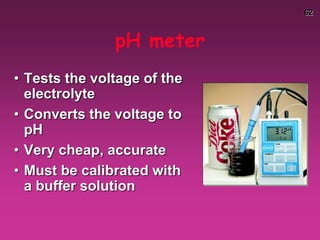
pH meter
• Tests the voltage of the
electrolyte
• Converts the voltage to
pH
• Very cheap, accurate
• Must be calibrated with
a buffer solution
63
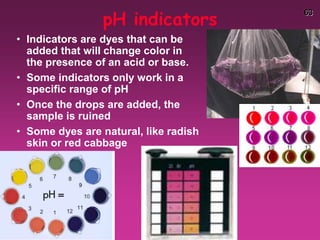
pH indicators
• Indicators are dyes that can be
added that will change color in
the presence of an acid or base.
• Some indicators only work in a
specific range of pH
• Once the drops are added, the
sample is ruined
• Some dyes are natural, like radish
skin or red cabbage
64
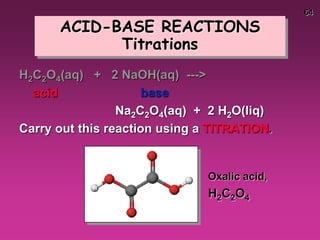
ACID-BASE REACTIONS
Titrations
H2C2O4(aq) + 2 NaOH(aq) --->
acid base
Na2C2O4(aq) + 2 H2O(liq)
Carry out this reaction using a TITRATION.
Oxalic acid,
H2C2O4
65
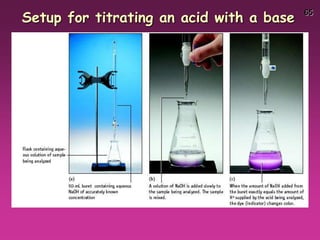
Setup for titrating an acid with a base
66
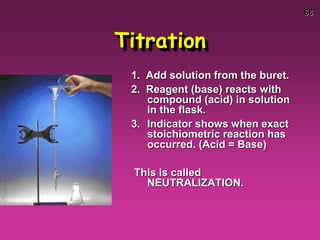
Titration
1. Add solution from the buret.
2. Reagent (base) reacts with
compound (acid) in solution
in the flask.
3. Indicator shows when exact
stoichiometric reaction has
occurred. (Acid = Base)
This is called
NEUTRALIZATION.
67
35.62 mL of NaOH is
neutralized with 25.2 mL of
0.0998 M HCl by titration to
an equivalence point. What
is the concentration of the
NaOH?
LAB PROBLEM #1: Standardize a
solution of NaOH — i.e., accurately
determine its concentration.
68
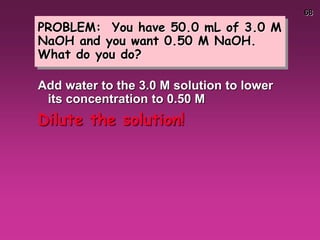
PROBLEM: You have 50.0 mL of 3.0 M
NaOH and you want 0.50 M NaOH.
What do you do?
Add water to the 3.0 M solution to lower
its concentration to 0.50 M
Dilute the solution!
69
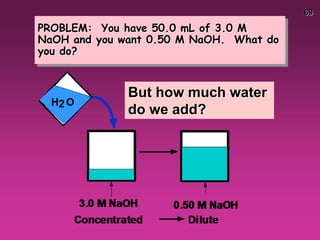
PROBLEM: You have 50.0 mL of 3.0 M
NaOH and you want 0.50 M NaOH. What do
you do?
But how much water
do we add?
70
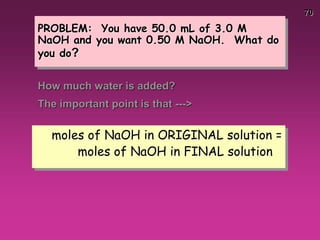
PROBLEM: You have 50.0 mL of 3.0 M
NaOH and you want 0.50 M NaOH. What do
you do?
How much water is added?
The important point is that --->
moles of NaOH in ORIGINAL solution =
moles of NaOH in FINAL solution
71
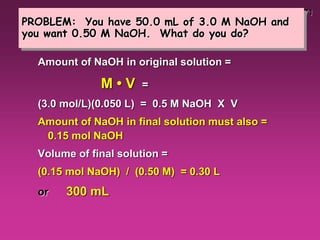
PROBLEM: You have 50.0 mL of 3.0 M NaOH and
you want 0.50 M NaOH. What do you do?
Amount of NaOH in original solution =
M • V =
(3.0 mol/L)(0.050 L) = 0.5 M NaOH X V
Amount of NaOH in final solution must also =
0.15 mol NaOH
Volume of final solution =
(0.15 mol NaOH) / (0.50 M) = 0.30 L
or 300 mL
72
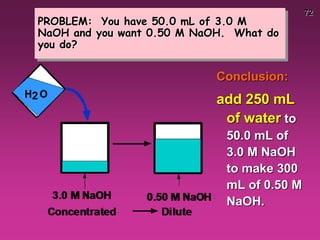
PROBLEM: You have 50.0 mL of 3.0 M
NaOH and you want 0.50 M NaOH. What do
you do?
Conclusion:
add 250 mL
of water to
50.0 mL of
3.0 M NaOH
to make 300
mL of 0.50 M
NaOH.
73
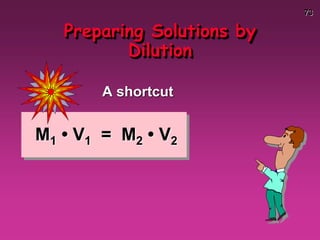
A shortcut
M1 • V1 = M2 • V2
Preparing Solutions by
Dilution
74
You try this dilution problem
• You have a stock bottle of hydrochloric acid,
which is 12.1 M. You need 400. mL of 0.10 M
HCl. How much of the acid and how much
water will you need?

Acids-Bases-pH-PPT-2018.ppt.organic-chemistry

  • 1.
    1 The Chemistry of Acidsand Bases SAVE PAPER AND INK!!! When you print out the notes on PowerPoint, print "Handouts" instead of "Slides" in the print setup. Also, turn off the backgrounds (Tools>Options>Print>UNcheck "Background Printing")!
  • 2.
  • 3.
  • 4.
  • 5.
    5 Acids Have a sourtaste. Vinegar is a solution of acetic acid. Citrus fruits contain citric acid. React with certain metals to produce hydrogen gas. React with carbonates and bicarbonates to produce carbon dioxide gas Have a bitter taste. Feel slippery. Many soaps contain bases. Bases
  • 6.
    6 Some Properties ofAcids  Produce H+ (as H3O+) ions in water (the hydronium ion is a hydrogen ion attached to a water molecule)  Taste sour  Corrode metals  Electrolytes  React with bases to form a salt and water  pH is less than 7  Turns blue litmus paper to red “Blue to Red A-CID”
  • 7.
    7 Anion Ending Acid Name -idehydro-(stem)-ic acid -ate (stem)-ic acid -ite (stem)-ous acid Acid Nomenclature Review No Oxygen w/Oxygen An easy way to remember which goes with which… “In the cafeteria, you ATE something ICky”
  • 8.
    8 • HBr (aq) •H2CO3 • H2SO3  hydrobromic acid  carbonic acid  sulfurous acid Acid Nomenclature Review
  • 9.
    9 Name ‘Em! • HI(aq) • HCl (aq) • H2SO3 • HNO3 • HIO4
  • 10.
    10 Some Properties ofBases  Produce OH- ions in water  Taste bitter, chalky  Are electrolytes  Feel soapy, slippery  React with acids to form salts and water  pH greater than 7  Turns red litmus paper to blue “Basic Blue”
  • 11.
    11 Some Common Bases NaOHsodium hydroxide lye KOH potassium hydroxide liquid soap Ba(OH)2 barium hydroxide stabilizer for plastics Mg(OH)2 magnesium hydroxide “MOM” Milk of magnesia Al(OH)3 aluminum hydroxide Maalox (antacid)
  • 12.
    12 Acid/Base definitions • Definition#1: Arrhenius (traditional) Acids – produce H+ ions (or hydronium ions H3O+) Bases – produce OH- ions (problem: some bases don’t have hydroxide ions!)
  • 13.
    13 Arrhenius acid isa substance that produces H+ (H3O+) in water Arrhenius base is a substance that produces OH- in water
  • 14.
    14 Acid/Base Definitions • Definition#2: Brønsted – Lowry Acids – proton donor Bases – proton acceptor A “proton” is really just a hydrogen atom that has lost it’s electron!
  • 15.
    15 A Brønsted-Lowry acidis a proton donor A Brønsted-Lowry base is a proton acceptor acid conjugate base base conjugate acid
  • 16.
    16 ACID-BASE THEORIES The Brønsteddefinition means NH3 is a BASE in water — and water is itself an ACID Base Acid Acid Base NH4 + + OH- NH3 + H2O
  • 17.
  • 18.
    18 Learning Check! Label theacid, base, conjugate acid, and conjugate base in each reaction: HONORS ONLY! HCl + OH-  Cl- + H2O H2O + H2SO4  HSO4 - + H3O+
  • 19.
    19 Acids & BaseDefinitions Lewis acid - a substance that accepts an electron pair Lewis base - a substance that donates an electron pair Definition #3 – Lewis
  • 20.
    20 Formation of hydroniumion is also an excellent example. Lewis Acids & Bases •Electron pair of the new O-H bond originates on the Lewis base. H H H BASE •• • ••• O—H O—H H+ ACID
  • 21.
  • 22.
    22 Lewis Acid-Base Interactions inBiology • The heme group in hemoglobin can interact with O2 and CO. • The Fe ion in hemoglobin is a Lewis acid • O2 and CO can act as Lewis bases Heme group
  • 23.
    23 The pH scaleis a way of expressing the strength of acids and bases. Instead of using very small numbers, we just use the NEGATIVE power of 10 on the Molarity of the H+ (or OH-) ion. Under 7 = acid 7 = neutral Over 7 = base
  • 24.
  • 25.
    25 Calculating the pH pH= - log [H+] (Remember that the [ ] mean Molarity) Example: If [H+] = 1 X 10⁻¹⁰ pH = - log 1 X 10⁻¹⁰ pH = - (- 10) pH = 10 Example: If [H+] = 1.8 X 10⁻⁵ pH = - log 1.8 X 10⁻⁵ pH = - (- 4.74) pH = 4.74
  • 26.
    26 Try These! Find thepH of these: 1) A 0.15 M solution of Hydrochloric acid 2) A 3.00 X 10⁻⁷ M solution of Nitric acid
  • 27.
    27 pH calculations –Solving for H+ If the pH of Coke is 3.12, [H+] = ??? Because pH = - log [H+] then - pH = log [H+] Take antilog (10x) of both sides and get 10-pH = [H+] [H+] = 10-3.12 = 7.6 x 10⁻⁴ M *** to find antilog on your calculator, look for “Shift” or “2nd function” and then the log button
  • 28.
    28 pH calculations –Solving for H+ • A solution has a pH of 8.5. What is the Molarity of hydrogen ions in the solution? pH = - log [H+] 8.5 = - log [H+] -8.5 = log [H+] Antilog -8.5 = antilog (log [H+]) 10-8.5 = [H+] 3.16 X 10-9 = [H+]
  • 29.
    29 More About Water H2Ocan function as both an ACID and a BASE. In pure water there can be AUTOIONIZATION Equilibrium constant for water = Kw Kw = [H3O+] [OH-] = 1.00 x 10⁻¹⁴ at 25 oC HONORS ONLY!
  • 30.
    30 More About Water Kw= [H3O+] [OH-] = 1.00 x 10⁻¹⁴ at 25 oC In a neutral solution [H3O+] = [OH-] so Kw = [H3O+]2 = [OH-]2 and so [H3O+] = [OH-] = 1.00 x 10⁻⁷ M OH- H3O+ Autoionization HONORS ONLY!
  • 31.
    31 pOH • Since acidsand bases are opposites, pH and pOH are opposites! • pOH does not really exist, but it is useful for changing bases to pH. • pOH looks at the perspective of a base pOH = - log [OH-] Since pH and pOH are on opposite ends, pH + pOH = 14
  • 32.
  • 33.
    33 [H3O+], [OH-] andpH What is the pH of the 0.0010 M NaOH solution? [OH-] = 0.0010 (or 1.0 X 10⁻³ M) pOH = - log 0.0010 pOH = 3 pH = 14 – 3 = 11 OR Kw = [H3O+] [OH-] [H3O+] = 1.0 x 10⁻¹¹ M pH = - log (1.0 x 10⁻¹¹) = 11.00
  • 34.
    34 The pH ofrainwater collected in a certain region of the northeastern United States on a particular day was 4.82. What is the H+ ion concentration of the rainwater? The OH- ion concentration of a blood sample is 2.5 x 10⁻⁷ M. What is the pH of the blood?
  • 35.
  • 36.
    36 Calculating [H3O+], pH,[OH-], and pOH Problem 1: A chemist dilutes concentrated hydrochloric acid to make two solutions: (a) 3.0 M and (b) 0.0024 M. Calculate the [H3O+], pH, [OH-], and pOH of the two solutions at 25°C. Problem 2: What is the [H3O+], [OH-], and pOH of a solution with pH = 3.67? Is this an acid, base, or neutral? Problem 3: Problem #2 with pH = 8.05?
  • 37.
    37 HNO3, HCl, H2SO4and HClO4 are among the only known strong acids. Strong and Weak Acids/Bases The strength of an acid (or base) is determined by the amount of IONIZATION. HONORS ONLY!
  • 38.
    38 Strong and WeakAcids/Bases • Generally divide acids and bases into STRONG or WEAK ones. STRONG ACID: HNO3 (aq) + H2O (l) ---> H3O+ (aq) + NO3 - (aq) HNO3 is about 100% dissociated in water. HONORS ONLY!
  • 39.
    39 • Weak acidsare much less than 100% ionized in water. One of the best known is acetic acid = CH3CO2H Strong and Weak Acids/Bases HONORS ONLY!
  • 40.
    40 • Strong Base:100% dissociated in water. NaOH (aq) ---> Na+ (aq) + OH- (aq) Strong and Weak Acids/Bases Other common strong bases include KOH and Ca(OH)2. CaO (lime) + H2O --> Ca(OH)2 (slaked lime) CaO HONORS ONLY!
  • 41.
    41 • Weak base:less than 100% ionized in water One of the best known weak bases is ammonia NH3 (aq) + H2O (l)  NH4 + (aq) + OH- (aq) Strong and Weak Acids/Bases HONORS ONLY!
  • 42.
  • 43.
    43 Equilibria Involving Weak Acidsand Bases Consider acetic acid, HC2H3O2 (HOAc) HC2H3O2 + H2O  H3O+ + C2H3O2 - Acid Conj. base Ka  [H3O+][OAc-] [HOAc]  1.8 x 10⁻⁵ (K is designated Ka for ACID) K gives the ratio of ions (split up) to molecules (don’t split up) HONORS ONLY!
  • 44.
    44 Ionization Constants forAcids/Bases Acids Conjugate Bases Increase strength Increase strength HONORS ONLY!
  • 45.
    45 Equilibrium Constants for WeakAcids Weak acid has Ka < 1 Leads to small [H3O+] and a pH of 2 - 7 HONORS ONLY!
  • 46.
    46 Equilibrium Constants for WeakBases Weak base has Kb < 1 Leads to small [OH-] and a pH of 12 - 7 HONORS ONLY!
  • 47.
  • 48.
    48 Equilibria Involving AWeak Acid You have 1.00 M HOAc. Calc. the equilibrium concs. of HOAc, H3O+, OAc-, and the pH. Step 1. Define equilibrium concs. in ICE table. [HOAc] [H3O+] [OAc-] initial change equilib 1.00 0 0 -x +x +x 1.00-x x x HONORS ONLY!
  • 49.
    49 Equilibria Involving AWeak Acid Step 2. Write Ka expression You have 1.00 M HOAc. Calc. the equilibrium concs. of HOAc, H3O+, OAc-, and the pH. Ka  1.8 x 10-5 = [H3O+][OAc-] [HOAc]  x2 1.00 - x This is a quadratic. Solve using quadratic formula. or you can make an approximation if x is very small! (Rule of thumb: 10-5 or smaller is ok) HONORS ONLY!
  • 50.
    50 Equilibria Involving AWeak Acid Step 3. Solve Ka expression You have 1.00 M HOAc. Calc. the equilibrium concs. of HOAc, H3O+, OAc-, and the pH. Ka  1.8 x 10-5 = [H3O+][OAc-] [HOAc]  x2 1.00 - x First assume x is very small because Ka is so small. Ka  1.8 x 10-5 = x2 1.00 Now we can more easily solve this approximate expression. HONORS ONLY!
  • 51.
    51 Approximating If K isreally small, the equilibrium concentrations will be nearly the same as the initial concentrations. Example: 0.20 – x is just about 0.20 if x is really small. If the K is 10-5 or smaller (10-6, 10-7, etc.), you should approximate. Otherwise, you have to use the quadratic.
  • 52.
    52 Equilibria Involving AWeak Acid Step 3. Solve Ka approximate expression You have 1.00 M HOAc. Calc. the equilibrium concs. of HOAc, H3O+, OAc-, and the pH. Ka  1.8 x 10-5 = x2 1.00 x = [H3O+] = [OAc-] = 4.2 x 10⁻³ M pH = - log [H3O+] = -log (4.2 x 10⁻³) = 2.37 HONORS ONLY!
  • 53.
    53 Equilibria Involving AWeak Acid Calculate the pH of a 0.0010 M solution of formic acid, HCO2H. HCO2H + H2O  HCO2 - + H3O+ Ka = 1.8 x 10⁻⁴ Approximate solution [H3O+] = 4.2 x 10⁻⁴ M, pH = 3.37 Exact Solution [H3O+] = [HCO2 -] = 3.4 x 10⁻⁴ M [HCO2H] = 0.0010 - 3.4 x 10-4 = 0.0007 M pH = 3.47 HONORS ONLY!
  • 54.
    54 Equilibria Involving AWeak Base You have 0.010 M NH3. Calc. the pH. NH3 + H2O  NH4 + + OH- Kb = 1.8 x 10⁻⁵ Step 1. Define equilibrium concs. in ICE table [NH3] [NH4 +] [OH-] initial change equilib 0.010 0 0 -x +x +x 0.010 - x x x HONORS ONLY!
  • 55.
    55 Equilibria Involving AWeak Base You have 0.010 M NH3. Calc. the pH. NH3 + H2O  NH4 + + OH- Kb = 1.8 x 10⁻⁵ Step 1. Define equilibrium concs. in ICE table [NH3] [NH4 +] [OH-] initial change equilib 0.010 0 0 -x +x +x 0.010 - x x x HONORS ONLY!
  • 56.
    56 Equilibria Involving AWeak Base You have 0.010 M NH3. Calc. the pH. NH3 + H2O  NH4 + + OH- Kb = 1.8 x 10⁻⁵ Step 2. Solve the equilibrium expression Kb  1.8 x 10-5 = [NH4 +][OH-] [NH3] = x2 0.010 - x Assume x is small, so x = [OH-] = [NH4 +] = 4.2 x 10⁻⁴ M and [NH3] = 0.010 - 4.2 x 10⁻⁴ ≈ 0.010 M The approximation is valid ! HONORS ONLY!
  • 57.
    57 Equilibria Involving AWeak Base You have 0.010 M NH3. Calc. the pH. NH3 + H2O  NH4 + + OH- Kb = 1.8 x 10⁻⁵ Step 3. Calculate pH [OH-] = 4.2 x 10⁻⁴ M so pOH = - log [OH-] = 3.37 Because pH + pOH = 14, pH = 10.63 HONORS ONLY!
  • 58.
    58 Types of Acid/BaseReactions: Summary HONORS ONLY!
  • 59.
    59 pH testing • Thereare several ways to test pH –Blue litmus paper (red = acid) –Red litmus paper (blue = basic) –pH paper (multi-colored) –pH meter (7 is neutral, <7 acid, >7 base) –Universal indicator (multi-colored) –Indicators like phenolphthalein –Natural indicators like red cabbage, radishes
  • 60.
    60 Paper testing • Papertests like litmus paper and pH paper – Put a stirring rod into the solution and stir. – Take the stirring rod out, and place a drop of the solution from the end of the stirring rod onto a piece of the paper – Read and record the color change. Note what the color indicates. – You should only use a small portion of the paper. You can use one piece of paper for several tests.
  • 61.
  • 62.
    62 pH meter • Teststhe voltage of the electrolyte • Converts the voltage to pH • Very cheap, accurate • Must be calibrated with a buffer solution
  • 63.
    63 pH indicators • Indicatorsare dyes that can be added that will change color in the presence of an acid or base. • Some indicators only work in a specific range of pH • Once the drops are added, the sample is ruined • Some dyes are natural, like radish skin or red cabbage
  • 64.
    64 ACID-BASE REACTIONS Titrations H2C2O4(aq) +2 NaOH(aq) ---> acid base Na2C2O4(aq) + 2 H2O(liq) Carry out this reaction using a TITRATION. Oxalic acid, H2C2O4
  • 65.
    65 Setup for titratingan acid with a base
  • 66.
    66 Titration 1. Add solutionfrom the buret. 2. Reagent (base) reacts with compound (acid) in solution in the flask. 3. Indicator shows when exact stoichiometric reaction has occurred. (Acid = Base) This is called NEUTRALIZATION.
  • 67.
    67 35.62 mL ofNaOH is neutralized with 25.2 mL of 0.0998 M HCl by titration to an equivalence point. What is the concentration of the NaOH? LAB PROBLEM #1: Standardize a solution of NaOH — i.e., accurately determine its concentration.
  • 68.
    68 PROBLEM: You have50.0 mL of 3.0 M NaOH and you want 0.50 M NaOH. What do you do? Add water to the 3.0 M solution to lower its concentration to 0.50 M Dilute the solution!
  • 69.
    69 PROBLEM: You have50.0 mL of 3.0 M NaOH and you want 0.50 M NaOH. What do you do? But how much water do we add?
  • 70.
    70 PROBLEM: You have50.0 mL of 3.0 M NaOH and you want 0.50 M NaOH. What do you do? How much water is added? The important point is that ---> moles of NaOH in ORIGINAL solution = moles of NaOH in FINAL solution
  • 71.
    71 PROBLEM: You have50.0 mL of 3.0 M NaOH and you want 0.50 M NaOH. What do you do? Amount of NaOH in original solution = M • V = (3.0 mol/L)(0.050 L) = 0.5 M NaOH X V Amount of NaOH in final solution must also = 0.15 mol NaOH Volume of final solution = (0.15 mol NaOH) / (0.50 M) = 0.30 L or 300 mL
  • 72.
    72 PROBLEM: You have50.0 mL of 3.0 M NaOH and you want 0.50 M NaOH. What do you do? Conclusion: add 250 mL of water to 50.0 mL of 3.0 M NaOH to make 300 mL of 0.50 M NaOH.
  • 73.
    73 A shortcut M1 •V1 = M2 • V2 Preparing Solutions by Dilution
  • 74.
    74 You try thisdilution problem • You have a stock bottle of hydrochloric acid, which is 12.1 M. You need 400. mL of 0.10 M HCl. How much of the acid and how much water will you need?