MRS.JAYA.R
BSC (N)
NURSING TUTOR
FON DEPARTMENT
GANGA COLLEGE OF NURSING
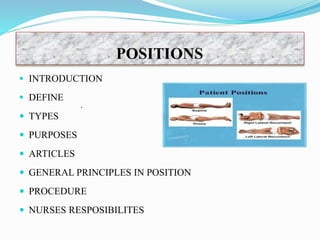
POSITIONS
 INTRODUCTION
 DEFINE
 TYPES
 PURPOSES
 ARTICLES
 GENERAL PRINCIPLES IN POSITION
 PROCEDURE
 NURSES RESPOSIBILITES
.
INTRODUCTION
 One of the basic procedures that nursing personnel
perform most frequently is that of changing in the
patients position
Any position and even the most comfortable positions
unbearable after the long time.
DEFINITION
 POSITION is defined as planning the person in a proper body alignment for
the purpose of preventive ,curative, rehabilitative, aspect of health or
placing the patient in good body alignment
TYPES
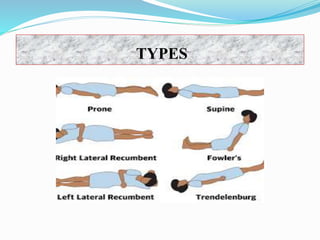
TYPES
 PRONE POSITION
 LATREL
 SUPINE POSITION
 LITHOTOMY POSITION
 FOWLER`S POSITION
 SIMS POSITION
 TREDLENBERG POSITION
 KNEE CHEST POSITION
 ORTHOPNEIC POSITION /CARDIAC POSITION
 DORSAL RECUMBENT POSITION
 To promote comfort
 To relive pressure
 To prevent bed sores
 To promote blood circulation
 To maintain body proper. alignment
PRINCIPLES:
 Maintain good body mechanics
 Hand washing
 Ensure Patient`s comfort
 Obtain assistance as required
 Ensure that mattress is firm and level of bed is at working level
 Follow safety measures and prevent accidents
 Follow the systematic and orderly way of doing
 Use right technique at right time
ARTICLES REQUIRED FOR
POSITIONING
 Clean try/firm bed,
 Different type of mattresses,
 Bed boards ,
 Pillows,
 Foot board,
 Sand bag,
 Hand rolls,
 Trochanter rolls,
 Bed blocks,
 Over bed table /cardiac table,
 Additional sheets,
 Trapeze bar,
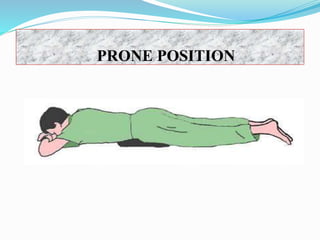
PRONE POSITION
PRONE POSITION
 In prone position, the patient lies on the abdomen with head turned to one
side; the hips are not flexed.
 This is the only bed position that allows full extension of the hip and knee
joints.
 Prone position also promotes drainage from the mouth and useful for clients
who are unconscious or those recover from surgery of the mouth or throat.
PRONE POSITION
Indication:
 For patient with pressure sore,burns,injuries and operations on the back,
 After 24 hours of amputation of lower limps,
Contraindication:
 Hip replacement ,
 Orthopedic surgery,
POSITIONING PROCEDURE
PRONE POSITION:
 After providing explanation about the procedure. Roll patient over, with
arm positioning close to the body with elbows straight, and hands under
hips.
 Position the patient on abdomen in center of bed with bed flat
 Turn patient’s head to one side and support with a small pillow
 Place small pillow under abdomen below the diaphragm
 Support arm in flexed position a level of shoulder.
 Support lower leg with pillow to elevate toes.
LATERAL/SEMI PRONE POSITION
 In lateral or side-lying position, the patient lies on one side of the body with
the top leg in front of the bottom leg and the hip and knee flexed.
 Flexing the top hip and knee and placing this leg in front of the body creates
a wider, triangular base of support and achieves greater stability.
LATERAL/SEMI PRONE POSITION
 INDICATION
 A patient may be positioned in Lateral position during back, colorectal,
kidney, and hip surgeries. For giving enema,
 Checking rectal temperature,
 Rectal examination,
 It's also commonly used during thoracic and ENT surgeries, and
neurosurgery,
POSITIONING PROCEDURE
LATRAL/SIDE LYING POSITION
 Explain the procedure to the client
 Lower head of bed as low as patient can tolerate
 Position patient to side of bed
 Turn patient to one side
 Place pillow under patient’s head and neck
 Bring shoulder blade forward
 Place tuck-back pillow under back
 Position both arms in flexed position. Upper most arm is supported by
pillow on level with shoulder.
 Place pillow under semi flexed upper leg level at hip, from groin to foot.
 place sand bag parallel to plantar surface of dependant foot.
SUPINE POSITION:
SUPINE POSITION
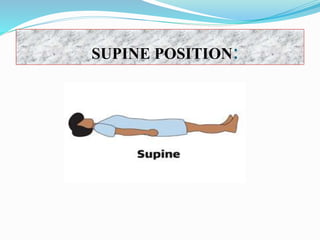
 Supine position, also known as Dorsal Decubitus, is the most frequently
used position for procedures
 In this position, the patient is face-up. The patient's arms should be tucked
at the patient's sides with a bed sheet secured with arm guards to sleds.
 The arms may be flexed and secured across the body or extended and
secured on padded arm boards.
SUPINE POSITION
 Supine or Dorsal position
 Supine is a back-lying position similar to dorsal recumbent but the head and
shoulders are not elevated.
 Just like dorsal recumbent, supine position provides comfort in general for
patients recover after some types of surgery.
 INDICATION:
 During physical examination,
 Checking vital signs,
 CONTRAINDICATION:
 Spinal surgery,
 Spinal cord fracture ,
POSITIONING PROCEDURE
 SUPINE /DORSAL RECUMBENT /BACK LYING POSITION:
 Place patient on back with head of the bed flat
 Place a small rolled towel under the lumbar area of the back
 Place pillow under the head, neck ,and upper shoulder
 Place trochanter rolls/sand bags parallel to lateral surface of thighs
 Place small pillow /roll under ankle to elevate heels
 Place foot board under pronated arm maintaining upper arm parallel to
body
 If patient is paralyzed place hand rolls in hand.
LITHOTOMY POSITION
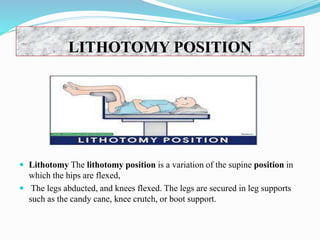
 Lithotomy The lithotomy position is a variation of the supine position in
which the hips are flexed,
 The legs abducted, and knees flexed. The legs are secured in leg supports
such as the candy cane, knee crutch, or boot support.
LITHOTOMY POSITION
 In Lithotomy position, the patient can be placed in either a boot-style leg
holder or stirrup-style position. Modifications to this position include low,
standard, high, exaggerated or hemi.
• This position is typically used for gynecology, colorectal, urology, perineal
or pelvis procedures.
INDICATION:
For delivery and vaginal examination.
For rectal surgeries,(e.g.) Hemorrhoidectomy
For vaginal hysterectomy.
CONTRAINDICATION:
Hip fracture.
Osteoporosis patient’s
POSITIONING PROCEDURE
 LITHOTOMY POSITION :
 Place patient in supine position
 Place pillow under head and neck
 Place both legs flexed at hip and knee, at 90 degree with legs
supported on stirrups
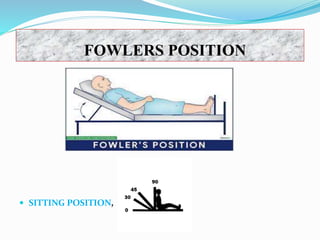
FOWLERS POSITION
 SITTING POSITION,
FOWLER’POSITION
 Fowler’s position, is a bed position wherein the head and trunk are raised 40
to 90 degrees.
 Fowler’s position is used for people who have difficulty breathing because
in this position, gravity pulls the diaphragm downward allowing greater
chest and lung expansion.
 In low Fowler’s or semi-Fowler’s position, the head and trunk are raised to
15 to 45 degrees; in high Fowler’s, the head and trunk are raised 90 degrees.
PURPOSES/INDICATION
 To relieve or minimize dyspnea,
 To relieve tension on abdominal sutures,
 Cardiac, respiratory, or neurological problems,
 Patients who have nasogastric tube in place,.
CONTRAINDICATION
 After spinal anesthesia,
 After brain surgeries,
 Increased intracranial pressure,
FOWLERS POSITION
POSITIONING PROCEDURE
• FOWLER’S POSITION:
 Explain the procedure to the client
 Elevate head of the bed( fowlers 45to 90 degree)semi fowlers(15to45
degree)high fowlers(90 degree)
 Rest head against mattress or small pillow
 Place a small pillow at lower back
 Place a small pillow under ankle/under thigh
 Place a foot board at bottom of patient’s feet
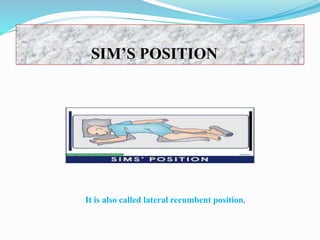
SIM’S POSITION
It is also called lateral recumbent position.
 Sims’ is a semi-prone position where the patient assumes a posture halfway
between the lateral and prone positions. The lower arm is positioned behind
the client, and the upper arm is flexed at the shoulder and the elbow. Both
legs are flexed in front of the client. The upper leg is more acutely flexed at
both the hip and the knee, than is the lower one.
 Sims’ may be used for unconscious clients because it facilitates drainage
from the mouth and prevents aspiration of fluids.
SIM’S POSITION
SIM’S POSITION
 It is also used for paralyzed clients because it reduces pressure over the sacrum
and greater trochanter of the hip.
 It is often used for clients receiving enemas and occasionally for clients
undergoing examinations or treatments of the perineal area.
 Pregnant women may find the Sims position comfortable for sleeping. Sims’
may be used for unconscious clients because it facilitates drainage from the
mouth and prevents aspiration of fluids
 Support proper body alignment in Sims’s position by placing a pillow
underneath the patient’s head and under the upper arm to prevent internal
rotation. Place another pillow between legs.
POSITIONING PROCEDURE
 SIM’S POSITION :
 Provide explanation and prepare patient for the position
 Place head of bed flat /Place patient in supine position ,turn patient in
onto lateral position lying partially on the abdomen
 Place small pillow under head and neck
 Place pillow under flexed upper supporting arm level with shoulder.
 Place pillow under flexed upper leg, supporting leg level with hip
 Place sand bags parallel to planter surface of dependant foot
TRENDELENBURG’S POSITION
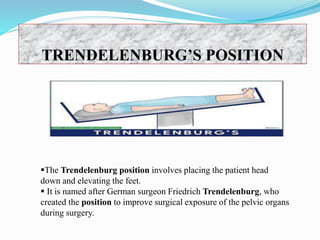
The Trendelenburg position involves placing the patient head
down and elevating the feet.
 It is named after German surgeon Friedrich Trendelenburg, who
created the position to improve surgical exposure of the pelvic organs
during surgery.
 Trendelenburg’s
 Trendelenburg’s position involves lowering the head of the bed and raising
the foot of the bed of the patient.
 Patients who have hypotension can benefit from this position because it
promotes venous return.
 Reverse Trendelenburg
 Reverse Trendelenburg is the opposite of Trendelenburg’s position.
 Here the HOB is elevated with the foot of bed down.
 This is often a position of choice for patients with gastrointestinal problems
as it can help minimize esophageal reflux.
TRENDELENBURG’S POSITION
INDICATION:
 The Trendelenburg position is used in surgery, especially of the abdomen
and genitourinary system.
 It allows better access to the pelvic organs as gravity pulls the intra-
abdominal organs away from the pelvis.
CONTRAINDICATION:
 Patient with an intracranial pressure (ICP) greater than 20 mm Hg or in
whom increased intracranial pressure should be avoided.
 Uncontrolled hypertension.
POSITIONING PROCEDURE
 TRENDLENBURG POSITION :
 Explain the procedure to patient.
 Place patient in supine position.
 Lower head end of the bed using bed key .if he is not adjustable type,
use bed blocke at foot end and tilt entire frame of bed down.
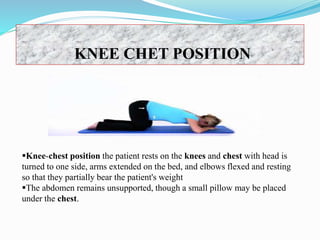
KNEE CHET POSITION
Knee-chest position the patient rests on the knees and chest with head is
turned to one side, arms extended on the bed, and elbows flexed and resting
so that they partially bear the patient's weight
The abdomen remains unsupported, though a small pillow may be placed
under the chest.
KNEE CHET POSITION
INDICATION:
 Indications include recurrent vulvar infection,
 presence of a foreign body or neoplasm, abnormal bleeding, and congenital
anomaly.
 The knee‐chest position is generally favored for vaginoscopy.
CONTRAINDICATION:
 Increased ICP
 Rib fracture/recent spinal surgeries./thoracic surgeries.
 Head injury.
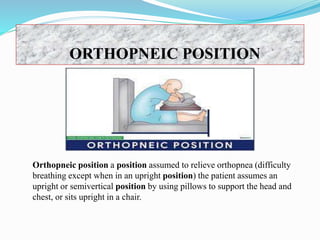
ORTHOPNEIC POSITION
Orthopneic position a position assumed to relieve orthopnea (difficulty
breathing except when in an upright position) the patient assumes an
upright or semivertical position by using pillows to support the head and
chest, or sits upright in a chair.
ORTHOPNEIC POSITION
 Orthopneic or Tripod
 Orthopneic or tripod position places the patients in a sitting position or on the
side of the bed with an over bed table in front to lean on and several pillows on
the table to rest on.
 Patients who are having difficulty breathing are often placed in this position
since it allows maximum expansion of the chest.
INDICATION:
Respiratory problem patient
Cardiac problem patient
CONTRAINDICATION:
Spinal cord injury
Head injury
Brain surgeries
ORTHOPNEIC POSITION
 Orthopneic position otherwise called cardiac position
 Patient's head of bed is placed at a 30-degree angle.
 This position is used for patients who have cardiac or respiratory
conditions, and for patients with a nasogastric tube.
 Patient sits at the side of the bed with head resting on an over-bed table on
top of several pillows.
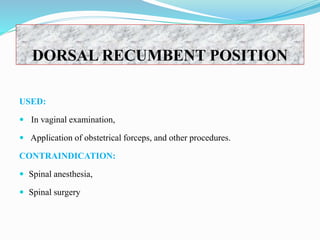
DORSAL RECUMBENT POSITION
Position of patient on the back, with lower limbs flexed and
rotated outward; used in vaginal examination, application of
obstetrical forceps, and other procedures
DORSAL RECUMBENT POSITION
USED:
 In vaginal examination,
 Application of obstetrical forceps, and other procedures.
CONTRAINDICATION:
 Spinal anesthesia,
 Spinal surgery
Nurse’s Responsibilities
 Nurses Responsibilities in Patient Positioning:
 Explain the procedure /arrange the articles properly,
 Hand washing,
 Check the doctors order,
 Monitor the vital signs,
 Follow the principles ,
 Help the patient assume the desired or required bed position,
 The nurse assists the patient to achieve proper body positioning and
alignment,
 Support patient's body in correct alignment using pillows or splints,
 For unconscious patient every 2hrs once change position.
 Monitor the complication.
 Record and report.
 Position
 Position

Position

  • 1.
    MRS.JAYA.R BSC (N) NURSING TUTOR FONDEPARTMENT GANGA COLLEGE OF NURSING
  • 2.
    POSITIONS  INTRODUCTION  DEFINE TYPES  PURPOSES  ARTICLES  GENERAL PRINCIPLES IN POSITION  PROCEDURE  NURSES RESPOSIBILITES .
  • 3.
    INTRODUCTION  One ofthe basic procedures that nursing personnel perform most frequently is that of changing in the patients position Any position and even the most comfortable positions unbearable after the long time.
  • 4.
    DEFINITION  POSITION isdefined as planning the person in a proper body alignment for the purpose of preventive ,curative, rehabilitative, aspect of health or placing the patient in good body alignment
  • 5.
  • 6.
    TYPES  PRONE POSITION LATREL  SUPINE POSITION  LITHOTOMY POSITION  FOWLER`S POSITION  SIMS POSITION  TREDLENBERG POSITION  KNEE CHEST POSITION  ORTHOPNEIC POSITION /CARDIAC POSITION  DORSAL RECUMBENT POSITION
  • 7.
     To promotecomfort  To relive pressure  To prevent bed sores  To promote blood circulation  To maintain body proper. alignment
  • 8.
    PRINCIPLES:  Maintain goodbody mechanics  Hand washing  Ensure Patient`s comfort  Obtain assistance as required  Ensure that mattress is firm and level of bed is at working level  Follow safety measures and prevent accidents  Follow the systematic and orderly way of doing  Use right technique at right time
  • 9.
    ARTICLES REQUIRED FOR POSITIONING Clean try/firm bed,  Different type of mattresses,  Bed boards ,  Pillows,  Foot board,  Sand bag,  Hand rolls,  Trochanter rolls,  Bed blocks,  Over bed table /cardiac table,  Additional sheets,  Trapeze bar,
  • 10.
  • 11.
    PRONE POSITION  Inprone position, the patient lies on the abdomen with head turned to one side; the hips are not flexed.  This is the only bed position that allows full extension of the hip and knee joints.  Prone position also promotes drainage from the mouth and useful for clients who are unconscious or those recover from surgery of the mouth or throat.
  • 12.
    PRONE POSITION Indication:  Forpatient with pressure sore,burns,injuries and operations on the back,  After 24 hours of amputation of lower limps, Contraindication:  Hip replacement ,  Orthopedic surgery,
  • 13.
    POSITIONING PROCEDURE PRONE POSITION: After providing explanation about the procedure. Roll patient over, with arm positioning close to the body with elbows straight, and hands under hips.  Position the patient on abdomen in center of bed with bed flat  Turn patient’s head to one side and support with a small pillow  Place small pillow under abdomen below the diaphragm  Support arm in flexed position a level of shoulder.  Support lower leg with pillow to elevate toes.
  • 14.
  • 15.
     In lateralor side-lying position, the patient lies on one side of the body with the top leg in front of the bottom leg and the hip and knee flexed.  Flexing the top hip and knee and placing this leg in front of the body creates a wider, triangular base of support and achieves greater stability. LATERAL/SEMI PRONE POSITION
  • 16.
    LATERAL/SEMI PRONE POSITION INDICATION  A patient may be positioned in Lateral position during back, colorectal, kidney, and hip surgeries. For giving enema,  Checking rectal temperature,  Rectal examination,  It's also commonly used during thoracic and ENT surgeries, and neurosurgery,
  • 17.
    POSITIONING PROCEDURE LATRAL/SIDE LYINGPOSITION  Explain the procedure to the client  Lower head of bed as low as patient can tolerate  Position patient to side of bed  Turn patient to one side  Place pillow under patient’s head and neck  Bring shoulder blade forward  Place tuck-back pillow under back  Position both arms in flexed position. Upper most arm is supported by pillow on level with shoulder.  Place pillow under semi flexed upper leg level at hip, from groin to foot.  place sand bag parallel to plantar surface of dependant foot.
  • 18.
  • 19.
    SUPINE POSITION  Supineposition, also known as Dorsal Decubitus, is the most frequently used position for procedures  In this position, the patient is face-up. The patient's arms should be tucked at the patient's sides with a bed sheet secured with arm guards to sleds.  The arms may be flexed and secured across the body or extended and secured on padded arm boards.
  • 20.
    SUPINE POSITION  Supineor Dorsal position  Supine is a back-lying position similar to dorsal recumbent but the head and shoulders are not elevated.  Just like dorsal recumbent, supine position provides comfort in general for patients recover after some types of surgery.  INDICATION:  During physical examination,  Checking vital signs,  CONTRAINDICATION:  Spinal surgery,  Spinal cord fracture ,
  • 21.
    POSITIONING PROCEDURE  SUPINE/DORSAL RECUMBENT /BACK LYING POSITION:  Place patient on back with head of the bed flat  Place a small rolled towel under the lumbar area of the back  Place pillow under the head, neck ,and upper shoulder  Place trochanter rolls/sand bags parallel to lateral surface of thighs  Place small pillow /roll under ankle to elevate heels  Place foot board under pronated arm maintaining upper arm parallel to body  If patient is paralyzed place hand rolls in hand.
  • 22.
    LITHOTOMY POSITION  LithotomyThe lithotomy position is a variation of the supine position in which the hips are flexed,  The legs abducted, and knees flexed. The legs are secured in leg supports such as the candy cane, knee crutch, or boot support.
  • 23.
    LITHOTOMY POSITION  InLithotomy position, the patient can be placed in either a boot-style leg holder or stirrup-style position. Modifications to this position include low, standard, high, exaggerated or hemi. • This position is typically used for gynecology, colorectal, urology, perineal or pelvis procedures. INDICATION: For delivery and vaginal examination. For rectal surgeries,(e.g.) Hemorrhoidectomy For vaginal hysterectomy. CONTRAINDICATION: Hip fracture. Osteoporosis patient’s
  • 24.
    POSITIONING PROCEDURE  LITHOTOMYPOSITION :  Place patient in supine position  Place pillow under head and neck  Place both legs flexed at hip and knee, at 90 degree with legs supported on stirrups
  • 25.
  • 26.
    FOWLER’POSITION  Fowler’s position,is a bed position wherein the head and trunk are raised 40 to 90 degrees.  Fowler’s position is used for people who have difficulty breathing because in this position, gravity pulls the diaphragm downward allowing greater chest and lung expansion.  In low Fowler’s or semi-Fowler’s position, the head and trunk are raised to 15 to 45 degrees; in high Fowler’s, the head and trunk are raised 90 degrees.
  • 27.
    PURPOSES/INDICATION  To relieveor minimize dyspnea,  To relieve tension on abdominal sutures,  Cardiac, respiratory, or neurological problems,  Patients who have nasogastric tube in place,. CONTRAINDICATION  After spinal anesthesia,  After brain surgeries,  Increased intracranial pressure, FOWLERS POSITION
  • 28.
    POSITIONING PROCEDURE • FOWLER’SPOSITION:  Explain the procedure to the client  Elevate head of the bed( fowlers 45to 90 degree)semi fowlers(15to45 degree)high fowlers(90 degree)  Rest head against mattress or small pillow  Place a small pillow at lower back  Place a small pillow under ankle/under thigh  Place a foot board at bottom of patient’s feet
  • 29.
    SIM’S POSITION It isalso called lateral recumbent position.
  • 30.
     Sims’ isa semi-prone position where the patient assumes a posture halfway between the lateral and prone positions. The lower arm is positioned behind the client, and the upper arm is flexed at the shoulder and the elbow. Both legs are flexed in front of the client. The upper leg is more acutely flexed at both the hip and the knee, than is the lower one.  Sims’ may be used for unconscious clients because it facilitates drainage from the mouth and prevents aspiration of fluids. SIM’S POSITION
  • 31.
    SIM’S POSITION  Itis also used for paralyzed clients because it reduces pressure over the sacrum and greater trochanter of the hip.  It is often used for clients receiving enemas and occasionally for clients undergoing examinations or treatments of the perineal area.  Pregnant women may find the Sims position comfortable for sleeping. Sims’ may be used for unconscious clients because it facilitates drainage from the mouth and prevents aspiration of fluids  Support proper body alignment in Sims’s position by placing a pillow underneath the patient’s head and under the upper arm to prevent internal rotation. Place another pillow between legs.
  • 32.
    POSITIONING PROCEDURE  SIM’SPOSITION :  Provide explanation and prepare patient for the position  Place head of bed flat /Place patient in supine position ,turn patient in onto lateral position lying partially on the abdomen  Place small pillow under head and neck  Place pillow under flexed upper supporting arm level with shoulder.  Place pillow under flexed upper leg, supporting leg level with hip  Place sand bags parallel to planter surface of dependant foot
  • 33.
    TRENDELENBURG’S POSITION The Trendelenburgposition involves placing the patient head down and elevating the feet.  It is named after German surgeon Friedrich Trendelenburg, who created the position to improve surgical exposure of the pelvic organs during surgery.
  • 34.
     Trendelenburg’s  Trendelenburg’sposition involves lowering the head of the bed and raising the foot of the bed of the patient.  Patients who have hypotension can benefit from this position because it promotes venous return.  Reverse Trendelenburg  Reverse Trendelenburg is the opposite of Trendelenburg’s position.  Here the HOB is elevated with the foot of bed down.  This is often a position of choice for patients with gastrointestinal problems as it can help minimize esophageal reflux. TRENDELENBURG’S POSITION
  • 35.
    TRENDELENBURG’S POSITION INDICATION:  TheTrendelenburg position is used in surgery, especially of the abdomen and genitourinary system.  It allows better access to the pelvic organs as gravity pulls the intra- abdominal organs away from the pelvis. CONTRAINDICATION:  Patient with an intracranial pressure (ICP) greater than 20 mm Hg or in whom increased intracranial pressure should be avoided.  Uncontrolled hypertension.
  • 36.
    POSITIONING PROCEDURE  TRENDLENBURGPOSITION :  Explain the procedure to patient.  Place patient in supine position.  Lower head end of the bed using bed key .if he is not adjustable type, use bed blocke at foot end and tilt entire frame of bed down.
  • 37.
    KNEE CHET POSITION Knee-chestposition the patient rests on the knees and chest with head is turned to one side, arms extended on the bed, and elbows flexed and resting so that they partially bear the patient's weight The abdomen remains unsupported, though a small pillow may be placed under the chest.
  • 38.
    KNEE CHET POSITION INDICATION: Indications include recurrent vulvar infection,  presence of a foreign body or neoplasm, abnormal bleeding, and congenital anomaly.  The knee‐chest position is generally favored for vaginoscopy. CONTRAINDICATION:  Increased ICP  Rib fracture/recent spinal surgeries./thoracic surgeries.  Head injury.
  • 39.
    ORTHOPNEIC POSITION Orthopneic positiona position assumed to relieve orthopnea (difficulty breathing except when in an upright position) the patient assumes an upright or semivertical position by using pillows to support the head and chest, or sits upright in a chair.
  • 40.
    ORTHOPNEIC POSITION  Orthopneicor Tripod  Orthopneic or tripod position places the patients in a sitting position or on the side of the bed with an over bed table in front to lean on and several pillows on the table to rest on.  Patients who are having difficulty breathing are often placed in this position since it allows maximum expansion of the chest. INDICATION: Respiratory problem patient Cardiac problem patient CONTRAINDICATION: Spinal cord injury Head injury Brain surgeries
  • 41.
    ORTHOPNEIC POSITION  Orthopneicposition otherwise called cardiac position  Patient's head of bed is placed at a 30-degree angle.  This position is used for patients who have cardiac or respiratory conditions, and for patients with a nasogastric tube.  Patient sits at the side of the bed with head resting on an over-bed table on top of several pillows.
  • 42.
    DORSAL RECUMBENT POSITION Positionof patient on the back, with lower limbs flexed and rotated outward; used in vaginal examination, application of obstetrical forceps, and other procedures
  • 43.
    DORSAL RECUMBENT POSITION USED: In vaginal examination,  Application of obstetrical forceps, and other procedures. CONTRAINDICATION:  Spinal anesthesia,  Spinal surgery
  • 44.
  • 45.
    Nurse’s Responsibilities  NursesResponsibilities in Patient Positioning:  Explain the procedure /arrange the articles properly,  Hand washing,  Check the doctors order,  Monitor the vital signs,  Follow the principles ,  Help the patient assume the desired or required bed position,  The nurse assists the patient to achieve proper body positioning and alignment,  Support patient's body in correct alignment using pillows or splints,  For unconscious patient every 2hrs once change position.  Monitor the complication.  Record and report.