VIDHYAKIRANA
GROUP OF
INSTITUTION
SUBJECT- NURSING FOUNDATION
TOPIC- SECSORY NEED/ DEPRIVATION
PRESENTTED BY- MRS. SULEKHA DESHMUKH
INTRODUCTION:
• Sensation is the neurological process by which we
become aware of surrounding environment
WHAT IS THE SENSE ORGAN
• The human body has five main sense organs –
• EYE- which provide the sense of sight
• NOSE- which provide the sense of smell
• EAR – which provide the sense of hearing
• SKIN – which provide the sense of touch
• TONGUE – which provide the sense of taste
• SENSORY NEED – sensory need or issue occurs when
we have difficulties for receiving and responding to
information from their sense
• Most of the patient may develop sensory
impairment and at the risk of injury
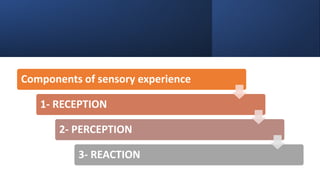
Components of sensory experience
1- RECEPTION
2- PERCEPTION
3- REACTION
• 1 RECEPTION - Reception is the process of receiving
internal and external stimuli from nerve ending
through vision, hearing, smell, taste and touch .
• Once receive the stimulus they convert energy from
stimulus to electrical signals.
• This electrical signals passes from the spinal cord to
the brain
• PERCEPTION – Is the vital aspect of senses to
understand world around people.
• Is the ability to receive sensory input, through
various physiological processes in the body
• The perception is strongly influence by level of
consciousness, past experience, education, culture,
value and other factors
• REACTION – The human brain is filled with millions
of stimuli entering into the nervous system among
those choosing appropriate response to the proper
stimuli is called sensory reaction .
• It is an uncontrolled emotional or behavioral
reaction to overwhelming stress or sensory overload
that can trigger a flight or fight reaction.
• The person usually reacts to environmental stimuli
when it is most important and meaningful
• AROUSAL MECHANISM- arousal is the process of
conscious a wakefulness of physiological and
psychological sensory perception.
• It mainly balance the alertness, consciousness,
attention and informing processing.
• Arousal is the most powerful and essential function
in the brain.
• It involves activation of the autonomy nervous
system, endocrine system for the readiness to
respond perceived stimuli
• Raised blood pressure, pulse, respiration, emotion,
behavior, fight or flight response and sexual activity.
FACTORS AFFECTING SENSORY FUNCTION
Developmental
consideration
Vision Hearing Pain and touch
Culture
personality and
lifestyle
Stress and
illness
Medication
• DEVELOPMENTAL CONSIDERATION- human nervous
system consisting of many neuron, for their growth
required different sensory stimulation will active
• In infant and children sense organs play major role in
activating mind and notify their familiar surrounding
at birth many neural pathway are immature as age
increase it will be become mature.
• VISION- newborn cannot visualize 8- 16 inches away
from their face, the mother womb is dark
environment and there is poorly developed vision
sense at birth
• However by 2-3 month the child can sense familiar
face, objects, image and contrast colours
• HEARING - the infant’s sense of hearing is very
strong from 5th month of prenatal development.
• Hearing ability of the infant become strong when
infants heard their mother’s voice during sucking
• PAIN AND TOUCH- the sense of touch is essential for
the growth of infant’s physical ability and emotional
competency.
• Newborn is sensitive to touch, immediately after
birth responding with crying, increased heart rate
and increase blood flow .
• Sensory function become impaired as result of
ageing process or chronic disease.
• PERSONALITY AND LIFESTYLE – personality and life
style practices unique to each individual, it
consistently influences the way a person responds to
world and how interacting with others
• STRESS AND ILLNESS- Stress is anormal feeling come
from the person’s perception on the challenge or
demand, it makes feel frustrated, angry or nervous.
• It cause many type of physical and emotional
symptoms, some time stress can be positive to
overcome danger situation.
• MEDICATION- the human perceive information from
the primary sense i.e. vision, hearing, and touch
many drug alert or depress the sensory stimulation,
it decrease the brain activity.
ASSESSMENT OF
SENSORY
ALTERATION
• Sensory assessment is scientific evaluation of human
sense sight, smell, taste, touch, and hearing to
understand the individual’s level of stimulation who
has admitted in the hospital
• Sensory assessment can be performed in formal and
informal ways
• FORMAL- Assessment done by the specialist eg.
ophthalmologist and audiologist.
• INFORMAL- Assessment by observation e.g. patients
daily routines
SENSORY ALTERATION [ a small change in
something]
• Careful assessment help the client in reducing
sensory alteration and early identification/
management of disorders
• SENSORY DEFICIT
• SENSORY DEPRIVATION
• SENSORY OVERLOAD
• SENSORY DEFICIT- sensory deficit is an inappropriate
functioning of the sensory system, result brain
receives less input from the sense.
• Sensory deficit is impaired reception, perception or
both
• Possible impairment includes visual, hearing sensory
deficit mostly present at the time of birth
• Or old age who are suffering from chronic illness.
• SENSORY DEPRIVATION- sensory deprivation is also
known as perceptual isolation, it occurs when
individuals receive sensory stimuli below the normal
threshold from one or more sense
• These alteration may develop due to acute or chronic
illness, aging, trauma environmental cause.
• Short term sensory deprivation indicates relaxing,
where as long term deprivation leads to anxiety,
hallucination and depression.
• Alteration in perception leads to reduced capacity to
learn, disorientation, decreased colour perception
• SENSORY OVERLOAD – overstimulation from the
environment may result to a condition called sensory
overload
• Sensory overload occurs when the body receives an
excessive input from any sense like sound, bright
light ,strong odours, touch.
• Overstimulation patient may experience extreme
irritability, difficulty focusing, restlessness and
discomfort about the circumstances.
•PREVENTION AND
MANAGEMENT OF
CLIENT WITH
SENSORY
ALTERATION
• PEVENTION OF SENSORY OVERLOAD –
 Provide quiet environment and avoid unnecessary
noise and light
Suggest dark glasses and earplugs, if necessary
Administer analgesic if patient complain pain
Speak slowly, clearly and do not shout to the patient
Repeat the sentence if it is necessary to avoid
misunderstanding
• PREVENTION OF SENSORY DEPRIVATION
• Educate the client importance of using eyeglasses
and hearing aids
• Address the client by name
• Have a meaningful interaction with the client
• Allow client to active participation in recreational
activity like reading, watching TV, play, hand crafts
Con…..
…..And also encourage in social interactions
• Encourage the client physical care through back
massage, hair care, foot care to improve tactile
stimulation.
• Advice client to use self stimulation skills such as
singing and dancing
• COMMUNICATION WITH APHASIA CLIENT [ aphasia
is loss of the ability to understanding the spoken or
written language ]
• Make sure that the client surrounding environment
should be quiet and relaxed
• Start conversation with general information to
specific details
• Ask the questions by using simple language and
sentence that patient can give answered in yes or no
• Repeat the sentence whenever necessary wait for
answer without hesitation
• Speak slowly do not shout at the client for not
understanding
• Recovering of speech after aphasic condition is most
• … difficulty, time taking and need practice
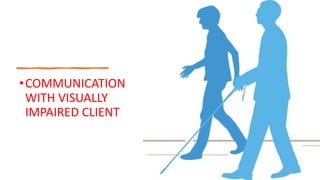
•COMMUNICATION
WITH VISUALLY
IMPAIRED CLIENT
• Introduce self, name/ position while entering into
the client room
• Visual impaired patient unable to pick up non- verbal
cues, so speak with normal tone
• Give a clear indication to the patient while entering
and leaving the room
• Should not touch the client without their concern
while doing any procedure or care
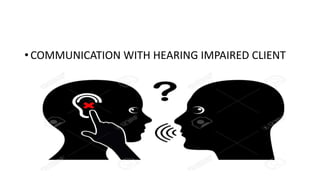
• COMMUNICATION WITH HEARING IMPAIRED CLIENT
• Make sure that the client surrounding environment
should be quiet and relaxed
• Ask the patient to wear their hearing aid and sit
closer before beginning of the communication
• While speaking maintain eye contact, clear and
moderate volume
• Face the patient and speak his/her best side of
hearing
• Use short sentence for better understanding
• Ensure that hearing aids are on with working
• Encourage non- verbal communication such as touch
head nods, writing and use communication boards
Sensory need.pptx

Sensory need.pptx

  • 1.
    VIDHYAKIRANA GROUP OF INSTITUTION SUBJECT- NURSINGFOUNDATION TOPIC- SECSORY NEED/ DEPRIVATION PRESENTTED BY- MRS. SULEKHA DESHMUKH
  • 2.
    INTRODUCTION: • Sensation isthe neurological process by which we become aware of surrounding environment
  • 3.
    WHAT IS THESENSE ORGAN • The human body has five main sense organs – • EYE- which provide the sense of sight • NOSE- which provide the sense of smell • EAR – which provide the sense of hearing • SKIN – which provide the sense of touch • TONGUE – which provide the sense of taste
  • 5.
    • SENSORY NEED– sensory need or issue occurs when we have difficulties for receiving and responding to information from their sense • Most of the patient may develop sensory impairment and at the risk of injury
  • 6.
    Components of sensoryexperience 1- RECEPTION 2- PERCEPTION 3- REACTION
  • 7.
    • 1 RECEPTION- Reception is the process of receiving internal and external stimuli from nerve ending through vision, hearing, smell, taste and touch . • Once receive the stimulus they convert energy from stimulus to electrical signals. • This electrical signals passes from the spinal cord to the brain
  • 8.
    • PERCEPTION –Is the vital aspect of senses to understand world around people. • Is the ability to receive sensory input, through various physiological processes in the body • The perception is strongly influence by level of consciousness, past experience, education, culture, value and other factors
  • 9.
    • REACTION –The human brain is filled with millions of stimuli entering into the nervous system among those choosing appropriate response to the proper stimuli is called sensory reaction . • It is an uncontrolled emotional or behavioral reaction to overwhelming stress or sensory overload that can trigger a flight or fight reaction.
  • 10.
    • The personusually reacts to environmental stimuli when it is most important and meaningful
  • 11.
    • AROUSAL MECHANISM-arousal is the process of conscious a wakefulness of physiological and psychological sensory perception. • It mainly balance the alertness, consciousness, attention and informing processing. • Arousal is the most powerful and essential function in the brain.
  • 12.
    • It involvesactivation of the autonomy nervous system, endocrine system for the readiness to respond perceived stimuli • Raised blood pressure, pulse, respiration, emotion, behavior, fight or flight response and sexual activity.
  • 13.
    FACTORS AFFECTING SENSORYFUNCTION Developmental consideration Vision Hearing Pain and touch Culture personality and lifestyle Stress and illness Medication
  • 14.
    • DEVELOPMENTAL CONSIDERATION-human nervous system consisting of many neuron, for their growth required different sensory stimulation will active • In infant and children sense organs play major role in activating mind and notify their familiar surrounding at birth many neural pathway are immature as age increase it will be become mature.
  • 15.
    • VISION- newborncannot visualize 8- 16 inches away from their face, the mother womb is dark environment and there is poorly developed vision sense at birth • However by 2-3 month the child can sense familiar face, objects, image and contrast colours
  • 16.
    • HEARING -the infant’s sense of hearing is very strong from 5th month of prenatal development. • Hearing ability of the infant become strong when infants heard their mother’s voice during sucking
  • 17.
    • PAIN ANDTOUCH- the sense of touch is essential for the growth of infant’s physical ability and emotional competency. • Newborn is sensitive to touch, immediately after birth responding with crying, increased heart rate and increase blood flow . • Sensory function become impaired as result of ageing process or chronic disease.
  • 18.
    • PERSONALITY ANDLIFESTYLE – personality and life style practices unique to each individual, it consistently influences the way a person responds to world and how interacting with others
  • 19.
    • STRESS ANDILLNESS- Stress is anormal feeling come from the person’s perception on the challenge or demand, it makes feel frustrated, angry or nervous. • It cause many type of physical and emotional symptoms, some time stress can be positive to overcome danger situation.
  • 20.
    • MEDICATION- thehuman perceive information from the primary sense i.e. vision, hearing, and touch many drug alert or depress the sensory stimulation, it decrease the brain activity.
  • 21.
  • 22.
    • Sensory assessmentis scientific evaluation of human sense sight, smell, taste, touch, and hearing to understand the individual’s level of stimulation who has admitted in the hospital • Sensory assessment can be performed in formal and informal ways
  • 23.
    • FORMAL- Assessmentdone by the specialist eg. ophthalmologist and audiologist. • INFORMAL- Assessment by observation e.g. patients daily routines
  • 24.
    SENSORY ALTERATION [a small change in something] • Careful assessment help the client in reducing sensory alteration and early identification/ management of disorders • SENSORY DEFICIT • SENSORY DEPRIVATION • SENSORY OVERLOAD
  • 25.
    • SENSORY DEFICIT-sensory deficit is an inappropriate functioning of the sensory system, result brain receives less input from the sense. • Sensory deficit is impaired reception, perception or both • Possible impairment includes visual, hearing sensory deficit mostly present at the time of birth
  • 26.
    • Or oldage who are suffering from chronic illness.
  • 27.
    • SENSORY DEPRIVATION-sensory deprivation is also known as perceptual isolation, it occurs when individuals receive sensory stimuli below the normal threshold from one or more sense • These alteration may develop due to acute or chronic illness, aging, trauma environmental cause.
  • 28.
    • Short termsensory deprivation indicates relaxing, where as long term deprivation leads to anxiety, hallucination and depression. • Alteration in perception leads to reduced capacity to learn, disorientation, decreased colour perception
  • 29.
    • SENSORY OVERLOAD– overstimulation from the environment may result to a condition called sensory overload • Sensory overload occurs when the body receives an excessive input from any sense like sound, bright light ,strong odours, touch. • Overstimulation patient may experience extreme irritability, difficulty focusing, restlessness and discomfort about the circumstances.
  • 30.
  • 31.
    • PEVENTION OFSENSORY OVERLOAD –  Provide quiet environment and avoid unnecessary noise and light Suggest dark glasses and earplugs, if necessary Administer analgesic if patient complain pain Speak slowly, clearly and do not shout to the patient
  • 32.
    Repeat the sentenceif it is necessary to avoid misunderstanding
  • 33.
    • PREVENTION OFSENSORY DEPRIVATION • Educate the client importance of using eyeglasses and hearing aids • Address the client by name • Have a meaningful interaction with the client • Allow client to active participation in recreational activity like reading, watching TV, play, hand crafts
  • 34.
    Con….. …..And also encouragein social interactions • Encourage the client physical care through back massage, hair care, foot care to improve tactile stimulation. • Advice client to use self stimulation skills such as singing and dancing
  • 35.
    • COMMUNICATION WITHAPHASIA CLIENT [ aphasia is loss of the ability to understanding the spoken or written language ] • Make sure that the client surrounding environment should be quiet and relaxed • Start conversation with general information to specific details
  • 36.
    • Ask thequestions by using simple language and sentence that patient can give answered in yes or no • Repeat the sentence whenever necessary wait for answer without hesitation • Speak slowly do not shout at the client for not understanding • Recovering of speech after aphasic condition is most
  • 37.
    • … difficulty,time taking and need practice
  • 38.
  • 39.
    • Introduce self,name/ position while entering into the client room • Visual impaired patient unable to pick up non- verbal cues, so speak with normal tone • Give a clear indication to the patient while entering and leaving the room • Should not touch the client without their concern while doing any procedure or care
  • 40.
    • COMMUNICATION WITHHEARING IMPAIRED CLIENT
  • 41.
    • Make surethat the client surrounding environment should be quiet and relaxed • Ask the patient to wear their hearing aid and sit closer before beginning of the communication • While speaking maintain eye contact, clear and moderate volume • Face the patient and speak his/her best side of hearing
  • 42.
    • Use shortsentence for better understanding • Ensure that hearing aids are on with working • Encourage non- verbal communication such as touch head nods, writing and use communication boards