Testing and Evaluation System
in Higher Education
Dr.VMS
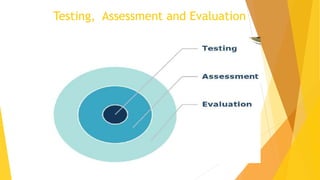
Testing, Assessment and Evaluation
Testing
Testing is an important phenomenon from science to arts, in order
to weigh, measure and qualify the validity and the quantum of
things.
In order to find out the nature and state of the students
proficiency, tests are to be conducted and the results are the only
source, which provide valuable ideas, and suggestions.
The most common use of test is to pinpoint strengths and
weakness in the learnt abilities of the students.
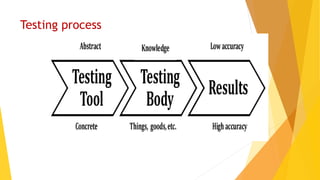
Testing process
Assessment
 Mousavi (2009, p. 36) defined assessment as “appraising or estimating
the level or magnitude of some attribute of a person.”
 Classroom assessment, Mihai (2010) categorized it according to
intention, purpose, interpretation, and administration.
 In regard to intention, an assessment can be informal when it is a
spontaneous comment, or it can be formal when it is carried out in a
systematic manner.
 In terms of purpose, an assessment can be formative if it focuses on
the process of learning or it can be summative when it is used to
measure student learning outcomes at the end of an education cycle.
Evaluation
 Evaluation is the process of assessing or judging the value, worth, quality, or significance of something.
 Educational Evaluation: In education, evaluation involves assessing students' learning, progress, and
achievements. It can also refer to assessing the effectiveness of educational programs, curriculum, or teaching
methods.
 Performance Evaluation: In the workplace, evaluation often involves assessing an employee's job performance,
typically for the purpose of determining promotions, raises, or areas for improvement.
 Program Evaluation: Program evaluation involves assessing the effectiveness, efficiency, and impact of a
program or intervention. This is often done to determine whether the program is meeting its goals and
objectives.
 Product Evaluation: This involves assessing the quality, usability, and effectiveness of a product, such as a
consumer product, software application, or medical device.
 Policy Evaluation: Policy evaluation involves assessing the impact and effectiveness of government policies,
programs, or initiatives.
Types of tests
 Achievement Test
 Achievement tests are typically used in educational settings to assess a student's
level of mastery in a specific subject area, such as math, reading, science, or
history. Achievement tests are often used to evaluate the effectiveness of
educational programs, or to determine eligibility for educational placement or
certification.
Types of Tests
 Diagnostic Test
 Diagnostic tests are often used to assess a student's readiness for a
particular course or to identify areas where additional instruction
may be needed. In healthcare, diagnostic tests are used to identify
the presence or extent of a disease or condition. These tests are an
important tool for educators and healthcare providers to tailor their
instruction or treatment plans to meet the individual needs of their
students or patients.
 Unlike achievement tests, which measure overall knowledge or
proficiency, diagnostic tests are designed to identify strengths and
weaknesses in specific areas.
Types of Tests
 Discrete-Point Test
 The discrete-point test, also called as discrete-item test, constructed
to measure understanding of specific scientific concepts, their ability to
apply formulas or solve problems, or their knowledge of scientific
terminology.
 Language Aptitude Test
 Language aptitude refers to the potential abilities that a learner has for
learning languages. The potential ability of a leaner is often evaluated
using formal aptitude tests, which predict the degree of success the
learner will have in language. Language aptitude also refers to the
learners’ linguistic and personal abilities towards learning language.
Types of Tests
 Placement Test
 A placement test is a test given by a school to determine the
academic or skill level of a student, especially a new student, in
order to place them in the correct class. Also placement tests are
designed to place learners at an appropriate level in a programme
or course.
 Proficiency Test
 A proficiency test is a measure of an individual's ability to perform
tasks and skills in a specific domain, such as language,
mathematics, or a professional field. Proficiency tests are designed
to assess a person's level of mastery or competence in a particular
area, typically against a predefined standard or benchmark.
Progress Test
 A progress test considers identifying the progress of a learner in
the given point of time in the selected learning item. It is closely
related to the particular teaching materials and particular
course of instruction. Progress tests are administered several
times during the course work such as at the end of a unit, a
course, or term. A progress test may be viewed as similar to an
achievement test but much narrower and much more specific in
scope (Richards et al., 1989).
Reliability
 A test is considered reliable if it is administered on different
occasions and similar results are obtained. Brown and
Abeywickrama (2010, p. 27) suggested the following ways to
ensure that a test is reliable:
 It is consistent in its conditions across two or more
administrations.
 It gives clear directions for scoring or evaluation.
 It has uniform rubrics for scoring or evaluation.
 It lends itself to consistent application of those rubrics by the
rater.
 It contains items or tasks that are unambiguous to the test-
takers.
Practicality
 Practicality refers to the logistical, practical, and administrative
issues involved in the process of constructing, administering, and
rating an assessment instrument (Brown & Abeywickrama, 2010).
 Bachman and Palmer (1996, p. 36), defined practicality as “the
relationship between the resources that will be required in the
design, development, and use of the test and the resources that will
be available for testing activities.”
Washback
 Washback may have been called backwash, test impact,
measurement-driven instruction, curriculum alignment, and test
feedback (Brown & Hudson, 1998).
 Washback, the effect of testing and assessment on the language
teaching curriculum that is related to it.
 washback is used to refer to the influence that a test has on
teaching and learning (Hughes, 2003).
Assessment
 Assessment is “appraising or estimating the level or magnitude of
some attribute of a person.” Mousavi (2009, p. 36)
 Classroom assessment, Mihai (2010) categorized it according to
intention, purpose, interpretation, and administration.
 In regard to intention, an assessment can be informal when it is a
spontaneous comment, or it can be formal when it is carried out in a
systematic manner.
 In terms of purpose, an assessment can be formative if it focuses on
the process of learning or it can be summative when it is used to
measure student learning outcomes at the end of an education cycle.
Assessment
 In the field of education, “some form of assessment is inevitable; it is
inherent in the teaching – learning process” (Hopkins, Stanley, &
Hopkins, 1990, p.194).
 Stoynoff and Chapelle (2005) stated that “teachers are involved in many
forms of assessment and testing through their daily teaching and use of
test scores” (p. 1),
 Assessment is the process of documenting, usually in measurable terms,
knowledge, skills, attitudes and beliefs. Assessment in education is the
process of gathering, interpreting, recording & using information about
pupils’ responses to an educational task. (Harlen, Gipps, Broadfoot,
Nuttal, 1992)
Types of Assessment
 Formative assessment occurs throughout a class or course,
and seeks to improve student achievement of learning
objectives through approaches that can support specific
student needs (Theal and Franklin, 2010, p. 151).
 Summative assessments evaluate student learning,
knowledge, proficiency, or success at the conclusion of an
instructional period, like a unit, course, or program.
Assessment Need
 According to Airasian (1994) and Pellegrino, Chudowsky and Glaser
(2001), assessment has three main purposes:
 to assist learning
 to measure a particular student’s achievement and
 to evaluate the whole program
 without good assessment techniques it is difficult to ascertain whether
reforms in instruction and curriculum are working.
 The suitable assessment is one that can be used or leads to
improvement in student’s learning. Moreover, it can reveal the
student’s weakness and strength areas; the strength area to be
enhanced and the weakness area to be treated.
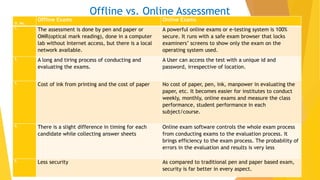
Offline vs. Online Assessment
Sl. No.
Offline Exams Online Exams
1. The assessment is done by pen and paper or
OMR(optical mark reading), done in a computer
lab without Internet access, but there is a local
network available.
A powerful online exams or e-testing system is 100%
secure. It runs with a safe exam browser that locks
examiners’ screens to show only the exam on the
operating system used.
2. A long and tiring process of conducting and
evaluating the exams.
A User can access the test with a unique id and
password, irrespective of location.
3. Cost of ink from printing and the cost of paper No cost of paper, pen, ink, manpower in evaluating the
paper, etc. It becomes easier for institutes to conduct
weekly, monthly, online exams and measure the class
performance, student performance in each
subject/course.
4. There is a slight difference in timing for each
candidate while collecting answer sheets
Online exam software controls the whole exam process
from conducting exams to the evaluation process. It
brings efficiency to the exam process. The probability of
errors in the evaluation and results is very less
5. Less security As compared to traditional pen and paper based exam,
security is far better in every aspect.
Challenges
 How can the assessment be condensed in content and length and still
provide useful results?
 How can assessment results be provided in a timely manner?
 How can the assessment be administered under different scenarios,
including at home, at school, or virtually at an off-site location?
 How can the schools and colleges be supported in using high-quality
curricula that are aligned to various standards and assessments?
Online assessment challenges
 Various studies reported considerable amount of barriers that affect
online assessment. Multiple challenges have been emerging. The shift
from a physical classroom to a virtual class has changed traditional
techniques and assessment methods.
 E- Assessment has been a challenging process in the sense that it
required using a frame work that should be valid and reliable.
 Multiple challenges have been encountered by instructors questioning
the consequences of the shift from face to face learning to full-time e
learning (Yadov, Gupta, & Khetrapal, 2018).
Use of Technology in Assessment
• Greater variety and authenticity in the design of assessments
• Improved learner engagement, for example through interactive
formative assessments with adaptive feedback
• Choice in the timing and location
• Capture of wider skills and attributes not easily assessed by other
means, for example through simulations, e-portfolios and interactive
games
• Efficient submission, marking, moderation and data storage processes
Use of Technology in Assessment
• Consistent, accurate results with opportunities to combine human
and computer marking
• Immediate feedback
• Increased opportunities for learners to act on feedback, for example
by reflection in e-portfolios
• Innovative approaches based around use of creative media and
online peer and self- assessment
• Accurate, timely and accessible evidence on the effectiveness of
curriculum design and delivery
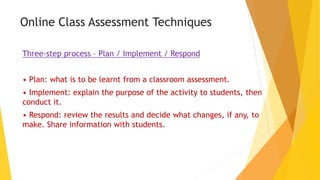
Online Class Assessment Techniques
Three-step process – Plan / Implement / Respond
• Plan: what is to be learnt from a classroom assessment.
• Implement: explain the purpose of the activity to students, then
conduct it.
• Respond: review the results and decide what changes, if any, to
make. Share information with students.
Equivalency and Authenticity
 In assessment, equivalency refers to the idea that different
forms of a test or assessment should be comparable in terms
of the content covered and the level of difficulty. This
ensures that the results of the assessment are fair and
reliable, regardless of which form of the test a person takes.
 “An assessment has the property of equivalency if it is
directly based on curriculum standards or instructional
activities. Specifically, equivalency determines in what ways
assessment design is influenced by teaching” (Mihai, 2010, p.
45).
Evaluation
 Evaluation is an activity through which the human behaviors,
actions and happenings of the world are identified, perceived
and realized. It is the only activity that controls and provides
valid judgments and conclusions about each and every activity
of the day-to-day events.
 Test is a part in the process of evaluation but not the whole of
it.
 An evaluation process may be complete when the tests are
rightly interpreted with pros and cons of it.
Testing and Evaluation in Curriculum Domain
 Tests do not always follow evaluation procedures and in
many cases the purpose of the tests is specific and they do
not necessarily include the evaluation procedures. Mostly
tests are conducted and made use of for pedagogical and
recruitment purposes.
Grant Henning (1987,p: 9)
Evaluation of the language tests should consider
 Purpose of the test
 Characteristics of the examinees
 Accuracy of measurement
 Suitability of the format and features of a test
 Developmental sample
 Availability of equivalent or equated forms
 Nature of the scoring and reporting of scores
 Procurement and
 Political compatibility of the test.
Role of evaluation
 Identification of course objectives. (the expected or desired
learning outcome)
 Defining the objectives in terms of learners’ terminal behavior.
 Constructing appropriate tools or instrument for measuring the
behavior.
 Applying or administering the tools/instruments and analyzing the
results to determine the degree of learners’ achievement in the
instructional program.
 The above four steps are basically the same in the evaluation of
instructions, curriculum or the program as a whole. Both
measurement and evaluation require broad variety of tools or
instruments such as, tests, rating scales, inventories, check lists,
questionnaires etc.
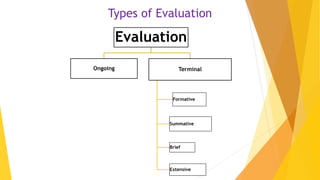
Types of Evaluation
Evaluation
Ongoing Terminal
Formative
Summative
Brief
Extensive
Ongoing evaluation
 Ongoing evaluation is meant for getting the feedback
regularly after the completion of every step during its
process viz. planning, preparation, production and
application. This would enable the program to improve at
various stages at that time of the program itself. This
type of evaluation is more helpful to modify anything if
necessary in the course of the didactic process.
Terminal evaluation
 Terminal evaluation is a type of evaluation that is made after the
completion of the program and it is used to know whether the
program is success or failure. This type of evaluation would not
be used for any improvement of the program. In general,
evaluation has been further classified into four categories: They
are:
 Formative evaluation
 Summative evaluation
 Brief evaluation and
 Extensive evaluation
Types of Evaluation
 Formative evaluation
 Formative evaluation is a process of evaluation that is made from
time to time in the case of an instructional program and from one
stage to the other. It does not provide a totalitarian impression of
the quality either of the instructional programs, the techniques
and methods, materials or media.
 Summative evaluation
 Summative evaluation is that kind of evaluation which takes into
consideration the periodic evaluation that has been made and in
addition to a total evaluation of the program: process or product
made and the conclusions are arrived at keeping in view the
outcome of the periodic evaluation in addition to the final
evaluation.
Types of Evaluation
 Brief evaluation
 Evaluating a program can also be made taking into account only
some aspects and the evaluator can also give a judgment based on
the few aspects chosen for evaluation. But it will be subjective
and impressionistic and not a realistic one. This can be useful to
roughly compare two (or) more programs.
 Extensive evaluation
 Extensive evaluation involves the analysis of a program in its
entire main and sub aspects. The evaluator has to rate and weigh
each of them individually and consolidate the total rating based on
which he makes his value judgment. This is more objective and
valid.
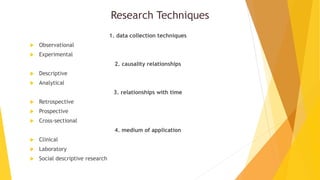
Research Techniques
1. data collection techniques
 Observational
 Experimental
2. causality relationships
 Descriptive
 Analytical
3. relationships with time
 Retrospective
 Prospective
 Cross-sectional
4. medium of application
 Clinical
 Laboratory
 Social descriptive research
Scientific Research
 Scientific research is a systematic investigation conducted to
discover new knowledge, validate existing knowledge, or solve
specific problems in the natural or social sciences. It follows a
structured process that involves formulating a research question or
hypothesis, designing and conducting experiments or studies,
collecting and analyzing data, and drawing conclusions based on the
findings.
 Scientific research is characterized by its emphasis on objectivity,
systematic methodology, and reproducibility. It is typically
conducted by trained researchers, such as scientists, scholars, or
academics, and often involves collaboration with other researchers
or experts in the field.
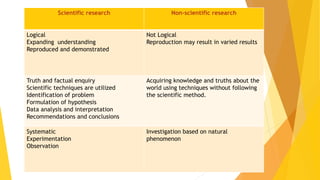
Scientific research Non-scientific research
Logical
Expanding understanding
Reproduced and demonstrated
Not Logical
Reproduction may result in varied results
Truth and factual enquiry
Scientific techniques are utilized
Identification of problem
Formulation of hypothesis
Data analysis and interpretation
Recommendations and conclusions
Acquiring knowledge and truths about the
world using techniques without following
the scientific method.
Systematic
Experimentation
Observation
Investigation based on natural
phenomenon
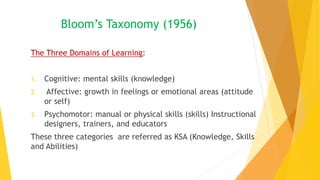
Bloom’s Taxonomy (1956)
The Three Domains of Learning:
1. Cognitive: mental skills (knowledge)
2. Affective: growth in feelings or emotional areas (attitude
or self)
3. Psychomotor: manual or physical skills (skills) Instructional
designers, trainers, and educators
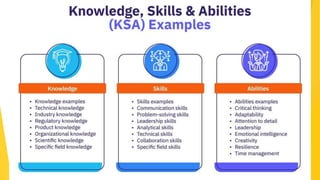
These three categories are referred as KSA (Knowledge, Skills
and Abilities)
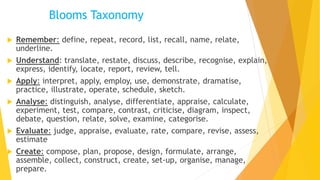
Blooms Taxonomy
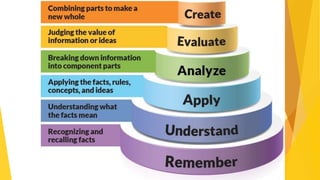
 Remember: define, repeat, record, list, recall, name, relate,
underline.
 Understand: translate, restate, discuss, describe, recognise, explain,
express, identify, locate, report, review, tell.
 Apply: interpret, apply, employ, use, demonstrate, dramatise,
practice, illustrate, operate, schedule, sketch.
 Analyse: distinguish, analyse, differentiate, appraise, calculate,
experiment, test, compare, contrast, criticise, diagram, inspect,
debate, question, relate, solve, examine, categorise.
 Evaluate: judge, appraise, evaluate, rate, compare, revise, assess,
estimate
 Create: compose, plan, propose, design, formulate, arrange,
assemble, collect, construct, create, set-up, organise, manage,
prepare.
COGNITIVE DOMAIN
 The cognitive domain involves knowledge and the
development of intellectual skills.
 This includes the recall or recognition of specific facts,
procedural patterns, and concepts that serve in the
development of intellectual abilities and skills. There are six
major categories of cognitive processes, starting from the
simplest to the most complex
COGNITIVE DOMAIN
KNOWLEDGE
“involves the recall of specifics and universals, the recall of methods
and processes, or the recall of a pattern, structure, or setting.”
Student can: Write, List, Define with his knowledge if he have.
COMPREHENSION
Refers to a type of understanding or apprehension such that the
individual knows what is being communicated.
Student translates, comprehends or interprets information based on
prior learning like: Explain, summarize, paraphrase, describe
COGNITIVE DOMAIN
APPLICATION
Refers to the “use of abstractions in particular and concrete
situations.”
Student selects, transfers and uses data and principles to
complete a problem with a minimum of direction.
How student can use, compute, solve and apply his knowledge.
ANALYSIS
Breakdown of a communication into its constituent elements or
parts. Student distinguishes, classifies and relates the evidence or
structure of a statement or question.
Student can analyze, categorize, compare and separate.
COGNITIVE DOMAIN
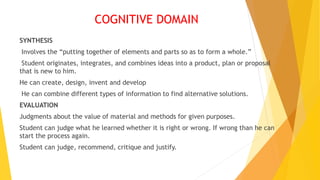
SYNTHESIS
Involves the “putting together of elements and parts so as to form a whole.”
Student originates, integrates, and combines ideas into a product, plan or proposal
that is new to him.
He can create, design, invent and develop
He can combine different types of information to find alternative solutions.
EVALUATION
Judgments about the value of material and methods for given purposes.
Student can judge what he learned whether it is right or wrong. If wrong than he can
start the process again.
Student can judge, recommend, critique and justify.
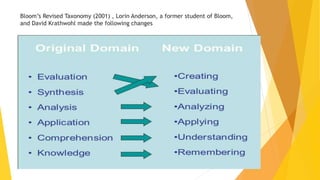
Bloom’s Revised Taxonomy (2001) , Lorin Anderson, a former student of Bloom,
and David Krathwohl made the following changes
The Affective Domain
 Skills in the affective domain describe the way people react
emotionally and their ability to feel other living things' pain or joy.
Affective objectives typically target the awareness and growth in
attitudes, emotion, and feelings.
 There are five levels in the affective domain moving through the
lowest-order processes to the highest:
 Receiving, Responding , Valuing , Organizing and characterizing.
Affective Domains
 RECEIVING
The lowest level; the student passively pays attention. Without this
level, no learning can occur. Receiving is about the student's memory
and recognition as well. EXAMPLE: Student saw a person helping
poor...
 RESPONDING
The student actively participates in the learning process, not only
attends to a stimulus; the student also reacts in some way. EXAMPLE:
He saw that people appreciating the person who helped poor…
Affective Domains
 VALUING
The student attaches a value to an object, phenomenon, or piece of
information. The student associates a value or some values to the knowledge
they acquired. Example: He gives value that helping poor is an appreciable
work…
 ORGANIZING
The student can put together different values, information, and ideas, and
can accommodate them within his/her own schema; the student is
comparing, relating and elaborating on what has been learned. Example: He
organizes his learning that how he can help poor…
 CHARACTARIZING
The student at this level tries to build abstract knowledge. Example: At this
stage the habit becomes the part of his character.
The Psychomotor Domain
 Skills in the psychomotor domain describe the ability to
physically manipulate a tool or instrument like a hand or a
hammer. Psychomotor objectives usually focus on change
and/or development in behavior and/or skills.
Knowledge to be tested
 Factual Knowledge
 Terminology, Facts, Figures
 Conceptual Knowledge
 Classification, Principles, Theories, Structures, Frameworks
 Procedural Knowledge
 Algorithms, Techniques and Methods and Knowing when and how to
use them.
 Metacognitive Knowledge
 Strategy, Overview, Self Knowledge, Knowing how you know.
Higher order thinking skills
 The term higher‐order thinking skills refers to the complex cognitive
processes by which individuals go beyond simply memorizing
information such as grammar rules and words.
 Higher‐order thinking skills include, for example, developing logical
steps to work through language tasks, assessing the situation or
context in which they are to complete a task, finding a solution to a
problem (e.g., by taking into account the nature of a given task, the
resources available or required, the time allowed, and the people
involved), and making judgments of their own performance through
monitoring, evaluating, and reflecting on their thinking or
performance.
 Higher‐order thinking skills should be considered an integral part of
ongoing language learning and development.
Lower and Higher order Skills
 Newman (1990), in order to differentiate between the two
categories of skills, concludes that the lower skills require simple
applications and routine steps.
 In contrast and according to Newman (1993) higher order thinking
skills "challenge students to interpret, analyze, or manipulate
information" (P.44). However, Newman argues that the terms
higher and lower skills is relative, a specific subject might
demand higher skills for a particular student, whereas, another
one requires lower skills.
Assessment practices
 Many educators believe that in order to teach higher-order
thinking skills, to fill the gap between the teachers’ assessment
practices and instructional tasks or goals, and to implement
new assessment ideas and classroom practices, a great change
from traditional assessment which assess students’ abilities to
remember the facts (NRC, 2000), into authentic assessment
that has the ability to reflect and measure the actual learning-
teaching outcomes, and to evaluate and reform the goal of the
new curricula and teaching strategies used in classes is
required. As a result of this demand, other forms of assessment
have been sought and many alternatives have been
implemented.
What is an Open Book Examination
• examinees are allowed to consult their class notes, textbooks, and
other approved material while answering questions.
•It is ideally suited to teaching programmes that especially aim at
developing the skills of critical and creative thinking.
• In the broadest sense, an open book exam allows students to consult
some form of reference material in the course of completing the
exam.
• Open book exams and closed book exams have different pedagogical
ends.
• While a closed book exam “places a premium on accurate and
extensive recall, and unless carefully designed, its assessment of
students’ knowledge is likely to be dominated by that ability”.
Open Book Exams
Open book exams places the focus on higher level learning. Because
open book exams don’t have the same emphasis on memorization,
questions can move up Bloom’s Taxonomy of Educational Objectives,
and ask students to analyze, evaluate, or synthesize knowledge,
rather than just remember it. According to Chan, 2009.
• Students are allowed to review reference material during the
examination
• Exam questions are distributed to students in advance of the
exam, allowing students to prepare resources for use in the exam.
• Students are allowed to take home their exams to complete at
home within a specified time period.
Types of Open Book Examinations
Restricted Type and Unrestricted Types
Restricted type:
1. Students are permitted to bring into the examination room one or more specific
documents approved by the course instructor.
2. Students may be permitted to consult printed documents such as the logarithmic
tables, dictionaries, or complete works of Shakespeare, but no handwritten material
or printed documents which have not had prior approval.
3. The approved documents function more or less as appendices to the question paper
itself.
4. These examinations are not radically different from closed book examinations.
They do not present any special problems, irrespective of the nature of the course.
Types of Open Book Examinations
 Unrestricted Type:
• students are free to bring whatever they like.
• They may bring any books, lecture handouts of the course instructor,
or their own handwritten notes.
• The use of such examinations presumes certain teaching strategies
and types of questions.
• In particular, it demands that the course focuses on a set of
intellectual skills, rather than on the information content, and that no
content based questions be asked in the examination.
Open Book Exam Questions
 What kinds of questions will an open book exam have?
• Open Book Exams don't test students memory. They test their ability to
find and use information for problem solving, and to deliver well-
structured and well-presented arguments and solutions.
• Open Book exam questions usually require students to apply
knowledge, and they may be essay-style questions or involve
explanations with real data or delivering solutions. The style of question
depends on the faculty or school setting the exam.
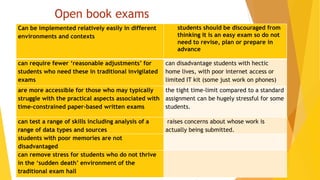
Open book exams
Can be implemented relatively easily in different
environments and contexts
students should be discouraged from
thinking it is an easy exam so do not
need to revise, plan or prepare in
advance
can require fewer ‘reasonable adjustments’ for
students who need these in traditional invigilated
exams
can disadvantage students with hectic
home lives, with poor internet access or
limited IT kit (some just work on phones)
are more accessible for those who may typically
struggle with the practical aspects associated with
time-constrained paper-based written exams
the tight time-limit compared to a standard
assignment can be hugely stressful for some
students.
can test a range of skills including analysis of a
range of data types and sources
raises concerns about whose work is
actually being submitted.
students with poor memories are not
disadvantaged
can remove stress for students who do not thrive
in the ‘sudden death’ environment of the
traditional exam hall
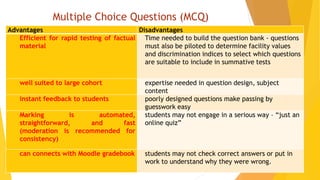
Multiple Choice Questions (MCQ)
Advantages Disadvantages
Efficient for rapid testing of factual
material
Time needed to build the question bank - questions
must also be piloted to determine facility values
and discrimination indices to select which questions
are suitable to include in summative tests
well suited to large cohort expertise needed in question design, subject
content
instant feedback to students poorly designed questions make passing by
guesswork easy
Marking is automated,
straightforward, and fast
(moderation is recommended for
consistency)
students may not engage in a serious way – “just an
online quiz”
can connects with Moodle gradebook students may not check correct answers or put in
work to understand why they were wrong.
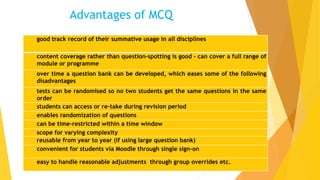
Advantages of MCQ
good track record of their summative usage in all disciplines
content coverage rather than question-spotting is good - can cover a full range of
module or programme
over time a question bank can be developed, which eases some of the following
disadvantages
tests can be randomised so no two students get the same questions in the same
order
students can access or re-take during revision period
enables randomization of questions
can be time-restricted within a time window
scope for varying complexity
reusable from year to year (if using large question bank)
convenient for students via Moodle through single sign-on
easy to handle reasonable adjustments through group overrides etc.
Testing and Evaluation System in Higher Education.pptx

Testing and Evaluation System in Higher Education.pptx

  • 1.
    Testing and EvaluationSystem in Higher Education Dr.VMS
  • 2.
  • 3.
    Testing Testing is animportant phenomenon from science to arts, in order to weigh, measure and qualify the validity and the quantum of things. In order to find out the nature and state of the students proficiency, tests are to be conducted and the results are the only source, which provide valuable ideas, and suggestions. The most common use of test is to pinpoint strengths and weakness in the learnt abilities of the students.
  • 4.
  • 5.
    Assessment  Mousavi (2009,p. 36) defined assessment as “appraising or estimating the level or magnitude of some attribute of a person.”  Classroom assessment, Mihai (2010) categorized it according to intention, purpose, interpretation, and administration.  In regard to intention, an assessment can be informal when it is a spontaneous comment, or it can be formal when it is carried out in a systematic manner.  In terms of purpose, an assessment can be formative if it focuses on the process of learning or it can be summative when it is used to measure student learning outcomes at the end of an education cycle.
  • 6.
    Evaluation  Evaluation isthe process of assessing or judging the value, worth, quality, or significance of something.  Educational Evaluation: In education, evaluation involves assessing students' learning, progress, and achievements. It can also refer to assessing the effectiveness of educational programs, curriculum, or teaching methods.  Performance Evaluation: In the workplace, evaluation often involves assessing an employee's job performance, typically for the purpose of determining promotions, raises, or areas for improvement.  Program Evaluation: Program evaluation involves assessing the effectiveness, efficiency, and impact of a program or intervention. This is often done to determine whether the program is meeting its goals and objectives.  Product Evaluation: This involves assessing the quality, usability, and effectiveness of a product, such as a consumer product, software application, or medical device.  Policy Evaluation: Policy evaluation involves assessing the impact and effectiveness of government policies, programs, or initiatives.
  • 7.
    Types of tests Achievement Test  Achievement tests are typically used in educational settings to assess a student's level of mastery in a specific subject area, such as math, reading, science, or history. Achievement tests are often used to evaluate the effectiveness of educational programs, or to determine eligibility for educational placement or certification.
  • 8.
    Types of Tests Diagnostic Test  Diagnostic tests are often used to assess a student's readiness for a particular course or to identify areas where additional instruction may be needed. In healthcare, diagnostic tests are used to identify the presence or extent of a disease or condition. These tests are an important tool for educators and healthcare providers to tailor their instruction or treatment plans to meet the individual needs of their students or patients.  Unlike achievement tests, which measure overall knowledge or proficiency, diagnostic tests are designed to identify strengths and weaknesses in specific areas.
  • 9.
    Types of Tests Discrete-Point Test  The discrete-point test, also called as discrete-item test, constructed to measure understanding of specific scientific concepts, their ability to apply formulas or solve problems, or their knowledge of scientific terminology.  Language Aptitude Test  Language aptitude refers to the potential abilities that a learner has for learning languages. The potential ability of a leaner is often evaluated using formal aptitude tests, which predict the degree of success the learner will have in language. Language aptitude also refers to the learners’ linguistic and personal abilities towards learning language.
  • 10.
    Types of Tests Placement Test  A placement test is a test given by a school to determine the academic or skill level of a student, especially a new student, in order to place them in the correct class. Also placement tests are designed to place learners at an appropriate level in a programme or course.  Proficiency Test  A proficiency test is a measure of an individual's ability to perform tasks and skills in a specific domain, such as language, mathematics, or a professional field. Proficiency tests are designed to assess a person's level of mastery or competence in a particular area, typically against a predefined standard or benchmark.
  • 11.
    Progress Test  Aprogress test considers identifying the progress of a learner in the given point of time in the selected learning item. It is closely related to the particular teaching materials and particular course of instruction. Progress tests are administered several times during the course work such as at the end of a unit, a course, or term. A progress test may be viewed as similar to an achievement test but much narrower and much more specific in scope (Richards et al., 1989).
  • 12.
    Reliability  A testis considered reliable if it is administered on different occasions and similar results are obtained. Brown and Abeywickrama (2010, p. 27) suggested the following ways to ensure that a test is reliable:  It is consistent in its conditions across two or more administrations.  It gives clear directions for scoring or evaluation.  It has uniform rubrics for scoring or evaluation.  It lends itself to consistent application of those rubrics by the rater.  It contains items or tasks that are unambiguous to the test- takers.
  • 13.
    Practicality  Practicality refersto the logistical, practical, and administrative issues involved in the process of constructing, administering, and rating an assessment instrument (Brown & Abeywickrama, 2010).  Bachman and Palmer (1996, p. 36), defined practicality as “the relationship between the resources that will be required in the design, development, and use of the test and the resources that will be available for testing activities.”
  • 14.
    Washback  Washback mayhave been called backwash, test impact, measurement-driven instruction, curriculum alignment, and test feedback (Brown & Hudson, 1998).  Washback, the effect of testing and assessment on the language teaching curriculum that is related to it.  washback is used to refer to the influence that a test has on teaching and learning (Hughes, 2003).
  • 15.
    Assessment  Assessment is“appraising or estimating the level or magnitude of some attribute of a person.” Mousavi (2009, p. 36)  Classroom assessment, Mihai (2010) categorized it according to intention, purpose, interpretation, and administration.  In regard to intention, an assessment can be informal when it is a spontaneous comment, or it can be formal when it is carried out in a systematic manner.  In terms of purpose, an assessment can be formative if it focuses on the process of learning or it can be summative when it is used to measure student learning outcomes at the end of an education cycle.
  • 16.
    Assessment  In thefield of education, “some form of assessment is inevitable; it is inherent in the teaching – learning process” (Hopkins, Stanley, & Hopkins, 1990, p.194).  Stoynoff and Chapelle (2005) stated that “teachers are involved in many forms of assessment and testing through their daily teaching and use of test scores” (p. 1),  Assessment is the process of documenting, usually in measurable terms, knowledge, skills, attitudes and beliefs. Assessment in education is the process of gathering, interpreting, recording & using information about pupils’ responses to an educational task. (Harlen, Gipps, Broadfoot, Nuttal, 1992)
  • 17.
    Types of Assessment Formative assessment occurs throughout a class or course, and seeks to improve student achievement of learning objectives through approaches that can support specific student needs (Theal and Franklin, 2010, p. 151).  Summative assessments evaluate student learning, knowledge, proficiency, or success at the conclusion of an instructional period, like a unit, course, or program.
  • 18.
    Assessment Need  Accordingto Airasian (1994) and Pellegrino, Chudowsky and Glaser (2001), assessment has three main purposes:  to assist learning  to measure a particular student’s achievement and  to evaluate the whole program  without good assessment techniques it is difficult to ascertain whether reforms in instruction and curriculum are working.  The suitable assessment is one that can be used or leads to improvement in student’s learning. Moreover, it can reveal the student’s weakness and strength areas; the strength area to be enhanced and the weakness area to be treated.
  • 19.
    Offline vs. OnlineAssessment Sl. No. Offline Exams Online Exams 1. The assessment is done by pen and paper or OMR(optical mark reading), done in a computer lab without Internet access, but there is a local network available. A powerful online exams or e-testing system is 100% secure. It runs with a safe exam browser that locks examiners’ screens to show only the exam on the operating system used. 2. A long and tiring process of conducting and evaluating the exams. A User can access the test with a unique id and password, irrespective of location. 3. Cost of ink from printing and the cost of paper No cost of paper, pen, ink, manpower in evaluating the paper, etc. It becomes easier for institutes to conduct weekly, monthly, online exams and measure the class performance, student performance in each subject/course. 4. There is a slight difference in timing for each candidate while collecting answer sheets Online exam software controls the whole exam process from conducting exams to the evaluation process. It brings efficiency to the exam process. The probability of errors in the evaluation and results is very less 5. Less security As compared to traditional pen and paper based exam, security is far better in every aspect.
  • 20.
    Challenges  How canthe assessment be condensed in content and length and still provide useful results?  How can assessment results be provided in a timely manner?  How can the assessment be administered under different scenarios, including at home, at school, or virtually at an off-site location?  How can the schools and colleges be supported in using high-quality curricula that are aligned to various standards and assessments?
  • 21.
    Online assessment challenges Various studies reported considerable amount of barriers that affect online assessment. Multiple challenges have been emerging. The shift from a physical classroom to a virtual class has changed traditional techniques and assessment methods.  E- Assessment has been a challenging process in the sense that it required using a frame work that should be valid and reliable.  Multiple challenges have been encountered by instructors questioning the consequences of the shift from face to face learning to full-time e learning (Yadov, Gupta, & Khetrapal, 2018).
  • 22.
    Use of Technologyin Assessment • Greater variety and authenticity in the design of assessments • Improved learner engagement, for example through interactive formative assessments with adaptive feedback • Choice in the timing and location • Capture of wider skills and attributes not easily assessed by other means, for example through simulations, e-portfolios and interactive games • Efficient submission, marking, moderation and data storage processes
  • 23.
    Use of Technologyin Assessment • Consistent, accurate results with opportunities to combine human and computer marking • Immediate feedback • Increased opportunities for learners to act on feedback, for example by reflection in e-portfolios • Innovative approaches based around use of creative media and online peer and self- assessment • Accurate, timely and accessible evidence on the effectiveness of curriculum design and delivery
  • 24.
    Online Class AssessmentTechniques Three-step process – Plan / Implement / Respond • Plan: what is to be learnt from a classroom assessment. • Implement: explain the purpose of the activity to students, then conduct it. • Respond: review the results and decide what changes, if any, to make. Share information with students.
  • 25.
    Equivalency and Authenticity In assessment, equivalency refers to the idea that different forms of a test or assessment should be comparable in terms of the content covered and the level of difficulty. This ensures that the results of the assessment are fair and reliable, regardless of which form of the test a person takes.  “An assessment has the property of equivalency if it is directly based on curriculum standards or instructional activities. Specifically, equivalency determines in what ways assessment design is influenced by teaching” (Mihai, 2010, p. 45).
  • 26.
    Evaluation  Evaluation isan activity through which the human behaviors, actions and happenings of the world are identified, perceived and realized. It is the only activity that controls and provides valid judgments and conclusions about each and every activity of the day-to-day events.  Test is a part in the process of evaluation but not the whole of it.  An evaluation process may be complete when the tests are rightly interpreted with pros and cons of it.
  • 27.
    Testing and Evaluationin Curriculum Domain  Tests do not always follow evaluation procedures and in many cases the purpose of the tests is specific and they do not necessarily include the evaluation procedures. Mostly tests are conducted and made use of for pedagogical and recruitment purposes.
  • 28.
    Grant Henning (1987,p:9) Evaluation of the language tests should consider  Purpose of the test  Characteristics of the examinees  Accuracy of measurement  Suitability of the format and features of a test  Developmental sample  Availability of equivalent or equated forms  Nature of the scoring and reporting of scores  Procurement and  Political compatibility of the test.
  • 29.
    Role of evaluation Identification of course objectives. (the expected or desired learning outcome)  Defining the objectives in terms of learners’ terminal behavior.  Constructing appropriate tools or instrument for measuring the behavior.  Applying or administering the tools/instruments and analyzing the results to determine the degree of learners’ achievement in the instructional program.  The above four steps are basically the same in the evaluation of instructions, curriculum or the program as a whole. Both measurement and evaluation require broad variety of tools or instruments such as, tests, rating scales, inventories, check lists, questionnaires etc.
  • 30.
    Types of Evaluation Evaluation OngoingTerminal Formative Summative Brief Extensive
  • 31.
    Ongoing evaluation  Ongoingevaluation is meant for getting the feedback regularly after the completion of every step during its process viz. planning, preparation, production and application. This would enable the program to improve at various stages at that time of the program itself. This type of evaluation is more helpful to modify anything if necessary in the course of the didactic process.
  • 32.
    Terminal evaluation  Terminalevaluation is a type of evaluation that is made after the completion of the program and it is used to know whether the program is success or failure. This type of evaluation would not be used for any improvement of the program. In general, evaluation has been further classified into four categories: They are:  Formative evaluation  Summative evaluation  Brief evaluation and  Extensive evaluation
  • 33.
    Types of Evaluation Formative evaluation  Formative evaluation is a process of evaluation that is made from time to time in the case of an instructional program and from one stage to the other. It does not provide a totalitarian impression of the quality either of the instructional programs, the techniques and methods, materials or media.  Summative evaluation  Summative evaluation is that kind of evaluation which takes into consideration the periodic evaluation that has been made and in addition to a total evaluation of the program: process or product made and the conclusions are arrived at keeping in view the outcome of the periodic evaluation in addition to the final evaluation.
  • 34.
    Types of Evaluation Brief evaluation  Evaluating a program can also be made taking into account only some aspects and the evaluator can also give a judgment based on the few aspects chosen for evaluation. But it will be subjective and impressionistic and not a realistic one. This can be useful to roughly compare two (or) more programs.  Extensive evaluation  Extensive evaluation involves the analysis of a program in its entire main and sub aspects. The evaluator has to rate and weigh each of them individually and consolidate the total rating based on which he makes his value judgment. This is more objective and valid.
  • 35.
    Research Techniques 1. datacollection techniques  Observational  Experimental 2. causality relationships  Descriptive  Analytical 3. relationships with time  Retrospective  Prospective  Cross-sectional 4. medium of application  Clinical  Laboratory  Social descriptive research
  • 36.
    Scientific Research  Scientificresearch is a systematic investigation conducted to discover new knowledge, validate existing knowledge, or solve specific problems in the natural or social sciences. It follows a structured process that involves formulating a research question or hypothesis, designing and conducting experiments or studies, collecting and analyzing data, and drawing conclusions based on the findings.  Scientific research is characterized by its emphasis on objectivity, systematic methodology, and reproducibility. It is typically conducted by trained researchers, such as scientists, scholars, or academics, and often involves collaboration with other researchers or experts in the field.
  • 37.
    Scientific research Non-scientificresearch Logical Expanding understanding Reproduced and demonstrated Not Logical Reproduction may result in varied results Truth and factual enquiry Scientific techniques are utilized Identification of problem Formulation of hypothesis Data analysis and interpretation Recommendations and conclusions Acquiring knowledge and truths about the world using techniques without following the scientific method. Systematic Experimentation Observation Investigation based on natural phenomenon
  • 38.
    Bloom’s Taxonomy (1956) TheThree Domains of Learning: 1. Cognitive: mental skills (knowledge) 2. Affective: growth in feelings or emotional areas (attitude or self) 3. Psychomotor: manual or physical skills (skills) Instructional designers, trainers, and educators These three categories are referred as KSA (Knowledge, Skills and Abilities)
  • 40.
    Blooms Taxonomy  Remember:define, repeat, record, list, recall, name, relate, underline.  Understand: translate, restate, discuss, describe, recognise, explain, express, identify, locate, report, review, tell.  Apply: interpret, apply, employ, use, demonstrate, dramatise, practice, illustrate, operate, schedule, sketch.  Analyse: distinguish, analyse, differentiate, appraise, calculate, experiment, test, compare, contrast, criticise, diagram, inspect, debate, question, relate, solve, examine, categorise.  Evaluate: judge, appraise, evaluate, rate, compare, revise, assess, estimate  Create: compose, plan, propose, design, formulate, arrange, assemble, collect, construct, create, set-up, organise, manage, prepare.
  • 41.
    COGNITIVE DOMAIN  Thecognitive domain involves knowledge and the development of intellectual skills.  This includes the recall or recognition of specific facts, procedural patterns, and concepts that serve in the development of intellectual abilities and skills. There are six major categories of cognitive processes, starting from the simplest to the most complex
  • 42.
    COGNITIVE DOMAIN KNOWLEDGE “involves therecall of specifics and universals, the recall of methods and processes, or the recall of a pattern, structure, or setting.” Student can: Write, List, Define with his knowledge if he have. COMPREHENSION Refers to a type of understanding or apprehension such that the individual knows what is being communicated. Student translates, comprehends or interprets information based on prior learning like: Explain, summarize, paraphrase, describe
  • 43.
    COGNITIVE DOMAIN APPLICATION Refers tothe “use of abstractions in particular and concrete situations.” Student selects, transfers and uses data and principles to complete a problem with a minimum of direction. How student can use, compute, solve and apply his knowledge. ANALYSIS Breakdown of a communication into its constituent elements or parts. Student distinguishes, classifies and relates the evidence or structure of a statement or question. Student can analyze, categorize, compare and separate.
  • 44.
    COGNITIVE DOMAIN SYNTHESIS Involves the“putting together of elements and parts so as to form a whole.” Student originates, integrates, and combines ideas into a product, plan or proposal that is new to him. He can create, design, invent and develop He can combine different types of information to find alternative solutions. EVALUATION Judgments about the value of material and methods for given purposes. Student can judge what he learned whether it is right or wrong. If wrong than he can start the process again. Student can judge, recommend, critique and justify.
  • 45.
    Bloom’s Revised Taxonomy(2001) , Lorin Anderson, a former student of Bloom, and David Krathwohl made the following changes
  • 46.
    The Affective Domain Skills in the affective domain describe the way people react emotionally and their ability to feel other living things' pain or joy. Affective objectives typically target the awareness and growth in attitudes, emotion, and feelings.  There are five levels in the affective domain moving through the lowest-order processes to the highest:  Receiving, Responding , Valuing , Organizing and characterizing.
  • 47.
    Affective Domains  RECEIVING Thelowest level; the student passively pays attention. Without this level, no learning can occur. Receiving is about the student's memory and recognition as well. EXAMPLE: Student saw a person helping poor...  RESPONDING The student actively participates in the learning process, not only attends to a stimulus; the student also reacts in some way. EXAMPLE: He saw that people appreciating the person who helped poor…
  • 48.
    Affective Domains  VALUING Thestudent attaches a value to an object, phenomenon, or piece of information. The student associates a value or some values to the knowledge they acquired. Example: He gives value that helping poor is an appreciable work…  ORGANIZING The student can put together different values, information, and ideas, and can accommodate them within his/her own schema; the student is comparing, relating and elaborating on what has been learned. Example: He organizes his learning that how he can help poor…  CHARACTARIZING The student at this level tries to build abstract knowledge. Example: At this stage the habit becomes the part of his character.
  • 49.
    The Psychomotor Domain Skills in the psychomotor domain describe the ability to physically manipulate a tool or instrument like a hand or a hammer. Psychomotor objectives usually focus on change and/or development in behavior and/or skills.
  • 51.
    Knowledge to betested  Factual Knowledge  Terminology, Facts, Figures  Conceptual Knowledge  Classification, Principles, Theories, Structures, Frameworks  Procedural Knowledge  Algorithms, Techniques and Methods and Knowing when and how to use them.  Metacognitive Knowledge  Strategy, Overview, Self Knowledge, Knowing how you know.
  • 52.
    Higher order thinkingskills  The term higher‐order thinking skills refers to the complex cognitive processes by which individuals go beyond simply memorizing information such as grammar rules and words.  Higher‐order thinking skills include, for example, developing logical steps to work through language tasks, assessing the situation or context in which they are to complete a task, finding a solution to a problem (e.g., by taking into account the nature of a given task, the resources available or required, the time allowed, and the people involved), and making judgments of their own performance through monitoring, evaluating, and reflecting on their thinking or performance.  Higher‐order thinking skills should be considered an integral part of ongoing language learning and development.
  • 53.
    Lower and Higherorder Skills  Newman (1990), in order to differentiate between the two categories of skills, concludes that the lower skills require simple applications and routine steps.  In contrast and according to Newman (1993) higher order thinking skills "challenge students to interpret, analyze, or manipulate information" (P.44). However, Newman argues that the terms higher and lower skills is relative, a specific subject might demand higher skills for a particular student, whereas, another one requires lower skills.
  • 54.
    Assessment practices  Manyeducators believe that in order to teach higher-order thinking skills, to fill the gap between the teachers’ assessment practices and instructional tasks or goals, and to implement new assessment ideas and classroom practices, a great change from traditional assessment which assess students’ abilities to remember the facts (NRC, 2000), into authentic assessment that has the ability to reflect and measure the actual learning- teaching outcomes, and to evaluate and reform the goal of the new curricula and teaching strategies used in classes is required. As a result of this demand, other forms of assessment have been sought and many alternatives have been implemented.
  • 55.
    What is anOpen Book Examination • examinees are allowed to consult their class notes, textbooks, and other approved material while answering questions. •It is ideally suited to teaching programmes that especially aim at developing the skills of critical and creative thinking. • In the broadest sense, an open book exam allows students to consult some form of reference material in the course of completing the exam. • Open book exams and closed book exams have different pedagogical ends. • While a closed book exam “places a premium on accurate and extensive recall, and unless carefully designed, its assessment of students’ knowledge is likely to be dominated by that ability”.
  • 56.
    Open Book Exams Openbook exams places the focus on higher level learning. Because open book exams don’t have the same emphasis on memorization, questions can move up Bloom’s Taxonomy of Educational Objectives, and ask students to analyze, evaluate, or synthesize knowledge, rather than just remember it. According to Chan, 2009. • Students are allowed to review reference material during the examination • Exam questions are distributed to students in advance of the exam, allowing students to prepare resources for use in the exam. • Students are allowed to take home their exams to complete at home within a specified time period.
  • 57.
    Types of OpenBook Examinations Restricted Type and Unrestricted Types Restricted type: 1. Students are permitted to bring into the examination room one or more specific documents approved by the course instructor. 2. Students may be permitted to consult printed documents such as the logarithmic tables, dictionaries, or complete works of Shakespeare, but no handwritten material or printed documents which have not had prior approval. 3. The approved documents function more or less as appendices to the question paper itself. 4. These examinations are not radically different from closed book examinations. They do not present any special problems, irrespective of the nature of the course.
  • 58.
    Types of OpenBook Examinations  Unrestricted Type: • students are free to bring whatever they like. • They may bring any books, lecture handouts of the course instructor, or their own handwritten notes. • The use of such examinations presumes certain teaching strategies and types of questions. • In particular, it demands that the course focuses on a set of intellectual skills, rather than on the information content, and that no content based questions be asked in the examination.
  • 59.
    Open Book ExamQuestions  What kinds of questions will an open book exam have? • Open Book Exams don't test students memory. They test their ability to find and use information for problem solving, and to deliver well- structured and well-presented arguments and solutions. • Open Book exam questions usually require students to apply knowledge, and they may be essay-style questions or involve explanations with real data or delivering solutions. The style of question depends on the faculty or school setting the exam.
  • 60.
    Open book exams Canbe implemented relatively easily in different environments and contexts students should be discouraged from thinking it is an easy exam so do not need to revise, plan or prepare in advance can require fewer ‘reasonable adjustments’ for students who need these in traditional invigilated exams can disadvantage students with hectic home lives, with poor internet access or limited IT kit (some just work on phones) are more accessible for those who may typically struggle with the practical aspects associated with time-constrained paper-based written exams the tight time-limit compared to a standard assignment can be hugely stressful for some students. can test a range of skills including analysis of a range of data types and sources raises concerns about whose work is actually being submitted. students with poor memories are not disadvantaged can remove stress for students who do not thrive in the ‘sudden death’ environment of the traditional exam hall
  • 61.
    Multiple Choice Questions(MCQ) Advantages Disadvantages Efficient for rapid testing of factual material Time needed to build the question bank - questions must also be piloted to determine facility values and discrimination indices to select which questions are suitable to include in summative tests well suited to large cohort expertise needed in question design, subject content instant feedback to students poorly designed questions make passing by guesswork easy Marking is automated, straightforward, and fast (moderation is recommended for consistency) students may not engage in a serious way – “just an online quiz” can connects with Moodle gradebook students may not check correct answers or put in work to understand why they were wrong.
  • 62.
    Advantages of MCQ goodtrack record of their summative usage in all disciplines content coverage rather than question-spotting is good - can cover a full range of module or programme over time a question bank can be developed, which eases some of the following disadvantages tests can be randomised so no two students get the same questions in the same order students can access or re-take during revision period enables randomization of questions can be time-restricted within a time window scope for varying complexity reusable from year to year (if using large question bank) convenient for students via Moodle through single sign-on easy to handle reasonable adjustments through group overrides etc.

Editor's Notes

  • #18  •Should be offered as often as possible •Is a powerful form of practice for students that helps them evaluate their learning progress and become self-regulating •Helps students understand that the goal is to improve learning, not only apply final grades •Especially important right now when students may feel less connected to their instructor and their peers •Create more stability in a time when students are experiencing a high level of uncertainty  •You can create a low stakes back and forth feedback loop that is important for students to measure their progress. Summative Assessment: When some of us hear assessment, we think of summative assessments. read slide They are often the most heavily weighted.  These are often finate and fixed. Summative assessments can be used in conjunction with formative assessments. It is especially important to insure that the assessment aligns with the goals and expected outcomes of the instruction.