1
Azelnidipine – A novel CCB
Dr Awadhesh Sharma,DM,FACC,FSCAI
Assistant Professor
LPS Institute of Cardiology
GSVM Medical College, Kanpur, UP
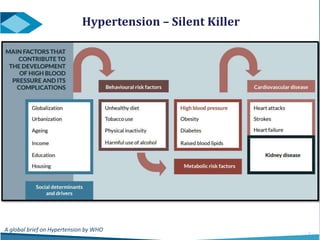
Hypertension – Silent Killer
2
A global brief on Hypertension by WHO
ACC/AHA – New Guideline
3
2019 ACC/AHA Guidelines
BP Category SBP DBP
Normal <120 mm Hg and <80 mm Hg
Elevated 120–129 mm Hg and <80 mm Hg
Hypertension
Stage 1 130–139 mm Hg or 80–89 mm Hg
Stage 2 ≥140 mm Hg or ≥90 mm Hg
New Goal for BP Levels
4
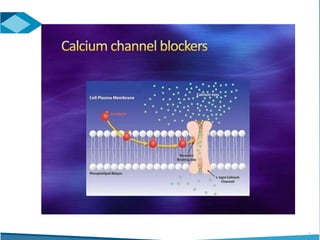
• L-type - main targets of CCBs
- cardiac, smooth muscles & endocrine cells
• T-type – neurons & endocrine cells
- pacemaker cells, atrial cells and purkinje fibers
• N-/P-/R type – brain, neuron & pituitary gland
Conventional CCB’s fails
here…
• Reflex tachycardia
• More incidence of Pedal Edema
• Elevated Proteinuria level
Looking beyondthe conventional CCB
Azelnidipine – Drug Profile of A Novel CCB
8
Drugs Blocking activity
L-type N-type T-type
Nifedipine + - -
Amlodipine + - -
Cilnidipine + + -
Efonidipine + - +
Azelnidipine + - +
Keio J Med. September 2010 ; 59 (3) : 84-95.
Chemical Structure - Azelnidipine
9
• Azelnidipine is a new dihydropyridine calcium channel antagonist
• It is L and T type of calcium channel blocker
• Composed of a racemic mixture containing a 1:1 ratio of the
active R-enantiomer and the inactive S-enantiomer
Drugs 2003; 63 (23): 2613-2621
Mechanism of Action of Azelnidipine
 Blocks L-Type calcium channel in blood vessel and T-type Calcium
channel in heart
 Results in vasodilation and reduced heart rate
 Shows 17-folds higher lipophilicity than of amlodipine
10
Drugs 2003; 63 (23): 2613-2621
Mechanism of Action
 Azelnidipine acts on SA node
 Inhibits T-type Calcium
channel activation
 It prolongs the late phase-4
depolarization
11
 Azelnidipine block T-type Calcium
channel present on zona glomerulosa
 Inhibit Aldosterone synthesis and
release
Drugs 2003; 63 (23): 2613-2621
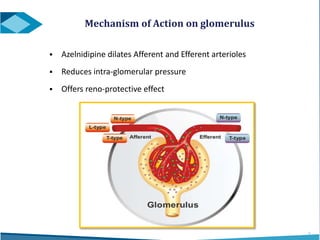
Mechanism of Action on glomerulus
 Azelnidipine dilates Afferent and Efferent arterioles
 Reduces intra-glomerular pressure
 Offers reno-protective effect
12
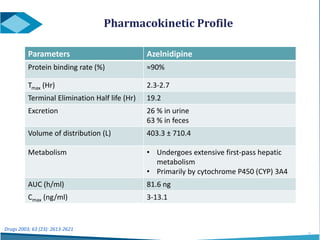
Pharmacokinetic Profile
13
Parameters Azelnidipine
Protein binding rate (%) ≈90%
Tmax (Hr) 2.3-2.7
Terminal Elimination Half life (Hr) 19.2
Excretion 26 % in urine
63 % in feces
Volume of distribution (L) 403.3 ± 710.4
Metabolism • Undergoes extensive first-pass hepatic
metabolism
• Primarily by cytochrome P450 (CYP) 3A4
AUC (h/ml) 81.6 ng
Cmax (ng/ml) 3-13.1
Drugs 2003; 63 (23): 2613-2621
Dosage and Indications
 Azelnidipine tablets 16 mg
 For the treatment of Essential Hypertension.
14
CDSCO site
Approved by
DCGI
USE IN SPECIFIC POPULATION
 Severe renal Impairment: Efficacy have not been established
 Severe hepatic impairment: Efficacy have not been established
 Pediatric Use: Efficacy have not been established
 Elderly Use: Low dose (8 mg once daily) is recommended
 Pregnancy: Not recommended
 Nursing mother: Not recommended
Contraindications
 Hypersensitivity to any of the ingredients
 Pregnant and nursing women
 Concomitant administration of systematic azole antifungal agent (e.g.
fluconazole)
 Concomitant administration of HIV protease inhibitor (e.g atazanavir)
15
Drug / Class Action
Azole anti-fungal agent
These drugs Inhibits CYP3A4 and increases
the concentration of Azelnidipine in body
HIV protease inhibitor
Cimetidine
Erythromycin, Azithromycin
Digoxin Cmax of digoxin increases
http://www.kegg.jp/medicus- in/japic_med?japic_code=00061591
Drug Interactions
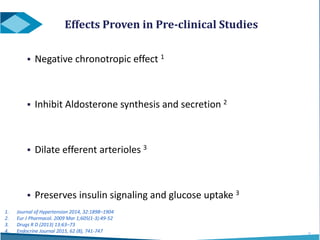
Effects Proven in Pre-clinical Studies
 Negative chronotropic effect 1
 Inhibit Aldosterone synthesis and secretion 2
 Dilate efferent arterioles 3
 Preserves insulin signaling and glucose uptake 3
16
1. Journal of Hypertension 2014, 32:1898–1904
2. Eur J Pharmacol. 2009 Mar 1;605(1-3):49-52
3. Drugs R D (2013) 13:63–73
4. Endocrine Journal 2015, 62 (8), 741-747
Azelnidipine
BP Control & Cardio-protection
17
Clinical Evidences
Azelnidipine
Cardiac Perspective
Study 1: Sustained Blood Pressure-Lowering Effect of Azelnidipine
Guided by Self-Measured Morning and Evening Home Blood
Pressure: Subgroup Analysis of the At-HOME Study
• At-HOME study conducted in Japan
• Objective: To evaluate the sustained BP lowering effect of Azelnidipine,
using mean morning and evening systolic BP [ME average] and morning
systolic BP minus evening systolic BP (ME difference).
• Efficacy analysis- N = 4852
• Safety analysis- N = 5265
18
Drugs R D (2013) 13:75–85
Clinical Improvement From Baseline
19
Changes in a morning and evening home blood
pressure (BP)
Changes in morning and evening home pulse
rates after Azelnidipine treatment
*p0.0001 vs. baseline, according to Dunnett’s test. DBP diastolic blood pressure, SBP systolic blood pressure
Changes in morning & evening SBP (ME average) & morning SBP minus evening SBP (ME difference) following
Azelnidipine treatment
Drugs R D (2013) 13:75–85
Improvement in Patient Distribution
Drugs R D (2013) 13:75–85
20
Changes in patient distribution according to morning and evening systolic blood pressure (ME average) and morning systolic blood
pressure minus evening systolic blood pressure (ME difference) [n = 2,101; p0.0001 vs. baseline according to the McNemar test].
• Significant reduction in home SBP and DBP
• BP-lowering effect lasted till next day morning
• Useful for patients with morning hypertension, who are at high risk
of cardiovascular events, especially stroke.
Study 2: Inhibitory Effects of Azelnidipine Tablets on
Morning Hypertension
Treatment: Azlenidipine 8/16 mg once daily for 16 weeks
21
Drugs R D (2013) 13:63–73
• Objective: To determine the BP- and pulse rate-lowering effects of
Azelnidipine, administered once daily in the morning.
• N=5433 Hypertensive patients
156.9 143 140 138.3 137.1
89.7 82.4 80.8 79.8 78.9
BASELINE4 WEEKS 8 WEEKS12 WEEKS16 WEEKS
Change in Blood pressure
SBP (mmHg) DBP (mmHg)
72.7
69.6
68.8 68.7 68.7
BASELINE 4 WEEKS 8 WEEKS 12
WEEKS
16
WEEKS
Change in Heart rate
Heart Rate (bpm)
• Azelnidipine offered significant reduction in morning BP
and heart rate within 4 weeks
Study 3: Azelnidipine and Amlodipine: A Comparison
of their Pharmacokinetics and Effects on ABPM
To compare the effects of Azelnidipine and Amlodipine on 24-h blood
pressure
 A randomized, double-blind Study in Hypertensive patients
 Azelnidipine 16 mg (23 patients) or amlodipine 5 mg (23 patients)
was administered once daily for 6 weeks
22
Hypertens Res. 2003 Mar;26(3):201-8.
23
 Hypertens Res. 2003 Mar;26(3):201-8.
Differences of Blood Pressure (BP) and Pulse Rate (PR) from the
Baseline Values after 6 Weeks of Treatment with Azelnidipine or
Amlodipine
• Both drugs offered 24h BP reduction and have similar antihypertensive effect
• Azelnidipine decrease pulse rate
• Amlodipine significantly increased pulse rate
Study 4: Azelnidipine and Amlodipine: A Comparison of Their Effects
and Safety in a Randomized Double-Blinded Clinical Trial in Chinese
Essential Hypertensive Patients
 N=220
 Treatment Azelnidipine 8 and 16 mg. Amlodipine 2.5 and 5 mg
 Duration: 8 Weeks
 ABPM was monitored at baseline and at 8 weeks (N=40)
24
 Clinical and Experimental Hypertension, 32(6): 372–376, (2010)
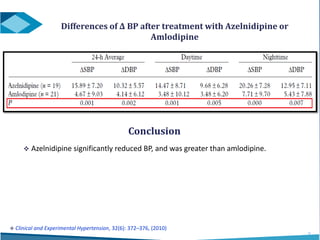
Changes of blood pressure and pulse rate in azelnidipine or amlodipine group
Conclusion
 Azelnidipine significantly reduced BP, and was greater than amlodipine.
25
 Clinical and Experimental Hypertension, 32(6): 372–376, (2010)
Differences of Δ BP after treatment with Azelnidipine or
Amlodipine
Study 5: Clinical use of Azelnidipine in
Treatment of Hypertension in Chinese Patients
• Relevant literature identified by from PubMed and CNKI (China
National Knowledge Infrastructure)
• Total of 23 articles selected from 54 articles
26
Therapeutics and Clinical Risk Management 2015:11
Azelnidipine and BP Reduction
• Significant reduction in BP mild-to moderate hypertension, similar to amlodipine and nifedipine
• Showed CV protective effects, anti-oxidative action, reduction in heart rate and improved systolic and
diastolic function
• Well tolerated and no severe adverse events were observed
Study 6: Impact of Azelnidipine and Amlodipine on Left
Ventricular Mass & Longitudinal Function in Hypertensive
Patients with LVH
 The study conducted to compare the effects of Azelnidipine & amlodipine on
LV function
 N= 32 hypertensive patients
 Intervention- 5 mg of amlodipine/day and16 mg of Azelnidipine/day.
 LV function and morphology was examined by conventional and speckle
tracking echocardiography at baseline and at 1, 3, 6,and 12 months after
treatment initiation
27
DOI: 10.1111/echo.12548 Echocardiography
28
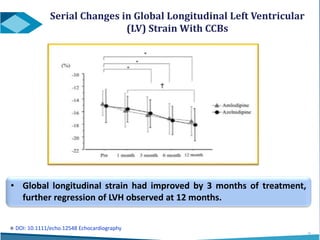
 DOI: 10.1111/echo.12548 Echocardiography
Serial Changes in Global Longitudinal Left Ventricular
(LV) Strain With CCBs
• Global longitudinal strain had improved by 3 months of treatment,
further regression of LVH observed at 12 months.
Study 7: Effects Of Azelnidipine Plus Olmesartan Vs Amlodipine
Plus Olmesartan on Central BP and LVMI: The AORTA Study
 Effects of olmesartan combined with either Azelnidipine or
amlodipine on central blood pressure (CBP) and left ventricular mass
index (LVMI) in hypertensive patients was tested.
 Patients with SBP > 140 mmHg and/or DBP >90 mmHg received
olmesartan monotherapy (20 mg daily) for 12 weeks.
 The patients were then randomly assigned to fixed-dose add-on
therapy with Azelnidipine (16 mg daily) or amlodipine (5 mg daily) (25
patients/group) for a further 24 weeks.
 CBP and LVMI were measured at baseline and at the end of study
29
Vascular Health and Risk Management 2011:7
Changes in CBP and LVMI
30
Vascular Health and Risk Management 2011:7 AIx@75: Heart Rate-corrected Augmentation Index
• 24 weeks of combination therapy, olmesartan/Azelnidipine
showed significantly greater decreases in CBP than
olmesartan/amlodipine
• HR showed significantly greater reduction with
olmesartan/Azelnidipine than with olmesartan/amlodipine.
Study 8: Effects of Azelnidipine on Reflex Tachycardia
 95 patients with mild-to-moderate hypertension were treated with
Azelnidipine for 1 year
31
Drugs. 2003;63(23):2613-21; discussion 2623-4.
165.7
95.4
138.2
79.9
SBP(MMHG) DBP (MMHG)
Change in BP (mmHg)
Baseline Series 2
• Azelnidipine significantly reduced BP
• Its use was not associated with reflex tachycardia
3290
Clinical Evidences
Azelnidipine and Kidney
Protection
Azelnidipine Reduces Urinary Protein Excretion and
Urinary Liver-Type Fatty Acid Binding Protein in
Patients with Hypertensive Chronic Kidney Disease
 A randomized study
 N= 30 Hypertensive CKD patients
 Azelnidipine 16 mg once daily or amlodipine 5 mg once daily
 Duration 6 months
 Endpoints:
 Change in BP and HR
 Urinary protein excretion and urinary levels of 8-OHdG and urinary
L-FABP measured before 3 and 6 months post treatment
33
Am J Med Sci 2007;333(6):321–326.
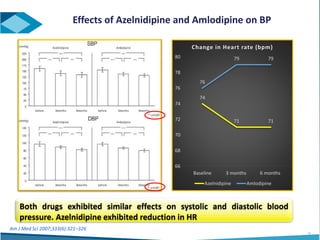
Effects of Azelnidipine and Amlodipine on BP
Both drugs exhibited similar effects on systolic and diastolic blood
pressure. Azelnidipine exhibited reduction in HR
34
Am J Med Sci 2007;333(6):321–326
74
71 71
76
79 79
66
68
70
72
74
76
78
80
Baseline 3 months 6 months
Change in Heart rate (bpm)
Azelnidipine Amlodipine
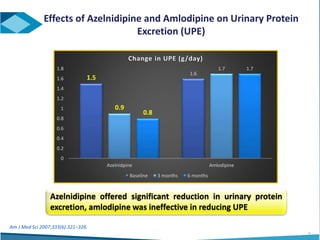
Effects of Azelnidipine and Amlodipine on Urinary Protein
Excretion (UPE)
35
1.5
1.6
0.9
1.7
0.8
1.7
0
0.2
0.4
0.6
0.8
1
1.2
1.4
1.6
1.8
Azelnidpine Amlodipine
Change in UPE (g/day)
Baseline 3 months 6 months
Azelnidipine offered significant reduction in urinary protein
excretion, amlodipine was ineffective in reducing UPE
Am J Med Sci 2007;333(6):321–326.
Effects of Azelnidipine on Uric Acid Metabolism
in Patients with Essential Hypertension
 N= 72
 Azelnidipine 8 or 16 mg
 In 22 cases out of the 72 patients, a different CCB was switched
to Azelnidipine
 BP measured and biochemical parameters of blood and urine
were evaluated before and 2–3 months after the administration
36
Clin Exp Hypertens, 2014; 36(7): 447–453
Effects of Azelnidipine on Uric Acid Metabolism
in patients with Essential Hypertension
37
Clin Exp Hypertens, 2014; 36(7): 447–453
SBP: systolic blood pressure, DBP: diastolic blood pressure, Cr: creatinine, eGFR: estimated glomerular filtration rate, LDL:
low density lipoprotein, HDL: high-density lipoprotein
1
Azelnidipine
Diabetic Perspective
Azelnidipine and Amlodipine on Glucose Tolerance and
Endothelial function (AGENT Trial)
 N=17 non-diabetic patients with essential hypertension, controlled BP with
amlodipine (5 mg/day) were enrolled
 Either Azelnidipine (16 mg/day) or amlodipine (5 mg/day) was administered in a
crossover design for 12-weeks
 At baseline and the end of each CCB therapy, OGTT was performed
39
Cardiovascular Diabetology 2011 10:79.
Comparison of Laboratory Data and PAT Ratio Between
Treatment with Azelnidipine and Amlodipine
Cardiovascular Diabetology 2011 10:79.
40
Data are mean ± SD. TC; total cholesterol, LDL-C; low-density lipoprotein cholesterol, HDL-C; high-density lipoprotein cholesterol, Hb; hemoglobin, hs-CRP; high
sensitivity C-reactive protein, BNP; brain natriuretic peptide, eGFR; estimated glomerular filtration ratio, GFR(ml/min/1.73 m2) L-FABP, L-type fatty acid binding
protein, alb; albuminuria, U-Cre; urine creatinine, HPC; hematopoietic progenitor cell, PAT: peripheral arterial tonometry. * P < 0.05 vs. baseline. ** Azelnidipine vs.
amlodipine.
Azelnidipine treatment have beneficial effects against glucose intolerance, insulin
sensitivity, inflammatory state in non-diabetic patients with hypertension.
Azelnidipine, but not amlodipine, reduces urinary albumin excretion and
carotid atherosclerosis in subjects with type 2 diabetes: blood pressure
control with olmesartan and azelnidipine in Type 2 diabetes (BOAT2 study)
To evaluate the efficacy of Azelnidipine and amlodipine on diabetic nephropathy and
atherosclerosis
 A prospective, two-arm, randomized controlled clinical study
 38 hypertensive subjects with type 2 diabetes
 Treatment: Azelnidipine 16 mg/day or amlodipine 5mg/day for 32 weeks
Endpoints:
 Change in BP and heart rate
41
Diabetol Metab Syndr. 2015; 7: 80.
BOAT2 Study- Efficacy in Reduction of BP and HR
42
Reduction in BP was similar between both groups
Azelnidipine offered significant reduction in HR than Amlodipine
(p < 0.05)
Diabetol Metab Syndr. 2015; 7: 80.
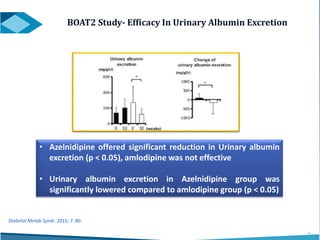
BOAT2 Study- Efficacy In Urinary Albumin Excretion
43
• Azelnidipine offered significant reduction in Urinary albumin
excretion (p < 0.05), amlodipine was not effective
• Urinary albumin excretion in Azelnidipine group was
significantly lowered compared to amlodipine group (p < 0.05)
Diabetol Metab Syndr. 2015; 7: 80.
BOAT2 Study- Carotid Intima Media Thickness And
Inflammatory Markers
IMT: Carotid intima-media thickness
MCP -1: monocyte chemoattractant protein 1 (type of cytokine)
TNF: Tumor necrosis factor
44
• Azelnidipine offered significant reduction in Max IMT, MCP-1and TNF -α
compared to amlodipine
• Azelnidipine but not amlodipine, delayed the progression of urinary albumin
excretion and carotid atherosclerosis
(p < 0.05)(p < 0.05) (p =0.05)
Changes in Left Ventricular Relaxation After Azelnidipine
Treatment in Hypertensive Patients With Diabetes: Sub Analysis
of Prospective Single-arm Multicentre Study
45
BMJ Open 2014;4:e006136
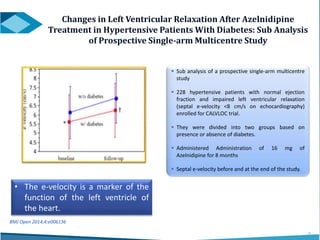
• The e-velocity is a marker of the
function of the left ventricle of
the heart.
 Sub analysis of a prospective single-arm multicentre
study
 228 hypertensive patients with normal ejection
fraction and impaired left ventricular relaxation
(septal e-velocity <8 cm/s on echocardiography)
enrolled for CALVLOC trial.
 They were divided into two groups based on
presence or absence of diabetes.
 Administered Administration of 16 mg of
Azelnidipine for 8 months
 Septal e-velocity before and at the end of the study.
Changes in LV Relaxation After Azelnidipine Treatment in
Hypertensive Patients With Diabetes
Whereas patients with diabetes (n=53, 23.2%) had lower SBP than Patients without
diabetes (155±17 vs 161±16 mm Hg, p=0.03).
They had lower e’ velocity (5.7±1.5 vs 6.1±1.4 cm/s, p=0.04) at baseline.
Azelnidipine decreased BP and heart rate, and increased e’ velocity similarly in patients
with diabetes (5.7±1.5 to .3±1.5 cm/s, p=0.0003) and without diabetes (6.1±1.4 to 6.9 ±1.4
cm/s, p<0.0001).
•LV relaxation was more impaired in hypertensive patients with diabetes
than in those without diabetes.
•Azelnidipine improved LV relaxation in both groups to the same degree
46BMJ Open 2014;4:e006136
Salient Features
 Azelnidipine offers 24 hr smooth BP control including double digit BP control
 Superior sympathetic nerve activity reduction compared to amlodipine –
sympathomodulating CCB
 Reduces proteinuria, reduces glomerular hypertension
 Exhibits anti oxidant property, improves endothelial function and arterial stiffness
 Reduction in B type natriuretic peptide, can be beneficial in improving prognosis of HF
patients
 Preserves insulin signaling
 Reduces serum uric acid in hypertensive patients with hyperuricemia
 Exhibits -Cardio-protection, Neuro-protection and renal protection & Lesser incidences
of pedal edema
 Well tolerated
47
Thank You
48

Azelnidipine

  • 1.
    1 Azelnidipine – Anovel CCB Dr Awadhesh Sharma,DM,FACC,FSCAI Assistant Professor LPS Institute of Cardiology GSVM Medical College, Kanpur, UP
  • 2.
    Hypertension – SilentKiller 2 A global brief on Hypertension by WHO
  • 3.
    ACC/AHA – NewGuideline 3 2019 ACC/AHA Guidelines BP Category SBP DBP Normal <120 mm Hg and <80 mm Hg Elevated 120–129 mm Hg and <80 mm Hg Hypertension Stage 1 130–139 mm Hg or 80–89 mm Hg Stage 2 ≥140 mm Hg or ≥90 mm Hg New Goal for BP Levels
  • 4.
  • 5.
    • L-type -main targets of CCBs - cardiac, smooth muscles & endocrine cells • T-type – neurons & endocrine cells - pacemaker cells, atrial cells and purkinje fibers • N-/P-/R type – brain, neuron & pituitary gland
  • 6.
    Conventional CCB’s fails here… •Reflex tachycardia • More incidence of Pedal Edema • Elevated Proteinuria level
  • 7.
  • 8.
    Azelnidipine – DrugProfile of A Novel CCB 8 Drugs Blocking activity L-type N-type T-type Nifedipine + - - Amlodipine + - - Cilnidipine + + - Efonidipine + - + Azelnidipine + - + Keio J Med. September 2010 ; 59 (3) : 84-95.
  • 9.
    Chemical Structure -Azelnidipine 9 • Azelnidipine is a new dihydropyridine calcium channel antagonist • It is L and T type of calcium channel blocker • Composed of a racemic mixture containing a 1:1 ratio of the active R-enantiomer and the inactive S-enantiomer Drugs 2003; 63 (23): 2613-2621
  • 10.
    Mechanism of Actionof Azelnidipine  Blocks L-Type calcium channel in blood vessel and T-type Calcium channel in heart  Results in vasodilation and reduced heart rate  Shows 17-folds higher lipophilicity than of amlodipine 10 Drugs 2003; 63 (23): 2613-2621
  • 11.
    Mechanism of Action Azelnidipine acts on SA node  Inhibits T-type Calcium channel activation  It prolongs the late phase-4 depolarization 11  Azelnidipine block T-type Calcium channel present on zona glomerulosa  Inhibit Aldosterone synthesis and release Drugs 2003; 63 (23): 2613-2621
  • 12.
    Mechanism of Actionon glomerulus  Azelnidipine dilates Afferent and Efferent arterioles  Reduces intra-glomerular pressure  Offers reno-protective effect 12
  • 13.
    Pharmacokinetic Profile 13 Parameters Azelnidipine Proteinbinding rate (%) ≈90% Tmax (Hr) 2.3-2.7 Terminal Elimination Half life (Hr) 19.2 Excretion 26 % in urine 63 % in feces Volume of distribution (L) 403.3 ± 710.4 Metabolism • Undergoes extensive first-pass hepatic metabolism • Primarily by cytochrome P450 (CYP) 3A4 AUC (h/ml) 81.6 ng Cmax (ng/ml) 3-13.1 Drugs 2003; 63 (23): 2613-2621
  • 14.
    Dosage and Indications Azelnidipine tablets 16 mg  For the treatment of Essential Hypertension. 14 CDSCO site Approved by DCGI USE IN SPECIFIC POPULATION  Severe renal Impairment: Efficacy have not been established  Severe hepatic impairment: Efficacy have not been established  Pediatric Use: Efficacy have not been established  Elderly Use: Low dose (8 mg once daily) is recommended  Pregnancy: Not recommended  Nursing mother: Not recommended
  • 15.
    Contraindications  Hypersensitivity toany of the ingredients  Pregnant and nursing women  Concomitant administration of systematic azole antifungal agent (e.g. fluconazole)  Concomitant administration of HIV protease inhibitor (e.g atazanavir) 15 Drug / Class Action Azole anti-fungal agent These drugs Inhibits CYP3A4 and increases the concentration of Azelnidipine in body HIV protease inhibitor Cimetidine Erythromycin, Azithromycin Digoxin Cmax of digoxin increases http://www.kegg.jp/medicus- in/japic_med?japic_code=00061591 Drug Interactions
  • 16.
    Effects Proven inPre-clinical Studies  Negative chronotropic effect 1  Inhibit Aldosterone synthesis and secretion 2  Dilate efferent arterioles 3  Preserves insulin signaling and glucose uptake 3 16 1. Journal of Hypertension 2014, 32:1898–1904 2. Eur J Pharmacol. 2009 Mar 1;605(1-3):49-52 3. Drugs R D (2013) 13:63–73 4. Endocrine Journal 2015, 62 (8), 741-747
  • 17.
    Azelnidipine BP Control &Cardio-protection 17 Clinical Evidences Azelnidipine Cardiac Perspective
  • 18.
    Study 1: SustainedBlood Pressure-Lowering Effect of Azelnidipine Guided by Self-Measured Morning and Evening Home Blood Pressure: Subgroup Analysis of the At-HOME Study • At-HOME study conducted in Japan • Objective: To evaluate the sustained BP lowering effect of Azelnidipine, using mean morning and evening systolic BP [ME average] and morning systolic BP minus evening systolic BP (ME difference). • Efficacy analysis- N = 4852 • Safety analysis- N = 5265 18 Drugs R D (2013) 13:75–85
  • 19.
    Clinical Improvement FromBaseline 19 Changes in a morning and evening home blood pressure (BP) Changes in morning and evening home pulse rates after Azelnidipine treatment *p0.0001 vs. baseline, according to Dunnett’s test. DBP diastolic blood pressure, SBP systolic blood pressure Changes in morning & evening SBP (ME average) & morning SBP minus evening SBP (ME difference) following Azelnidipine treatment Drugs R D (2013) 13:75–85
  • 20.
    Improvement in PatientDistribution Drugs R D (2013) 13:75–85 20 Changes in patient distribution according to morning and evening systolic blood pressure (ME average) and morning systolic blood pressure minus evening systolic blood pressure (ME difference) [n = 2,101; p0.0001 vs. baseline according to the McNemar test]. • Significant reduction in home SBP and DBP • BP-lowering effect lasted till next day morning • Useful for patients with morning hypertension, who are at high risk of cardiovascular events, especially stroke.
  • 21.
    Study 2: InhibitoryEffects of Azelnidipine Tablets on Morning Hypertension Treatment: Azlenidipine 8/16 mg once daily for 16 weeks 21 Drugs R D (2013) 13:63–73 • Objective: To determine the BP- and pulse rate-lowering effects of Azelnidipine, administered once daily in the morning. • N=5433 Hypertensive patients 156.9 143 140 138.3 137.1 89.7 82.4 80.8 79.8 78.9 BASELINE4 WEEKS 8 WEEKS12 WEEKS16 WEEKS Change in Blood pressure SBP (mmHg) DBP (mmHg) 72.7 69.6 68.8 68.7 68.7 BASELINE 4 WEEKS 8 WEEKS 12 WEEKS 16 WEEKS Change in Heart rate Heart Rate (bpm) • Azelnidipine offered significant reduction in morning BP and heart rate within 4 weeks
  • 22.
    Study 3: Azelnidipineand Amlodipine: A Comparison of their Pharmacokinetics and Effects on ABPM To compare the effects of Azelnidipine and Amlodipine on 24-h blood pressure  A randomized, double-blind Study in Hypertensive patients  Azelnidipine 16 mg (23 patients) or amlodipine 5 mg (23 patients) was administered once daily for 6 weeks 22 Hypertens Res. 2003 Mar;26(3):201-8.
  • 23.
    23  Hypertens Res.2003 Mar;26(3):201-8. Differences of Blood Pressure (BP) and Pulse Rate (PR) from the Baseline Values after 6 Weeks of Treatment with Azelnidipine or Amlodipine • Both drugs offered 24h BP reduction and have similar antihypertensive effect • Azelnidipine decrease pulse rate • Amlodipine significantly increased pulse rate
  • 24.
    Study 4: Azelnidipineand Amlodipine: A Comparison of Their Effects and Safety in a Randomized Double-Blinded Clinical Trial in Chinese Essential Hypertensive Patients  N=220  Treatment Azelnidipine 8 and 16 mg. Amlodipine 2.5 and 5 mg  Duration: 8 Weeks  ABPM was monitored at baseline and at 8 weeks (N=40) 24  Clinical and Experimental Hypertension, 32(6): 372–376, (2010) Changes of blood pressure and pulse rate in azelnidipine or amlodipine group
  • 25.
    Conclusion  Azelnidipine significantlyreduced BP, and was greater than amlodipine. 25  Clinical and Experimental Hypertension, 32(6): 372–376, (2010) Differences of Δ BP after treatment with Azelnidipine or Amlodipine
  • 26.
    Study 5: Clinicaluse of Azelnidipine in Treatment of Hypertension in Chinese Patients • Relevant literature identified by from PubMed and CNKI (China National Knowledge Infrastructure) • Total of 23 articles selected from 54 articles 26 Therapeutics and Clinical Risk Management 2015:11 Azelnidipine and BP Reduction • Significant reduction in BP mild-to moderate hypertension, similar to amlodipine and nifedipine • Showed CV protective effects, anti-oxidative action, reduction in heart rate and improved systolic and diastolic function • Well tolerated and no severe adverse events were observed
  • 27.
    Study 6: Impactof Azelnidipine and Amlodipine on Left Ventricular Mass & Longitudinal Function in Hypertensive Patients with LVH  The study conducted to compare the effects of Azelnidipine & amlodipine on LV function  N= 32 hypertensive patients  Intervention- 5 mg of amlodipine/day and16 mg of Azelnidipine/day.  LV function and morphology was examined by conventional and speckle tracking echocardiography at baseline and at 1, 3, 6,and 12 months after treatment initiation 27 DOI: 10.1111/echo.12548 Echocardiography
  • 28.
    28  DOI: 10.1111/echo.12548Echocardiography Serial Changes in Global Longitudinal Left Ventricular (LV) Strain With CCBs • Global longitudinal strain had improved by 3 months of treatment, further regression of LVH observed at 12 months.
  • 29.
    Study 7: EffectsOf Azelnidipine Plus Olmesartan Vs Amlodipine Plus Olmesartan on Central BP and LVMI: The AORTA Study  Effects of olmesartan combined with either Azelnidipine or amlodipine on central blood pressure (CBP) and left ventricular mass index (LVMI) in hypertensive patients was tested.  Patients with SBP > 140 mmHg and/or DBP >90 mmHg received olmesartan monotherapy (20 mg daily) for 12 weeks.  The patients were then randomly assigned to fixed-dose add-on therapy with Azelnidipine (16 mg daily) or amlodipine (5 mg daily) (25 patients/group) for a further 24 weeks.  CBP and LVMI were measured at baseline and at the end of study 29 Vascular Health and Risk Management 2011:7
  • 30.
    Changes in CBPand LVMI 30 Vascular Health and Risk Management 2011:7 AIx@75: Heart Rate-corrected Augmentation Index • 24 weeks of combination therapy, olmesartan/Azelnidipine showed significantly greater decreases in CBP than olmesartan/amlodipine • HR showed significantly greater reduction with olmesartan/Azelnidipine than with olmesartan/amlodipine.
  • 31.
    Study 8: Effectsof Azelnidipine on Reflex Tachycardia  95 patients with mild-to-moderate hypertension were treated with Azelnidipine for 1 year 31 Drugs. 2003;63(23):2613-21; discussion 2623-4. 165.7 95.4 138.2 79.9 SBP(MMHG) DBP (MMHG) Change in BP (mmHg) Baseline Series 2 • Azelnidipine significantly reduced BP • Its use was not associated with reflex tachycardia
  • 32.
  • 33.
    Azelnidipine Reduces UrinaryProtein Excretion and Urinary Liver-Type Fatty Acid Binding Protein in Patients with Hypertensive Chronic Kidney Disease  A randomized study  N= 30 Hypertensive CKD patients  Azelnidipine 16 mg once daily or amlodipine 5 mg once daily  Duration 6 months  Endpoints:  Change in BP and HR  Urinary protein excretion and urinary levels of 8-OHdG and urinary L-FABP measured before 3 and 6 months post treatment 33 Am J Med Sci 2007;333(6):321–326.
  • 34.
    Effects of Azelnidipineand Amlodipine on BP Both drugs exhibited similar effects on systolic and diastolic blood pressure. Azelnidipine exhibited reduction in HR 34 Am J Med Sci 2007;333(6):321–326 74 71 71 76 79 79 66 68 70 72 74 76 78 80 Baseline 3 months 6 months Change in Heart rate (bpm) Azelnidipine Amlodipine
  • 35.
    Effects of Azelnidipineand Amlodipine on Urinary Protein Excretion (UPE) 35 1.5 1.6 0.9 1.7 0.8 1.7 0 0.2 0.4 0.6 0.8 1 1.2 1.4 1.6 1.8 Azelnidpine Amlodipine Change in UPE (g/day) Baseline 3 months 6 months Azelnidipine offered significant reduction in urinary protein excretion, amlodipine was ineffective in reducing UPE Am J Med Sci 2007;333(6):321–326.
  • 36.
    Effects of Azelnidipineon Uric Acid Metabolism in Patients with Essential Hypertension  N= 72  Azelnidipine 8 or 16 mg  In 22 cases out of the 72 patients, a different CCB was switched to Azelnidipine  BP measured and biochemical parameters of blood and urine were evaluated before and 2–3 months after the administration 36 Clin Exp Hypertens, 2014; 36(7): 447–453
  • 37.
    Effects of Azelnidipineon Uric Acid Metabolism in patients with Essential Hypertension 37 Clin Exp Hypertens, 2014; 36(7): 447–453 SBP: systolic blood pressure, DBP: diastolic blood pressure, Cr: creatinine, eGFR: estimated glomerular filtration rate, LDL: low density lipoprotein, HDL: high-density lipoprotein
  • 38.
  • 39.
    Azelnidipine and Amlodipineon Glucose Tolerance and Endothelial function (AGENT Trial)  N=17 non-diabetic patients with essential hypertension, controlled BP with amlodipine (5 mg/day) were enrolled  Either Azelnidipine (16 mg/day) or amlodipine (5 mg/day) was administered in a crossover design for 12-weeks  At baseline and the end of each CCB therapy, OGTT was performed 39 Cardiovascular Diabetology 2011 10:79.
  • 40.
    Comparison of LaboratoryData and PAT Ratio Between Treatment with Azelnidipine and Amlodipine Cardiovascular Diabetology 2011 10:79. 40 Data are mean ± SD. TC; total cholesterol, LDL-C; low-density lipoprotein cholesterol, HDL-C; high-density lipoprotein cholesterol, Hb; hemoglobin, hs-CRP; high sensitivity C-reactive protein, BNP; brain natriuretic peptide, eGFR; estimated glomerular filtration ratio, GFR(ml/min/1.73 m2) L-FABP, L-type fatty acid binding protein, alb; albuminuria, U-Cre; urine creatinine, HPC; hematopoietic progenitor cell, PAT: peripheral arterial tonometry. * P < 0.05 vs. baseline. ** Azelnidipine vs. amlodipine. Azelnidipine treatment have beneficial effects against glucose intolerance, insulin sensitivity, inflammatory state in non-diabetic patients with hypertension.
  • 41.
    Azelnidipine, but notamlodipine, reduces urinary albumin excretion and carotid atherosclerosis in subjects with type 2 diabetes: blood pressure control with olmesartan and azelnidipine in Type 2 diabetes (BOAT2 study) To evaluate the efficacy of Azelnidipine and amlodipine on diabetic nephropathy and atherosclerosis  A prospective, two-arm, randomized controlled clinical study  38 hypertensive subjects with type 2 diabetes  Treatment: Azelnidipine 16 mg/day or amlodipine 5mg/day for 32 weeks Endpoints:  Change in BP and heart rate 41 Diabetol Metab Syndr. 2015; 7: 80.
  • 42.
    BOAT2 Study- Efficacyin Reduction of BP and HR 42 Reduction in BP was similar between both groups Azelnidipine offered significant reduction in HR than Amlodipine (p < 0.05) Diabetol Metab Syndr. 2015; 7: 80.
  • 43.
    BOAT2 Study- EfficacyIn Urinary Albumin Excretion 43 • Azelnidipine offered significant reduction in Urinary albumin excretion (p < 0.05), amlodipine was not effective • Urinary albumin excretion in Azelnidipine group was significantly lowered compared to amlodipine group (p < 0.05) Diabetol Metab Syndr. 2015; 7: 80.
  • 44.
    BOAT2 Study- CarotidIntima Media Thickness And Inflammatory Markers IMT: Carotid intima-media thickness MCP -1: monocyte chemoattractant protein 1 (type of cytokine) TNF: Tumor necrosis factor 44 • Azelnidipine offered significant reduction in Max IMT, MCP-1and TNF -α compared to amlodipine • Azelnidipine but not amlodipine, delayed the progression of urinary albumin excretion and carotid atherosclerosis (p < 0.05)(p < 0.05) (p =0.05)
  • 45.
    Changes in LeftVentricular Relaxation After Azelnidipine Treatment in Hypertensive Patients With Diabetes: Sub Analysis of Prospective Single-arm Multicentre Study 45 BMJ Open 2014;4:e006136 • The e-velocity is a marker of the function of the left ventricle of the heart.  Sub analysis of a prospective single-arm multicentre study  228 hypertensive patients with normal ejection fraction and impaired left ventricular relaxation (septal e-velocity <8 cm/s on echocardiography) enrolled for CALVLOC trial.  They were divided into two groups based on presence or absence of diabetes.  Administered Administration of 16 mg of Azelnidipine for 8 months  Septal e-velocity before and at the end of the study.
  • 46.
    Changes in LVRelaxation After Azelnidipine Treatment in Hypertensive Patients With Diabetes Whereas patients with diabetes (n=53, 23.2%) had lower SBP than Patients without diabetes (155±17 vs 161±16 mm Hg, p=0.03). They had lower e’ velocity (5.7±1.5 vs 6.1±1.4 cm/s, p=0.04) at baseline. Azelnidipine decreased BP and heart rate, and increased e’ velocity similarly in patients with diabetes (5.7±1.5 to .3±1.5 cm/s, p=0.0003) and without diabetes (6.1±1.4 to 6.9 ±1.4 cm/s, p<0.0001). •LV relaxation was more impaired in hypertensive patients with diabetes than in those without diabetes. •Azelnidipine improved LV relaxation in both groups to the same degree 46BMJ Open 2014;4:e006136
  • 47.
    Salient Features  Azelnidipineoffers 24 hr smooth BP control including double digit BP control  Superior sympathetic nerve activity reduction compared to amlodipine – sympathomodulating CCB  Reduces proteinuria, reduces glomerular hypertension  Exhibits anti oxidant property, improves endothelial function and arterial stiffness  Reduction in B type natriuretic peptide, can be beneficial in improving prognosis of HF patients  Preserves insulin signaling  Reduces serum uric acid in hypertensive patients with hyperuricemia  Exhibits -Cardio-protection, Neuro-protection and renal protection & Lesser incidences of pedal edema  Well tolerated 47
  • 48.

Editor's Notes

  • #11 The T-type channel is found principally in pacemaker, atrial, and Purkinje cells. During the action potential generation, the first channel to come into play is the T-type Ca+2 channel, which opens at a specific level of membrane depolarisation. T-type channels provides the initial depolarising kick to fire the action potential. The opening of L-type (L for long-lasting) Ca channels then mediates this action potential to the other parts of the heart Reflex tachycardia:increased heart rate in response to some stimulus conveyed through the cardiac nerves.
  • #12 The T-type channel is found principally in pacemaker, atrial, and Purkinje cells. During the action potential generation, the first channel to come into play is the T-type Ca+2 channel, which opens at a specific level of membrane depolarisation. T-type channels provides the initial depolarising kick to fire the action potential. The opening of L-type (L for long-lasting) Ca channels then mediates this action potential to the other parts of the heart Reflex tachycardia:increased heart rate in response to some stimulus conveyed through the cardiac nerves.
  • #13 Afferent arteriole brings blood to the glomerulus and the efferent arteriole takes blood away from the glomerulus. The efferent arteriole carries blood away from the glomerulus. Because it has a smaller diameter than the afferent arteriole, it creates some resistance to blood flow, producing the back-up of blood in the glomerulus which creates higher pressure in the glomerular cavity.
  • #23 2 vs 4
  • #34 Urinary 8-OHdG (8hydroxy2‘ deoxyguanosine) Urinary L-FABP (Urinary liver-type fatty acid binding protein) Urinary L-FABP, therefore, represents a potential clinical biomarker that may be of use in monitoring and predicting the progression of chronic renal disease. Urinary 8-OHdG has been reported to serve as a sensitive biomarker of oxidative DNA damage and also of oxidative stress. Increased urinary 8-OHdG and the risk of vascular complication may be present at early stages of diabetes. Also marker of endothelial dysfunction
  • #46 Azelnidipine treatment significantly increased e0 velocity in patients with diabetes (p=0.0003) as well as in patients without diabetes (p<0.0001). The changes in e0 velocity were parallel between the two groups, implying that the effects of Azelnidipine were similar between them. Patients with diabetes had lower e0 velocity than patients without diabetes even after treatment (6.3±1.5 vs 6.9±1.4 cm/s, p=0.006). *p=0.04, †p=0.006 versus patients without diabetes.