Accreditation & Distance Learning:
 What every DL professional needs to know


Bob Knipe
Dean of Learning Technologies
Genesee Community College


                                       11
Accreditation Types

Institutional
  6 regional accrediting bodies - in our
  case, Middle States
  State authorizing agency (in our case,
  SUNY / NYSED)
Program or
discipline-specific
(specialized) professional
accreditation                              21
Institutional accreditation


Verification of institutional quality
assurance
Periodic (10-year, 5-year)
Accountability
Professional and collegial
Regional

                                        31
Accreditation & Distance Learning

 Old paradigm:
 “Show us you’re really doing what
 you say you’re doing.”

 New paradigm:
 “What you’re doing should be w/in
 your own mission, culture &
 institutional procedures, but should
 also follow these guidelines.”
                                     41
Accreditation & Distance Learning

 Old Standards: Distance Learning
 Programs: Interregional Guidelines for
 Electronically Offered Degree and Certificate
 Programs (2002)


                                          51
New Standards:
    Characteristics of Excellence in Higher Education
    (2006-09) Standard 13 - “Related Educational
    Activities: Distance or Distributed Learning”
    http://www.msche.org/publications/CHX06_Aug08REVMarch09.pdf

    Characteristics of Excellence in Higher Education
    Std. 10 (Faculty), Std. 11 (Educ. Offerings),
    Std.14 (Assessment of Student Learning)
    + other Standards


    Team Visits: Conducting and Hosting an
    Evaluation Visit – Appendix 10, Guidelines for
    Reviewing Distance Education Programs
    & Appendix 11
•   http://www.msche.org/publications/Team-Visits-2009-FINAL2.pdf
                                                                61
Standards:
  Demonstrate meeting comparable
  academic standards / SLOs

  Continuity & continuation

  Legal & regulatory compliance

  Partner/vendor integrity & faculty
  validation

                                       71
Standards:
  Appropriate student resources & support
  services

  Appropriate faculty training, support &
  technology

  Assessment & quality improvement

  Documentation (data data   data      )
                                    data


                                            81
Accreditation & Distance Learning

 The substantive change clause: how
 much DL delivery is substantive?
   >50% of courses leading to degree or
   certificate are delivered via DL

 http://www.msche.org/documents/6B---6-SubstantiveChange_4_.pdf


                                                            91
Accreditation & Distance Learning

 Substantive change usually requires a
 change in mission statement, which should
 include reference to distance learning or
 alternative program delivery


 Substantive change ramps up institutional
 commitment to
   Student support services
   Business processes
   Institutional expectation of what’s a collegial
   experience

                                               101
                                               101
Accreditation & Distance Learning
Regional accreditation commissions’ acceptance of
          other standards: models include

  NY State Department of Education/SUNY:
  http://www.highered.nysed.gov/ocue/ded/
  AQIP: http://www.aqip.org (North Central Assoc.)
  Western Governors University:
  http://wgu.edu/index.html
  Council for Adult & Experiential Learning:
  http://www.cael.org
  Many others!

                                                 111
                                                 111
Regional accreditors’
      “Best Practices” include:

Substantive & coherent curricula which
define & track student learning outcomes

Learning is dynamic & interactive
(regardless of setting or delivery)


Institutional support of students’
academic success

Assessment & improvement
                                      121
                                      121
Components:

Institutional Context & Commitment

Curriculum & Instruction

Faculty Support

Student Support

Evaluation & Assessment
                                     131
                                     131
Institutional Context & Commitment

Consistent with role & mission
Aware of substantive change implications
Budget, policy, goal statements reflect
commitment
Staffing, technology, facilities adequate
Organizational structure reflects commitment
Based on outcomes not delivery
Consistent, coherent technology framework
Student technology support
Technology choices based on appropriateness
Legal & regulatory requirements accommodated

                                         141
                                         141
Curriculum & Instruction

Equivalent college-level outcomes &
including general education
Qualified academics make
decisions
Uniform & clearly communicated
student access
Consortial or contracted elements
are consistent with institution
Appropriate interaction is reflected
in design & delivery


                                       151
                                       151
Faculty Support

Workload, compensation & ownership
issues are addressed
Technology, instructional design,
production support are provided
Faculty & staff training & professional
development are provided
Quality assurance processes in place
Training for all who work with students

                                      161
                                      161
Student Support

Institutional commitment is sufficient to
time necessary for degree completion
Pre-admission screening as appropriate
Thorough student information &
orientation are provided
Student support services in place *
Institution recognizes and imparts “sense
of community” among distant students


                                      171
                                      171
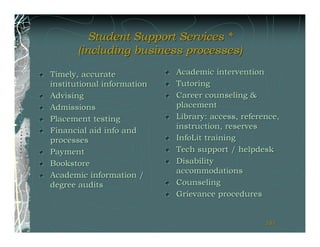
Student Support Services *
       (including business processes)

Timely, accurate            Academic intervention
institutional information   Tutoring
Advising                    Career counseling &
Admissions                  placement
Placement testing           Library: access, reference,
                            instruction, reserves
Financial aid info and
processes                   InfoLit training
Payment                     Tech support / helpdesk
Bookstore                   Disability
                            accommodations
Academic information /
degree audits               Counseling
                            Grievance procedures


                                                   181
                                                   181
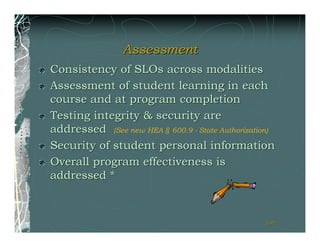
Assessment
Consistency of SLOs across modalities
Assessment of student learning in each
course and at program completion
Testing integrity & security are
addressed (See new HEA § 600.9 - State Authorization)
Security of student personal information
Overall program effectiveness is
addressed *


                                                  191
                                                  191
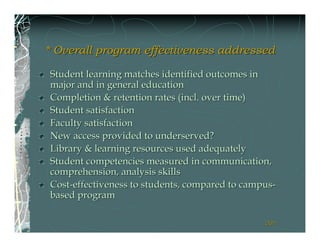
* Overall program effectiveness addressed

Student learning matches identified outcomes in
major and in general education
Completion & retention rates (incl. over time)
Student satisfaction
Faculty satisfaction
New access provided to underserved?
Library & learning resources used adequately
Student competencies measured in communication,
comprehension, analysis skills
Cost-effectiveness to students, compared to campus-
based program

                                                201
                                                201
Accreditation & Distance Learning

Thank you…
Thank you very much.


                               211
                               211

Bob Knipe's presentation on accreditation and DL: what ever DL director should know

  • 1.
    Accreditation & DistanceLearning: What every DL professional needs to know Bob Knipe Dean of Learning Technologies Genesee Community College 11
  • 2.
    Accreditation Types Institutional 6 regional accrediting bodies - in our case, Middle States State authorizing agency (in our case, SUNY / NYSED) Program or discipline-specific (specialized) professional accreditation 21
  • 3.
    Institutional accreditation Verification ofinstitutional quality assurance Periodic (10-year, 5-year) Accountability Professional and collegial Regional 31
  • 4.
    Accreditation & DistanceLearning Old paradigm: “Show us you’re really doing what you say you’re doing.” New paradigm: “What you’re doing should be w/in your own mission, culture & institutional procedures, but should also follow these guidelines.” 41
  • 5.
    Accreditation & DistanceLearning Old Standards: Distance Learning Programs: Interregional Guidelines for Electronically Offered Degree and Certificate Programs (2002) 51
  • 6.
    New Standards: Characteristics of Excellence in Higher Education (2006-09) Standard 13 - “Related Educational Activities: Distance or Distributed Learning” http://www.msche.org/publications/CHX06_Aug08REVMarch09.pdf Characteristics of Excellence in Higher Education Std. 10 (Faculty), Std. 11 (Educ. Offerings), Std.14 (Assessment of Student Learning) + other Standards Team Visits: Conducting and Hosting an Evaluation Visit – Appendix 10, Guidelines for Reviewing Distance Education Programs & Appendix 11 • http://www.msche.org/publications/Team-Visits-2009-FINAL2.pdf 61
  • 7.
    Standards: Demonstratemeeting comparable academic standards / SLOs Continuity & continuation Legal & regulatory compliance Partner/vendor integrity & faculty validation 71
  • 8.
    Standards: Appropriatestudent resources & support services Appropriate faculty training, support & technology Assessment & quality improvement Documentation (data data data ) data 81
  • 9.
    Accreditation & DistanceLearning The substantive change clause: how much DL delivery is substantive? >50% of courses leading to degree or certificate are delivered via DL http://www.msche.org/documents/6B---6-SubstantiveChange_4_.pdf 91
  • 10.
    Accreditation & DistanceLearning Substantive change usually requires a change in mission statement, which should include reference to distance learning or alternative program delivery Substantive change ramps up institutional commitment to Student support services Business processes Institutional expectation of what’s a collegial experience 101 101
  • 11.
    Accreditation & DistanceLearning Regional accreditation commissions’ acceptance of other standards: models include NY State Department of Education/SUNY: http://www.highered.nysed.gov/ocue/ded/ AQIP: http://www.aqip.org (North Central Assoc.) Western Governors University: http://wgu.edu/index.html Council for Adult & Experiential Learning: http://www.cael.org Many others! 111 111
  • 12.
    Regional accreditors’ “Best Practices” include: Substantive & coherent curricula which define & track student learning outcomes Learning is dynamic & interactive (regardless of setting or delivery) Institutional support of students’ academic success Assessment & improvement 121 121
  • 13.
    Components: Institutional Context &Commitment Curriculum & Instruction Faculty Support Student Support Evaluation & Assessment 131 131
  • 14.
    Institutional Context &Commitment Consistent with role & mission Aware of substantive change implications Budget, policy, goal statements reflect commitment Staffing, technology, facilities adequate Organizational structure reflects commitment Based on outcomes not delivery Consistent, coherent technology framework Student technology support Technology choices based on appropriateness Legal & regulatory requirements accommodated 141 141
  • 15.
    Curriculum & Instruction Equivalentcollege-level outcomes & including general education Qualified academics make decisions Uniform & clearly communicated student access Consortial or contracted elements are consistent with institution Appropriate interaction is reflected in design & delivery 151 151
  • 16.
    Faculty Support Workload, compensation& ownership issues are addressed Technology, instructional design, production support are provided Faculty & staff training & professional development are provided Quality assurance processes in place Training for all who work with students 161 161
  • 17.
    Student Support Institutional commitmentis sufficient to time necessary for degree completion Pre-admission screening as appropriate Thorough student information & orientation are provided Student support services in place * Institution recognizes and imparts “sense of community” among distant students 171 171
  • 18.
    Student Support Services* (including business processes) Timely, accurate Academic intervention institutional information Tutoring Advising Career counseling & Admissions placement Placement testing Library: access, reference, instruction, reserves Financial aid info and processes InfoLit training Payment Tech support / helpdesk Bookstore Disability accommodations Academic information / degree audits Counseling Grievance procedures 181 181
  • 19.
    Assessment Consistency of SLOsacross modalities Assessment of student learning in each course and at program completion Testing integrity & security are addressed (See new HEA § 600.9 - State Authorization) Security of student personal information Overall program effectiveness is addressed * 191 191
  • 20.
    * Overall programeffectiveness addressed Student learning matches identified outcomes in major and in general education Completion & retention rates (incl. over time) Student satisfaction Faculty satisfaction New access provided to underserved? Library & learning resources used adequately Student competencies measured in communication, comprehension, analysis skills Cost-effectiveness to students, compared to campus- based program 201 201
  • 21.
    Accreditation & DistanceLearning Thank you… Thank you very much. 211 211