Benchmarking and Self-
Assessment for Quality in CPD
   and Distance Learning
DAETE – Development of Accreditation
for Engineering Training and Education
• Standardized tool for benchmarking that enables
  continuous quality improvement and self-assessment in
  higher education
• Based on the European Foundation for Quality
  Management (EFQM) Excellence Model
• Collaboration sponsored by the International Association
  for Continuing Engineering Education (IACEE ) –
  supported through funding from FIPSE and EU
  Commission
• Originally adapted for CEE Centers – recently expanded
  for all disciplines and being applied for distance learning
Collaboration Team
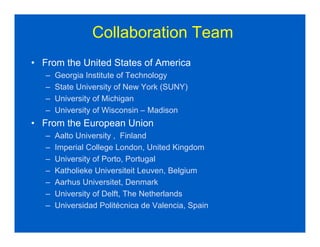
• From the United States of America
   –   Georgia Institute of Technology
   –   State University of New York (SUNY)
   –   University of Michigan
   –   University of Wisconsin – Madison
• From the European Union
   –   Aalto University , Finland
   –   Imperial College London, United Kingdom
   –   University of Porto, Portugal
   –   Katholieke Universiteit Leuven, Belgium
   –   Aarhus Universitet, Denmark
   –   University of Delft, The Netherlands
   –   Universidad Politécnica de Valencia, Spain
Process and Tools
                              Benchmarking
                              Demographic
Start here                   Data Sheet and
                            Supplemental Data
                                  Sheet


                                            DAETE Matrix &
                                            score sheet


                                 Best Practices
                                 Template
European Foundation for Quality
Management (EFQM) Excellence Model
                 ENABLERS                                                RESULTS


                                                              7 Staff
                   3 People
                                                              Results


                                                            6 Customer                9 Key
                    2 Policy
  1 Leadership                          5 Processes           Oriented             Performance
                  and Strategy
                                                              Results                Results


                 4 Partnerships                              8 Society
                 and Resources                                Results


                                  INNOVATION AND LEARNING

                                                 © European Foundation for Quality Management
Adaptation of EFQM Model for CE Centers
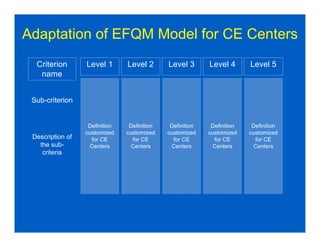
  Criterion       Level 1       Level 2       Level 3       Level 4       Level 5
   name


 Sub-criterion


                   Definition    Definition    Definition    Definition    Definition
                  customized    customized    customized    customized    customized
 Description of     for CE        for CE        for CE        for CE        for CE
   the sub-        Centers       Centers       Centers       Centers       Centers
    criteria
Five Level Structure for Rating Sub-criteria
 Level 1: Quality depends solely on the individual (no
          processes)

 Level 2: Process awakening (basic processes)

 Level 3: Vision through processes, professionalization and
          a guarantee of quality (intermediate processes)

 Level 4: Systematic assessment and improvement of
          processes (sophisticated processes)

 Level 5: Aiming for external excellence (excellent
          processes)
Adaptability to Distance/Online Learning

- This is an organizational self-assessment tool

- Quality in DL/Online/Elearning is dependent on
  the support of the organization

- The EFQM model criteria align with the NYS ICR
  criteria, which are also based on the
  organization

- The DAETE tools and processes provide a way
  to standardize on what the levels mean and also
  document and share best practices
Would a tool like this be helpful to
       you in your roles?

 How could you use something like
this to assess and improve quality?

How would you take advantage of
  the benchmarking capability?
There is also an opportunity to use
the results of self-assessment and
 benchmarking for organizational
           development

Kim Scalzo's DAETE presentation- SLN SOLsummit

  • 1.
    Benchmarking and Self- Assessmentfor Quality in CPD and Distance Learning
  • 2.
    DAETE – Developmentof Accreditation for Engineering Training and Education • Standardized tool for benchmarking that enables continuous quality improvement and self-assessment in higher education • Based on the European Foundation for Quality Management (EFQM) Excellence Model • Collaboration sponsored by the International Association for Continuing Engineering Education (IACEE ) – supported through funding from FIPSE and EU Commission • Originally adapted for CEE Centers – recently expanded for all disciplines and being applied for distance learning
  • 3.
    Collaboration Team • Fromthe United States of America – Georgia Institute of Technology – State University of New York (SUNY) – University of Michigan – University of Wisconsin – Madison • From the European Union – Aalto University , Finland – Imperial College London, United Kingdom – University of Porto, Portugal – Katholieke Universiteit Leuven, Belgium – Aarhus Universitet, Denmark – University of Delft, The Netherlands – Universidad Politécnica de Valencia, Spain
  • 4.
    Process and Tools Benchmarking Demographic Start here Data Sheet and Supplemental Data Sheet DAETE Matrix & score sheet Best Practices Template
  • 5.
    European Foundation forQuality Management (EFQM) Excellence Model ENABLERS RESULTS 7 Staff 3 People Results 6 Customer 9 Key 2 Policy 1 Leadership 5 Processes Oriented Performance and Strategy Results Results 4 Partnerships 8 Society and Resources Results INNOVATION AND LEARNING © European Foundation for Quality Management
  • 6.
    Adaptation of EFQMModel for CE Centers Criterion Level 1 Level 2 Level 3 Level 4 Level 5 name Sub-criterion Definition Definition Definition Definition Definition customized customized customized customized customized Description of for CE for CE for CE for CE for CE the sub- Centers Centers Centers Centers Centers criteria
  • 7.
    Five Level Structurefor Rating Sub-criteria Level 1: Quality depends solely on the individual (no processes) Level 2: Process awakening (basic processes) Level 3: Vision through processes, professionalization and a guarantee of quality (intermediate processes) Level 4: Systematic assessment and improvement of processes (sophisticated processes) Level 5: Aiming for external excellence (excellent processes)
  • 8.
    Adaptability to Distance/OnlineLearning - This is an organizational self-assessment tool - Quality in DL/Online/Elearning is dependent on the support of the organization - The EFQM model criteria align with the NYS ICR criteria, which are also based on the organization - The DAETE tools and processes provide a way to standardize on what the levels mean and also document and share best practices
  • 9.
    Would a toollike this be helpful to you in your roles? How could you use something like this to assess and improve quality? How would you take advantage of the benchmarking capability?
  • 10.
    There is alsoan opportunity to use the results of self-assessment and benchmarking for organizational development