Developmental Education
Redesign Recommendations
Overview
 The DETF recommendations
 Math
 College Reading and Composition (English & Reading)
 Administrative
 Proposed timeline
The problem
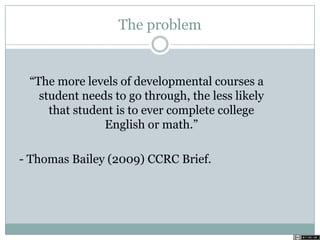
―The more levels of developmental courses a
student needs to go through, the less likely
that student is to ever complete college
English or math.‖
- Thomas Bailey (2009) CCRC Brief.
The goal of the redesign
Move students quickly and effectively through their
first college level course.
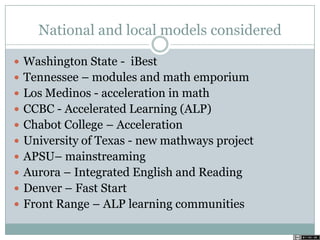
National and local models considered
 Washington State - iBest
 Tennessee – modules and math emporium
 Los Medinos - acceleration in math
 CCBC - Accelerated Learning (ALP)
 Chabot College – Acceleration
 University of Texas - new mathways project
 APSU– mainstreaming
 Aurora – Integrated English and Reading
 Denver – Fast Start
 Front Range – ALP learning communities
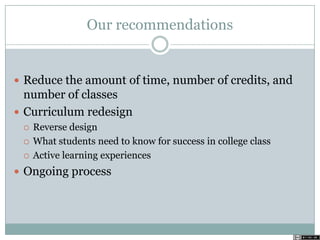
Our recommendations
 Reduce the amount of time, number of credits, and
number of classes
 Curriculum redesign
 Reverse design
 What students need to know for success in college class
 Active learning experiences
 Ongoing process
Math
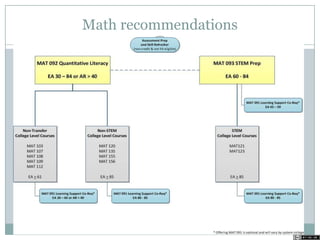
Math recommendations
College Reading and Composition
(English & Reading)
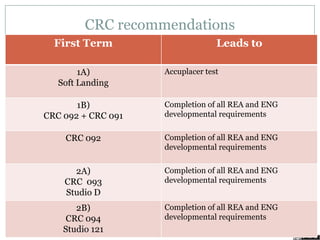
CRC recommendations
First Term Leads to
1A)
Soft Landing
Accuplacer test
1B)
CRC 092 + CRC 091
Completion of all REA and ENG
developmental requirements
CRC 092 Completion of all REA and ENG
developmental requirements
2A)
CRC 093
Studio D
Completion of all REA and ENG
developmental requirements
2B)
CRC 094
Studio 121
Completion of all REA and ENG
developmental requirements
Administrative
Testing and placement
 Colorado specific Accuplacer with ―strands‖
 Uniform multiple measures built into Accuplacer
system
 Consistent test administration statewide
 Validate Accuplacer scores every 3-5 years – are we
using the right cut scores
 To accomplish these goals use a system level
institutional administrator (IA) in addition to college
site administrators for local control
Student support
 Use CCCSE practices
 Orientation
 Goal setting and planning
 No late registrations
 First year experience
 Student success course
 Tutoring
 Supplemental instruction
 Case management/academic advising/career coaches
 College develop a plan to use for
planning, initiating, and sustaining success for
developmental students
Faculty support and development
 Colleges create a professional development plan
 Offer limited full time positions to current adjunct instructors
during implementation
 Provide release time for implementation
 Course release and reassigned time to develop and implement
student success strategies
 Functional work groups on campus—i.e.
BANNER, Advising, Testing—address the issues of the
implementation process
 Provide, with CCCS, continuing professional development
focusing on research-based strategies
 Train transfer level and developmental faculty
Measures of success
 Successful developmental students and programs
should be measured in the following ways:
 In Math – Successful completion of any college level (100+)
math course
 In English and Reading – Successful completion of any college
level (100+) English course or any college level discipline
strands course.
What happens next?
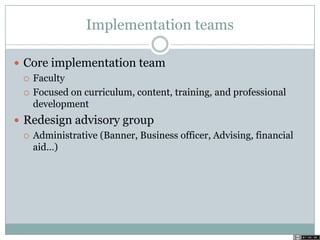
Implementation teams
 Core implementation team
 Faculty
 Focused on curriculum, content, training, and professional
development
 Redesign advisory group
 Administrative (Banner, Business officer, Advising, financial
aid…)
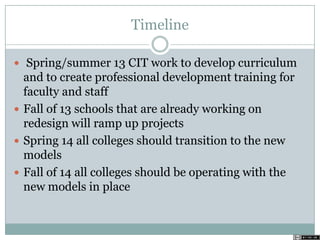
Timeline
 Spring/summer 13 CIT work to develop curriculum
and to create professional development training for
faculty and staff
 Fall of 13 schools that are already working on
redesign will ramp up projects
 Spring 14 all colleges should transition to the new
models
 Fall of 14 all colleges should be operating with the
new models in place
Questions?
Workshop
 You are being given a handout with a series of
questions.
 Arrange yourselves into small groups. These can be
by discipline, or not, whatever works best for you.
 You will work in 15 minute increments to brainstorm
responses to each question. At the end of the 15
minutes, all groups will report out.
 As you move through the questions, note common
themes, concerns and emergent needs to discuss
with the larger group
Discussion Questions
 What are the implications of the DE redesign for…
 Faculty?
 Student Services?
 Testing?
 What are the barriers to implementation?
 What kinds of training and support do you need?
 How will this affect your partnerships with K-12 and
four year institutions?
System Support
 Faculty Professional Development
 Online courses
 Regional/state workshops
 Campus workshops
 Resource support
 Ongoing Technical Support
Contact us
 Bitsy Cohn bitsy.cohn@cccs.edu
 (720) 858-2883
 Elaine Baker elaine.baker@cccs.edu
 (720) 858-2807
 Marilyn Smith marilyn.smith@cccs.edu
 (720) 858-2328
Creative Commons Attribution
Unless otherwise specified, this work by the Colorado Community College System http://www.cccs.edu is licensed
under a Creative Commons Attribution-NonCommercial-ShareAlike 3.0 United States License. The material was
created with funds from the Trade Adjustment Assistance Community College and Career Training (TAACCCT)
Grant awarded to the Colorado Online Energy Training Consortium (COETC).

DETF recommendations CMC 2013

  • 1.
  • 2.
    Overview  The DETFrecommendations  Math  College Reading and Composition (English & Reading)  Administrative  Proposed timeline
  • 3.
    The problem ―The morelevels of developmental courses a student needs to go through, the less likely that student is to ever complete college English or math.‖ - Thomas Bailey (2009) CCRC Brief.
  • 4.
    The goal ofthe redesign Move students quickly and effectively through their first college level course.
  • 5.
    National and localmodels considered  Washington State - iBest  Tennessee – modules and math emporium  Los Medinos - acceleration in math  CCBC - Accelerated Learning (ALP)  Chabot College – Acceleration  University of Texas - new mathways project  APSU– mainstreaming  Aurora – Integrated English and Reading  Denver – Fast Start  Front Range – ALP learning communities
  • 6.
    Our recommendations  Reducethe amount of time, number of credits, and number of classes  Curriculum redesign  Reverse design  What students need to know for success in college class  Active learning experiences  Ongoing process
  • 7.
  • 8.
  • 9.
    College Reading andComposition (English & Reading)
  • 10.
    CRC recommendations First TermLeads to 1A) Soft Landing Accuplacer test 1B) CRC 092 + CRC 091 Completion of all REA and ENG developmental requirements CRC 092 Completion of all REA and ENG developmental requirements 2A) CRC 093 Studio D Completion of all REA and ENG developmental requirements 2B) CRC 094 Studio 121 Completion of all REA and ENG developmental requirements
  • 11.
  • 12.
    Testing and placement Colorado specific Accuplacer with ―strands‖  Uniform multiple measures built into Accuplacer system  Consistent test administration statewide  Validate Accuplacer scores every 3-5 years – are we using the right cut scores  To accomplish these goals use a system level institutional administrator (IA) in addition to college site administrators for local control
  • 13.
    Student support  UseCCCSE practices  Orientation  Goal setting and planning  No late registrations  First year experience  Student success course  Tutoring  Supplemental instruction  Case management/academic advising/career coaches  College develop a plan to use for planning, initiating, and sustaining success for developmental students
  • 14.
    Faculty support anddevelopment  Colleges create a professional development plan  Offer limited full time positions to current adjunct instructors during implementation  Provide release time for implementation  Course release and reassigned time to develop and implement student success strategies  Functional work groups on campus—i.e. BANNER, Advising, Testing—address the issues of the implementation process  Provide, with CCCS, continuing professional development focusing on research-based strategies  Train transfer level and developmental faculty
  • 15.
    Measures of success Successful developmental students and programs should be measured in the following ways:  In Math – Successful completion of any college level (100+) math course  In English and Reading – Successful completion of any college level (100+) English course or any college level discipline strands course.
  • 16.
  • 17.
    Implementation teams  Coreimplementation team  Faculty  Focused on curriculum, content, training, and professional development  Redesign advisory group  Administrative (Banner, Business officer, Advising, financial aid…)
  • 18.
    Timeline  Spring/summer 13CIT work to develop curriculum and to create professional development training for faculty and staff  Fall of 13 schools that are already working on redesign will ramp up projects  Spring 14 all colleges should transition to the new models  Fall of 14 all colleges should be operating with the new models in place
  • 19.
  • 20.
    Workshop  You arebeing given a handout with a series of questions.  Arrange yourselves into small groups. These can be by discipline, or not, whatever works best for you.  You will work in 15 minute increments to brainstorm responses to each question. At the end of the 15 minutes, all groups will report out.  As you move through the questions, note common themes, concerns and emergent needs to discuss with the larger group
  • 21.
    Discussion Questions  Whatare the implications of the DE redesign for…  Faculty?  Student Services?  Testing?  What are the barriers to implementation?  What kinds of training and support do you need?  How will this affect your partnerships with K-12 and four year institutions?
  • 22.
    System Support  FacultyProfessional Development  Online courses  Regional/state workshops  Campus workshops  Resource support  Ongoing Technical Support
  • 23.
    Contact us  BitsyCohn bitsy.cohn@cccs.edu  (720) 858-2883  Elaine Baker elaine.baker@cccs.edu  (720) 858-2807  Marilyn Smith marilyn.smith@cccs.edu  (720) 858-2328
  • 24.
    Creative Commons Attribution Unlessotherwise specified, this work by the Colorado Community College System http://www.cccs.edu is licensed under a Creative Commons Attribution-NonCommercial-ShareAlike 3.0 United States License. The material was created with funds from the Trade Adjustment Assistance Community College and Career Training (TAACCCT) Grant awarded to the Colorado Online Energy Training Consortium (COETC).

Editor's Notes