www.suny.edu
February 25, 2021
SUNY Online Summit
Session is being recorded.
Recordings and slides will be shared with all attendees.
LumenCircles –
A Panel Conversation
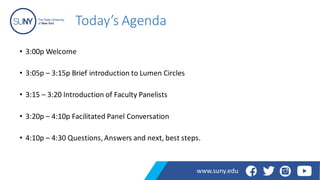
Today’s Agenda
• 3:00p Welcome
• 3:05p – 3:15p Brief introduction to Lumen Circles
• 3:15 – 3:20 Introduction of Faculty Panelists
• 3:20p – 4:10p Facilitated Panel Conversation
• 4:10p – 4:30 Questions, Answers and next, best steps.
www.suny.edu
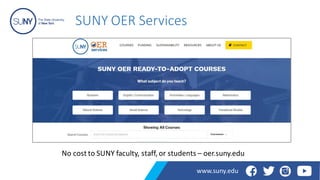
SUNY OER Services
No cost to SUNY faculty, staff, or students – oer.suny.edu
www.suny.edu
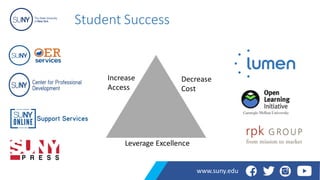
Student Success
Leverage Excellence
www.suny.edu
Decrease
Cost
Increase
Access
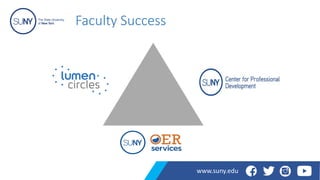
Faculty Success
www.suny.edu
Critical Reflection
“Critical reflection is … the sustainedand intentionalprocess of identifying and checking the accuracy and validityof
our teaching assumptions.” -Stephen Brookfield, Becoming a CriticallyReflective Teacher
Critical reflection looks to clarify and investigatethe truth of teaching assumptions using four lenses:
• Students’ eyes (reflection through student feedback)
• Colleagues’ perceptions(reflecting with peers)
• Personal experience (critical self-reflection)
• Theory and Research (reflecting through critical reading)
It is not enough to learn about new teaching methods, techniques, strategies, tools, etc. You also need an iterative
process that allowsyou to learn how to applythis information given the changing nature of yourstudents and teaching
environment.
www.suny.edu
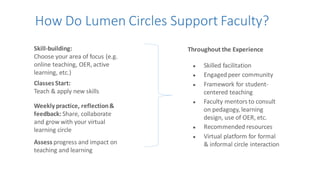
How Do Lumen Circles Support Faculty?
Skill-building:
Choose your area of focus (e.g.
online teaching, OER, active
learning, etc.)
Classes Start:
Teach & apply new skills
Weekly practice, reflection&
feedback: Share, collaborate
and grow with your virtual
learning circle
Assess progress and impact on
teaching and learning
Throughout the Experience
● Skilled facilitation
● Engagedpeer community
● Framework for student-
centered teaching
● Faculty mentors to consult
on pedagogy, learning
design, use of OER, etc.
● Recommended resources
● Virtual platform for formal
& informal circle interaction
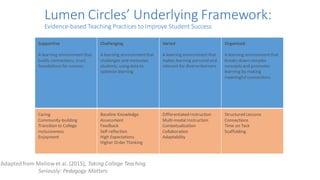
Lumen Circles’ Underlying Framework:
Evidence-based Teaching Practices to Improve Student Success
Supportive
A learning environmentthat
builds connections, trust,
foundations for success
Challenging
A learning environmentthat
challenges and motivates
students, using data to
optimize learning
Varied
A leanring environmentthat
makes learning personaland
relevant for diverselearners
Organized
A learning environmentthat
breaks down complex
concepts and promotes
learning by making
meaningful connections
Caring
Community-building
Transition to College
Inclusiveness
Enjoyment
Baseline Knowledge
Assessment
Feedback
Self-reflection
High Expectations
Higher Order Thinking
Differentiated Instruction
Multi-modal Instruction
Contextualization
Collaboration
Adaptability
Structured Lessons
Connections
Time on Task
Scaffolding
Adaptedfrom Mellow et al. (2015), Taking College Teaching
Seriously: Pedagogy Matters
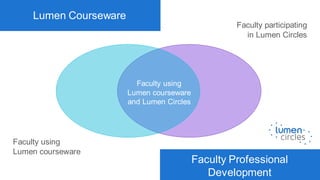
Lumen Courseware
Faculty Professional
Development
Faculty using
Lumen courseware
Faculty participating
in Lumen Circles
Faculty using
Lumen courseware
and Lumen Circles
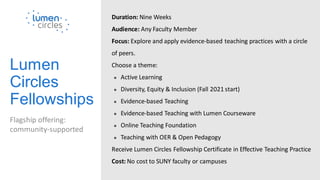
Lumen
Circles
Fellowships
Flagship offering:
community-supported
Duration: Nine Weeks
Audience: Any Faculty Member
Focus: Explore and apply evidence-based teaching practices with a circle
of peers.
Choose a theme:
● Active Learning
● Diversity, Equity & Inclusion (Fall 2021 start)
● Evidence-based Teaching
● Evidence-based Teaching with Lumen Courseware
● Online Teaching Foundation
● Teaching with OER & Open Pedagogy
Receive Lumen Circles Fellowship Certificate in Effective Teaching Practice
Cost: No cost to SUNY faculty or campuses
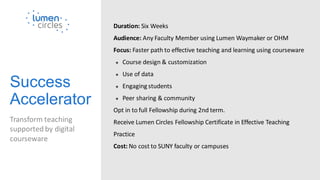
Success
Accelerator
Transform teaching
supported by digital
courseware
Duration: Six Weeks
Audience: Any Faculty Member using Lumen Waymaker or OHM
Focus: Faster path to effective teaching and learning using courseware
● Course design & customization
● Use of data
● Engaging students
● Peer sharing & community
Opt in to full Fellowship during 2nd term.
Receive Lumen Circles Fellowship Certificate in Effective Teaching
Practice
Cost: No cost to SUNY faculty or campuses
Our Faculty Panelists
Trudi E. Jacobson, MLS, MA, Distinguished Librarian, Head, Information Literacy
Department, University at Albany.
Dr. Nicole Simon Professor, Engineering/Physics/Technology, Nassau Community College.
Rob Faivre, Professor of English, SUNY Adirondack.
Sophia Georgiakaki is a Professor of Mathematics at Tompkins Cortland Community College.
Rachel Rigolino is the Coordinator of the Supplemental Writing Workshop (SWW) Program at SUNY
New Paltz.
www.suny.edu
Additional Resources
www.suny.edu
Introduction to Lumen Circles: Video
Apply for a Lumen Circles Fellowship (Fall 2021)
SUNY Faculty Perspective - Being a Lumen Circle Fellow: Video
SUNY Faculty Panelists (2/25/21)
SUNY Center for Professional Development
SUNY OER Services

Daly & Price: Lumen Circles – A Panel Conversation

  • 1.
    www.suny.edu February 25, 2021 SUNYOnline Summit Session is being recorded. Recordings and slides will be shared with all attendees. LumenCircles – A Panel Conversation
  • 2.
    Today’s Agenda • 3:00pWelcome • 3:05p – 3:15p Brief introduction to Lumen Circles • 3:15 – 3:20 Introduction of Faculty Panelists • 3:20p – 4:10p Facilitated Panel Conversation • 4:10p – 4:30 Questions, Answers and next, best steps. www.suny.edu
  • 3.
    SUNY OER Services Nocost to SUNY faculty, staff, or students – oer.suny.edu www.suny.edu
  • 4.
  • 5.
  • 6.
    Critical Reflection “Critical reflectionis … the sustainedand intentionalprocess of identifying and checking the accuracy and validityof our teaching assumptions.” -Stephen Brookfield, Becoming a CriticallyReflective Teacher Critical reflection looks to clarify and investigatethe truth of teaching assumptions using four lenses: • Students’ eyes (reflection through student feedback) • Colleagues’ perceptions(reflecting with peers) • Personal experience (critical self-reflection) • Theory and Research (reflecting through critical reading) It is not enough to learn about new teaching methods, techniques, strategies, tools, etc. You also need an iterative process that allowsyou to learn how to applythis information given the changing nature of yourstudents and teaching environment. www.suny.edu
  • 7.
    How Do LumenCircles Support Faculty? Skill-building: Choose your area of focus (e.g. online teaching, OER, active learning, etc.) Classes Start: Teach & apply new skills Weekly practice, reflection& feedback: Share, collaborate and grow with your virtual learning circle Assess progress and impact on teaching and learning Throughout the Experience ● Skilled facilitation ● Engagedpeer community ● Framework for student- centered teaching ● Faculty mentors to consult on pedagogy, learning design, use of OER, etc. ● Recommended resources ● Virtual platform for formal & informal circle interaction
  • 8.
    Lumen Circles’ UnderlyingFramework: Evidence-based Teaching Practices to Improve Student Success Supportive A learning environmentthat builds connections, trust, foundations for success Challenging A learning environmentthat challenges and motivates students, using data to optimize learning Varied A leanring environmentthat makes learning personaland relevant for diverselearners Organized A learning environmentthat breaks down complex concepts and promotes learning by making meaningful connections Caring Community-building Transition to College Inclusiveness Enjoyment Baseline Knowledge Assessment Feedback Self-reflection High Expectations Higher Order Thinking Differentiated Instruction Multi-modal Instruction Contextualization Collaboration Adaptability Structured Lessons Connections Time on Task Scaffolding Adaptedfrom Mellow et al. (2015), Taking College Teaching Seriously: Pedagogy Matters
  • 9.
    Lumen Courseware Faculty Professional Development Facultyusing Lumen courseware Faculty participating in Lumen Circles Faculty using Lumen courseware and Lumen Circles
  • 10.
    Lumen Circles Fellowships Flagship offering: community-supported Duration: NineWeeks Audience: Any Faculty Member Focus: Explore and apply evidence-based teaching practices with a circle of peers. Choose a theme: ● Active Learning ● Diversity, Equity & Inclusion (Fall 2021 start) ● Evidence-based Teaching ● Evidence-based Teaching with Lumen Courseware ● Online Teaching Foundation ● Teaching with OER & Open Pedagogy Receive Lumen Circles Fellowship Certificate in Effective Teaching Practice Cost: No cost to SUNY faculty or campuses
  • 11.
    Success Accelerator Transform teaching supported bydigital courseware Duration: Six Weeks Audience: Any Faculty Member using Lumen Waymaker or OHM Focus: Faster path to effective teaching and learning using courseware ● Course design & customization ● Use of data ● Engaging students ● Peer sharing & community Opt in to full Fellowship during 2nd term. Receive Lumen Circles Fellowship Certificate in Effective Teaching Practice Cost: No cost to SUNY faculty or campuses
  • 12.
    Our Faculty Panelists TrudiE. Jacobson, MLS, MA, Distinguished Librarian, Head, Information Literacy Department, University at Albany. Dr. Nicole Simon Professor, Engineering/Physics/Technology, Nassau Community College. Rob Faivre, Professor of English, SUNY Adirondack. Sophia Georgiakaki is a Professor of Mathematics at Tompkins Cortland Community College. Rachel Rigolino is the Coordinator of the Supplemental Writing Workshop (SWW) Program at SUNY New Paltz. www.suny.edu
  • 13.
    Additional Resources www.suny.edu Introduction toLumen Circles: Video Apply for a Lumen Circles Fellowship (Fall 2021) SUNY Faculty Perspective - Being a Lumen Circle Fellow: Video SUNY Faculty Panelists (2/25/21) SUNY Center for Professional Development SUNY OER Services