National Center for Higher Education Management Systems
3035 Center Green Drive, Suite 150
Boulder, Colorado 80301
Creating Sustainable
Competency-Based Education Programs
Presented to:
CBE4CC
June 5, 2015
Design Principles for Competency-Based Education
Programs (CBE)
•  The degree reflects robust and valid competencies
•  Students are able to learn at a variable pace and are
supported in their learning
•  Effective learning resources are available anytime and
are reusable
•  The process for mapping competencies to courses,
learning outcomes, and assessments is explicit
•  Assessments are secure and reliable
2
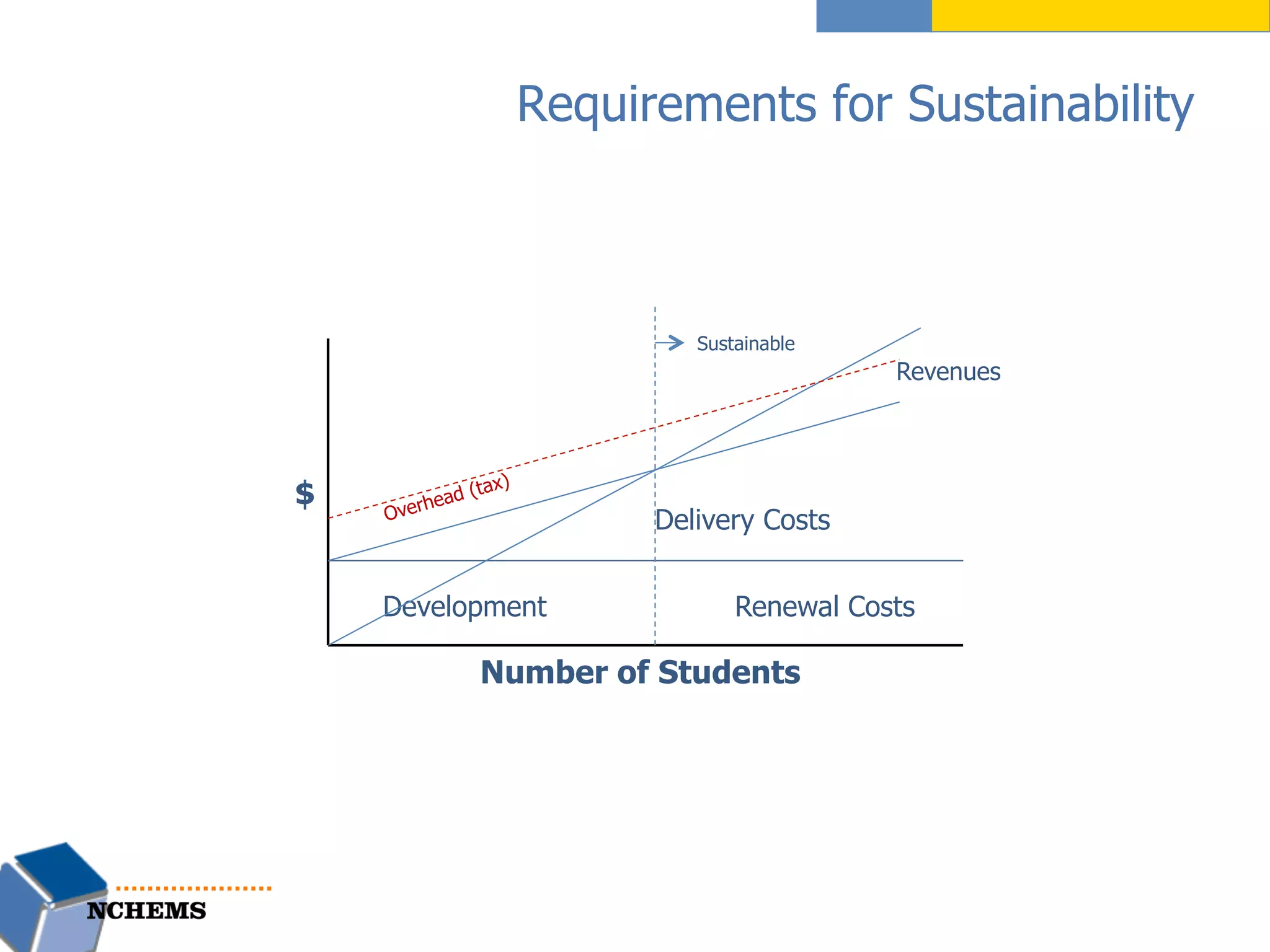
Requirements for Sustainability
$
Number of Students
Development Renewal Costs
Delivery Costs
Revenues
Overhead (tax)
Sustainable
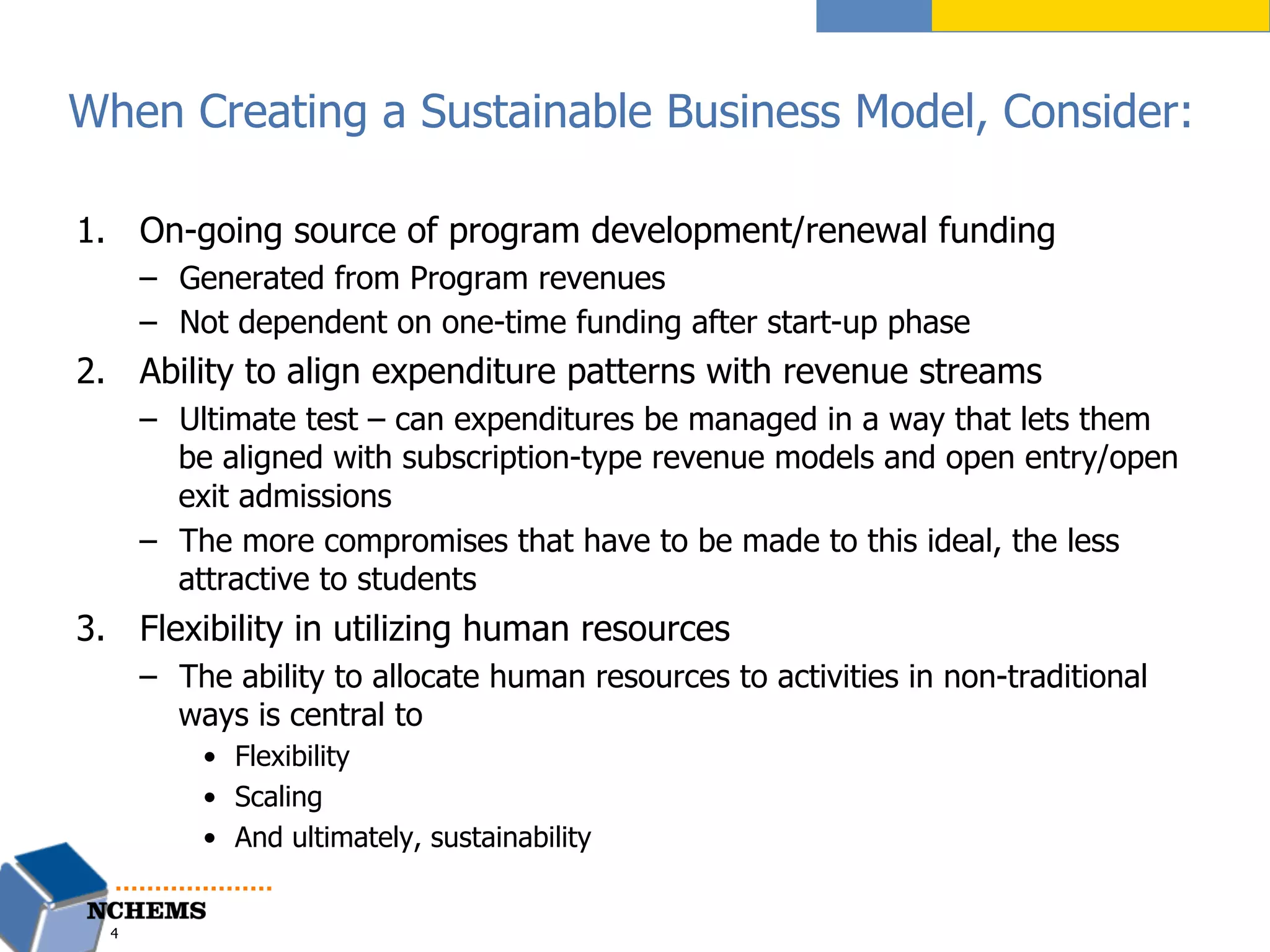
When Creating a Sustainable Business Model, Consider:
1.  On-going source of program development/renewal funding
–  Generated from Program revenues
–  Not dependent on one-time funding after start-up phase
2.  Ability to align expenditure patterns with revenue streams
–  Ultimate test – can expenditures be managed in a way that lets them
be aligned with subscription-type revenue models and open entry/open
exit admissions
–  The more compromises that have to be made to this ideal, the less
attractive to students
3.  Flexibility in utilizing human resources
–  The ability to allocate human resources to activities in non-traditional
ways is central to
•  Flexibility
•  Scaling
•  And ultimately, sustainability
4
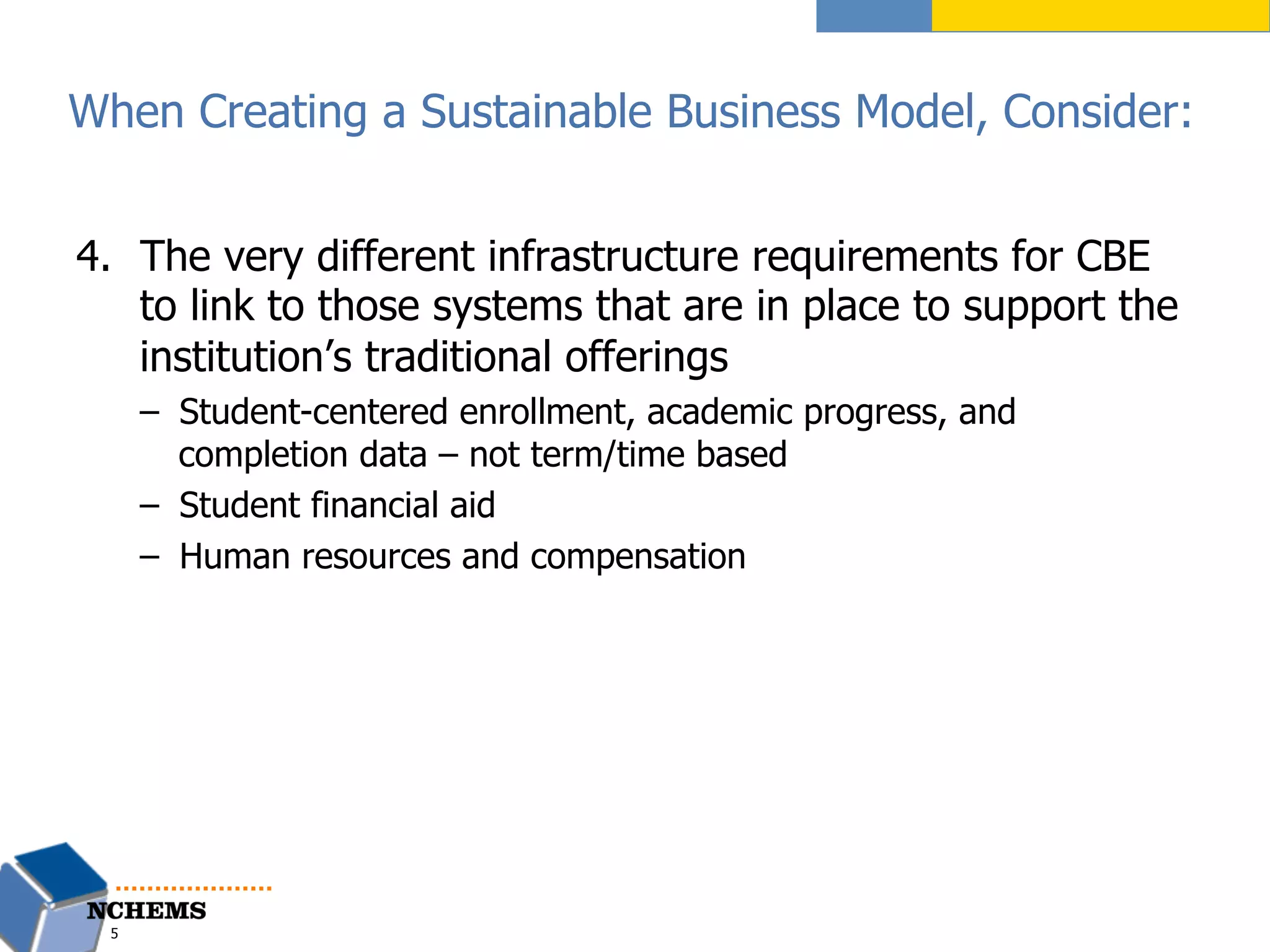
4.  The very different infrastructure requirements for CBE
to link to those systems that are in place to support the
institution’s traditional offerings
–  Student-centered enrollment, academic progress, and
completion data – not term/time based
–  Student financial aid
–  Human resources and compensation
5
When Creating a Sustainable Business Model, Consider:
Characteristics of Sustainable Models
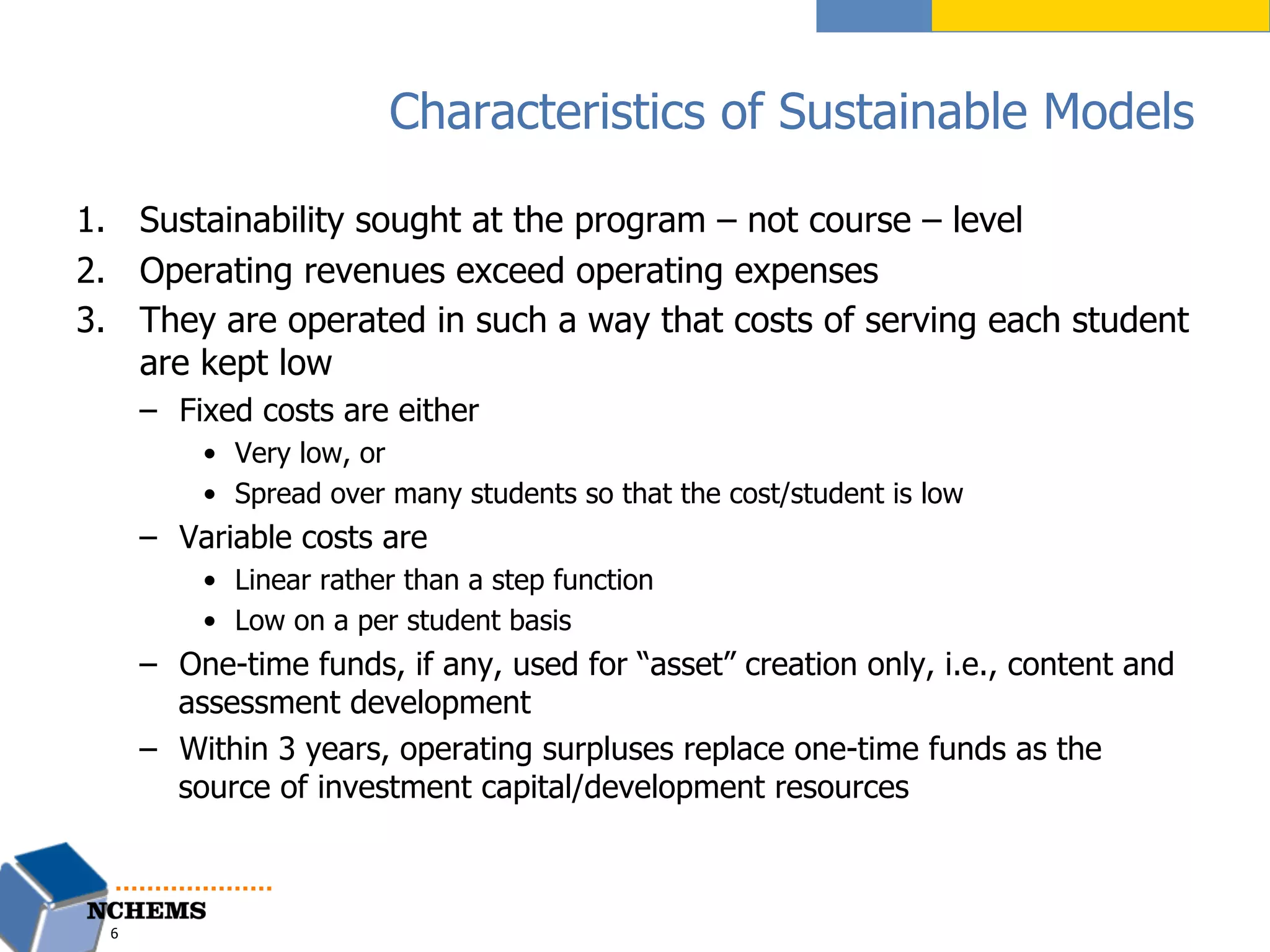
1.  Sustainability sought at the program – not course – level
2.  Operating revenues exceed operating expenses
3.  They are operated in such a way that costs of serving each student
are kept low
–  Fixed costs are either
•  Very low, or
•  Spread over many students so that the cost/student is low
–  Variable costs are
•  Linear rather than a step function
•  Low on a per student basis
–  One-time funds, if any, used for “asset” creation only, i.e., content and
assessment development
–  Within 3 years, operating surpluses replace one-time funds as the
source of investment capital/development resources
6
Characteristics of Sustainable Models
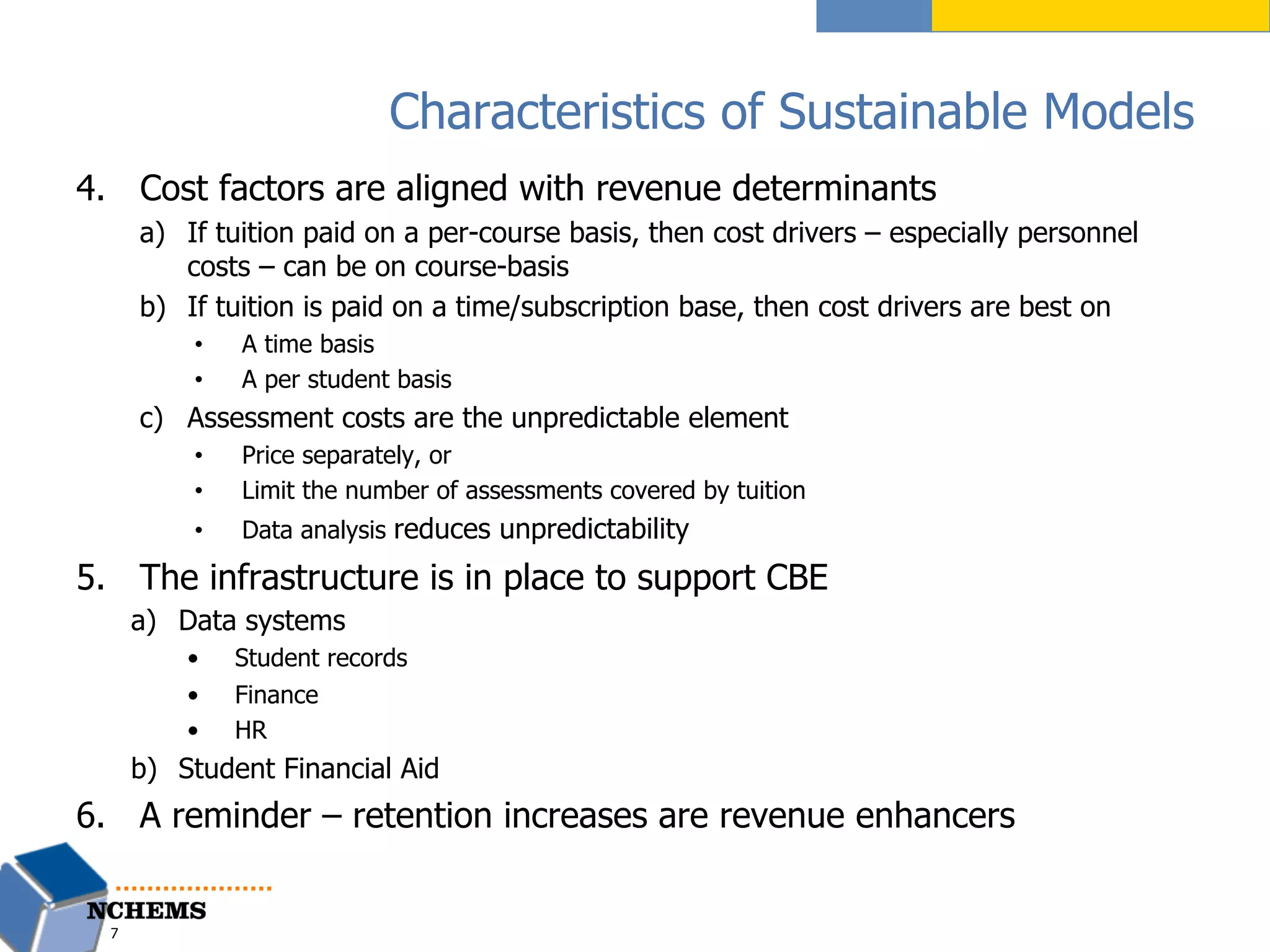
4.  Cost factors are aligned with revenue determinants
a)  If tuition paid on a per-course basis, then cost drivers – especially personnel
costs – can be on course-basis
b)  If tuition is paid on a time/subscription base, then cost drivers are best on
•  A time basis
•  A per student basis
c)  Assessment costs are the unpredictable element
•  Price separately, or
•  Limit the number of assessments covered by tuition
•  Data analysis reduces unpredictability
5.  The infrastructure is in place to support CBE
a)  Data systems
•  Student records
•  Finance
•  HR
b)  Student Financial Aid
6.  A reminder – retention increases are revenue enhancers
7
A Framework for the Cost Calculation
8
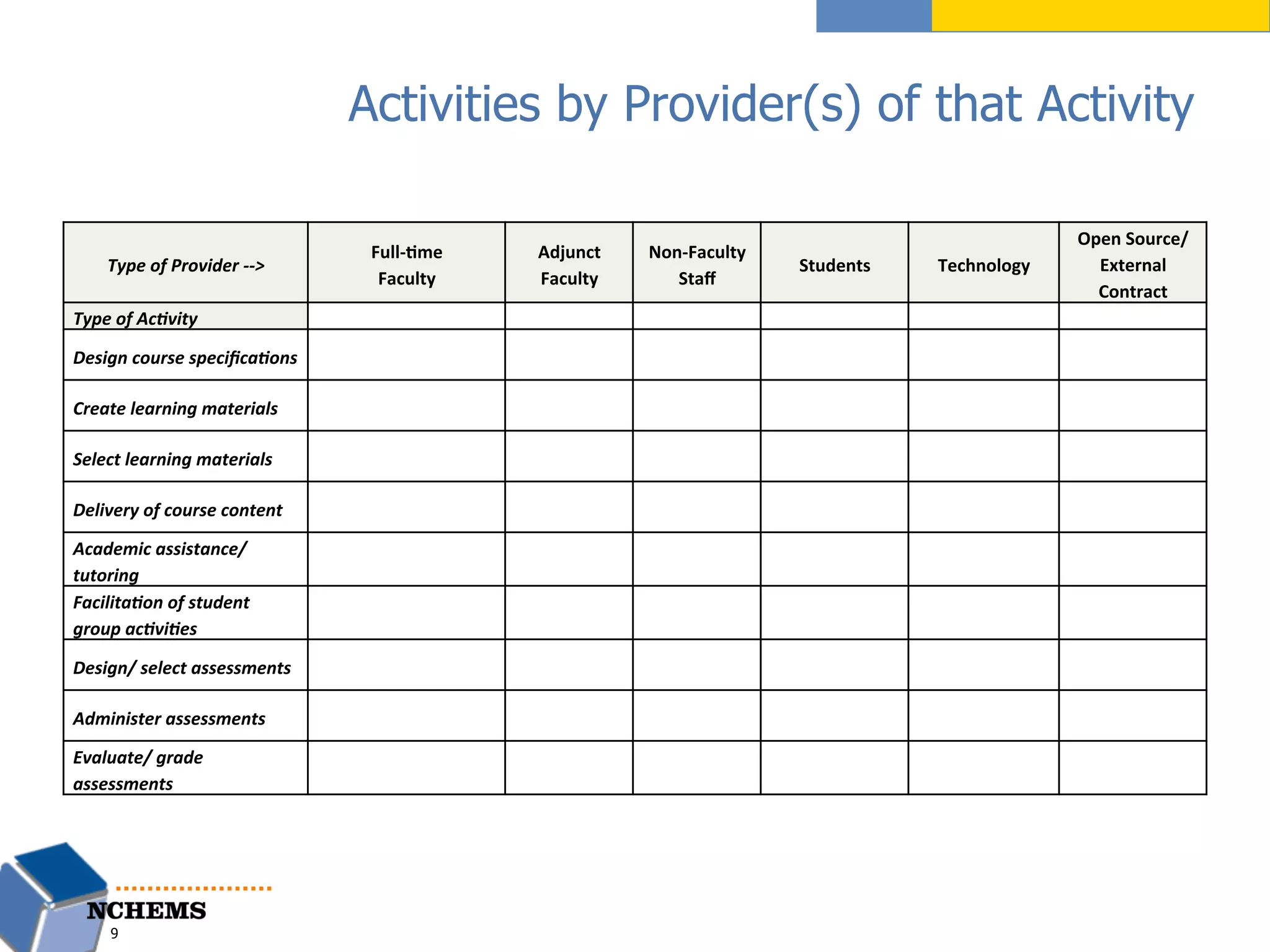
Activities by Provider(s) of that Activity
9
Type	
  of	
  Provider	
  -­‐-­‐>	
  
Full-­‐%me	
  
Faculty	
  
Adjunct	
  
Faculty	
  
Non-­‐Faculty	
  
Staff	
  
Students	
   Technology	
  
Open	
  Source/	
  
External	
  
Contract	
  
Type	
  of	
  Ac1vity	


Design	
  course	
  specifica1ons	


Create	
  learning	
  materials	


Select	
  learning	
  materials	


Delivery	
  of	
  course	
  content	


Academic	
  assistance/
tutoring	


Facilita1on	
  of	
  student	
  
group	
  ac1vi1es	


Design/	
  select	
  assessments	


Administer	
  assessments	


Evaluate/	
  grade	
  
assessments	
  
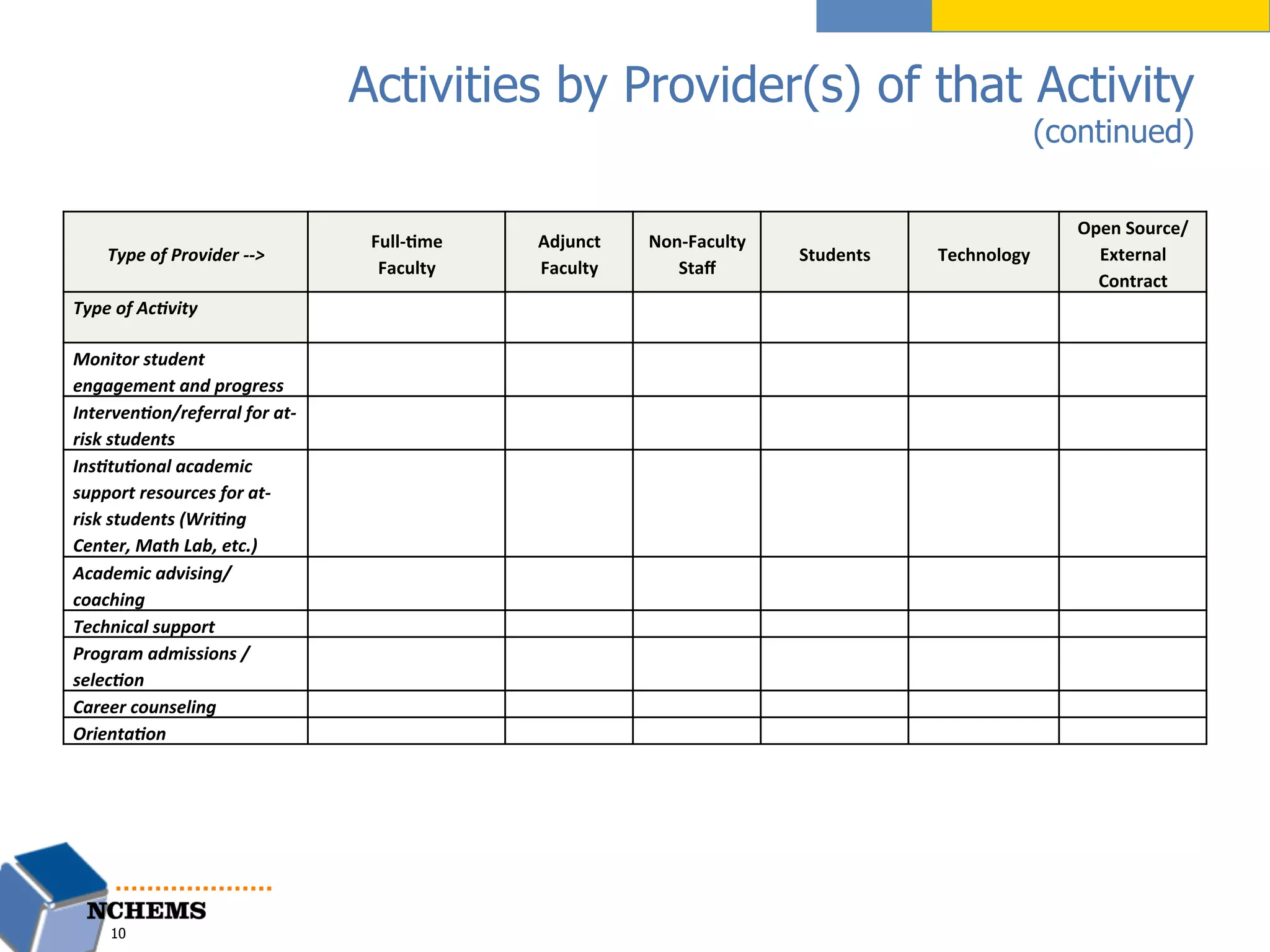
Activities by Provider(s) of that Activity
(continued)
10
Type	
  of	
  Provider	
  -­‐-­‐>	
  
Full-­‐%me	
  
Faculty	
  
Adjunct	
  
Faculty	
  
Non-­‐Faculty	
  
Staff	
  
Students	
   Technology	
  
Open	
  Source/	
  
External	
  
Contract	
  
Type	
  of	
  Ac1vity	


Monitor	
  student	
  
engagement	
  and	
  progress	


Interven1on/referral	
  for	
  at-­‐
risk	
  students	


Ins1tu1onal	
  academic	
  
support	
  resources	
  for	
  at-­‐
risk	
  students	
  (Wri1ng	
  
Center,	
  Math	
  Lab,	
  etc.)	


Academic	
  advising/
coaching	


Technical	
  support	


Program	
  admissions	
  /	
  
selec1on	


Career	
  counseling	


Orienta1on	


Activities by Provider(s) of that Activity
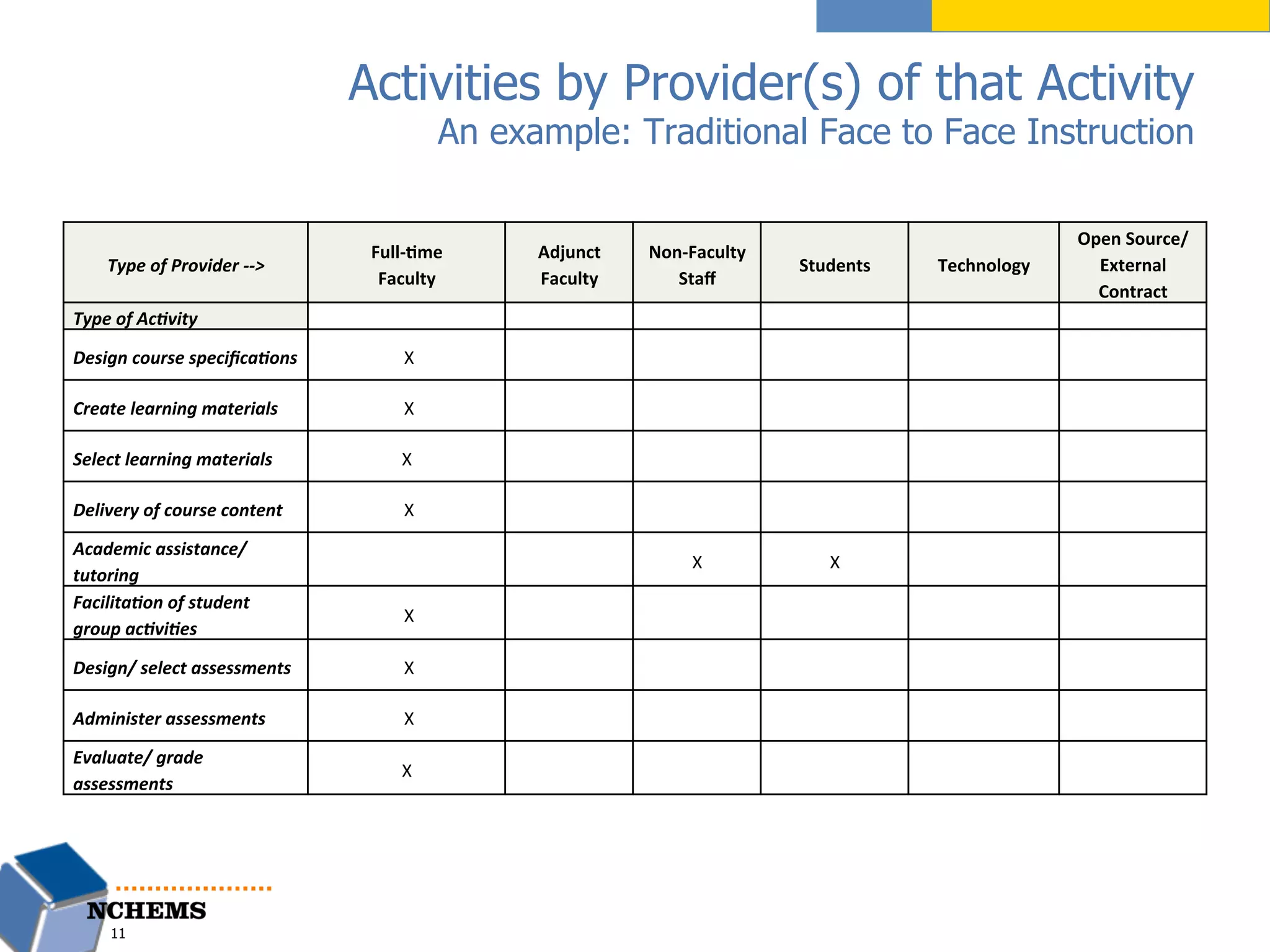
An example: Traditional Face to Face Instruction
11
Type	
  of	
  Provider	
  -­‐-­‐>	
  
Full-­‐%me	
  
Faculty	
  
Adjunct	
  
Faculty	
  
Non-­‐Faculty	
  
Staff	
  
Students	
   Technology	
  
Open	
  Source/	
  
External	
  
Contract	
  
Type	
  of	
  Ac1vity	


Design	
  course	
  specifica1ons	
   	
  X	


Create	
  learning	
  materials	
   	
  X	


Select	
  learning	
  materials	
   X	


Delivery	
  of	
  course	
  content	
   	
  X	


Academic	
  assistance/
tutoring	


   X	
  	
   X	


Facilita1on	
  of	
  student	
  
group	
  ac1vi1es	
  
	
  X	


Design/	
  select	
  assessments	
   	
  X	


Administer	
  assessments	
   	
  X	


Evaluate/	
  grade	
  
assessments	
  
X	
  
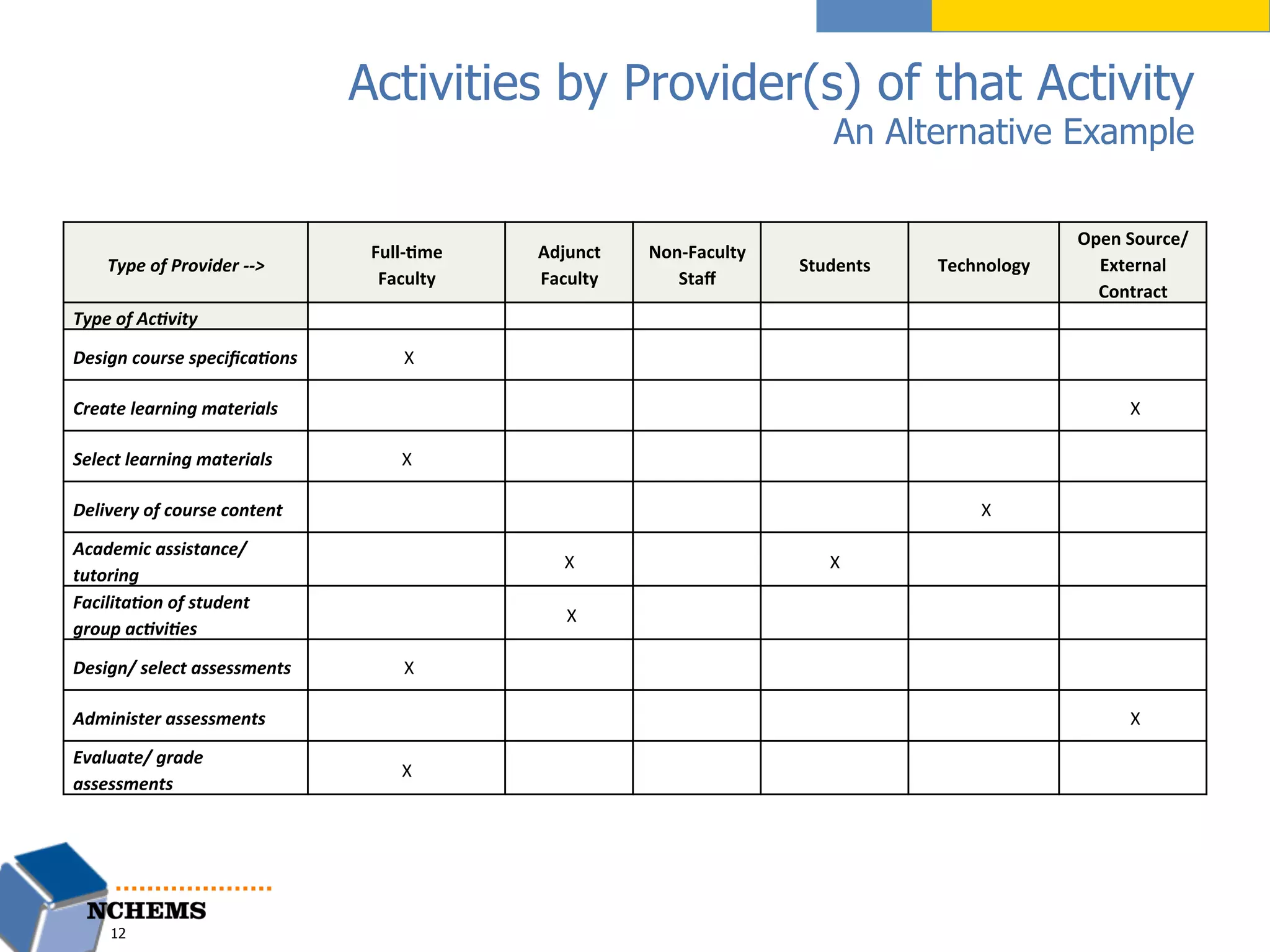
Activities by Provider(s) of that Activity
An Alternative Example
12
Type	
  of	
  Provider	
  -­‐-­‐>	
  
Full-­‐%me	
  
Faculty	
  
Adjunct	
  
Faculty	
  
Non-­‐Faculty	
  
Staff	
  
Students	
   Technology	
  
Open	
  Source/	
  
External	
  
Contract	
  
Type	
  of	
  Ac1vity	


Design	
  course	
  specifica1ons	
   	
  X	


Create	
  learning	
  materials	


  X	
  
Select	
  learning	
  materials	
   X	


Delivery	
  of	
  course	
  content	


  X	


Academic	
  assistance/
tutoring	


   X	
  	
   X	


Facilita1on	
  of	
  student	
  
group	
  ac1vi1es	


  X	


Design/	
  select	
  assessments	
   	
  X	


Administer	
  assessments	


  X	
  
Evaluate/	
  grade	
  
assessments	
  
X	
  
For More Information Contact:
Dennis Jones
dennis@nchems.org
303-497-0301
National Center for Higher Education Management Systems

Budgeting, Financing, and Sustaining CBE Programs Faculty Development Model - Competency-Based Education

  • 1.
    National Center forHigher Education Management Systems 3035 Center Green Drive, Suite 150 Boulder, Colorado 80301 Creating Sustainable Competency-Based Education Programs Presented to: CBE4CC June 5, 2015
  • 2.
    Design Principles forCompetency-Based Education Programs (CBE) •  The degree reflects robust and valid competencies •  Students are able to learn at a variable pace and are supported in their learning •  Effective learning resources are available anytime and are reusable •  The process for mapping competencies to courses, learning outcomes, and assessments is explicit •  Assessments are secure and reliable 2
  • 3.
    Requirements for Sustainability $ Numberof Students Development Renewal Costs Delivery Costs Revenues Overhead (tax) Sustainable
  • 4.
    When Creating aSustainable Business Model, Consider: 1.  On-going source of program development/renewal funding –  Generated from Program revenues –  Not dependent on one-time funding after start-up phase 2.  Ability to align expenditure patterns with revenue streams –  Ultimate test – can expenditures be managed in a way that lets them be aligned with subscription-type revenue models and open entry/open exit admissions –  The more compromises that have to be made to this ideal, the less attractive to students 3.  Flexibility in utilizing human resources –  The ability to allocate human resources to activities in non-traditional ways is central to •  Flexibility •  Scaling •  And ultimately, sustainability 4
  • 5.
    4.  The verydifferent infrastructure requirements for CBE to link to those systems that are in place to support the institution’s traditional offerings –  Student-centered enrollment, academic progress, and completion data – not term/time based –  Student financial aid –  Human resources and compensation 5 When Creating a Sustainable Business Model, Consider:
  • 6.
    Characteristics of SustainableModels 1.  Sustainability sought at the program – not course – level 2.  Operating revenues exceed operating expenses 3.  They are operated in such a way that costs of serving each student are kept low –  Fixed costs are either •  Very low, or •  Spread over many students so that the cost/student is low –  Variable costs are •  Linear rather than a step function •  Low on a per student basis –  One-time funds, if any, used for “asset” creation only, i.e., content and assessment development –  Within 3 years, operating surpluses replace one-time funds as the source of investment capital/development resources 6
  • 7.
    Characteristics of SustainableModels 4.  Cost factors are aligned with revenue determinants a)  If tuition paid on a per-course basis, then cost drivers – especially personnel costs – can be on course-basis b)  If tuition is paid on a time/subscription base, then cost drivers are best on •  A time basis •  A per student basis c)  Assessment costs are the unpredictable element •  Price separately, or •  Limit the number of assessments covered by tuition •  Data analysis reduces unpredictability 5.  The infrastructure is in place to support CBE a)  Data systems •  Student records •  Finance •  HR b)  Student Financial Aid 6.  A reminder – retention increases are revenue enhancers 7
  • 8.
    A Framework forthe Cost Calculation 8
  • 9.
    Activities by Provider(s)of that Activity 9 Type  of  Provider  -­‐-­‐>   Full-­‐%me   Faculty   Adjunct   Faculty   Non-­‐Faculty   Staff   Students   Technology   Open  Source/   External   Contract   Type  of  Ac1vity                           Design  course  specifica1ons                           Create  learning  materials                           Select  learning  materials                           Delivery  of  course  content                           Academic  assistance/ tutoring                           Facilita1on  of  student   group  ac1vi1es                           Design/  select  assessments                           Administer  assessments                           Evaluate/  grade   assessments  
  • 10.
    Activities by Provider(s)of that Activity (continued) 10 Type  of  Provider  -­‐-­‐>   Full-­‐%me   Faculty   Adjunct   Faculty   Non-­‐Faculty   Staff   Students   Technology   Open  Source/   External   Contract   Type  of  Ac1vity                           Monitor  student   engagement  and  progress                           Interven1on/referral  for  at-­‐ risk  students                           Ins1tu1onal  academic   support  resources  for  at-­‐ risk  students  (Wri1ng   Center,  Math  Lab,  etc.)                           Academic  advising/ coaching                           Technical  support                           Program  admissions  /   selec1on                           Career  counseling                           Orienta1on                          
  • 11.
    Activities by Provider(s)of that Activity An example: Traditional Face to Face Instruction 11 Type  of  Provider  -­‐-­‐>   Full-­‐%me   Faculty   Adjunct   Faculty   Non-­‐Faculty   Staff   Students   Technology   Open  Source/   External   Contract   Type  of  Ac1vity                           Design  course  specifica1ons    X                       Create  learning  materials    X                       Select  learning  materials   X                       Delivery  of  course  content    X                       Academic  assistance/ tutoring           X     X             Facilita1on  of  student   group  ac1vi1es    X                       Design/  select  assessments    X                       Administer  assessments    X                       Evaluate/  grade   assessments   X  
  • 12.
    Activities by Provider(s)of that Activity An Alternative Example 12 Type  of  Provider  -­‐-­‐>   Full-­‐%me   Faculty   Adjunct   Faculty   Non-­‐Faculty   Staff   Students   Technology   Open  Source/   External   Contract   Type  of  Ac1vity                           Design  course  specifica1ons    X                       Create  learning  materials                        X   Select  learning  materials   X                       Delivery  of  course  content                    X       Academic  assistance/ tutoring       X     X           Facilita1on  of  student   group  ac1vi1es        X                   Design/  select  assessments    X                       Administer  assessments                        X   Evaluate/  grade   assessments   X  
  • 13.
    For More InformationContact: Dennis Jones dennis@nchems.org 303-497-0301 National Center for Higher Education Management Systems