Program OverviewFlex-Paced Web IT Programs
This product was funded by a grant awarded by the U.S. Department of Labor’s Employment and Training Administration. The product was created by the grantee and does not necessarily reflect the official position of the U.S.
Department of Labor. The Department of Labor makes no guarantees, warranties, or assurances of any kind, express or implied, with respect to such information, including any information on linked sites and including, but not limited to,
accuracy of the information or its completeness, timeliness, usefulness, adequacy, continued availability, or ownership.
Adopting and Adapting Competency-Based Education:
A Community College Toolkit
September 23-24, 2015
Dave Siefert , Co-Director TAACCCT Grant
The TAACCCT ON! 2015 Conference
Agenda
1. What is CBE?
2. TAACCCT Grant
3. Strategy
4. Project Model Components
a. Workforce Relationships
b. Curriculum
c. Program Delivery
d. Student Experience
What is CBE?
What is CBE?
• Direct assessment
– Students demonstrate achievement of competencies without
regard to courses or credit hours. They demonstrate mastery of
individual competencies through summative assessments such
as exams and portfolios.
• Course-based
– Students demonstrate mastery of skills and knowledge at a
course or module-level. Competencies, defined at the program
level, are translated into topics that are packaged into the
courses or modules.
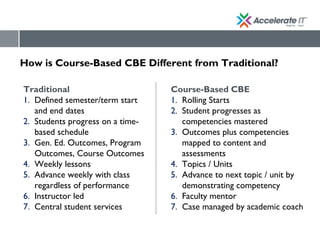
How is Course-Based CBE Different from Traditional?
Traditional
1. Defined semester/term start
and end dates
2. Students progress on a time-
based schedule
3. Gen. Ed. Outcomes, Program
Outcomes, Course Outcomes
4. Weekly lessons
5. Advance weekly with class
regardless of performance
6. Instructor led
7. Central student services
Course-Based CBE
1. Rolling Starts
2. Student progresses as
competencies mastered
3. Outcomes plus competencies
mapped to content and
assessments
4. Topics / Units
5. Advance to next topic / unit by
demonstrating competency
6. Faculty mentor
7. Case managed by academic coach
Indications that CBE is Important
• Employers want it
• Fed government
– DOL focused funding for TAACCT round 4 on CBE,
– DOE has changed financial aid policy to address CBE
• Accreditors
– developed rules and processes around CBE accreditation
• Lumina, Gates, and Joyce are funding
– Several CBE convenings prior to TAACCCT announcement
– Transformative Change Initiative
– CBE Sustainability convening
– Gates funded WGU to work with 12 CCs to develop CBE
programs
The Grant
What is Accelerate IT?
Sinclair’s TAACCCT Grant Project
• Grant Goal – Adapt and adopt competency-based IT
instruction to accelerate learning for TAA-eligible, veterans,
unemployed, and other adult learners.
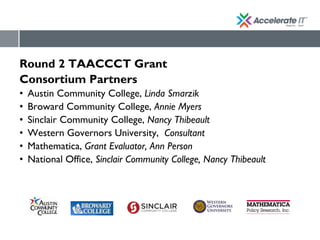
Round 2 TAACCCT Grant
Consortium Partners
• Austin Community College, Linda Smarzik
• Broward Community College, Annie Myers
• Sinclair Community College, Nancy Thibeault
• Western Governors University, Consultant
• Mathematica, Grant Evaluator, Ann Person
• National Office, Sinclair Community College, Nancy Thibeault
Annual Goals
• Y1: October 1, 2012 – September 30, 2013
Do whatever it takes to enroll and support 50 students
• Y2: October 1, 2013 – September 30, 2014
Refine processes, improve efficiencies, marketing, workforce
relationships/jobs
• Y3: October 1, 2014 – September 30, 2015
Automate processes; Sustainability and dissemination
• Y4: October 1, 2015 – September 30, 2016
Project Wrap up and 3rd party evaluation
Accelerate IT Model
Accelerate IT Model – Strategy and Planning
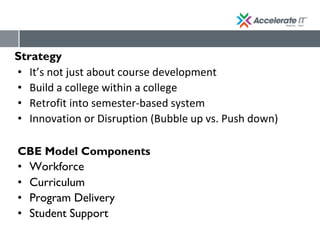
Strategy
• It’s not just about course development
• Build a college within a college
• Retrofit into semester-based system
• Innovation or Disruption (Bubble up vs. Push down)
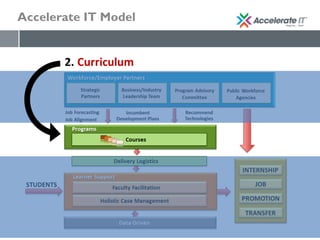
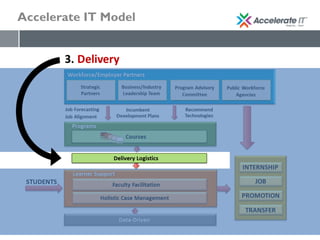
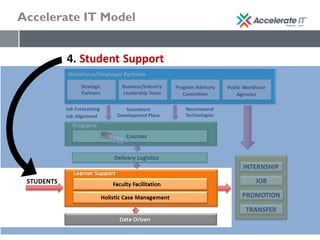
CBE Model Components
• Workforce
• Curriculum
• Program Delivery
• Student Support
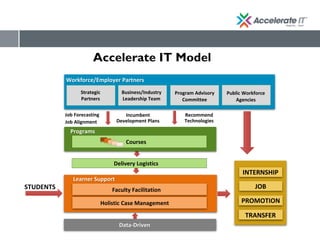
STUDENTS
Program Advisory
Committee
Programs
Courses
Delivery Logistics
Learner Support
Holistic Case Management
Faculty Facilitation
Recommend
Technologies
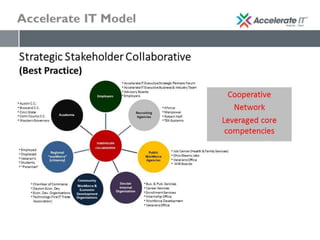
Strategic
Partners
Business/Industry
Leadership Team
Data-Driven
Job Forecasting
Job Alignment
Incumbent
Development Plans
Workforce/Employer Partners
Public Workforce
Agencies
JOB
INTERNSHIP
TRANSFER
PROMOTION
Accelerate IT Model
Accelerate IT Model
Accelerate IT Model
Accelerate IT Model
Accelerate IT Model
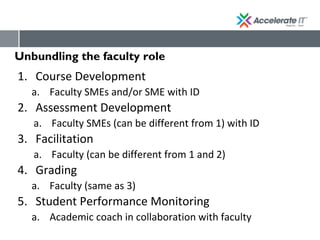
Unbundling the faculty role
1. Course Development
a. Faculty SMEs and/or SME with ID
2. Assessment Development
a. Faculty SMEs (can be different from 1) with ID
3. Facilitation
a. Faculty (can be different from 1 and 2)
4. Grading
a. Faculty (same as 3)
5. Student Performance Monitoring
a. Academic coach in collaboration with faculty
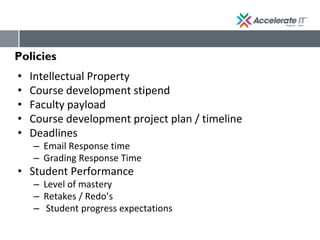
Policies
• Intellectual Property
• Course development stipend
• Faculty payload
• Course development project plan / timeline
• Deadlines
– Email Response time
– Grading Response Time
• Student Performance
– Level of mastery
– Retakes / Redo’s
– Student progress expectations
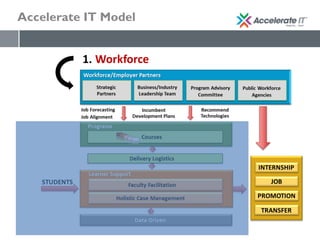
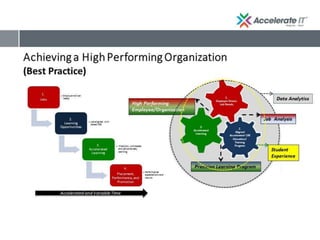
Accelerate IT Model - Workforce
Accelerate IT Model
Accelerate IT Model
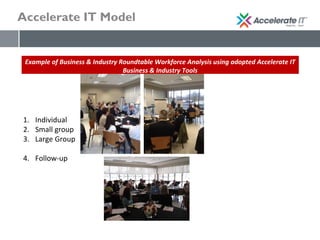
Example of Business & Industry Roundtable Workforce Analysis using adopted Accelerate IT
Business & Industry Tools
1. Individual
2. Small group
3. Large Group
4. Follow-up
Accelerate IT Model - Curriculum
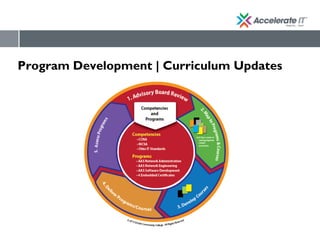
Program Development | Curriculum Updates
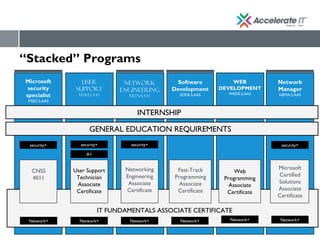
“Stacked” Programs
Microsoft
security
specialist
MSSC.S.AAS
User
Support
USSU.S.AAS
Network
Engineering
NEEN.S.AAS
Software
Development
SODE.S.AAS
WEB
DEVELOPMENT
WEDE.S.AAS
Network
Manager
NEMA.S.AAS
INTERNSHIP
GENERAL EDUCATION REQUIREMENTS
security+ security+ security+ security+
A+
Network+ Network+ Network+ Network+ Network+ Network+
CNSS
4011
User Support
Technician
Associate
Certificate
Networking
Engineering
Associate
Certificate
Microsoft
Certified
Solutions
Associate
Certificate
Fast-Track
Programming
Associate
Certificate
Web
Programming
Associate
Certificate
IT FUNDAMENTALS ASSOCIATE CERTIFICATE
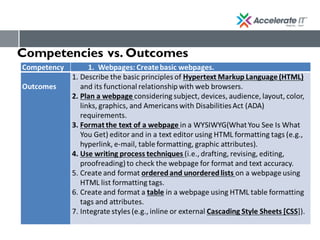
Competencies vs. Outcomes
• Competency
– A general statement detailing the desired knowledge and
skills of student graduating from our course or program.
(What employers expect graduates to know and be able
to do)
– A competency may have several specific learning
outcomes
• Outcome
– A very specific statement that describes exactly what a
student will be able to do in some measurable way.
– A learning outcome is written so that it can be measured
or assessed.
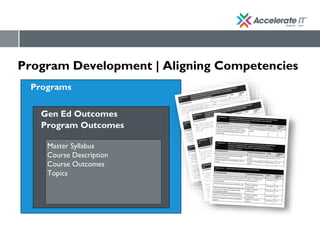
Program Development | Aligning Competencies
Programs
Gen Ed Outcomes
Program Outcomes
Master Syllabus
Course Description
Course Outcomes
Topics
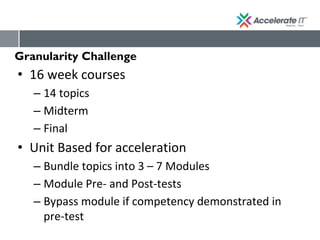
Granularity Challenge
• 16 week courses
– 14 topics
– Midterm
– Final
• Unit Based for acceleration
– Bundle topics into 3 – 7 Modules
– Module Pre- and Post-tests
– Bypass module if competency demonstrated in
pre-test
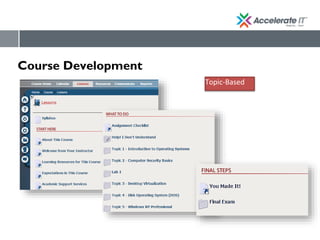
Course Development
Topic-Based
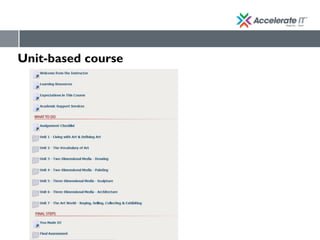
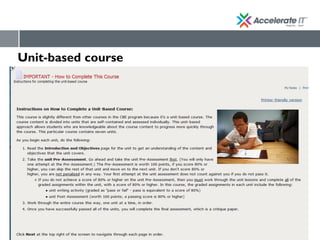
Unit-based course
PLA
• Sinclair PLA – Course-Based
– Credit by Exam (Proficiency, CLEP, Dantes, AP)
– Credit for what you know (Portfolio, Articulated credit)
– Problem: Students have gaps in their knowledge
• CBE – Module-based
– Complete module pre-assessments
• If passed, can skip over module activities
– Smaller chunks
• Skip over what you know, focus on your gaps
Unit-based course
Program Development | Assessments
• Assessments - Key to acceleration
• Students accelerate by demonstrating what they know, focusing
on what they don’t
• 80% required passing grade to continue
• Assessment Types
– Topic quizzes – low stakes – unlimited attempts
– Homework and Tests – 2 attempts
– Midterm – 2 attempts
– Final – 1 or 2 attempts (depending on course)
– Retake guidelines
• Demonstrate substantial additional engagement
Accelerate IT Model – Delivery
Program Delivery
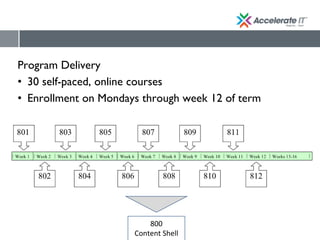
• 30 self-paced, online courses
• Enrollment on Mondays through week 12 of term
800
Content Shell
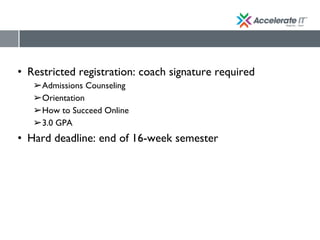
• Restricted registration: coach signature required
➢Admissions Counseling
➢Orientation
➢How to Succeed Online
➢3.0 GPA
• Hard deadline: end of 16-week semester
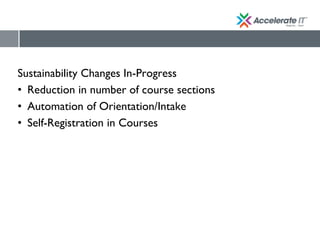
Sustainability Changes In-Progress
• Reduction in number of course sections
• Automation of Orientation/Intake
• Self-Registration in Courses
Accelerate IT Model – Student Experience
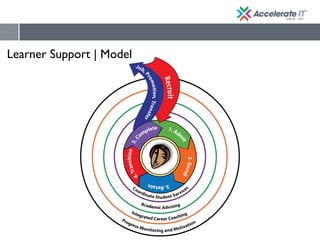
Learner Support | Model
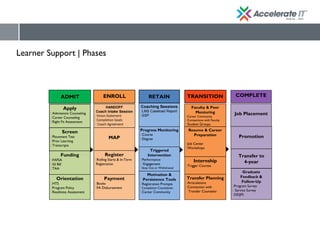
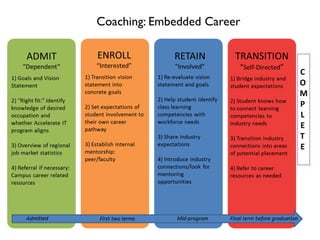
Learner Support | Phases
RETAINENROLL TRANSITION COMPLETE
Apply
Admissions Counseling
Career Counseling
Right Fit Assessment
Screen
Placement Test
Prior Learning
Transcripts
Funding
FAFSA
GI Bill
TAA
Orientation
HTS
Program Policy
Readiness Assessment
HANDOFF
Coach Intake Session
Vision Statement
Completion Goals
 Coach Agreement
Coaching Sessions
LMS Caseload Report
SSP
Progress Monitoring
Course
Degree
Triggered
Intervention
Performance
 Engagement
Stop Out or Withdrawal
Motivation &
Persistence Tools
Registration Prompts
Completion Countdown
Career Community
Register
Rolling Starts & In-Term
Registration
Payment
Books
FA Disbursement
MAP
Faculty & Peer
Mentoring
Career Community
Connections with Faculty
Student Groups
Resume & Career
Preparation
Job Center
Workshops
Internship
Trigger Courses
Transfer Planning
Articulations
Connection with
Transfer Counselor
Job Placement
Promotion
Transfer to
4-year
Graduate
Feedback &
Follow-Up
Program Survey
 Service Survey
ODJFS
ADMIT
Accelerate IT Model – Data Analytics
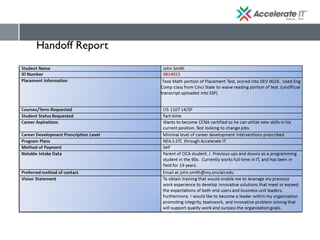
Handoff Report
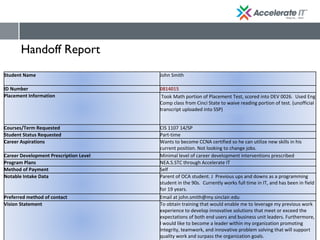
Student Name John Smith
ID Number 0814015
Placement Information Took Math portion of Placement Test, scored into DEV 0026. Used Eng
Comp class from Cinci State to waive reading portion of test. (unofficial
transcript uploaded into SSP)
Courses/Term Requested CIS 1107 14/SP
Student Status Requested Part-time
Career Aspirations Wants to become CCNA certified so he can utilize new skills in his
current position. Not looking to change jobs.
Career Development Prescription Level Minimal level of career development interventions prescribed
Program Plans NEA.S.STC through Accelerate IT
Method of Payment Self
Notable Intake Data Parent of OCA student. J Previous ups and downs as a programming
student in the 90s. Currently works full time in IT, and has been in field
for 19 years.
Preferred method of contact Email at john.smith@my.sinclair.edu
Vision Statement To obtain training that would enable me to leverage my previous work
experience to develop innovative solutions that meet or exceed the
expectations of both end users and business unit leaders. Furthermore,
I would like to become a leader within my organization promoting
integrity, teamwork, and innovative problem solving that will support
quality work and surpass the organization goals.
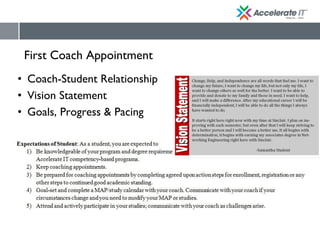
• Coach-Student Relationship
• Vision Statement
• Goals, Progress & Pacing
First Coach Appointment
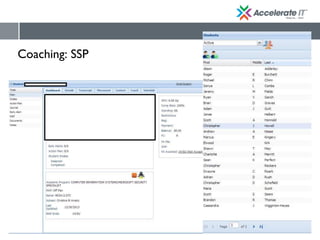
Coaching: SSP
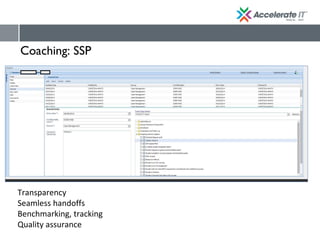
Coaching: SSP
Coaching: SSP
Transparency
Seamless handoffs
Benchmarking, tracking
Quality assurance
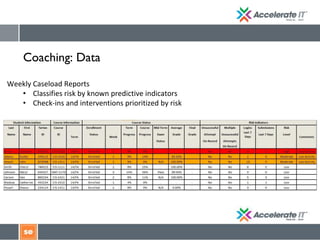
Coaching: Data
Weekly Caseload Reports
• Classifies risk by known predictive indicators
• Check-ins and interventions prioritized by risk
Coaching: Data
Q & A
Thank you!
http://www.sinclair.edu/accelerate/
Nancy.Thibeault@Sinclair.edu - TAACCCT Grant Director/Dean of eLearning
David.Siefert@Sinclair.edu - Co-Director
Christina.Amato.Sinclair.edu - Project Manager

Accelerate IT

  • 1.
    Program OverviewFlex-Paced WebIT Programs This product was funded by a grant awarded by the U.S. Department of Labor’s Employment and Training Administration. The product was created by the grantee and does not necessarily reflect the official position of the U.S. Department of Labor. The Department of Labor makes no guarantees, warranties, or assurances of any kind, express or implied, with respect to such information, including any information on linked sites and including, but not limited to, accuracy of the information or its completeness, timeliness, usefulness, adequacy, continued availability, or ownership. Adopting and Adapting Competency-Based Education: A Community College Toolkit September 23-24, 2015 Dave Siefert , Co-Director TAACCCT Grant The TAACCCT ON! 2015 Conference
  • 2.
    Agenda 1. What isCBE? 2. TAACCCT Grant 3. Strategy 4. Project Model Components a. Workforce Relationships b. Curriculum c. Program Delivery d. Student Experience
  • 3.
  • 4.
    What is CBE? •Direct assessment – Students demonstrate achievement of competencies without regard to courses or credit hours. They demonstrate mastery of individual competencies through summative assessments such as exams and portfolios. • Course-based – Students demonstrate mastery of skills and knowledge at a course or module-level. Competencies, defined at the program level, are translated into topics that are packaged into the courses or modules.
  • 5.
    How is Course-BasedCBE Different from Traditional? Traditional 1. Defined semester/term start and end dates 2. Students progress on a time- based schedule 3. Gen. Ed. Outcomes, Program Outcomes, Course Outcomes 4. Weekly lessons 5. Advance weekly with class regardless of performance 6. Instructor led 7. Central student services Course-Based CBE 1. Rolling Starts 2. Student progresses as competencies mastered 3. Outcomes plus competencies mapped to content and assessments 4. Topics / Units 5. Advance to next topic / unit by demonstrating competency 6. Faculty mentor 7. Case managed by academic coach
  • 6.
    Indications that CBEis Important • Employers want it • Fed government – DOL focused funding for TAACCT round 4 on CBE, – DOE has changed financial aid policy to address CBE • Accreditors – developed rules and processes around CBE accreditation • Lumina, Gates, and Joyce are funding – Several CBE convenings prior to TAACCCT announcement – Transformative Change Initiative – CBE Sustainability convening – Gates funded WGU to work with 12 CCs to develop CBE programs
  • 7.
  • 8.
    What is AccelerateIT? Sinclair’s TAACCCT Grant Project • Grant Goal – Adapt and adopt competency-based IT instruction to accelerate learning for TAA-eligible, veterans, unemployed, and other adult learners.
  • 9.
    Round 2 TAACCCTGrant Consortium Partners • Austin Community College, Linda Smarzik • Broward Community College, Annie Myers • Sinclair Community College, Nancy Thibeault • Western Governors University, Consultant • Mathematica, Grant Evaluator, Ann Person • National Office, Sinclair Community College, Nancy Thibeault
  • 10.
    Annual Goals • Y1:October 1, 2012 – September 30, 2013 Do whatever it takes to enroll and support 50 students • Y2: October 1, 2013 – September 30, 2014 Refine processes, improve efficiencies, marketing, workforce relationships/jobs • Y3: October 1, 2014 – September 30, 2015 Automate processes; Sustainability and dissemination • Y4: October 1, 2015 – September 30, 2016 Project Wrap up and 3rd party evaluation
  • 11.
  • 12.
    Accelerate IT Model– Strategy and Planning
  • 13.
    Strategy • It’s notjust about course development • Build a college within a college • Retrofit into semester-based system • Innovation or Disruption (Bubble up vs. Push down) CBE Model Components • Workforce • Curriculum • Program Delivery • Student Support
  • 14.
    STUDENTS Program Advisory Committee Programs Courses Delivery Logistics LearnerSupport Holistic Case Management Faculty Facilitation Recommend Technologies Strategic Partners Business/Industry Leadership Team Data-Driven Job Forecasting Job Alignment Incumbent Development Plans Workforce/Employer Partners Public Workforce Agencies JOB INTERNSHIP TRANSFER PROMOTION Accelerate IT Model
  • 15.
  • 16.
  • 17.
  • 18.
  • 19.
    Unbundling the facultyrole 1. Course Development a. Faculty SMEs and/or SME with ID 2. Assessment Development a. Faculty SMEs (can be different from 1) with ID 3. Facilitation a. Faculty (can be different from 1 and 2) 4. Grading a. Faculty (same as 3) 5. Student Performance Monitoring a. Academic coach in collaboration with faculty
  • 20.
    Policies • Intellectual Property •Course development stipend • Faculty payload • Course development project plan / timeline • Deadlines – Email Response time – Grading Response Time • Student Performance – Level of mastery – Retakes / Redo’s – Student progress expectations
  • 21.
  • 23.
  • 24.
    Accelerate IT Model Exampleof Business & Industry Roundtable Workforce Analysis using adopted Accelerate IT Business & Industry Tools 1. Individual 2. Small group 3. Large Group 4. Follow-up
  • 25.
    Accelerate IT Model- Curriculum
  • 26.
    Program Development |Curriculum Updates
  • 27.
    “Stacked” Programs Microsoft security specialist MSSC.S.AAS User Support USSU.S.AAS Network Engineering NEEN.S.AAS Software Development SODE.S.AAS WEB DEVELOPMENT WEDE.S.AAS Network Manager NEMA.S.AAS INTERNSHIP GENERAL EDUCATIONREQUIREMENTS security+ security+ security+ security+ A+ Network+ Network+ Network+ Network+ Network+ Network+ CNSS 4011 User Support Technician Associate Certificate Networking Engineering Associate Certificate Microsoft Certified Solutions Associate Certificate Fast-Track Programming Associate Certificate Web Programming Associate Certificate IT FUNDAMENTALS ASSOCIATE CERTIFICATE
  • 28.
    Competencies vs. Outcomes •Competency – A general statement detailing the desired knowledge and skills of student graduating from our course or program. (What employers expect graduates to know and be able to do) – A competency may have several specific learning outcomes • Outcome – A very specific statement that describes exactly what a student will be able to do in some measurable way. – A learning outcome is written so that it can be measured or assessed.
  • 30.
    Program Development |Aligning Competencies Programs Gen Ed Outcomes Program Outcomes Master Syllabus Course Description Course Outcomes Topics
  • 31.
    Granularity Challenge • 16week courses – 14 topics – Midterm – Final • Unit Based for acceleration – Bundle topics into 3 – 7 Modules – Module Pre- and Post-tests – Bypass module if competency demonstrated in pre-test
  • 32.
  • 33.
  • 34.
    PLA • Sinclair PLA– Course-Based – Credit by Exam (Proficiency, CLEP, Dantes, AP) – Credit for what you know (Portfolio, Articulated credit) – Problem: Students have gaps in their knowledge • CBE – Module-based – Complete module pre-assessments • If passed, can skip over module activities – Smaller chunks • Skip over what you know, focus on your gaps
  • 35.
  • 36.
    Program Development |Assessments • Assessments - Key to acceleration • Students accelerate by demonstrating what they know, focusing on what they don’t • 80% required passing grade to continue • Assessment Types – Topic quizzes – low stakes – unlimited attempts – Homework and Tests – 2 attempts – Midterm – 2 attempts – Final – 1 or 2 attempts (depending on course) – Retake guidelines • Demonstrate substantial additional engagement
  • 37.
    Accelerate IT Model– Delivery
  • 38.
    Program Delivery • 30self-paced, online courses • Enrollment on Mondays through week 12 of term 800 Content Shell
  • 39.
    • Restricted registration:coach signature required ➢Admissions Counseling ➢Orientation ➢How to Succeed Online ➢3.0 GPA • Hard deadline: end of 16-week semester
  • 40.
    Sustainability Changes In-Progress •Reduction in number of course sections • Automation of Orientation/Intake • Self-Registration in Courses
  • 41.
    Accelerate IT Model– Student Experience
  • 42.
  • 43.
    Learner Support |Phases RETAINENROLL TRANSITION COMPLETE Apply Admissions Counseling Career Counseling Right Fit Assessment Screen Placement Test Prior Learning Transcripts Funding FAFSA GI Bill TAA Orientation HTS Program Policy Readiness Assessment HANDOFF Coach Intake Session Vision Statement Completion Goals  Coach Agreement Coaching Sessions LMS Caseload Report SSP Progress Monitoring Course Degree Triggered Intervention Performance  Engagement Stop Out or Withdrawal Motivation & Persistence Tools Registration Prompts Completion Countdown Career Community Register Rolling Starts & In-Term Registration Payment Books FA Disbursement MAP Faculty & Peer Mentoring Career Community Connections with Faculty Student Groups Resume & Career Preparation Job Center Workshops Internship Trigger Courses Transfer Planning Articulations Connection with Transfer Counselor Job Placement Promotion Transfer to 4-year Graduate Feedback & Follow-Up Program Survey  Service Survey ODJFS ADMIT
  • 45.
    Accelerate IT Model– Data Analytics
  • 47.
    Handoff Report Student NameJohn Smith ID Number 0814015 Placement Information Took Math portion of Placement Test, scored into DEV 0026. Used Eng Comp class from Cinci State to waive reading portion of test. (unofficial transcript uploaded into SSP) Courses/Term Requested CIS 1107 14/SP Student Status Requested Part-time Career Aspirations Wants to become CCNA certified so he can utilize new skills in his current position. Not looking to change jobs. Career Development Prescription Level Minimal level of career development interventions prescribed Program Plans NEA.S.STC through Accelerate IT Method of Payment Self Notable Intake Data Parent of OCA student. J Previous ups and downs as a programming student in the 90s. Currently works full time in IT, and has been in field for 19 years. Preferred method of contact Email at john.smith@my.sinclair.edu Vision Statement To obtain training that would enable me to leverage my previous work experience to develop innovative solutions that meet or exceed the expectations of both end users and business unit leaders. Furthermore, I would like to become a leader within my organization promoting integrity, teamwork, and innovative problem solving that will support quality work and surpass the organization goals.
  • 48.
    • Coach-Student Relationship •Vision Statement • Goals, Progress & Pacing First Coach Appointment
  • 49.
  • 50.
  • 51.
    Coaching: Data Weekly CaseloadReports • Classifies risk by known predictive indicators • Check-ins and interventions prioritized by risk Coaching: Data
  • 52.
    Q & A Thankyou! http://www.sinclair.edu/accelerate/ Nancy.Thibeault@Sinclair.edu - TAACCCT Grant Director/Dean of eLearning David.Siefert@Sinclair.edu - Co-Director Christina.Amato.Sinclair.edu - Project Manager