OLIT 535
Pattie Salas
Francisco Apodaca
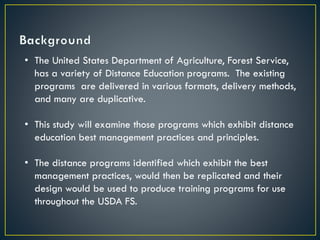
• The United States Department of Agriculture, Forest Service,
has a variety of Distance Education programs. The existing
programs are delivered in various formats, delivery methods,
and many are duplicative.
• This study will examine those programs which exhibit distance
education best management practices and principles.
• The distance programs identified which exhibit the best
management practices, would then be replicated and their
design would be used to produce training programs for use
throughout the USDA FS.
• The USDA FS, like all other federally funded
organizations, has been mandated to implement deep
fiscal budgetary reductions.
• The current use of traditional training programs is costly
and has resulted in the duplication of programs
throughout the USDA FS.
• Compounding this budgetary constraint is the loss of
knowledge through attrition and lack of communication
within the organization
• The current use of distance education programs is very
limited in scope and are centered in individual forest units
and divisions.
• By utilizing recognized distance education best
management practices and principles a unified distance
education system could be implemented, thereby reducing
costs and eliminating the duplication of programs.
• These programs would also lead to the establishment of
Communities of Practice and insure the management and
transfer of knowledge through the USDA FS.
• Twelve programs were examined to determine which of
those programs exhibit distance education best
management practices and principles. These included
12 unique elements of criteria as well as the following
qualitative areas:
1. Institutional Context and Commitment
2. Curriculum and Instruction
3. Faculty Support
4. Student Support
5. Evaluation and Assessment
FSP 6 8 10 12 55 82 85 181 182 186 194 266
Criteria
1 x x x x x x x x
2 x x x x x x x x x x
3 x x x x x x x x x x x
4 x x x x x x x x x x x
5 x x x
6 x x X x x x x x x x x
7 x x x x x x x
8 x x x
9 x x x x x x x x x
10 x x x x x x x x x x
11 x x x x x
12 x x x x x x x x x x
8 6 5 8 9 6 12 8 11 11 6 8
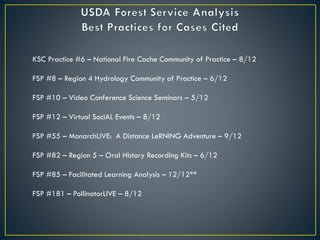
KSC Practice #6 – National Fire Cache Community of Practice – 8/12
FSP #8 – Region 4 Hydrology Community of Practice – 6/12
FSP #10 – Video Conference Science Seminars – 5/12
FSP #12 – Virtual SociAL Events – 8/12
FSP #55 – MonarchLIVE: A Distance LeRNING Adventure – 9/12
FSP #82 – Region 5 – Oral History Recording Kits – 6/12
FSP #85 – Facilitated Learning Analysis – 12/12**
FSP #181 – PollinatorLIVE – 8/12
• FSP #182 – Hands on the Land – 11/12*
• FSP #186 – NA S&PF use of Webinars – 11/12*
• FSP #194 – Emerald Ash Borer Webinars – 6/12
• FSP #266 – FS YouTube Channel – 8/12
•
• TOP 3 RATED BEST PRACTICES
• FSP #85 – Facilitated Learning Analysis – 12/12**
• FSP #182 – Hands on the Land – 11/12*
• FSP #186 – NA S&PF use of Webinars – 11/12*
1) Provides instruction (must meet this criteria or eliminated)
2) Androgogy – Adult based learning
3) Fosters knowledge meaning
4) Transfer of knowledge to learner-based systems
5) Provides for reciprocal teaching
6) Is learner-centered
7) Emphasis on active participation
8) Provides for analysis, synthesis, and evaluation
9) Promotes active learning
10) Allows for group collaboration and cooperative learning to
foster Communities of Practice
11)Provides for multiple levels of interaction (learner - instructor,
learner - learner, learner – group, learner – technology)
12) Focus on real-world problem-solving
*Adopted from the American Distance Education Consortium,
ADEC Guiding Principles for Distance Teaching and Learning ,
2003. http://www.adec.edu/admin/papers/distance-
teaching_principles.html
USDA
Forest Service
• Continuing Education
face-2-face ITV/Blended Distance Learning
Mobile Online
Current Best
Practices
Criteria for
Review/Evaluation
Briefing
DocumentModel
Concept Map
by
Francisco/Pattie
Based on the above analysis, the following Criteria are recommended as
Best Practices for Distance Education:
1. Define vision, mission, goals
2. Engage key stakeholders in needs analysis
3. Define roles and responsibilities
4. Benchmark milestones to assess goal achievement/set expectations
5. Design with flexibility to “go back” as needed
6. Provide reinforcement tools and investigate technical limitations
7. Evaluate, adjust, and monitor process for future use
The Constructivist Theory is an active process wherein Learners
construct their own knowledge by gathering information,
experience, and knowledge and making meaning of it.
In Distance Education, technology allows Learners to connect any
where there is accessibility and anytime they choose. This
connectivity environment provides for a network that spans global
communication.
Strategies for teaching adults (different from teaching children)
The Self Concept Principle - the self-directing character of the
adult learner rather than dependent nature of the child.
The Experience Prinicple - adults draw on experience whereas
children are deemed as not having sufficient experience
Readiness to learn - adult learning needs tend to focus more
towards their social roles while pedagogy claims that the learning
needs of children are geared towards physiological and mental
development stages
Orientation to learning assumes that adults put more value on
being able to practically apply their learning while pedagogy
suggests that children naturally focus on postponing immediate
application for future needs.
Knowles, " The Modern Practice of Adult Education", 1980
Best Practices Criteria*
Provides instruction (must meet this criteria or eliminated)
Androgogy – Adult based learning
Fosters knowledge meaning
Transfer of knowledge to learner-based systems
Provides for reciprocal teaching
Is learner-centered
Emphasis on active participation
Provides for analysis, synthesis, and evaluation
Promotes active learning
Allows for group collaboration and cooperative learning to
foster Communities of Practice
Provides for multiple levels of interaction (learner - instructor,
learner- learner, learner – group, learner –technology)
Focus on real-world problem-solving
*Adopted from the American Distance Education Consortium, ADEC Guiding
Principles for Distance Teaching and Learning , 2003.
http://www.adec.edu/admin/papers/distance-teaching_principles.html
Position Roles and job titles of the Distance Learning Management:
Director – recruits, leads an organization, understands
regulations, provides quality product/services. Strategic
planning and coordinating resources are a key role. This
position is responsible for Tasks of Courses offered and the
alignment of appropriate Staffing.
Administration - Managers who develop and manage online
programs, create the logistics, and conduct the training. Quality
assurance is a key role. This position is responsible for Tasks of
Administering all services in a teamwork environment.
Policy Issues – A vision and goal must be established and
communicated to all stakeholders.
With these goals and practices in mind, we analyzed the 12
Distance Education programs and determined which met the best
practice criteria in Distance Learning. The goal would be to replicate
those best practices in order to:
1. Eliminate duplication
2. Implement cost savings
3. Allow for the Distance Learner to expect consistent program
format by increasing department wide DE programs versus
regional or individual programs.
4. We will see increased communications, knowledge transfer, and
establish Communities of Practice.
The American Distance Education Consortium,
ADEC Guiding Principles for Distance Teaching
and Learning , 2003.
http://www.adec.edu/admin/papers/distance-
teaching_principles.html
Best Practices in Electronically Delivered Programs
www.sacscoc.org/pdf/commadap.pdf
These Best Practices are divided into five separate
components, each of which addresses a particular
area of institutional activity relevant to distance
education.
References

Usda fs ppt final 11.12.13

  • 1.
  • 3.
    • The UnitedStates Department of Agriculture, Forest Service, has a variety of Distance Education programs. The existing programs are delivered in various formats, delivery methods, and many are duplicative. • This study will examine those programs which exhibit distance education best management practices and principles. • The distance programs identified which exhibit the best management practices, would then be replicated and their design would be used to produce training programs for use throughout the USDA FS.
  • 4.
    • The USDAFS, like all other federally funded organizations, has been mandated to implement deep fiscal budgetary reductions. • The current use of traditional training programs is costly and has resulted in the duplication of programs throughout the USDA FS. • Compounding this budgetary constraint is the loss of knowledge through attrition and lack of communication within the organization
  • 5.
    • The currentuse of distance education programs is very limited in scope and are centered in individual forest units and divisions. • By utilizing recognized distance education best management practices and principles a unified distance education system could be implemented, thereby reducing costs and eliminating the duplication of programs. • These programs would also lead to the establishment of Communities of Practice and insure the management and transfer of knowledge through the USDA FS.
  • 6.
    • Twelve programswere examined to determine which of those programs exhibit distance education best management practices and principles. These included 12 unique elements of criteria as well as the following qualitative areas: 1. Institutional Context and Commitment 2. Curriculum and Instruction 3. Faculty Support 4. Student Support 5. Evaluation and Assessment
  • 7.
    FSP 6 810 12 55 82 85 181 182 186 194 266 Criteria 1 x x x x x x x x 2 x x x x x x x x x x 3 x x x x x x x x x x x 4 x x x x x x x x x x x 5 x x x 6 x x X x x x x x x x x 7 x x x x x x x 8 x x x 9 x x x x x x x x x 10 x x x x x x x x x x 11 x x x x x 12 x x x x x x x x x x 8 6 5 8 9 6 12 8 11 11 6 8
  • 8.
    KSC Practice #6– National Fire Cache Community of Practice – 8/12 FSP #8 – Region 4 Hydrology Community of Practice – 6/12 FSP #10 – Video Conference Science Seminars – 5/12 FSP #12 – Virtual SociAL Events – 8/12 FSP #55 – MonarchLIVE: A Distance LeRNING Adventure – 9/12 FSP #82 – Region 5 – Oral History Recording Kits – 6/12 FSP #85 – Facilitated Learning Analysis – 12/12** FSP #181 – PollinatorLIVE – 8/12
  • 9.
    • FSP #182– Hands on the Land – 11/12* • FSP #186 – NA S&PF use of Webinars – 11/12* • FSP #194 – Emerald Ash Borer Webinars – 6/12 • FSP #266 – FS YouTube Channel – 8/12 • • TOP 3 RATED BEST PRACTICES • FSP #85 – Facilitated Learning Analysis – 12/12** • FSP #182 – Hands on the Land – 11/12* • FSP #186 – NA S&PF use of Webinars – 11/12*
  • 10.
    1) Provides instruction(must meet this criteria or eliminated) 2) Androgogy – Adult based learning 3) Fosters knowledge meaning 4) Transfer of knowledge to learner-based systems 5) Provides for reciprocal teaching 6) Is learner-centered 7) Emphasis on active participation 8) Provides for analysis, synthesis, and evaluation
  • 11.
    9) Promotes activelearning 10) Allows for group collaboration and cooperative learning to foster Communities of Practice 11)Provides for multiple levels of interaction (learner - instructor, learner - learner, learner – group, learner – technology) 12) Focus on real-world problem-solving *Adopted from the American Distance Education Consortium, ADEC Guiding Principles for Distance Teaching and Learning , 2003. http://www.adec.edu/admin/papers/distance- teaching_principles.html
  • 12.
    USDA Forest Service • ContinuingEducation face-2-face ITV/Blended Distance Learning Mobile Online Current Best Practices Criteria for Review/Evaluation Briefing DocumentModel Concept Map by Francisco/Pattie
  • 13.
    Based on theabove analysis, the following Criteria are recommended as Best Practices for Distance Education: 1. Define vision, mission, goals 2. Engage key stakeholders in needs analysis 3. Define roles and responsibilities 4. Benchmark milestones to assess goal achievement/set expectations 5. Design with flexibility to “go back” as needed 6. Provide reinforcement tools and investigate technical limitations 7. Evaluate, adjust, and monitor process for future use
  • 14.
    The Constructivist Theoryis an active process wherein Learners construct their own knowledge by gathering information, experience, and knowledge and making meaning of it. In Distance Education, technology allows Learners to connect any where there is accessibility and anytime they choose. This connectivity environment provides for a network that spans global communication. Strategies for teaching adults (different from teaching children) The Self Concept Principle - the self-directing character of the adult learner rather than dependent nature of the child.
  • 15.
    The Experience Prinicple- adults draw on experience whereas children are deemed as not having sufficient experience Readiness to learn - adult learning needs tend to focus more towards their social roles while pedagogy claims that the learning needs of children are geared towards physiological and mental development stages Orientation to learning assumes that adults put more value on being able to practically apply their learning while pedagogy suggests that children naturally focus on postponing immediate application for future needs. Knowles, " The Modern Practice of Adult Education", 1980
  • 16.
    Best Practices Criteria* Providesinstruction (must meet this criteria or eliminated) Androgogy – Adult based learning Fosters knowledge meaning Transfer of knowledge to learner-based systems Provides for reciprocal teaching Is learner-centered Emphasis on active participation
  • 17.
    Provides for analysis,synthesis, and evaluation Promotes active learning Allows for group collaboration and cooperative learning to foster Communities of Practice Provides for multiple levels of interaction (learner - instructor, learner- learner, learner – group, learner –technology) Focus on real-world problem-solving *Adopted from the American Distance Education Consortium, ADEC Guiding Principles for Distance Teaching and Learning , 2003. http://www.adec.edu/admin/papers/distance-teaching_principles.html
  • 18.
    Position Roles andjob titles of the Distance Learning Management: Director – recruits, leads an organization, understands regulations, provides quality product/services. Strategic planning and coordinating resources are a key role. This position is responsible for Tasks of Courses offered and the alignment of appropriate Staffing. Administration - Managers who develop and manage online programs, create the logistics, and conduct the training. Quality assurance is a key role. This position is responsible for Tasks of Administering all services in a teamwork environment. Policy Issues – A vision and goal must be established and communicated to all stakeholders.
  • 19.
    With these goalsand practices in mind, we analyzed the 12 Distance Education programs and determined which met the best practice criteria in Distance Learning. The goal would be to replicate those best practices in order to: 1. Eliminate duplication 2. Implement cost savings 3. Allow for the Distance Learner to expect consistent program format by increasing department wide DE programs versus regional or individual programs. 4. We will see increased communications, knowledge transfer, and establish Communities of Practice.
  • 20.
    The American DistanceEducation Consortium, ADEC Guiding Principles for Distance Teaching and Learning , 2003. http://www.adec.edu/admin/papers/distance- teaching_principles.html Best Practices in Electronically Delivered Programs www.sacscoc.org/pdf/commadap.pdf These Best Practices are divided into five separate components, each of which addresses a particular area of institutional activity relevant to distance education. References