Giving Credit
Where Credit is Due
reTHINK PSU: Reframing
Challenge

Winter Symposium
Friday, January 16th 2013
Collaborators
   Project Lead
      Shelly Chabon, PhD, CCC-SLP, CLAS, Associate Dean of Humanities &
         Social Sciences

   Collaborators
      Peter Collier, PhD, Professor, Sociology
      Veronica Dujon, PhD, CLAS, Associate Dean of Curriculum
         Development & Enrollment Management
        Kathi Ketcheson, PhD, Director, Institutional Research & Planning –
         Academic Affairs
        Yves Labissiere, Assistant Director University Studies, Community
         Health – Urban & Public Affairs
        Beth Lloyd-Pool, Program Administrator, Institute for Sustainable
         Solutions
        Robert Mercer, Assistant Dean for Student Success, College of Liberal
         Arts and Sciences
        Drake Mitchell, PhD, CLAS, Associate Dean of Natural Sciences
        Kimberly Pendell, Social Sciences Librarian
Inspiration
    …inspiration can be found in the
            most unexpected places
Universal Challenge/Opportunity
 Increase in non-traditional students
       National: 38% over 25 yrs
        (projected to increase 23% by 2019)
        (National Center for Education
        Statistics, 2011)
       PSU: 60% over 25 yrs
 They face personal, financial, and
    scheduling challenges that can
    prevent completion of degree program
   They also bring a wealth of knowledge and
    experience
   Their #1 consideration in selecting a college is the
    availability of credit for life experience (Hoover, 2010)
       Build on their work experience
       Enhance their employment and career prospects
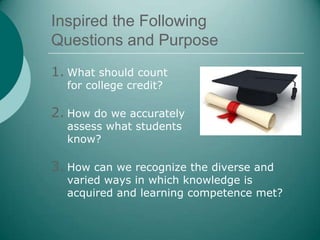
Inspired the Following
Questions and Purpose
1. What should count
  for college credit?

2. How do we accurately
  assess what students
  know?

3. How can we recognize the diverse and
  varied ways in which knowledge is
  acquired and learning competence met?
Purpose


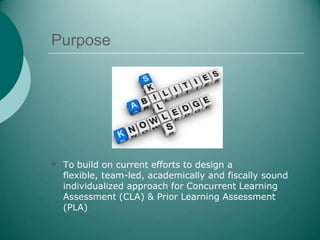
 To build on current efforts to design a
  flexible, team-led, academically and fiscally sound
  individualized approach for Concurrent Learning
  Assessment (CLA) & Prior Learning Assessment
  (PLA)
Definition of
Prior Learning Assessment
 Valid yet underused process of evaluating and
  recognizing learning that helps adults earn credit for
  knowledge acquired through work, military
  training, volunteer and union activities, hobbies and
  other life experiences.


            (Council for Adult & Experiential Learning, 2012)
Unique Solution:
Approach & Strategy
 Assemble                         Revisit/analyze PSU’s
  interdisciplinary, inter-         existing mechanisms for
  institutional team of             credit for prior learning
  faculty, staff and                    Investigate established
  students, including                    models for portfolio
                                         evaluations, narrative
     Content experts
                                         analyses, and other tools
     Instructional designers            used to provide evidence
     Librarians                         of learning
     Advisors                          Explore training
     Specialists in online              opportunities from CAEL
      delivery                          Consult/seek partnerships
     Specialists in assessment          with successful PLA
     Marketing experts                  programs across Oregon &
                                         elsewhere
     Consumers
     Future Employers
Approach & Strategy (cont.)
 Use existing course learning outcomes or help
  develop outcomes in required courses to guide
  assessment

 Select and pilot one or more of the following
  assessment tools for purpose of course equivalency
  evaluations
      Digital/personal narratives
      E-interviews
      E-portfolios
      Online assessment workshop
       or seminar
      Performance in MOOCs
Approach & Strategy (cont.)
 Train and use student
  advisors/coaches to guide
  prospective students
  through PLA & CLA

 Develop guidelines
  regarding
      Eligibility
      Credit maximums
      Roles & responsibilities
      Costs


 Engage with and market to potential
  employers, community college administrators, etc.
Unique Features
 Focus on prior and ongoing learning acquired
    outside of the traditional classroom
   On ground and online options for demonstrating and
    assessing learning
   Coordinated, interdisciplinary, inter-institutional
    team that includes faculty, staff, students and
    community members
   Individualized assessment to reach broad, diverse
    audience with different learning experiences & needs
   Use multiple assessments including personal
    narratives to provide evidence of learning outcomes
Impact/Significance
 Appropriate recognition of prior and
  concurrent learning will:
     Acknowledge value of learning through experience
     Decrease number of terms students take to complete
      degrees
     Lower debt and student loan payments
     Strengthen clarity of institutional learning through
      outcomes
     Improve placement of students based on knowledge &
      skill levels
     Attract more and more diverse students
     Increase access to college for adult students
Impact/Significance (cont.)
 “Prior learning’s impact on higher education
  could be enormous. Its potential could even
  rival that of online learning.”

                                       (Fain, 2012)


 “Prior learning is the next disruption.”
                                   (Klonoski, 2011)
Giving Credit Where Credit is Due

01 16-13 winter symposium presentation (no notes)

  • 1.
    Giving Credit Where Creditis Due reTHINK PSU: Reframing Challenge Winter Symposium Friday, January 16th 2013
  • 2.
    Collaborators  Project Lead  Shelly Chabon, PhD, CCC-SLP, CLAS, Associate Dean of Humanities & Social Sciences  Collaborators  Peter Collier, PhD, Professor, Sociology  Veronica Dujon, PhD, CLAS, Associate Dean of Curriculum Development & Enrollment Management  Kathi Ketcheson, PhD, Director, Institutional Research & Planning – Academic Affairs  Yves Labissiere, Assistant Director University Studies, Community Health – Urban & Public Affairs  Beth Lloyd-Pool, Program Administrator, Institute for Sustainable Solutions  Robert Mercer, Assistant Dean for Student Success, College of Liberal Arts and Sciences  Drake Mitchell, PhD, CLAS, Associate Dean of Natural Sciences  Kimberly Pendell, Social Sciences Librarian
  • 3.
    Inspiration …inspiration can be found in the most unexpected places
  • 4.
    Universal Challenge/Opportunity  Increasein non-traditional students  National: 38% over 25 yrs (projected to increase 23% by 2019) (National Center for Education Statistics, 2011)  PSU: 60% over 25 yrs  They face personal, financial, and scheduling challenges that can prevent completion of degree program  They also bring a wealth of knowledge and experience  Their #1 consideration in selecting a college is the availability of credit for life experience (Hoover, 2010)  Build on their work experience  Enhance their employment and career prospects
  • 5.
    Inspired the Following Questionsand Purpose 1. What should count for college credit? 2. How do we accurately assess what students know? 3. How can we recognize the diverse and varied ways in which knowledge is acquired and learning competence met?
  • 6.
    Purpose  To buildon current efforts to design a flexible, team-led, academically and fiscally sound individualized approach for Concurrent Learning Assessment (CLA) & Prior Learning Assessment (PLA)
  • 7.
    Definition of Prior LearningAssessment  Valid yet underused process of evaluating and recognizing learning that helps adults earn credit for knowledge acquired through work, military training, volunteer and union activities, hobbies and other life experiences. (Council for Adult & Experiential Learning, 2012)
  • 8.
    Unique Solution: Approach &Strategy  Assemble  Revisit/analyze PSU’s interdisciplinary, inter- existing mechanisms for institutional team of credit for prior learning faculty, staff and  Investigate established students, including models for portfolio evaluations, narrative  Content experts analyses, and other tools  Instructional designers used to provide evidence  Librarians of learning  Advisors  Explore training  Specialists in online opportunities from CAEL delivery  Consult/seek partnerships  Specialists in assessment with successful PLA  Marketing experts programs across Oregon & elsewhere  Consumers  Future Employers
  • 9.
    Approach & Strategy(cont.)  Use existing course learning outcomes or help develop outcomes in required courses to guide assessment  Select and pilot one or more of the following assessment tools for purpose of course equivalency evaluations  Digital/personal narratives  E-interviews  E-portfolios  Online assessment workshop or seminar  Performance in MOOCs
  • 10.
    Approach & Strategy(cont.)  Train and use student advisors/coaches to guide prospective students through PLA & CLA  Develop guidelines regarding  Eligibility  Credit maximums  Roles & responsibilities  Costs  Engage with and market to potential employers, community college administrators, etc.
  • 11.
    Unique Features  Focuson prior and ongoing learning acquired outside of the traditional classroom  On ground and online options for demonstrating and assessing learning  Coordinated, interdisciplinary, inter-institutional team that includes faculty, staff, students and community members  Individualized assessment to reach broad, diverse audience with different learning experiences & needs  Use multiple assessments including personal narratives to provide evidence of learning outcomes
  • 12.
    Impact/Significance  Appropriate recognitionof prior and concurrent learning will:  Acknowledge value of learning through experience  Decrease number of terms students take to complete degrees  Lower debt and student loan payments  Strengthen clarity of institutional learning through outcomes  Improve placement of students based on knowledge & skill levels  Attract more and more diverse students  Increase access to college for adult students
  • 13.
    Impact/Significance (cont.)  “Priorlearning’s impact on higher education could be enormous. Its potential could even rival that of online learning.” (Fain, 2012)  “Prior learning is the next disruption.” (Klonoski, 2011)
  • 14.
    Giving Credit WhereCredit is Due