Developmental
Education
Redesign
Decision
Making
Implementation Planning
The Problem
 Students stop out or drop out of the
developmental sequence before they complete
the gateway
 Students who begin at the developmental level in
one or more subjects complete college at
significantly lower rates
 Time, not student learning, is the greatest barrier to
student success
The DETF Charge
 Review and clarify the purpose of developmental
education and analyze implications for policy and
practice resulting from a clarified purpose.
 Review current system policies and practices
related to developmental education and propose
revisions that will promote greater student success
in alignment with sound academic principles and
practice
 On the basis of a comprehensive review, recommend
broad strategies and specific initiatives related to
developmental education that should be pursued by
Colorado's Community College System Colleges, leading
to enhanced outcomes for student learning and
success.
 Investigate and analyze measures of success, data
reports and studies on success of developmental
education students.
 Examine structures for developmental education,
highlighting innovative and successful strategies,
improving the student experience and identifying
barriers to success.
The Recommendations
Goal Statement
 To accelerate students by reducing the amount of
time, number of developmental credits, and
number of courses in the developmental
sequence so students can be successful in a
college level course. Accelerated learning will
require a curriculum redesign.
5 Principles: Curricular work
 Use reverse curriculum design to redesign courses
 Design courses for what students need to know for
success in college
 Encourage active learning by including active and/or
experiential learning experiences with each lesson
 Make curriculum design and assessment of student
learning and success a continuous process (see
National Center for Academic Transformation work)
 Provide students with individualized assistance through
embedded affective skills, professionalism, and support
services as much as possible in the process
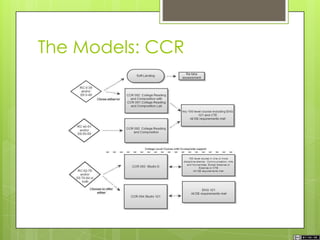
The Models: CCR
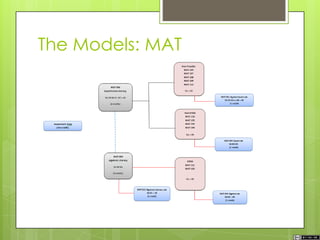
The Models: MAT
Implementation
 A redesign advisory group will be formed to address the
administrative issues and ensure smooth implementation, i.e.
BANNER, Business Officers, Advising, Financial Aid.
 To ensure effective implementation of the DETF
recommendations, CCCS should provide a line item budget
developed in consultation with individual colleges, the
Redesign Implementation Team, and functional groups to
accomplish tasks outlined in this document.
 The State Faculty Curriculum Committee and Educational
Services need to ensure an expedited curriculum approval
process for the new courses being developed. Additionally,
campus curriculum review processes must be expedited to
allow colleges to adopt new courses as they become
available.
Testing
 A CCCS specific Accuplacer
 Use uniform, weighted, multiple measures
 Test scores should be validated every three to five
years
 Calculators should be allowed to appear on the
elementary algebra exam
Testing: State-wide Institutional
Administrator
 Provide training and resources for Testing Center staff,
 Ensure consistency of standardized test
administration,
 Create, in conjunction with the appropriate
functional teams, uniform test delivery and scoring
practices (i.e. ensure that all colleges administer the
EA test before the AR test in math),
 Pull data from the system and provide regular reports
and presentations to CCCS functional groups and
constituency groups, and
 Ensure the Accuplacer is normed on a regular basis
Student Support
 CCCS colleges will provide students with access to
academic success strategies, college readiness skills,
and career counseling.
 Each college will adopt a plan that addresses planning
for success, initiating success, and sustaining success for
developmental students using these CCSSE
strategies. Minimally the college plan should address
the three points - planning, initiating, and sustaining
success - by using three different strategies
Student Support Plan
 Each College will develop a plan that engages developmental students from
their first contact with the College through the completion of their remedial
sequence and their entry into college level work.
 Colleges will identify how they are helping students plan for success through their
assessment and placement, through their orientations, through academic goal setting
and planning and/or through the registration process.
 Colleges will also demonstrate how they initiate success for students by providing
accelerated or fast track developmental education, a first year experience, a student
success course, and/or learning communities.
 The Colleges will also describe the intentional strategies they have in place to sustain
success such as class attendance, alert and intervention programs, experiential learning
beyond the classroom, tutoring, and supplemental instruction.
Faculty Professional
Development
 Colleges will create a professional development plan to
give current faculty the opportunity to improve their skills
to meet the requirements of the new courses.
Particularly in areas where it might be a preferable
delivery strategy to train current developmental and
college level faculty to teach the same content, the
professional development plan should address how that
training will happen on each campus.
Faculty Support: Some strategies
 Offer limited full time positions to current adjunct instructors during the
implementation phase of this work to stabilize our workforce to allow for program
adoption to scale on an accelerated pace.
 Provide release time to current full time faculty and pay to adjunct faculty so they
can work with the implementation team to prepare to offer new courses and
formats.
 Offer course release opportunities and reassigned time to faculty and staff to
develop and implement student success strategies.
 Offer other functional work groups on campus—like BANNER, Advising, Testing—time
to address the issues of the implementation process.
 Provide, in partnership with CCCS, continuing professional development for all
faculty and staff focusing on research-based student success strategies.
 Offer transfer level faculty the opportunity to train and understand the same delivery
models that will be used in developmental education.
Measures of Success
 Math – Successful completion of any college level
(100+) math course.
 College Composition and Reading – Successful
completion of ENG121 or other 100 level discipline
strands course.
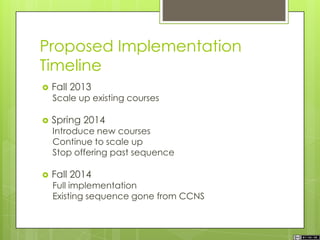
Proposed Implementation
Timeline
 Fall 2013
Scale up existing courses
 Spring 2014
Introduce new courses
Continue to scale up
Stop offering past sequence
 Fall 2014
Full implementation
Existing sequence gone from CCNS
Culture
 How will the college introduce the
redesign and the work that will be done
on the campus?
Faculty
Staff
 How will the college involve students in
the process?
Choices
 Soft landing?
Credit or non credit?
 Which models?
 Testing
Diagnostic/Secondary assessments?
 Current to scale
New ways to approach new curriculum?
Staffing
 How will the college staff the new
models?
Resources
Space
Time
 Who will work with the CITs to develop the
new curriculum?
Student Services
 What are the implications for
Advising/Educational Planning
Admissions and Records
Financial Aid
Supplemental services
 Who will need to be involved in the
planning and implementation?
Testing
 What involvement will your Testing Center
personnel have in the State Accuplacer
rollout process?
 What are the policy and financial
implications?
 How will your Director work with the rest of the
State Directors to support the new system?
What is your timeline?
Introduction to the campus
Catalog and schedule changes
Curricular development
Training
Steps to full implementation
What are the barriers?
 Identify roadblocks
State statute
CCCS
Institution
 Banner issues and planning
Faculty
 How will Developmental Education
faculty be involved in the planning and
implementation?
 How will the college involve transfer
faculty?
 Are there any credentialing issues?
Institutional decision making
Resources
 What resources does the college need to
allocate for implementation?
 How will TAA funds be used for the
process?
 How will the college plan for the fiscal
changes in the first three years of
implementation?
Training
 What are the immediate training needs?
Faculty
Staff
Students
 What needs to be developed for ongoing
training and orientation?
Partnerships
 How will the redesign influence your
relationships with
K-12
Workforce Center
Four year institutions
Adult Education/Literacy programs
Evaluation
 How will the college assess the redesign
on their campus?
Student outcomes
Staffing and resource allocations
Qualitative feedback
 How will the college use data to continue
to improve student outcomes?
Training Plan
 Online course
 Visits to colleges
 Facilitate/deliver PD
 State
 Region
 Campus
Questions?
Creative Commons
Attribution
Unless otherwise specified, this work by the Colorado Community College System http://www.cccs.edu is licensed
under a Creative Commons Attribution-NonCommercial-ShareAlike 3.0 United States License. The material was
created with funds from the Trade Adjustment Assistance Community College and Career Training (TAACCCT)
Grant awarded to the Colorado Online Energy Training Consortium (COETC).

ALP presentation

  • 1.
  • 2.
    The Problem  Studentsstop out or drop out of the developmental sequence before they complete the gateway  Students who begin at the developmental level in one or more subjects complete college at significantly lower rates  Time, not student learning, is the greatest barrier to student success
  • 3.
    The DETF Charge Review and clarify the purpose of developmental education and analyze implications for policy and practice resulting from a clarified purpose.  Review current system policies and practices related to developmental education and propose revisions that will promote greater student success in alignment with sound academic principles and practice
  • 4.
     On thebasis of a comprehensive review, recommend broad strategies and specific initiatives related to developmental education that should be pursued by Colorado's Community College System Colleges, leading to enhanced outcomes for student learning and success.  Investigate and analyze measures of success, data reports and studies on success of developmental education students.  Examine structures for developmental education, highlighting innovative and successful strategies, improving the student experience and identifying barriers to success.
  • 5.
    The Recommendations Goal Statement To accelerate students by reducing the amount of time, number of developmental credits, and number of courses in the developmental sequence so students can be successful in a college level course. Accelerated learning will require a curriculum redesign.
  • 6.
    5 Principles: Curricularwork  Use reverse curriculum design to redesign courses  Design courses for what students need to know for success in college  Encourage active learning by including active and/or experiential learning experiences with each lesson  Make curriculum design and assessment of student learning and success a continuous process (see National Center for Academic Transformation work)  Provide students with individualized assistance through embedded affective skills, professionalism, and support services as much as possible in the process
  • 7.
  • 8.
  • 9.
    Implementation  A redesignadvisory group will be formed to address the administrative issues and ensure smooth implementation, i.e. BANNER, Business Officers, Advising, Financial Aid.  To ensure effective implementation of the DETF recommendations, CCCS should provide a line item budget developed in consultation with individual colleges, the Redesign Implementation Team, and functional groups to accomplish tasks outlined in this document.  The State Faculty Curriculum Committee and Educational Services need to ensure an expedited curriculum approval process for the new courses being developed. Additionally, campus curriculum review processes must be expedited to allow colleges to adopt new courses as they become available.
  • 10.
    Testing  A CCCSspecific Accuplacer  Use uniform, weighted, multiple measures  Test scores should be validated every three to five years  Calculators should be allowed to appear on the elementary algebra exam
  • 11.
    Testing: State-wide Institutional Administrator Provide training and resources for Testing Center staff,  Ensure consistency of standardized test administration,  Create, in conjunction with the appropriate functional teams, uniform test delivery and scoring practices (i.e. ensure that all colleges administer the EA test before the AR test in math),  Pull data from the system and provide regular reports and presentations to CCCS functional groups and constituency groups, and  Ensure the Accuplacer is normed on a regular basis
  • 12.
    Student Support  CCCScolleges will provide students with access to academic success strategies, college readiness skills, and career counseling.  Each college will adopt a plan that addresses planning for success, initiating success, and sustaining success for developmental students using these CCSSE strategies. Minimally the college plan should address the three points - planning, initiating, and sustaining success - by using three different strategies
  • 13.
    Student Support Plan Each College will develop a plan that engages developmental students from their first contact with the College through the completion of their remedial sequence and their entry into college level work.  Colleges will identify how they are helping students plan for success through their assessment and placement, through their orientations, through academic goal setting and planning and/or through the registration process.  Colleges will also demonstrate how they initiate success for students by providing accelerated or fast track developmental education, a first year experience, a student success course, and/or learning communities.  The Colleges will also describe the intentional strategies they have in place to sustain success such as class attendance, alert and intervention programs, experiential learning beyond the classroom, tutoring, and supplemental instruction.
  • 14.
    Faculty Professional Development  Collegeswill create a professional development plan to give current faculty the opportunity to improve their skills to meet the requirements of the new courses. Particularly in areas where it might be a preferable delivery strategy to train current developmental and college level faculty to teach the same content, the professional development plan should address how that training will happen on each campus.
  • 15.
    Faculty Support: Somestrategies  Offer limited full time positions to current adjunct instructors during the implementation phase of this work to stabilize our workforce to allow for program adoption to scale on an accelerated pace.  Provide release time to current full time faculty and pay to adjunct faculty so they can work with the implementation team to prepare to offer new courses and formats.  Offer course release opportunities and reassigned time to faculty and staff to develop and implement student success strategies.  Offer other functional work groups on campus—like BANNER, Advising, Testing—time to address the issues of the implementation process.  Provide, in partnership with CCCS, continuing professional development for all faculty and staff focusing on research-based student success strategies.  Offer transfer level faculty the opportunity to train and understand the same delivery models that will be used in developmental education.
  • 16.
    Measures of Success Math – Successful completion of any college level (100+) math course.  College Composition and Reading – Successful completion of ENG121 or other 100 level discipline strands course.
  • 17.
    Proposed Implementation Timeline  Fall2013 Scale up existing courses  Spring 2014 Introduce new courses Continue to scale up Stop offering past sequence  Fall 2014 Full implementation Existing sequence gone from CCNS
  • 18.
    Culture  How willthe college introduce the redesign and the work that will be done on the campus? Faculty Staff  How will the college involve students in the process?
  • 19.
    Choices  Soft landing? Creditor non credit?  Which models?  Testing Diagnostic/Secondary assessments?  Current to scale New ways to approach new curriculum?
  • 20.
    Staffing  How willthe college staff the new models? Resources Space Time  Who will work with the CITs to develop the new curriculum?
  • 21.
    Student Services  Whatare the implications for Advising/Educational Planning Admissions and Records Financial Aid Supplemental services  Who will need to be involved in the planning and implementation?
  • 22.
    Testing  What involvementwill your Testing Center personnel have in the State Accuplacer rollout process?  What are the policy and financial implications?  How will your Director work with the rest of the State Directors to support the new system?
  • 23.
    What is yourtimeline? Introduction to the campus Catalog and schedule changes Curricular development Training Steps to full implementation
  • 24.
    What are thebarriers?  Identify roadblocks State statute CCCS Institution  Banner issues and planning
  • 25.
    Faculty  How willDevelopmental Education faculty be involved in the planning and implementation?  How will the college involve transfer faculty?  Are there any credentialing issues? Institutional decision making
  • 26.
    Resources  What resourcesdoes the college need to allocate for implementation?  How will TAA funds be used for the process?  How will the college plan for the fiscal changes in the first three years of implementation?
  • 27.
    Training  What arethe immediate training needs? Faculty Staff Students  What needs to be developed for ongoing training and orientation?
  • 28.
    Partnerships  How willthe redesign influence your relationships with K-12 Workforce Center Four year institutions Adult Education/Literacy programs
  • 29.
    Evaluation  How willthe college assess the redesign on their campus? Student outcomes Staffing and resource allocations Qualitative feedback  How will the college use data to continue to improve student outcomes?
  • 30.
    Training Plan  Onlinecourse  Visits to colleges  Facilitate/deliver PD  State  Region  Campus
  • 31.
  • 32.
    Creative Commons Attribution Unless otherwisespecified, this work by the Colorado Community College System http://www.cccs.edu is licensed under a Creative Commons Attribution-NonCommercial-ShareAlike 3.0 United States License. The material was created with funds from the Trade Adjustment Assistance Community College and Career Training (TAACCCT) Grant awarded to the Colorado Online Energy Training Consortium (COETC).