Program Learning Outcomes
   Eportfolio Pilot Project

     Justice Center
       Ronald S. Everett
      Deborah K. Periman
Project Goals
• Use Evidence-Based Practices to:
  – Improve Justice Center Program Assessment
  – Improve Coherence and Measurability of Program
    Outcomes
  – Improve Program Coherence and Content: Engage
    Faculty in Linking Outcomes to Course Content and
    Student Assignments
  – Make Program Outcomes More Visible to Students:
    Increase Student Engagement in Learning
Research Supporting Eportfolios
• Accountability in university education increasingly rests not on what an
  institution offers students, but on convincing evidence that students are learning.
• “Assessment goals and objectives should focus on ‘what students will be able to
  demonstrate that they know, believe, and can do . . ..’” (N. Buzzetto-More, The E-
  Portfolio Paradigm: Informing, Educating, Assessing, and Managing with E-
  Portfolios, 208 (2010).
• Eportfolios provide immediate access to content/capacity to include audio/video
  demonstrations of student work/activities. Id.
• Eportfolios are “especially effective when they are part of an ongoing assessment
  process from the time students enter a program until they complete their
  studies.” Id.
• Implementing eportfolios in multiple courses in a program provides a highly
  visible indicator of whether the curriculum is complete/cohesive or whether
  there are gaps or redundancies that should be addressed.
The Heart of the Eportfolio
Developing Appropriate       Integration of SLOs into Core
Outcomes                              Curriculum
 • Keyed to Program          • Faculty identify SLOs when
   Mission and Content         developing course content
 • Measurable                • Link course assignments to
 • Develop SLO’s measures      specific SLOs
   across multiple courses   • Develop multiple measures
                               within courses
Developing Outcomes-Based Assignments

•   Gaining faculty buy-in
•   Assignment coordination
•   Assignment assessment
•   Artifact collection
•   Student permissions
•   Artifact retention
Considerations in Platform Selection

General Considerations           Platforms Evaluated
•   Faculty Learning Curve   •   Maraha
•   University Support       •   Adobe
•   Student Learning Curve   •   PowerPoint
•   Student Access           •   (LiveText at Brandman
•   Portability                  University)
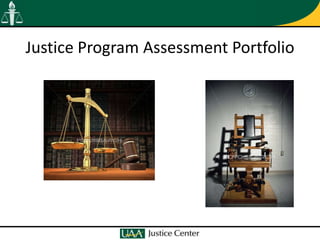
Justice Program Assessment Portfolio
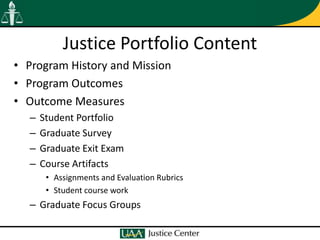
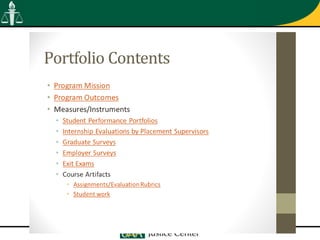
Justice Portfolio Content
• Program History and Mission
• Program Outcomes
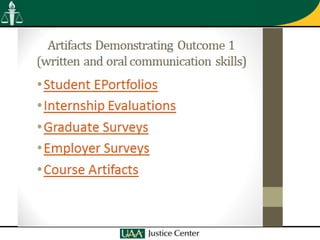
• Outcome Measures
  –   Student Portfolio
  –   Graduate Survey
  –   Graduate Exit Exam
  –   Course Artifacts
       • Assignments and Evaluation Rubrics
       • Student course work
  – Graduate Focus Groups
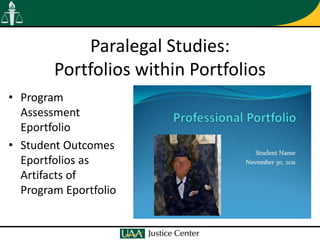
Paralegal Studies:
        Portfolios within Portfolios
• Program
  Assessment
  Eportfolio
• Student Outcomes
  Eportfolios as
  Artifacts of
  Program Eportfolio
UAA Legal Studies Program
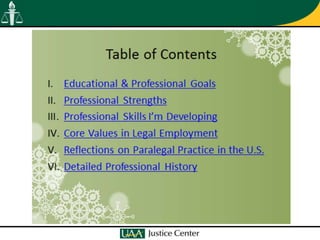
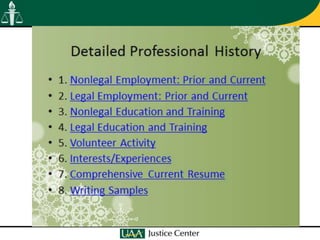
 Assessment Portfolio
Student Outcomes Portfolios
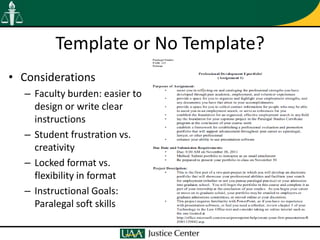
Template or No Template?
• Considerations
  – Faculty burden: easier to
    design or write clear
    instructions
  – Student frustration vs.
    creativity
  – Locked format vs.
    flexibility in format
  – Instructional Goals:
    Paralegal soft skills
Faculty Reflections: Benefits
• Program/Faculty               • Student Benefits:
  Benefits                         – Outcomes visible at outset
  – Highlights gaps or             – Link coursework to
                                     personal/academic development
    redundancies in program
                                   – Prepared to discuss strengths in
  – Provides focal points for        graduate or employment
    developing assignments           interview
  – Allows insights into           – Skills artifacts collected/readily
                                     displayed or submitted with
    student integration of
                                     applications
    instruction
Faculty Reflections: Challenges
• Student Contribution        • Faculty Contribution
  – Accumulating artifacts       – Thinking about SLOs
    across courses and over        when designing courses
    time                         – Developing specific
  – Identifying courses and        measures of SLOs
    specific SLOs                – Making SLOs explicit to
  – Demonstrating learning         students
Eportfolio Resources
•   Links from Dr. Helen Barrett:                          • The Association for
    Alternative Assessment & Electronic                      Authentic, Experiential and
    Portfolios                                               Evidence-Based
     –   http://electronicportfolios.org/portfolios/book
         marks.html                                           Learning,   http://www.aaeebl.org
     –   links to student career portfolios
         http://amby.com/kimeldorf/portfolio/
     –   portfolio use for assessment
         http://www2.ed.gov/pubs/OR/ConsumerGuid
         es/admuses.html
     –   Truman state analysis of senior portfolios --
         http://assessment.truman.edu/components/p
         ortfolio/CH14_2008.pdf [good!]
     – Kansas state eportfolio resources
         http://www.joandominick.com/pocketeportfoli
         o/intro.html

Justice project conference presentation

  • 1.
    Program Learning Outcomes Eportfolio Pilot Project Justice Center Ronald S. Everett Deborah K. Periman
  • 2.
    Project Goals • UseEvidence-Based Practices to: – Improve Justice Center Program Assessment – Improve Coherence and Measurability of Program Outcomes – Improve Program Coherence and Content: Engage Faculty in Linking Outcomes to Course Content and Student Assignments – Make Program Outcomes More Visible to Students: Increase Student Engagement in Learning
  • 3.
    Research Supporting Eportfolios •Accountability in university education increasingly rests not on what an institution offers students, but on convincing evidence that students are learning. • “Assessment goals and objectives should focus on ‘what students will be able to demonstrate that they know, believe, and can do . . ..’” (N. Buzzetto-More, The E- Portfolio Paradigm: Informing, Educating, Assessing, and Managing with E- Portfolios, 208 (2010). • Eportfolios provide immediate access to content/capacity to include audio/video demonstrations of student work/activities. Id. • Eportfolios are “especially effective when they are part of an ongoing assessment process from the time students enter a program until they complete their studies.” Id. • Implementing eportfolios in multiple courses in a program provides a highly visible indicator of whether the curriculum is complete/cohesive or whether there are gaps or redundancies that should be addressed.
  • 4.
    The Heart ofthe Eportfolio Developing Appropriate Integration of SLOs into Core Outcomes Curriculum • Keyed to Program • Faculty identify SLOs when Mission and Content developing course content • Measurable • Link course assignments to • Develop SLO’s measures specific SLOs across multiple courses • Develop multiple measures within courses
  • 5.
    Developing Outcomes-Based Assignments • Gaining faculty buy-in • Assignment coordination • Assignment assessment • Artifact collection • Student permissions • Artifact retention
  • 6.
    Considerations in PlatformSelection General Considerations Platforms Evaluated • Faculty Learning Curve • Maraha • University Support • Adobe • Student Learning Curve • PowerPoint • Student Access • (LiveText at Brandman • Portability University)
  • 7.
  • 8.
    Justice Portfolio Content •Program History and Mission • Program Outcomes • Outcome Measures – Student Portfolio – Graduate Survey – Graduate Exit Exam – Course Artifacts • Assignments and Evaluation Rubrics • Student course work – Graduate Focus Groups
  • 9.
    Paralegal Studies: Portfolios within Portfolios • Program Assessment Eportfolio • Student Outcomes Eportfolios as Artifacts of Program Eportfolio
  • 10.
    UAA Legal StudiesProgram Assessment Portfolio
  • 14.
  • 18.
    Template or NoTemplate? • Considerations – Faculty burden: easier to design or write clear instructions – Student frustration vs. creativity – Locked format vs. flexibility in format – Instructional Goals: Paralegal soft skills
  • 19.
    Faculty Reflections: Benefits •Program/Faculty • Student Benefits: Benefits – Outcomes visible at outset – Highlights gaps or – Link coursework to personal/academic development redundancies in program – Prepared to discuss strengths in – Provides focal points for graduate or employment developing assignments interview – Allows insights into – Skills artifacts collected/readily displayed or submitted with student integration of applications instruction
  • 20.
    Faculty Reflections: Challenges •Student Contribution • Faculty Contribution – Accumulating artifacts – Thinking about SLOs across courses and over when designing courses time – Developing specific – Identifying courses and measures of SLOs specific SLOs – Making SLOs explicit to – Demonstrating learning students
  • 21.
    Eportfolio Resources • Links from Dr. Helen Barrett: • The Association for Alternative Assessment & Electronic Authentic, Experiential and Portfolios Evidence-Based – http://electronicportfolios.org/portfolios/book marks.html Learning, http://www.aaeebl.org – links to student career portfolios http://amby.com/kimeldorf/portfolio/ – portfolio use for assessment http://www2.ed.gov/pubs/OR/ConsumerGuid es/admuses.html – Truman state analysis of senior portfolios -- http://assessment.truman.edu/components/p ortfolio/CH14_2008.pdf [good!] – Kansas state eportfolio resources http://www.joandominick.com/pocketeportfoli o/intro.html